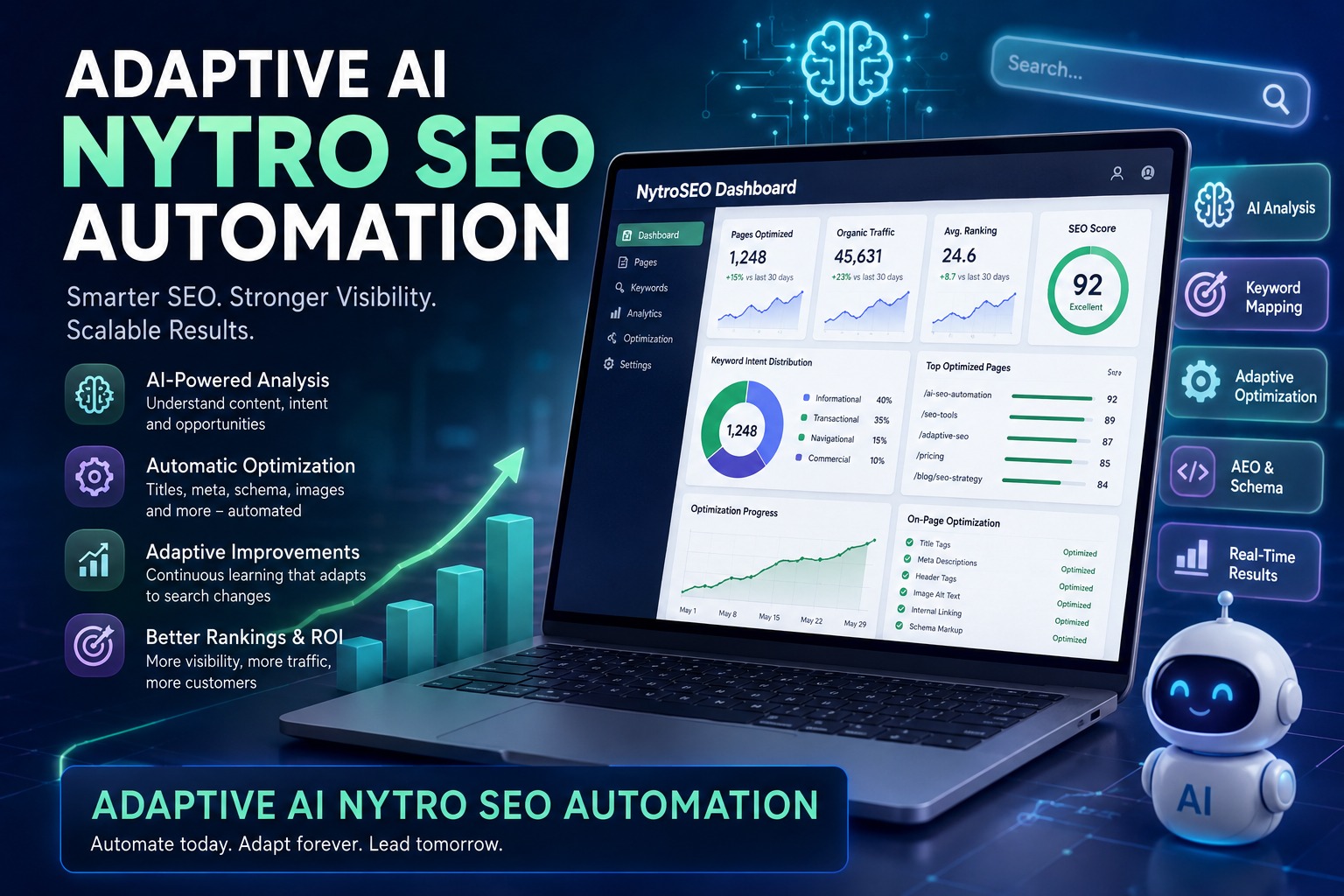
Adaptive AI Nytro SEO Automation is a practical approach to improving website visibility by using artificial intelligence, automation, and adaptive metadata optimization to help search engines and answer engines better understand page content. For SEO agencies, website developers, SMBs, and large website owners, the value is simple: optimize more pages with less manual work while keeping human strategy in control.
Adaptive AI Nytro SEO Automation matters because search has moved beyond traditional blue-link rankings. Google’s generative AI guidance explains that AI search features still rely on core search systems, crawlable content, helpful information, and technically accessible pages. That means websites need clear structure, relevant metadata, useful content, and ongoing refinement—not one-time optimization.
Adaptive AI Nytro SEO Automation helps solve one of the most common SEO bottlenecks: updating titles, descriptions, image alt text, link anchors, and keyword alignment across many pages. NytroSEO describes its platform as an automatic on-page SEO and AEO code optimization engine designed to improve how search engines and AI chat systems understand website content, metadata keyword terms, conversational questions, and user intent.
What Is Adaptive AI Nytro SEO Automation?
Adaptive AI Nytro SEO Automation is the use of AI-powered, adaptive SEO software to analyze website pages, assign relevant search terms, generate metadata recommendations, and dynamically optimize webpage code without requiring manual CMS editing on every page.
In plain English, it turns a repetitive SEO workflow into a managed automation process. Instead of having an SEO specialist rewrite every title tag, meta description, image alt attribute, and anchor text one by one, the system studies page content, compares it with target keywords, and applies optimized metadata through a controlled implementation layer.
This approach is especially useful for websites with many pages, agencies managing multiple client sites, and teams that want to keep SEO improvements active as search behavior changes. It does not replace SEO strategy, content planning, or editorial judgment. It handles the operational layer that often slows those strategies down.
Google’s SEO Starter Guide defines SEO as helping search engines understand content and helping users find a site through search. That definition is important because automation should not be treated as a shortcut around quality. The goal is to make good pages easier to discover, classify, and match with the right search intent.
Why Adaptive SEO Automation Matters in the AI Search Era
Adaptive SEO automation matters because search engines and answer engines increasingly interpret content through context, intent, entities, snippets, structured data, and page-level signals. A page with strong content but weak metadata can still struggle to communicate its value.
Modern search visibility depends on several connected layers:
Search engines need crawlable pages. Users need clear answers. AI systems need extractable passages. Agencies need efficient workflows. Website owners need scalable execution. Metadata needs to stay aligned with content and intent over time.
NytroSEO’s platform is positioned around this operational challenge. Its AI SEO optimization page describes dynamic code optimization through a small JavaScript snippet, automated keyword search query optimization, user search intent optimization, and adaptive algorithms that respond to changes in search behavior and page performance.
For agencies, that can reduce the manual workload associated with page-by-page metadata updates. For SMBs, it can make advanced SEO implementation more accessible. For large website owners, it can support broader coverage across pages that would otherwise remain under-optimized.
The key is not automation for its own sake. The key is adaptive execution guided by strategy.
How an Automatic SEO Service Supports Better Metadata at Scale
An Automatic SEO service supports better metadata at scale by helping teams identify relevant keyword-page relationships, create optimized title and description signals, and apply improvements consistently across many URLs.
Metadata is not the whole of SEO, but it is still important. Titles, descriptions, image alt text, and internal anchor text help search systems and users understand what a page is about. When those elements are missing, duplicated, too generic, or mismatched with the content, search engines have less clarity.
NytroSEO states that its system can automatically create optimized meta tags, including titles, descriptions, image alt texts, and link anchor texts, and dynamically update webpage code with relevant metadata.
For an SEO agency, this can be useful when a client has hundreds or thousands of existing pages that were published over several years. Many of those pages may have valuable content but weak optimization. Manually reviewing every page can be expensive and slow. A controlled automation platform can help the agency move faster while reserving expert review for strategic decisions.
For a business owner, this can reduce dependence on plugins, developers, or recurring manual metadata tasks. The business still needs strong content, good UX, technical accessibility, and a smart keyword strategy. The automation layer helps implement part of that strategy more efficiently.
The Core Workflow: From Page Discovery to Adaptive Optimization
A strong adaptive SEO workflow usually follows five stages.
First, the website is connected to the platform. The goal is to let the system identify pages, analyze metadata, and understand page-level content themes.
Second, target keywords are added. These can include commercial keywords, informational queries, local search terms, product phrases, category terms, and question-based phrases used in conversational search.
Third, the platform maps keywords to relevant pages. This step matters because not every keyword belongs on every page. A good match considers page content, topical relevance, user intent, and promotion potential.
Fourth, optimized metadata is generated. This may include title tags, meta descriptions, image alt attributes, and anchor text improvements.
Fifth, the system applies or stages changes through an implementation method that gives the website owner or SEO team control.
NytroSEO describes a similar setup path: quick setup, adding target keywords, executing automatic optimization, inserting the optimization snippet, and monitoring results over time.
This workflow works best when it is paired with human oversight. Automation can process patterns at scale, but humans should still define business priorities, approve messaging direction, refine page content, and decide which keywords are commercially meaningful.
Where NytroSEO Fits in the Optimization Stack
NytroSEO fits into the on-page execution layer of the SEO stack. It is designed to help with metadata, page-level keyword alignment, automated code updates, AEO readiness, and scalable optimization workflows.
A typical SEO stack may include:
- Keyword research tools for opportunity discovery.
- Analytics tools for performance monitoring.
- Content tools for briefs and editorial planning.
- Technical SEO crawlers for site health checks.
- CMS tools for publishing.
- Automation platforms for implementation at scale.
NytroSEO belongs in the implementation and optimization layer. Its website describes it as an automatic on-page Search Everywhere Optimization and Ask Engine Optimization code optimization engine that helps search engines and AI chat systems correlate page content with metadata, keyword terms, conversational questions, and user intent.
Relevant internal resources for readers include the NytroSEO homepage, the AI SEO tools page, the Automated SEO Software page, and the Adaptive SEO page.
What Makes Adaptive Optimization Different From Static Optimization?
Static optimization is a one-time update. Adaptive optimization is an ongoing process that adjusts as content, search behavior, competition, and ranking signals change.
A static SEO project may involve rewriting metadata once, publishing changes, and then moving on. That can help, but it often becomes outdated. Search intent changes. Competitors update content. Google rewrites snippets. New keywords emerge. Pages gain or lose topical relevance as websites expand.
Adaptive optimization treats metadata and search alignment as living assets. It monitors, refines, and responds. That is especially important for websites with large content libraries, SaaS sites, ecommerce catalogs, publisher archives, agency client portfolios, and multilingual pages.
Google’s guidance for generative AI search also reinforces the need for useful, well-organized, crawlable content. It emphasizes unique, helpful content, clear page organization, high-quality images and video, technical accessibility, crawlability, and avoiding content created only to manipulate rankings.
That is why adaptive optimization should never become keyword stuffing. The system should help clarify relevance, not overload pages with repetitive phrases.
How AEO Changes the Way SEO Content Should Be Built
Answer engine optimization, or AEO, focuses on making content easy for answer engines, AI assistants, and search features to extract, summarize, and cite.
Traditional SEO often asks: “Can this page rank?”
AEO asks: “Can this page directly answer the question?”
AI search optimization asks: “Can this page be trusted, extracted, and used as a source?”
That changes how content should be structured. AEO-ready pages should include clear definitions, direct answers, concise sections, question-based headings, structured lists, comparison tables, visible FAQs, and schema markup where appropriate.
The best pages also include source-backed claims. Google’s SEO guidance highlights helping search engines understand content, while Google’s generative AI guidance emphasizes helpful, unique, organized content that satisfies users.
For NytroSEO’s audience, this means metadata optimization should be paired with better page formatting. A well-optimized title tag can improve relevance, but a page also needs answer blocks, examples, topical depth, and internal links.
Practical Example: SEO Agency Managing 50 Client Websites
Consider an SEO agency managing 50 client websites. Each client has between 100 and 2,000 indexed pages. Many pages were written by different teams, published under different standards, and optimized inconsistently.
Without automation, the agency may need to:
- Audit all page titles.
- Rewrite missing or duplicated descriptions.
- Review image alt text.
- Map keywords to URLs.
- Update CMS fields manually.
- Coordinate with developers.
- Recheck changes after deployment.
- Repeat the process every few months.
- That is a lot of recurring labor.
With an adaptive automation workflow, the agency can add target keywords, let the system analyze page relevance, generate metadata, apply approved changes, and monitor performance. Strategists can then focus on higher-value work, such as content gaps, campaign planning, conversion optimization, link earning, and client reporting.
This does not mean every recommendation should be accepted blindly. Agencies should still review brand tone, compliance requirements, high-value pages, and sensitive industry language. Automation works best when it handles scale while experts handle judgment.
Practical Example: SMB Website With Limited SEO Resources
A small business may not have an in-house SEO team. The owner may rely on a web developer, a part-time marketer, or a generalist agency. The website may contain service pages, blog posts, location pages, testimonials, and product pages, but many of those pages may have weak metadata.
In that situation, an automatic optimization platform can help the business identify missed opportunities. It can connect service pages to commercial search terms, improve title and description relevance, and support stronger page-level alignment.
For example, a local service business may have separate pages for emergency repair, routine maintenance, pricing questions, and service areas. If the metadata is generic, search engines may not understand the unique purpose of each page. Adaptive optimization can help clarify the role of each URL.
The business still needs accurate service descriptions, trust signals, contact details, reviews, and locally relevant content. Automation improves the technical and metadata layer, but it should work alongside real business credibility.
Practical Example: Large Website Owner With Thousands of Pages
Large websites often face a different problem: volume. A publisher, marketplace, directory, SaaS knowledge base, or ecommerce site may have thousands of pages that cannot all receive equal manual attention.
In these cases, even small metadata improvements can have broad impact. A large website may have patterns such as:
- Template-generated titles that are too similar.
- Empty or duplicated meta descriptions.
- Product pages missing image alt text.
- Blog posts targeting outdated queries.
- Category pages with weak internal anchor text.
- Archived pages with unclear topical focus.
Adaptive optimization can help classify pages by intent and improve metadata in bulk. The human team can prioritize high-value templates, review risky page types, and create guardrails for brand language.
Google’s sitemap documentation is also relevant for larger sites. Google explains that a sitemap helps search engines understand important pages, relationships, update dates, and media files, and can improve crawling for large or complex sites.
Internal Linking and Search Intent Alignment
Internal links help users and crawlers understand how pages relate to each other. They also guide visitors from informational content toward product, pricing, service, or conversion pages.
For NytroSEO, a useful internal linking structure may connect:
- Educational content about AI SEO to the AI SEO tools page.
- Automation-focused content to the Automated SEO Software page.
- Search change and algorithm content to the Adaptive SEO page.
- Commercial-intent visitors to NytroSEO pricing.
- High-intent prospects to the free onboarding call.
Internal links should be placed naturally. They should help the reader take the next useful step. Avoid forcing links into unrelated paragraphs or repeating the same anchor text too often.
A good internal link answers a reader’s next question. For example, someone reading about automated metadata may want to see how the software works. Someone reading about agency efficiency may want pricing. Someone reading about AEO may want a product page that explains AI SEO tools.
External References That Strengthen Trust
Strong SEO and AEO content should link to authoritative, non-competing sources where they help readers verify best practices.
Recommended external references for this article include:
- Google Search Central’s SEO Starter Guide.
- Google Search Central’s guide to generative AI optimization.
- Google Search Central’s sitemap documentation.
- Schema.org’s FAQPage definition.
- Google’s FAQ structured data documentation.
These links support credibility because they point to official documentation instead of competing commercial tools.
Common Mistakes to Avoid With AI SEO Automation
The first mistake is treating automation as a replacement for strategy. AI can help process data, identify patterns, and apply changes, but it should not decide the business strategy alone.
The second mistake is optimizing every page for the same phrase. That creates overlap, weak relevance, and keyword cannibalization. Each page should have a clear role.
The third mistake is stuffing metadata with repetitive terms. Google’s generative AI guidance warns against creating content primarily to manipulate rankings or AI responses.
The fourth mistake is ignoring page quality. Metadata can improve clarity, but it cannot turn thin content into a strong page. If the page lacks useful information, the page itself should be improved.
The fifth mistake is failing to review changes. Automated recommendations should be checked against brand voice, compliance rules, local language, product claims, and conversion goals.
The sixth mistake is not tracking results. SEO improvements need time to appear. Google’s SEO Starter Guide notes that some changes may be reflected within hours, while others may take several months.
How to Measure Results From Adaptive SEO Automation
Results should be measured across visibility, relevance, traffic, engagement, and efficiency.
Useful SEO metrics include:
- Organic impressions.
- Organic clicks.
- Average ranking position.
- Click-through rate.
- Indexed page count.
- Pages gaining impressions.
- Pages losing impressions.
- Query diversity.
- Conversions from organic traffic.
- Time saved on metadata implementation.
Useful AEO and AI visibility metrics include:
- Whether pages appear in AI-generated answers.
- Whether brand mentions appear for priority queries.
- Whether pages are cited by AI search tools.
- Whether answer blocks are easy to extract.
- Whether FAQs are visible on the page.
- Whether structured data validates.
- Whether AI crawlers can access public content.
The most useful measurement approach compares before-and-after performance by page group. For example, an agency may compare optimized service pages against unoptimized pages, or compare metadata-updated pages against a control group.
Avoid judging success after only a few days. SEO systems need time to crawl, process, and test changes.
Schema, FAQ Content, and Answer Engine Readiness
FAQ content can help answer engines understand common buyer questions. It also helps users make decisions faster.
Schema.org defines FAQPage as a web page presenting one or more frequently asked questions. Google’s FAQ structured data documentation explains that structured data is a standardized format for providing information about a page and classifying its content, but it also notes that as of May 7, 2026, FAQ rich results are no longer appearing in Google Search and that FAQ rich result support is being deprecated in related tools.
That means FAQ schema should not be used as a shortcut to chase rich results. It should be used carefully as machine-readable context when the FAQ content is genuinely visible and useful to readers.
For AEO, the FAQ section itself remains valuable even if rich result eligibility changes. Clear questions and concise answers help answer engines extract information. They also reduce friction for buyers who want direct explanations before booking a demo or starting a trial.
Buyer Checklist for Selecting an SEO Automation Platform
Before choosing an SEO automation platform, evaluate whether it supports your workflow, not just whether it has AI features.
Ask these questions:
- Can it analyze page-level content and match keywords to relevant pages?
- Can it generate titles, descriptions, image alt text, and anchor suggestions?
- Can it work without direct manual editing inside every CMS page?
- Can teams review or control implementation?
- Can it support multiple websites or clients?
- Can it handle large page volumes?
- Does it align with search intent rather than forcing keywords?
- Does it support agencies, SMBs, and large website owners?
- Does it offer onboarding or implementation support?
- Does it help with AEO and AI search readiness?
NytroSEO’s website emphasizes automation, metadata optimization, page-code updates, AI/ML-driven keyword matching, and support for agencies and website owners. Its AI SEO page also highlights setup, keyword input, automatic optimization, snippet insertion, and monitoring as part of the workflow.
Adaptive AI Nytro SEO Automation Q&A
Adaptive AI SEO automation means using artificial intelligence and automation to analyze website pages, match them with relevant search terms, generate metadata, and adjust optimization over time as search behavior and page performance change.
SEO automation is safest when it includes human oversight, approval controls, and clear keyword strategy. It should improve metadata relevance and implementation efficiency, not create repetitive or spammy content.
An automatic SEO platform helps agencies reduce repetitive metadata work, optimize more client pages, apply improvements faster, and reserve expert time for strategy, content planning, reporting, and client growth.
Yes. Metadata helps search systems understand page meaning, but it must be paired with helpful content, crawlable pages, clear structure, internal links, and direct answers that users and answer engines can understand.
FAQ schema can still provide machine-readable context when the FAQ content is visible and useful, but it should not be used only to chase rich results. Google’s documentation says FAQ rich results are no longer appearing as of May 7, 2026, so FAQs should primarily serve users and answer engines.