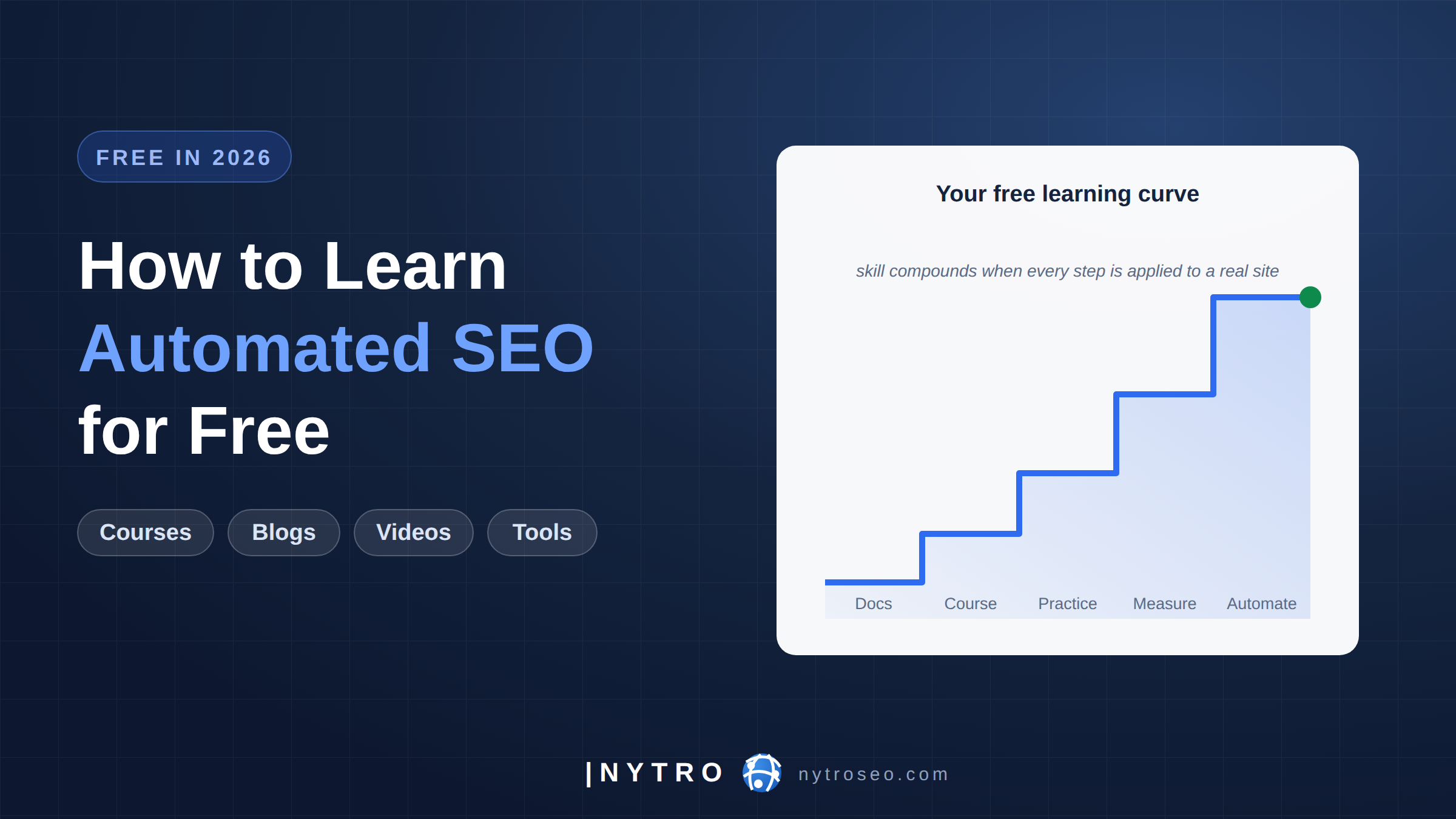
You can learn automated SEO for free using four kinds of resources: official documentation (Google Search Central), free structured courses (Moz Academy, Ahrefs Academy, Semrush Academy), practitioner blogs and videos, and free tools you practice on, with automation software handling the mechanical work while you learn the strategy. This guide gives you a step-by-step free learning path, the specific courses and channels worth your time in 2026, and the fastest route from reading about SEO to actually doing it.
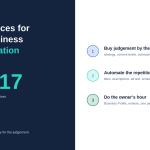
The reason a learning path matters more than a resource list: SEO in 2026 is really two skills. The first is judgment, understanding search intent, content quality, and strategy. The second is execution, metadata, keywords, structured data, technical hygiene. The execution layer is increasingly handled by automated SEO software, which changes what a beginner should actually study: learn the judgment deeply, and learn to direct and review automation rather than hand-writing every meta tag yourself.
Can You Learn SEO for Free?
Yes, completely. Every fundamental concept in SEO is documented for free by Google itself, and the industry’s best structured courses cost nothing. What separates people who learn SEO from people who read about SEO is practice on a real site: a free blog, a small business site, or a test project where you can apply each concept, watch Google Search Console respond, and correct course. Paid courses buy you curation and community, not secret knowledge, nothing behind a paywall is required to become competent.
What to Learn: The SEO Skill Map for 2026
Before choosing resources, know what the destination looks like. Competent SEO in 2026 rests on five skill areas, and free resources exist for every one of them:
Search intent and keywords. Reading a query the way the searcher meant it, informational, commercial, transactional, and mapping the right kind of page to each. This is the foundation everything else stands on.
Content quality. What makes a page worth ranking: direct answers, evidence, original insight, and structure that both readers and machines can parse. Google’s own quality-rater guidelines (free) describe what “good” means in practice.
Technical basics. Indexing, crawling, sitemaps, canonical URLs, page structure, and metadata. You don’t need to be a developer, you need to understand what search engines fetch and how they interpret it.
Measurement. Reading Search Console and analytics well enough to know whether a change worked. Impressions, click-through rate, and index coverage are the vocabulary of every real SEO conversation.
Automation and AI search. The newest layer: directing software that executes on-page work at scale, and optimizing for answer engines that cite pages instead of ranking them. This is where the field is moving and where beginners can still get ahead of the curve.
The Free Learning Path: 5 Steps in Order
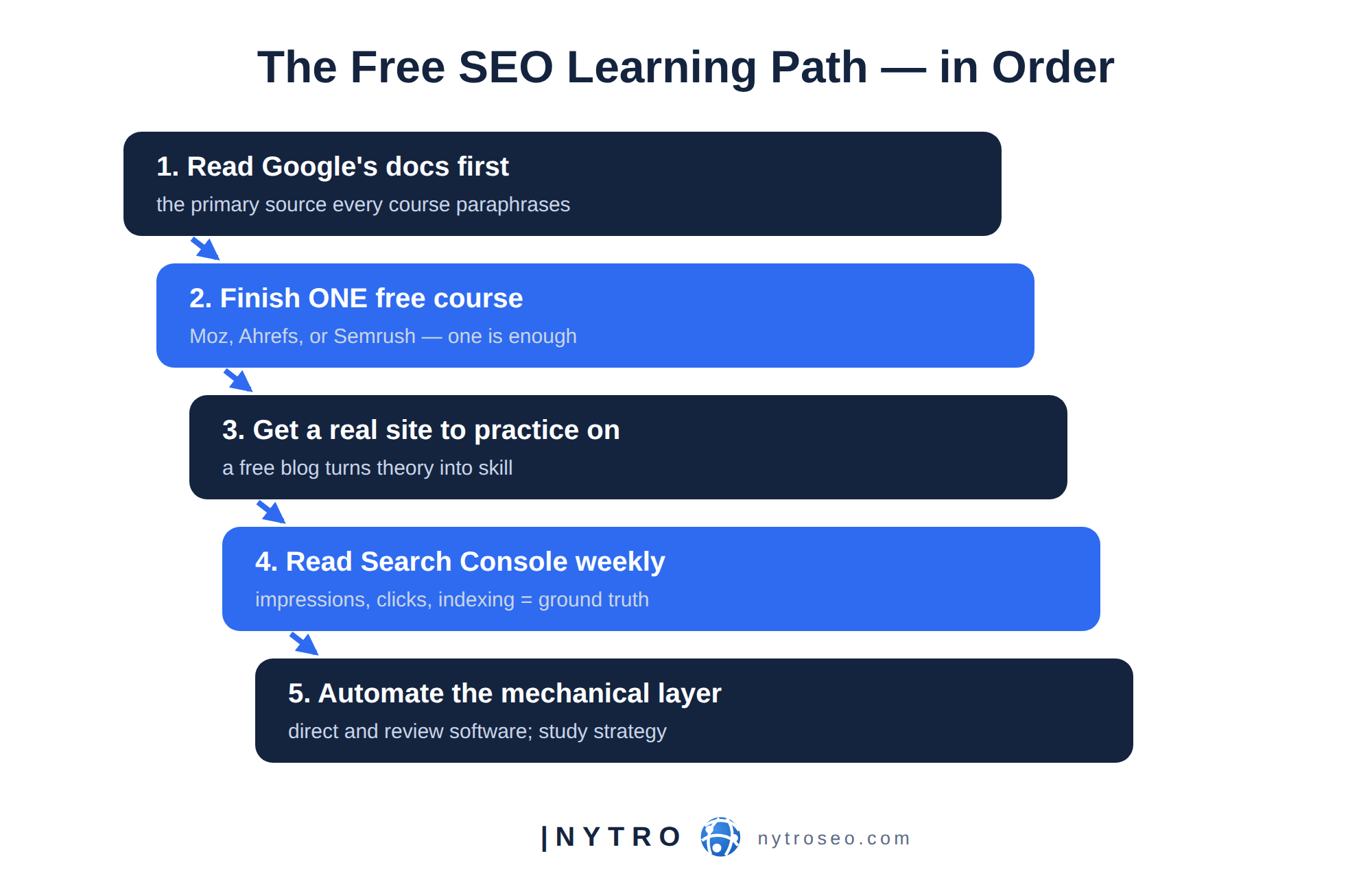
As the roadmap shows, order matters, most self-taught SEO stalls because people collect resources instead of sequencing them:
Step 1: Read Google’s own documentation first. Start with the SEO Starter Guide and the pages on how Search works. This is the primary source every course paraphrases, it’s free, and it immunizes you against outdated advice.
Step 2: Take exactly one structured course. One is enough. Moz Academy’s SEO fundamentals, Ahrefs’ certification course, or Semrush Academy all cover the same core well. Finishing one beats sampling five.
Step 3: Get a real site to practice on. A free WordPress blog about anything you genuinely know is ideal. Theory without a site is where most learners quit; every concept becomes concrete the first time you apply it to pages you own.
Step 4: Read Google Search Console weekly. GSC is free and it is the ground truth: which queries show your pages, which pages are indexed, what gets clicked. Learning to read the Performance and Page Indexing reports is the single highest-value practical skill in SEO.
Step 5: Automate the mechanical layer, study the strategic one. Once you understand why metadata and keywords matter, let software execute them at scale while you focus on intent, content, and measurement, the skills that appreciate over time. This is also how modern teams work, so learning this division of labor is itself career preparation. (Our guide to advanced SEO automation skills maps what to learn next.)
Free Courses, Blogs, and Videos Worth Your Time
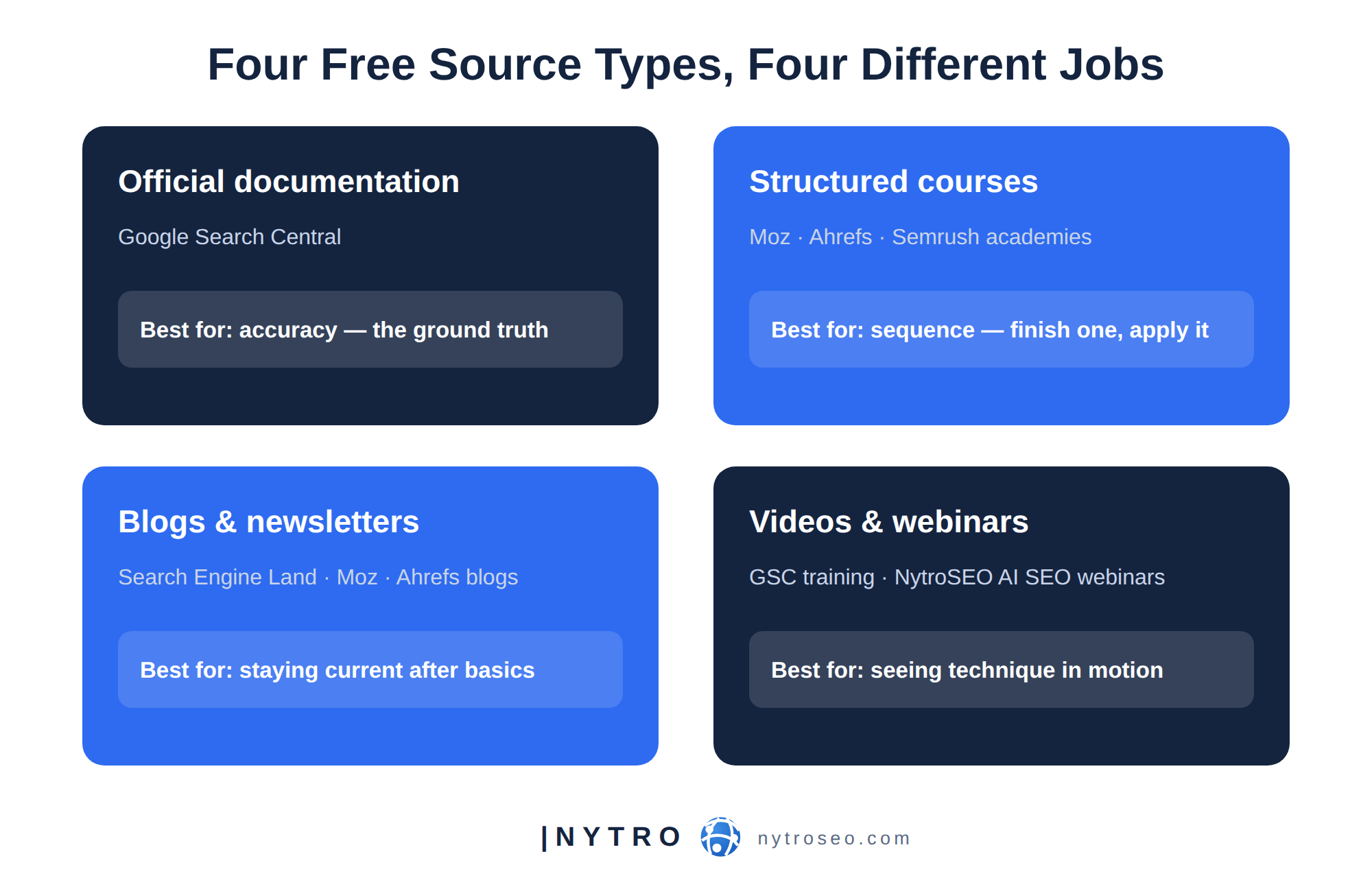
The comparison above is the honest map of the free-resource landscape. What each source type is actually for:
Official documentation (Google Search Central, its blog, and office-hours videos) is where accuracy lives. When a blog and Google’s docs disagree, the docs win.
Structured courses give you sequence. The reliable free options in 2026: Moz Academy (fundamentals, keyword research), Ahrefs Academy (practical, tool-driven), Semrush Academy (broad digital marketing context), and Google’s own Search Console training on YouTube.
| Free resource | Best for | Format |
|---|---|---|
| Google SEO Starter Guide & Search Central | Ground-truth fundamentals | Documentation |
| Moz Academy free courses | Structured fundamentals, keyword research | Video course |
| Ahrefs Academy | Practical, tool-driven technique | Video course |
| Semrush Academy | Broader digital-marketing context | Video course + certificates |
| Google Search Console training | Measurement skills | YouTube series |
| NytroSEO AI SEO webinars | Automation & AI-search visibility | Webinar recordings |
Blogs and newsletters keep you current after the fundamentals: Search Engine Land and Search Engine Journal for news, the Moz and Ahrefs blogs for method deep-dives. Treat individual practitioners’ claims as hypotheses to test on your own site, not laws.
Videos and webinars show technique in motion. Alongside YouTube staples, our own free AI SEO webinars and tutorials cover the newer layer most courses haven’t caught up to: how AI search engines select and cite pages, and how automation keeps sites visible through algorithm updates, including recovering from search engine core updates.
How to Learn Automated SEO Specifically: A Beginner’s Guide
Automated SEO is the practice of using software to execute on-page optimization, generating metadata, assigning keywords, injecting structured data, and monitoring performance, continuously across every page. Learning it is less about memorizing settings and more about understanding what should be automated and what shouldn’t:
Learn what automation does well: repeatable technical tasks at scale, title tags, meta descriptions, keyword-to-page mapping, schema markup, freshness upkeep. Study our breakdown of how automated SEO increases website traffic to see the four mechanisms in play.
Learn what stays human: strategy, positioning, the substance of content, and review of everything automation produces. The division of labor is the skill.
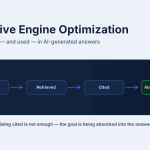
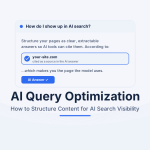
Learn the AI-search layer: answer engines (Google AI Overviews, ChatGPT, Perplexity) now cite pages rather than just ranking them. Understanding how AEO differs from SEO and how to measure AI search visibility is the newest, and least crowded, skill a beginner can build.
The through-line is learning by directing real systems rather than reading about them. As NytroSEO’s CEO Lee Agam puts it:
“The beginners who progress fastest are the ones who stop treating SEO as a reading subject. Put automation to work on a real site, then study what it changed and why rankings moved. You learn strategy by reviewing execution, not by doing the mechanical work by hand for years first.”
Learn by Doing: Free Tools to Practice With
Free tools are your laboratory. The practice stack that costs nothing: Google Search Console (your query and indexing ground truth), Google Analytics (what visitors do after the click), Google Trends (demand over time), the free tiers of Ahrefs Webmaster Tools and Semrush (backlink and audit basics), and your browser’s dev tools for inspecting what search engines actually see. Pair them with a weekly routine: pick one page, form a hypothesis (“a clearer title will lift CTR”), change one thing, and check GSC ten days later. That loop, repeated, is the entire craft.
A worked example of the loop: suppose GSC shows a page getting 400 impressions a month for a query it ranks #12 for, with zero clicks. Hypothesis: the title doesn’t match the query’s intent. You rewrite the title to answer the query directly, request indexing, and check back in two weeks. If CTR appears and position improves, you’ve learned something no course can teach, how your pages respond in your niche. If nothing changes, that’s a finding too: maybe the problem is content depth, not metadata, and the next hypothesis gets sharper. Twenty of these cycles teach more than two hundred hours of videos.
A 30-Day Free Study Plan
If you want the path compressed into a month of roughly an hour a day:
Week 1, Fundamentals. Read Google’s SEO Starter Guide and the “how Search works” documentation end to end. Set up a free blog and verify it in Search Console. Write one honest page about something you know.
Week 2, One course, applied. Start one free course (Moz or Ahrefs) and, after each module, apply the concept to your site the same day: fix a title, restructure headings, map one keyword to one page.
Week 3, Measurement. Learn the Search Console Performance and Page Indexing reports. Publish two more pages targeting different intent types, and record baseline impressions for every page you have.
Week 4, Automation and review. Turn on an automation layer for metadata and keywords, then review every change it makes: what did it write, why, and what happened in Search Console over the following weeks? Finish by writing down what you’d do differently next month, that review habit is the real curriculum.
Common Mistakes When Learning SEO Free
Collecting instead of completing. Ten bookmarked courses teach less than one finished course applied to a real site.
Learning without a site. SEO is a feedback-loop skill; without pages you control and a Search Console property, nothing you read gets tested.
Chasing tactics before fundamentals. Tricks age fast; intent, quality, and measurement compound. If a resource promises a shortcut around content quality, it is teaching you 2015.
Ignoring the automation and AI layer. Learning to hand-write every meta tag prepares you for a workflow that’s disappearing; learning to direct and audit automated systems prepares you for the one that’s arriving.
Confusing reading with progress. The weekly hypothesis loop, change one thing, measure, conclude, is what turns information into skill.
Frequently Asked Questions
Can I learn SEO for free?
Yes. Google’s official documentation, free courses from Moz, Ahrefs, and Semrush, and free tools like Google Search Console cover everything needed to become competent. Paid resources add curation and community, not required knowledge. The non-negotiable ingredient is a real site to practice on.
How long does it take to learn SEO?
The fundamentals take a few weeks of focused study; practical competence typically takes months of applying them to a real site, because you learn from how search engines respond to your changes, and that feedback loop runs in weeks, not hours. Timelines vary with practice time and the site you work on; be skeptical of any course promising mastery on a fixed schedule.
Do I need to know how to code to learn automated SEO?
No. Modern automated SEO platforms work through snippets and dashboards rather than hand-written code, and free courses assume no programming background. Basic HTML awareness (what a title tag or heading is) helps and can be learned in an afternoon.
What should I learn first in SEO?
Search intent, why someone types a query and what they expect to find. Every other skill (keywords, content, metadata, links) is a technique for satisfying intent. Start with Google’s SEO Starter Guide, then practice classifying real queries on your own site as informational, commercial, or transactional.
Is automated SEO good for beginners?
Yes, with the right framing: automation handles the mechanical layer so a beginner can focus on learning strategy and measurement. Reviewing what automation generates, and understanding why, is itself one of the fastest ways to learn on-page SEO. What beginners should not do is automate content creation without review.
Where can I practice SEO without a client?
Start a free blog on a topic you know well, or offer to manage search for a local organization. A site you control end-to-end, content, metadata, Search Console, teaches more than any course, because every concept becomes a change you can make and measure.
Where Free SEO Skills Lead
The skills this path builds are the same ones the market hires for. Freelancers start with local businesses that need exactly the fundamentals covered here, intent-matched pages, clean metadata, Search Console literacy. In-house and agency roles increasingly split along the line this guide teaches: strategists who direct automation across large sites, and specialists who audit what it produces. And site owners, affiliates, e-commerce, publishers, apply the same loop to their own revenue directly. Whichever route you take, the differentiator in 2026 is fluency with the automation and AI-search layer, precisely because most people learning from older material skip it; our roadmap of ten advanced SEO automation skills shows how far that track goes.
Put Your Learning Into Practice with Automated SEO
The fastest way to see on-page automation in action is to run it on your own site: NytroSEO connects with a snippet of code and generates optimized meta titles, descriptions, keywords, and structured data across every page, with an approval loop, so every change is also a lesson. Sign up to get started or compare pricing plans.