Last updated: July 17, 2026
Most teams treat the cost of on-page SEO as fixed: someone has to research, write, and deploy titles, descriptions, and other metadata, page by page, forever. That assumption is what makes SEO expensive. When you look closely at where the hours actually go, a large share is repetitive work a machine can do, which means you can reduce SEO cost substantially without cutting quality or output. This guide gives you a clear model for exactly how. We built our Automatic SEO platform around this problem, so the numbers here are illustrative rather than promotional: a framework you can plug your own rates into. Every figure below is labeled as an estimate with its assumptions stated, so you can adjust it to your team and get an honest answer for your situation.
Where the Hidden Cost of Manual On-Page SEO Hides
Before you can reduce SEO cost, you have to see it clearly. The obvious cost is the tool subscriptions and the visible project fees. The hidden cost is labor time spent on repetitive on-page work: writing and rewriting title tags and meta descriptions, adding image alt text, fixing duplicates, and keeping all of it current as content changes. That labor is expensive because skilled people do it. For a realistic blended rate, look at current wage benchmarks, the U.S. Bureau of Labor Statistics publishes occupational wage data for marketing and related roles, and industry SEO pricing varies widely, as guides like Ahrefs’ overview of SEO pricing show. The specific work being automated is the on-page layer Google describes in its own documentation on title links and snippets, real, ongoing work, not a one-time task. When that repetitive layer consumes hours that a specialist could spend on strategy, links, and analysis, the true cost of manual SEO is both the wages you pay and the higher-value work those hours displace. To reduce on-page SEO cost, you target that repetitive layer first.
How Automation Helps You Reduce SEO Cost
Automation lowers cost by removing the per-page labor from the most repetitive on-page tasks. Instead of a specialist spending minutes on every page’s metadata, a snippet-based system applies optimized titles, descriptions, and alt text across the whole site at once and keeps them current automatically. The specialist’s time shifts from production to judgment. This is the core of cost effective seo: you do not pay for the same repetitive task ten thousand times. You pay once for a system that performs it continuously. The savings compound because the work never stops needing to be redone, as your catalog and content change, manual metadata drifts stale and demands re-editing, while automation simply keeps pace. That is how you reduce overall on-page SEO operational cost rather than just trimming a single line item. For the broader financial case, our analysis of the economic impact of automated SEO software on agencies walks through the mechanics, and our guide to reducing your agency team’s operational cost applies it to agency workflows.
Reduce SEO Cost: A Worked Cost Model
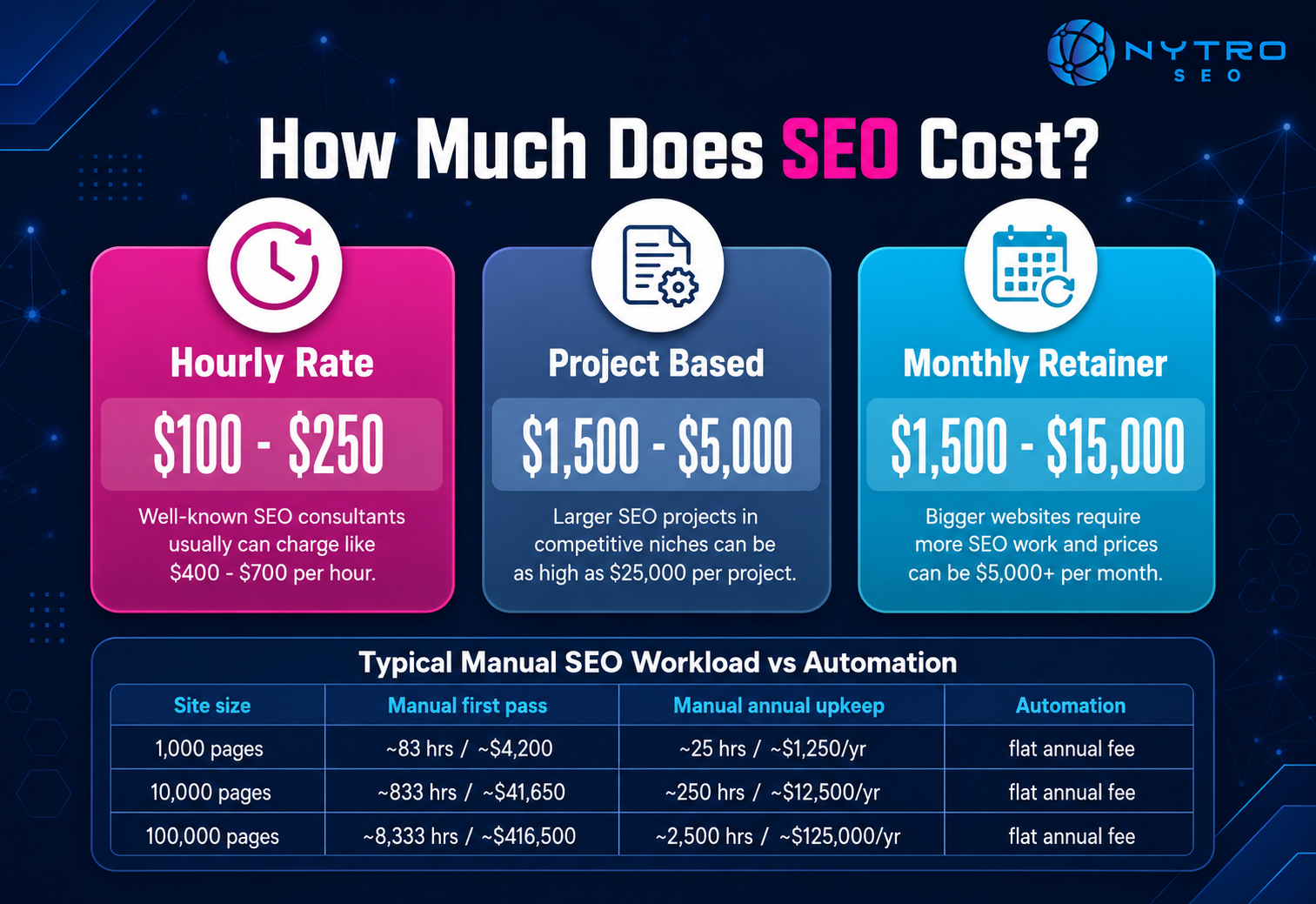
Here is a transparent model. Every number is an estimate with its assumptions stated; replace them with your own to get a figure you can trust. Assume a 10,000-page site. Assume manual on-page metadata work, research, writing, and deployment, averages five minutes per page (estimate; ranges roughly 3–10 minutes depending on CMS and complexity). Assume a blended fully-loaded labor rate of $50 per hour (estimate; adjust to your market using wage benchmarks).
- Manual one-time pass: 10,000 pages × 5 minutes = 833 hours × $50 = about $41,650 (estimate).
- Ongoing maintenance: because content changes, assume 30% of pages need re-editing each year: 3,000 pages × 5 minutes = 250 hours × $50 = about $12,500 per year (estimate).
Against that, a snippet-based automation platform applies and maintains metadata across all 10,000 pages continuously for a subscription fee. Even at a few thousand dollars per year, check current seo automation platform pricing for real figures, the model favors automation heavily once the site passes a few thousand pages, and the gap widens every year because the maintenance cost never lands on you. The larger and more dynamic the site, the more decisively automation wins. Margin of error on these figures is high because rates and page counts vary; the point is the shape of the curve, not the exact dollars.
The pattern holds across site sizes. The table below applies the same assumptions ($50/hour, five minutes per page, 30% annual re-editing) to three site sizes. All figures are estimates meant to show the shape, not to quote a price.
| Site size | Manual first pass | Manual annual upkeep | Automation (subscription) |
|---|---|---|---|
| 1,000 pages | ~83 hrs / ~$4,200 | ~25 hrs / ~$1,250/yr | flat annual fee |
| 10,000 pages | ~833 hrs / ~$41,650 | ~250 hrs / ~$12,500/yr | flat annual fee |
| 100,000 pages | ~8,333 hrs / ~$416,500 | ~2,500 hrs / ~$125,000/yr | flat annual fee |
At 1,000 pages, manual work is manageable and automation is mostly a convenience. By 10,000 pages the recurring upkeep alone rivals or exceeds a subscription, and at 100,000 pages manual work is simply not viable. That is the core reason large and enterprise sites reduce SEO cost most dramatically with automation: their repetitive labor bill grows linearly with page count while a subscription stays flat.
Reduce SEO Cost Without Cutting Capacity
The wrong way to cut SEO cost is to reduce output, fewer optimized pages, less maintenance, weaker search visibility. That saves money and loses results. Automation does the opposite: it lets you reduce SEO cost while increasing capacity, because the same team now covers far more pages than it could by hand. For an agency, this changes the unit economics. If a specialist no longer spends the bulk of their week on repetitive metadata, they can manage more client sites, or go deeper on strategy for existing ones. You can also automate seo reports so that the reporting layer, another repetitive, hours-heavy task, stops consuming billable time. The result is not a smaller team doing less; it is the same team producing more, which is a better way to reduce on-page SEO cost per client than simply doing less work. Our overview of AI for SEO agencies covers how this reshapes agency delivery.
Consider a concrete scenario. An agency specialist who spends roughly 60% of a 40-hour week on repetitive on-page metadata and reporting is giving up about 24 hours weekly to work a machine could do. Automate that layer and those hours return to the calendar. At that point the agency has a choice: take on additional clients with the same headcount, raising revenue without raising payroll, or reinvest the hours into deeper strategy and content that improves results and retention. Either path improves margin. The cost saving is real, but for an agency the capacity gain is often the larger prize, because it turns a fixed labor cost into a lever for growth rather than a ceiling on how many clients the team can serve.
Payback Period: How Quickly You Reduce SEO Cost
The question every buyer asks is how fast automation pays for itself. Using the model above, payback is a simple comparison: the annual subscription cost versus the labor hours it eliminates.
If automation removes even 250 maintenance hours a year at a $50 blended rate, that is $12,500 in recovered time (estimate) against a subscription that is typically a fraction of that for a site of this size. In that scenario, payback is measured in weeks, not months, and everything after is net savings plus recovered capacity. The break-even point arrives sooner the larger your site and the higher your labor rate, which is why enterprise and large-catalog sites see the fastest returns. For a fuller accounting of what drives SEO cost, our breakdown of the SEO costs that impact your ROI is worth reading alongside this model, as is our comparison of manual versus automated SEO services.
Common Mistakes When Trying to Cut SEO Cost
A few errors turn cost-cutting into a false economy.
- Cutting output instead of overhead. Reducing the number of optimized pages saves money but sacrifices search visibility. Target repetitive labor, not coverage.
- Ignoring maintenance cost. The recurring cost of keeping metadata current is often larger than the one-time build. A model that omits it understates your true spend.
- Counting only subscription price. The real comparison is subscription plus a little oversight versus the full labor cost of doing the same work by hand, including the higher-value work those hours displace.
- Automating without guardrails. Cheap automation that produces poor tags costs more in lost visibility than it saves. Reliable automation with human overrides is the goal, because a bad tag published across thousands of pages is an expensive mistake to unwind.
- Forgetting reporting time. Client and internal reporting is a hidden hours sink. If you automate seo reports, you recover time that rarely shows up in a naive cost estimate.
What You Can and Can’t Automate to Reduce SEO Cost
Automation cuts cost only when it targets the right work. Being clear about the boundary keeps you from either over-automating quality-sensitive tasks or leaving obvious savings on the table.
The repetitive, rules-based, high-volume work is where automation reliably helps you reduce SEO cost. That includes generating and maintaining title tags and meta descriptions, adding image alt text, standardizing social and Open Graph tags, keeping metadata current as content changes, and producing routine performance reports. These tasks are expensive mainly because of their volume, and volume is exactly what machines handle well.
The judgment-heavy work stays with people. Strategy, keyword and market research, original content, link building and relationships, and interpreting results all depend on human expertise, and trying to fully automate them costs more in quality than it saves. The most cost-effective model is a hybrid: automate the repetitive on-page layer so it runs continuously and consistently, and redirect your specialists’ recovered hours to the strategic work that actually differentiates your results. That division is how you reduce overall on-page SEO operational cost without weakening the parts of SEO that need a human.
How to Audit Your Current SEO Cost
Before you can reduce SEO cost, you need an honest baseline. Most teams underestimate it because the labor is spread across many people and never itemized. A quick audit fixes that. First, list the recurring on-page tasks: writing and updating titles and descriptions, alt text, fixing duplicates, and reporting. Second, estimate the hours each consumes per month, including the maintenance that happens as content changes, the number teams most often forget. Third, apply your blended, fully-loaded labor rate, not just salary, so the figure reflects true cost. Fourth, add the opportunity cost: the higher-value work those same hours could produce if they were freed. The total is your real annual on-page SEO cost, and it is almost always larger than the visible line items suggest. Once you have it, comparing against a subscription is straightforward, and the decision usually makes itself. Treat every number as an estimate and revisit it as your site grows.
How to Reduce SEO Cost Across Your Whole Site
The model scales with your site. On a small site, manual work is affordable and automation is a convenience. On a large or fast-changing site, the repetitive labor becomes the dominant cost, and automation is the clearest way to reduce overall on-page SEO operational cost while keeping every page optimized and current. The practical path is straightforward: measure your current on-page labor honestly, including maintenance and reporting; model it against automation using your own rates; and start with the highest-volume, most repetitive work, where the savings are largest. Our Automatic SEO software is built to remove exactly that repetitive layer, so your team’s hours go to strategy and analysis instead of retyping metadata across thousands of pages.
The Bottom Line on How to Reduce SEO Cost
The cost of SEO is not fixed; a large share of it is repetitive on-page labor that a machine can do continuously for a fraction of the price. Model your real spend, including maintenance and reporting, target the repetitive layer, and you can reduce SEO cost while covering more pages and freeing your specialists for higher-value work. For a large or growing site, that is the difference between a rising labor bill and a flat, predictable subscription.
Want to see what you could save on your own site? Book a free call and we will model your current on-page labor against automation using your real numbers, no guesswork. The sooner you replace repetitive per-page labor with a system that runs continuously, the sooner your SEO spend stops scaling with your page count and starts working in your favor.
Frequently Asked Questions
Start by separating strategy from repetitive execution. Strategy, links, and analysis need skilled people; repetitive on-page work – titles, descriptions, alt text, and reporting – can be automated. To reduce SEO cost, model your real labor hours on that repetitive layer, then replace it with a snippet-based automation platform so your specialists focus on higher-value work instead.
It depends on site size, but the savings scale with page count. As an estimate, at five minutes per page, a 10,000-page site represents over 800 hours of manual metadata work for a single pass, plus recurring maintenance as content changes. Automation removes most of that per-page labor, which is why large and dynamic sites see the biggest time savings.
No. Automation replaces repetitive tasks, not people. It removes the hours specialists spend retyping metadata across thousands of pages so they can focus on strategy, content, links, and analysis – work automation cannot do. For agencies, this usually means the same team handles more clients or delivers deeper work, rather than a smaller team.
Payback is the annual subscription cost versus the labor hours automation eliminates. For a site large enough that repetitive metadata consumes hundreds of hours a year, recovered time often far exceeds the subscription, so payback is commonly measured in weeks rather than months. The larger your site and the higher your labor rate, the faster automation breaks even. Treat any specific figure as an estimate.
Price alone is a poor guide. Reliable automation generates unique, relevant tags from each page’s own content, includes human overrides, and avoids keyword stuffing. Cheap tools that produce generic or stuffed metadata can cost more in lost search visibility than they save. Judge cost effective seo by output quality and control, not by subscription price in isolation.