Last updated: June 11, 2026
If you optimize websites for a living, you have probably noticed the ground shifting. Pages that rank on page one no longer guarantee traffic, because a growing share of answers now get assembled by AI before a user ever clicks. That shift is the entire reason the AEO vs SEO conversation exists, and why agencies, large-site owners, and developers are rethinking what “optimization” means in 2026.
This guide gives you a clear, practical breakdown: what each discipline is, how they differ, where Generative Engine Optimization (GEO) fits, and what to prioritize this year. We have spent years building automatic on-page optimization across thousands of pages, so the recommendations here are grounded in what moves search visibility in practice, not theory.
AEO vs SEO: The Short Answer
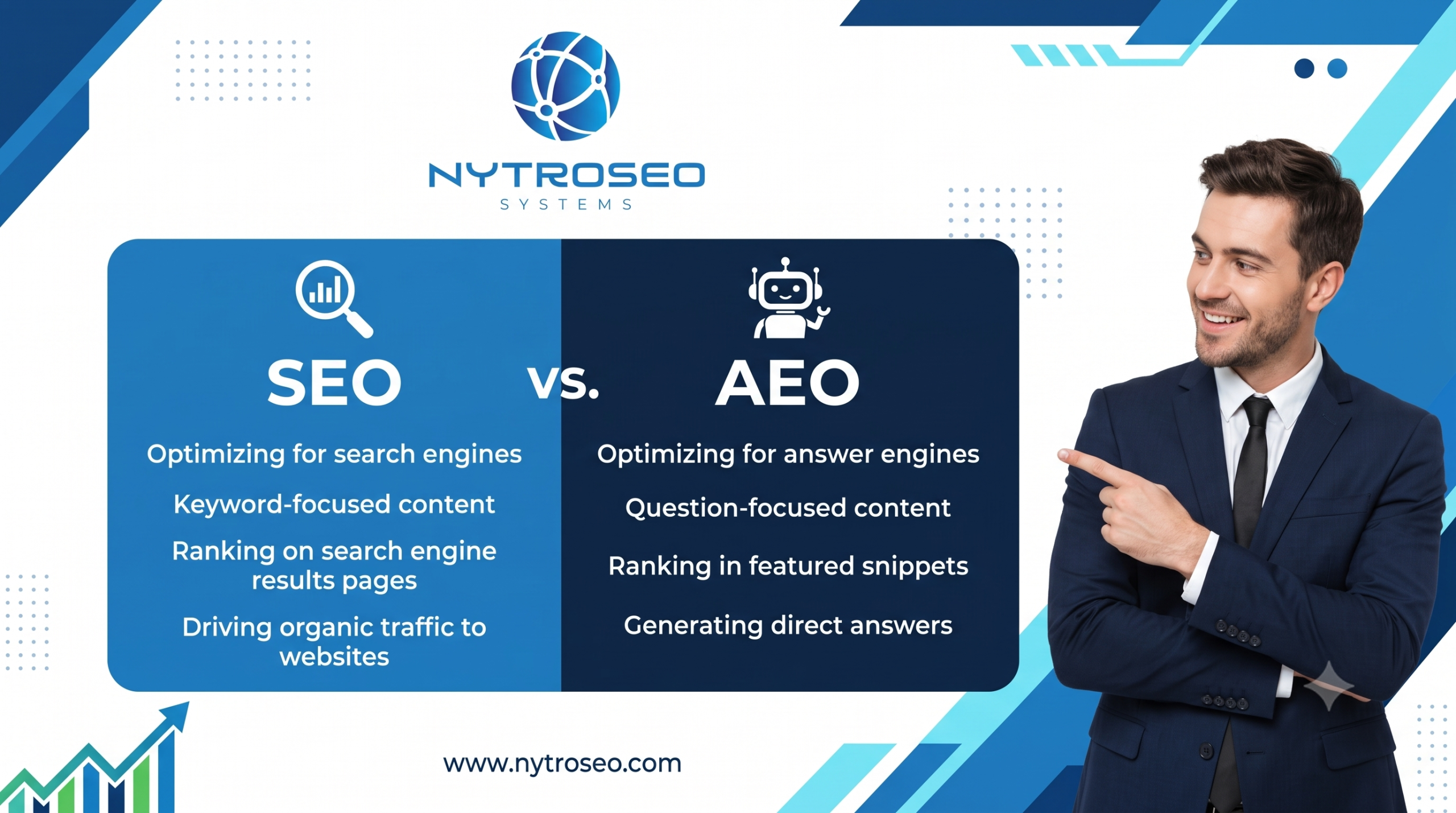
Here is the direct answer before the detail. SEO (Search Engine Optimization) is the practice of getting your pages to rank in a list of blue links on engines like Google and Bing. AEO (Answer Engine Optimization) is the practice of getting your content selected, quoted, and cited inside a direct answer, whether that answer appears in a Google AI Overview, ChatGPT, Perplexity, or a voice assistant.
Put simply: SEO competes for a ranking position. AEO competes for a citation inside the answer. They share a foundation, crawlable, trustworthy, well-structured content, but they optimize for different end states. You do not replace one with the other. In 2026, you need both working together.
AEO vs SEO: Core Definitions
Clear definitions matter here, because the terms get used loosely. Let’s separate them.
Search Engine Optimization (SEO). SEO is the long-standing discipline of improving a page so it ranks higher in organic search results. It covers technical health (crawlability, indexing, site speed), on-page signals (titles, meta descriptions, headings, internal links), and off-page signals (authority and links). The goal is a higher position in the ranked list so more people click through to your site.
Answer Engine Optimization (AEO). Answer Engine Optimization is the practice of structuring content so an answer engine can extract a precise, self-contained response and attribute it to you. The discipline of Ask Engine Optimization AEO grew out of featured snippets and “People Also Ask” boxes, then accelerated as large language models began composing answers directly. AEO rewards clear definitions, concise answer blocks, FAQ formatting, and structured data that machines can parse. We covered the mechanics in depth in our guide to Ask Engine Optimization and conversational questions.
Generative Engine Optimization (GEO). GEO is the newest term, focused specifically on visibility inside generative answers produced by LLMs. When people debate GEO vs traditional SEO, they are really asking how to be synthesized into an AI-generated response rather than merely listed beneath it. In practice, GEO and AEO overlap heavily; many teams use the terms interchangeably, with GEO leaning toward generative engines (ChatGPT, Gemini, Perplexity) and AEO covering the broader answer surface, including Google’s own answer features.
A useful way to remember the relationship: SEO is the foundation, AEO is the layer that makes your content answer-ready, and GEO is AEO aimed squarely at generative engines. None of them works without solid technical SEO underneath.
AEO vs SEO: How Each One Works
To make the AEO vs SEO distinction concrete, look at what each one actually optimizes.
How SEO works. A search engine crawls your site, indexes your pages, and ranks them against a query using hundreds of signals, relevance, authority, freshness, page experience, and more. Your job in SEO is to earn a high enough position that users notice and click. The unit of success is the ranked page.
How AEO works. An answer engine does not just rank pages; it reads them, extracts passages, and decides which sentences best answer a specific question. It then composes a response and, increasingly, cites the sources it pulled from. Your job in AEO is to make the passage, not just the page, easy to lift and trust. The unit of success is the extracted, attributed answer.
This is where query fan-out matters. Google’s AI features do not only answer the single query a user typed; they generate related sub-queries behind the scenes and synthesize across all of them. A page that comprehensively covers a topic and its sub-questions gets pulled into more of those fan-out answers than a narrow page targeting one keyword. That is why topical depth now beats single-keyword targeting, a theme we explore in our breakdown of LLM SEO strategies for AI search.
There is real data behind these structural choices. The 2024 academic study “GEO: Generative Engine Optimization” from researchers at Princeton and collaborators found that adding cited sources and statistics to content raised its visibility inside generative answers by roughly 30 to 40 percent, while keyword stuffing actually reduced visibility. You can read the GEO research on arXiv. The takeaway is concrete: facts, citations, and clean structure win citations; padding does not.
AEO vs SEO: A Side-by-Side Comparison
The table below summarizes the AEO vs SEO difference across the dimensions that matter most to agencies and large-site owners.
| Dimension | SEO | AEO |
| Primary goal | Rank in the list of results | Get cited inside the answer |
| Unit of success | The ranked page | The extracted, attributed passage |
| Where it shows up | Organic blue links | AI Overviews, ChatGPT, Perplexity, voice, featured snippets |
| Key content trait | Comprehensive, authoritative pages | Self-contained answer blocks, FAQs, definitions |
| Critical signals | Links, relevance, page experience | Clarity, structure, statistics, schema, citations |
| Measurement | Rankings, organic clicks, impressions | Citation rate, share of AI voice, referral from AI sources |
| Risk if ignored | Lower positions, fewer clicks | Invisible inside the answers users now read first |
Notice that the two columns do not conflict. Strong SEO makes you eligible; strong AEO makes you quotable. The brands winning in 2026 treat their SEO AEO efforts as one program with two outputs, not two competing budgets.
A Worked Example: One Query, Two Outcomes
Imagine a marketing lead at an agency searches for “best automatic SEO tool for agencies.” Two very different things happen depending on the surface.
On the traditional SEO surface, the engine returns a ranked list of pages, review roundups, vendor pages, and comparison posts. Visibility here is about position: the agency clicks one of the top results, and the page that ranks highest gets the visit. To win, your page needs authority, relevance, and a compelling title and meta description that earn the click.
On the answer surface, an AI assistant composes a single response: “Several tools automate on-page SEO for agencies, including platforms that apply meta-tag and answer-ready optimization across client sites via a JavaScript snippet without CMS access.” It may then cite two or three sources. To win here, your content needs a clean, self-contained passage that states exactly what the tool does and for whom, phrased so the model can lift and attribute it.
Same query, two outcomes. The page optimized only for ranking might never be quoted, while a page structured for extraction gets cited even if it sits at position four or five. That gap is the practical heart of the AEO vs SEO discussion, and it is why structure now matters as much as authority.
Where GEO Fits: GEO vs Traditional SEO
If AEO is about being the answer, GEO is about being the answer that an LLM generates. When teams weigh GEO vs traditional SEO, the honest conclusion is that GEO is not a replacement, it is an extension. Generative engines still rely on crawlable, indexable, trustworthy content. They simply add a new selection step: synthesis. To win there, you give the model clean, factual, well-attributed passages it can confidently restate.
Three practical GEO moves carry most of the weight:
- Lead with the answer. Put a direct, 40 to 60 word response at the top of each section so a model can lift it cleanly.
- Back claims with data and sources. Specific numbers with citations are far more likely to be reused than vague assertions.
- Make your site machine-readable. Ensure AI crawlers can access your pages, and use structured data so engines understand entities and relationships.
This is also where AI search optimization connects to brand strategy. Being cited repeatedly across AI answers builds recognition that compounds, a dynamic we unpack in what AI brand visibility is and how to optimize for AI Overviews.
What Google Says About Optimizing for AI
It is worth grounding the GEO vs traditional SEO debate in Google’s own position. In its guidance on AI features and your website, Google is direct: the best practices for SEO continue to apply, because its generative features are rooted in the same core ranking and quality systems. Google advises writing for people rather than chunking content into fragments for machines, and it warns against producing separate content “for AI,” which can trip its scaled-content-abuse policies. The practical reading for 2026 is reassuring: you do not need a parallel content strategy. You need one set of helpful, well-structured, trustworthy pages, then you make sure answer engines can read and cite them.
AEO vs SEO: Which Should You Prioritize in 2026?
The pragmatic answer to the AEO vs SEO prioritization question depends on where your gaps are, but the sequence is consistent.
First, fix the SEO foundation. If Google cannot crawl, index, and trust your pages, no answer engine will cite them either. Indexing problems, slow rendering, and thin content sink both SEO and AEO at once. Start by confirming your important pages are actually indexed and that AI crawlers are allowed to read them.
Second, layer AEO structure on top. Once the foundation is solid, restructure key pages for extraction: a direct answer up front, scannable subheads phrased the way people ask questions, an FAQ block, and structured data. This is the fastest way to start earning citations without rewriting your whole site.
Third, scale it. This is where most teams stall. Manually restructuring titles, meta descriptions, and answer blocks across thousands of pages is slow and error-prone. Automating that layer, applying consistent, keyword-aligned optimization across an entire site without editing the CMS, is what lets agencies and large-site owners keep pace. Our automated SEO software was built for exactly this: it optimizes on-page metadata and answer-ready signals at scale, so your SEO AEO program covers every page, not just the handful you have time to touch by hand.
For a sense of how quickly this can be deployed, we walk through the process in how to automatically optimize any website’s SEO in an hour.
Building for Both: A Practical Workflow
Here is a workflow that satisfies both disciplines without doubling your effort:
- Audit indexing and crawl access. Confirm priority pages are indexed and that GPTBot, PerplexityBot, ClaudeBot, and Google-Extended are not blocked.
- Map intent to structure. For each priority query, decide the answer shape: definition, steps, or comparison. Lead the section with that answer.
- Optimize metadata for both surfaces. Titles and meta descriptions still drive clicks in SEO and frame your content for answer engines.
- Add structured data. FAQ, HowTo, Article, and Organization schema give engines machine-readable context. The vocabularies are documented at schema.org, and the FAQ schema you will use for this very article is defined under schema.org/FAQPage.
- Cite and quantify. Add specific numbers and authoritative sources; they raise both credibility and citation rate.
- Measure both outcomes. Track rankings and organic clicks for SEO, and citation rate and share of AI voice for AEO.
- Automate the repetitive layer. Use automation to keep metadata and answer blocks consistent across the whole site as content and queries change.
Done well, this is not two programs. It is one optimization system producing two kinds of visibility, ranked positions and cited answers.
Common Myths About AEO vs SEO
A few persistent misconceptions slow teams down. Clearing them up sharpens the AEO vs SEO strategy.
Myth 1: AEO replaces SEO. It does not. Answer engines pull from indexed, ranked, trustworthy content. If your SEO foundation is weak, your AEO ceiling is low. The two reinforce each other; they do not substitute for one another.
Myth 2: You need to write separate “AI content.” You do not, and doing so is risky. The same well-structured page should serve people and machines. Writing thin variants aimed only at AI systems can trigger spam policies and rarely earns durable citations.
Myth 3: Schema is optional for everything. Structured data is not a magic ranking lever, and Google notes it is not required to appear in generative answers. But it gives engines clean, machine-readable context about your content and entities, and it measurably helps citation on several non-Google engines. For an answer-engine strategy, it is closer to table stakes than to a nice-to-have.
Myth 4: More keywords means more visibility in AI answers. The opposite is true. Research on generative engines found that keyword stuffing reduced visibility, while clarity, statistics, and citations increased it. Padding your content with repeated terms hurts you on the answer surface.
Myth 5: AEO is only for big brands. Structure is available to everyone. A focused page with a clear definition, an answer block, and an FAQ can get cited even when larger competitors do not bother to format their content for extraction. Smaller teams often win citations precisely because they make their answers easy to lift.
The Bottom Line on AEO vs SEO
SEO earns you a place in the results. AEO earns you a place in the answer. GEO is AEO pointed at generative engines. In 2026, the winners are not choosing between them, they are building a single foundation and optimizing it for both, at scale. The sooner your metadata, structure, and schema serve answer engines as well as they serve traditional rankings, the more often your brand shows up where decisions now get made: inside the answer.
Ready to see where your site stands? Book a free call with our team and we will show you the AEO and SEO gaps across your pages, and how to close them automatically.
AEO vs SEO describes two complementary optimization disciplines. SEO (Search Engine Optimization) aims to rank your pages higher in organic search results. AEO (Answer Engine Optimization) aims to get your content extracted and cited inside direct answers like AI Overviews, ChatGPT, and Perplexity. SEO competes for position; AEO competes for citation.
No. GEO (Generative Engine Optimization) is an extension of SEO, not a replacement. Generative engines still depend on crawlable, indexable, trustworthy content, then add a synthesis step. Strong technical SEO remains the foundation; GEO and AEO add the structure, data, and clarity that make content easy for AI to cite.
The two overlap heavily and are often used interchangeably. AEO (Answer Engine Optimization) covers the broad answer surface, including featured snippets, voice, and Google’s answer features. GEO (Generative Engine Optimization) focuses specifically on visibility inside answers generated by large language models such as ChatGPT, Gemini, and Perplexity.
Both, in sequence. Agencies should secure the SEO foundation first, indexing, crawl access, and authority, then layer AEO structure for citations. The differentiator in 2026 is doing this at scale across many client sites, which is why automation of on-page metadata and answer-ready signals has become an agency priority.
Yes. Because both disciplines share a foundation of crawlable, well-structured, trustworthy content, a single automated layer can optimize titles, meta descriptions, headings, answer blocks, and structured data for ranked results and for answer-engine citations at the same time, across an entire site, without editing the CMS.