Last updated: September 14, 2026
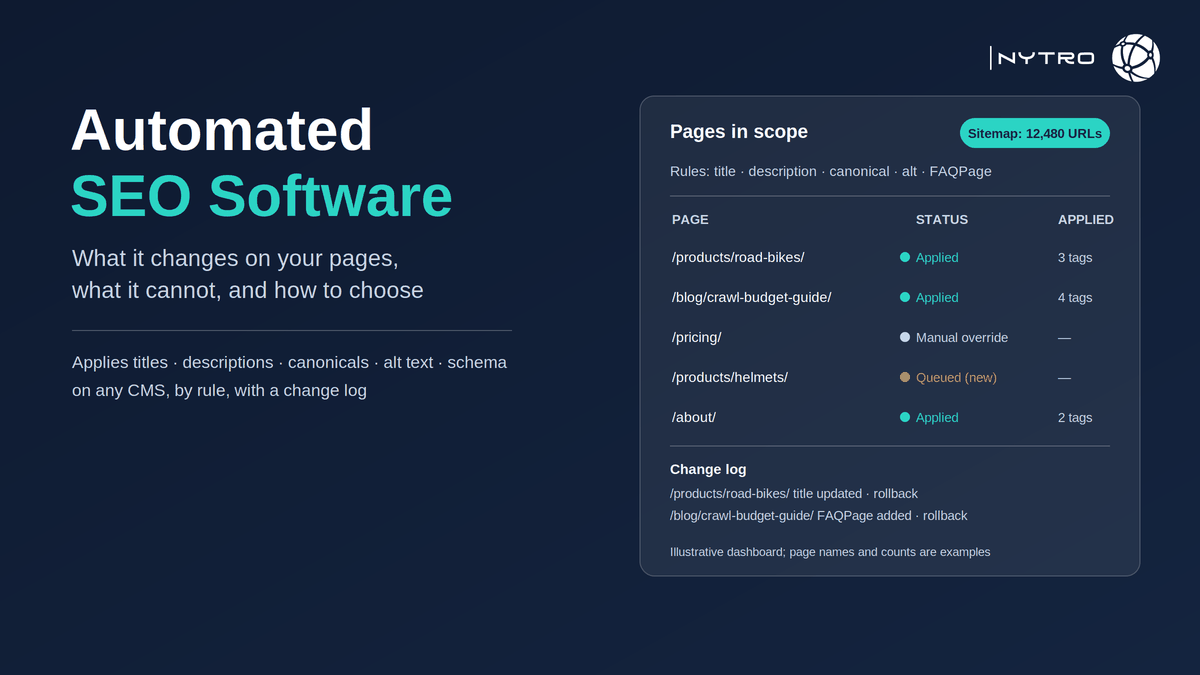
Automated SEO software applies on-page optimisation changes to a website without a person editing each page. In practice that means generating and maintaining titles, meta descriptions, canonical hints, image alt text and structured data across every page in scope, then keeping them aligned as content, templates and search systems change. It is distinct from audit software, which crawls a site and reports problems for someone else to fix. NytroSEO is automated SEO software of the first kind: it applies the changes, through a small JavaScript snippet in the site header, on any content management system, and it monitors the result. This guide explains what such software actually changes, what it does not, how it fits with Google’s guidance for AI search, and how to evaluate it with a twelve-point checklist.
Google’s Search Essentials set the standard any automation has to meet: pages should have unique, descriptive titles and descriptions that reflect their content, structured data should describe only what is visible on the page, and nothing on the page should be built to deceive users or search engines. Google’s guide to optimizing for generative AI features on Search, published in May 2026, adds that AI Overviews and AI Mode use the same core ranking systems as Search and require no special markup or AI-specific format. Automation that produces accurate, page-specific metadata sits inside those rules; automation that mass-produces manipulative or duplicate tags sits outside them, whatever the tool is called.
If you want to see what that looks like on your own pages before reading further, sign up for free and NytroSEO will show you the metadata it would apply, page by page, before anything goes live.
The distinction between applying and reporting is the one that matters most when you shop for this category. Most products described as automated seo tools are audit and monitoring tools: valuable, but they end with a list. The list is where large sites and agencies stall, because a backlog of ten thousand missing descriptions is not a task a team clears by hand. An seo automation platform that applies the fix, under rules you approve, is the difference between knowing about the backlog and clearing it.
Lee Agam, founder and CEO of NytroSEO, describes the choice most buyers actually face as one between two mental models rather than two products. In the first, SEO is a list of pages, each of which someone will eventually optimise; in the second, it is a set of rules that every page in scope obeys from the moment it is published. His experience with agencies and large-site owners is that the first model never catches up on a site with tens of thousands of URLs, and that the second only works if the rules are honest: metadata must describe the page, the sitemap must define the scope, and every change must be logged and reversible. He is equally clear about the limits. Software that rewrites the head of a page does not fix rendering, write body copy or earn links; it removes the repetitive on-page work so that the people on the account can do those things.
What automated seo software is (and what it is not)
Automated seo software is a system that generates, applies and maintains on-page SEO elements across a website according to rules, with page-level overrides and a change log, so that optimisation keeps pace with publishing. The elements it typically manages are the title tag, the meta description, the canonical hint, image alt attributes, structured data such as Organization, Article, FAQPage and Product, and in some platforms internal-link suggestions. The unit of work is a rule applied to a scope, not an edit applied to a page.
It is not an audit tool, a rank tracker or a content generator, although some platforms bundle those. An audit tool detects; a rank tracker measures; a content generator writes. Automated seo optimization sits between detection and measurement: it is the layer that changes the page. NytroSEO, for example, does not fix client-side rendering problems, does not write or rewrite body content, and only inserts links in the body where that has been configured and confirmed. Being precise about scope is how you avoid buying a tool for a job it does not do.
Three properties separate serious platforms from scripts that bulk-rewrite tags:
- Scope is explicit. The sitemap, or a defined URL set, decides which pages are touched; nothing outside it changes.
- Rules are reviewable and overridable. You can see what a rule will produce, exclude URLs, and hand-set any page.
- Every change is logged and reversible. You can see what was applied, when, and roll it back.
How automated seo tools change pages without editing your CMS
The delivery mechanism decides what a tool can change and what access it needs. There are four common approaches.
A JavaScript header snippet or tag-manager tag rewrites head elements at load time. It needs no CMS access, works on any platform, and Google renders JavaScript, so titles, descriptions and structured data added this way are read from the rendered page. It cannot change server-rendered body copy or fix a page that fails to render.
A CMS plugin writes to the stored fields in the content system. It is native to one platform, needs plugin permissions, and can edit any field the CMS exposes.
An API or CMS integration writes fields through the platform’s interface. It suits large publishers with engineering support and can be extended to body content.
An edge or CDN layer modifies the HTML in transit. It is powerful and platform-independent but needs infrastructure access and careful caching.
NytroSEO uses the first approach. A single snippet is installed in the site header, directly or through a tag manager, and the platform applies approved metadata and structured data to pages within the sitemap scope when they load. Processing happens on NytroSEO’s cloud platform, so there is no server-side installation and minimal performance impact. Newly added or updated pages are prioritised so that fresh content is optimised as it appears. Installation details are in our guide to installing the NytroSEO snippet in the page header, and the approach is the same whether the site runs on WordPress, Shopify, a no-code builder or a custom stack.
What a seo automation platform should automate in 2026
The tasks worth automating share three traits: they are repetitive, they follow rules a person can state, and they exist on every page. The tasks that should stay with people are the ones that need judgement about the business.
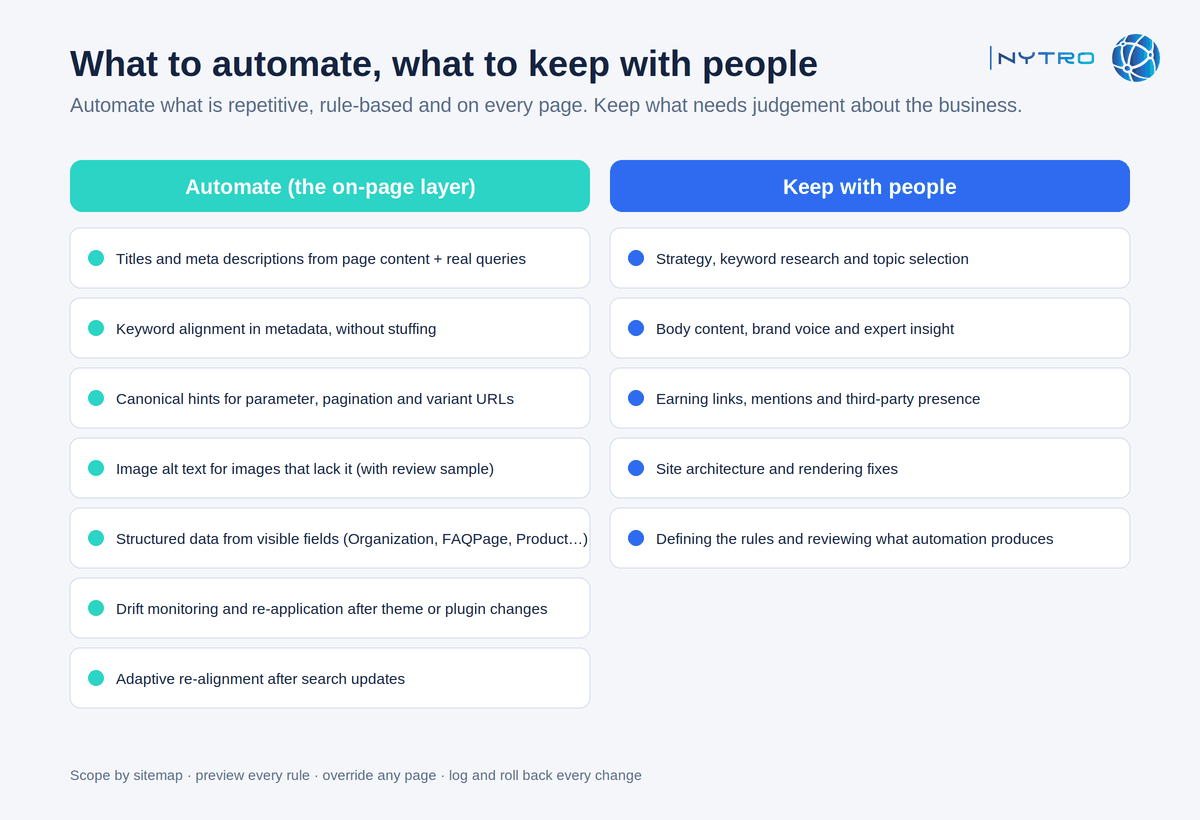
The split above is the one we recommend to every account: automate the rule-based on-page layer, keep judgement with people.
Automate:
- Titles and meta descriptions, generated from page content and the search queries the page already earns, so that snippets match intent. NytroSEO’s search-intent optimisation reads the queries users actually type and shapes each page’s title and description to match them, which is where click-through gains come from.
- Keyword alignment in metadata: incorporating the terms a page should be found for into its tags, without stuffing, and updating them as the query mix changes.
- Canonical hints and duplicate handling for parameter, pagination and variant URLs.
- Image alt text for images that lack it, drafted from image content and page context, with a review sample.
- Structured data generated from visible page fields: Organization and Person for identity, Article or BlogPosting for content, FAQPage for visible question-and-answer pairs, Product for catalogue pages.
- Monitoring for drift, so that a theme update or plugin that overwrites a title is caught and corrected rather than discovered months later.
- Adaptive re-alignment after search updates, so that metadata is re-checked against current guidance when Google changes its systems; see how adaptive automation supports recovery from core updates.
Keep with people:
- Strategy, keyword research and topic selection.
- Body content, brand voice and expert insight.
- Earning links, mentions and third-party presence.
- Site architecture and rendering fixes.
- Deciding the rules the automation follows and reviewing what it produces.
Our guide to when to automate SEO and when to keep it manual works through the decision task by task for teams that want a more detailed split.
Automated seo optimization for AI search, not just rankings
The reason to automate the on-page layer has changed since this page was first written. In 2024 the goal was consistent rankings; in 2026 it is also being retrieved, extracted and cited by AI Overviews, AI Mode, ChatGPT, Perplexity, Gemini and Copilot, each of which reads the same page.
Google’s position is that its AI features are built on the same core ranking and quality systems as Search, so the fundamentals are unchanged: indexable pages, helpful people-first content, clear structure and consistent entity data. Google also states that no llms.txt file, special markup or markdown version is needed. That is good news for automation, because the work is ordinary and repeatable. Three things move the needle across every engine:
- Accurate titles and descriptions. AI systems use them to decide what a page is about before reading it, and Search Console now attributes AI impressions to the canonical URL, so mismatched tags corrupt the measurement as well as the retrieval.
- Consistent structured data. Organization and Person markup on every page tells a model who is speaking; FAQPage markup that mirrors visible questions gives it a clean map of which passage answers what.
- Stability. Pages that were cited last month need to be the same pages this month. Automation that monitors and re-applies metadata prevents the silent drift that theme updates, builders and plugins introduce.
The Search Console Generative AI performance report, rolled out to all sites worldwide on 31 August 2026 according to Search Engine Journal’s coverage of the rollout, shows which pages earn impressions in AI Overviews and AI Mode. Pages that already appear there are the template for the rest of the site; automation is how the rest of the site adopts that template without a page-by-page project. Our guide to meta-tag automation for large websites shows the mechanics on a site with thousands of pages.
How to evaluate automatic seo software: a buyer’s checklist
Twelve criteria separate platforms that will still be earning their subscription in a year from ones that produce a burst of activity and then a cleanup.
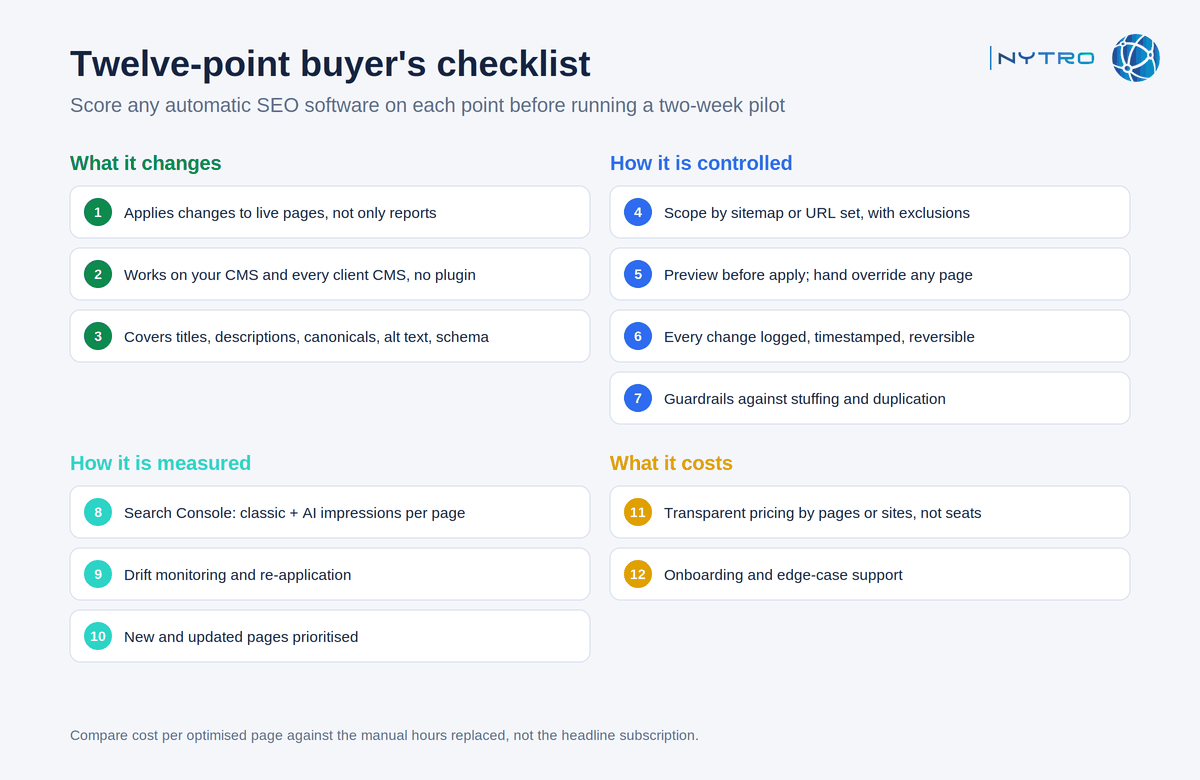
The checklist above groups the twelve criteria; score a candidate on each before running a pilot.
What it changes
- It applies changes to live pages, rather than only reporting them.
- It works on your CMS, and on every CMS your clients use, without a platform-specific plugin.
- It covers titles, descriptions, canonical hints, alt text and structured data, not titles alone.
How it is controlled
- Scope is defined by sitemap or URL set, with exclusions.
- Every rule shows a preview before it is applied, and any page can be overridden by hand.
- Every change is logged with a timestamp and can be rolled back.
- Generated metadata describes the page; the tool has guardrails against stuffing and duplication.
How it is measured
- It connects to Search Console and reports classic and AI impressions per page.
- It monitors for drift and re-applies approved values when a page changes underneath it.
- It prioritises new and updated pages so that fresh content is optimised as it appears.
What it costs
- Pricing is transparent and scales by pages or sites rather than by seat, so agencies can model cost per optimised page; see our pricing plans.
- Support exists for onboarding and edge cases, because every large site has them.
Compare the cost per optimised page against the manual hours the automation replaces rather than against the headline subscription; our cost model for agencies and large sites shows how to build that comparison. Agencies managing many client sites, and owners of large sites, can book a strategy meeting with the NytroSEO team to run the checklist against their own portfolio.
NytroSEO as automated seo software: what it does on your pages
NytroSEO is built for the first side of every criterion above. It applies changes rather than reporting them, on any CMS, through a header snippet, within a sitemap-defined scope, with previews, overrides and a full change log.
Its core capabilities, as they stand today:
- Search-intent metadata: titles and descriptions generated from page content and the queries the page already earns, so that search snippets match what people are looking for and click-through improves.
- Keyword search-query alignment: relevant, impactful terms incorporated into each page’s tags, updated as the query mix changes, without stuffing.
- Adaptive alignment: metadata re-checked against current search guidance when Google’s systems change, so the site is not left carrying tags written for last year’s rules.
- Priority optimisation: newly added and updated pages processed first.
- Dynamic code optimisation: the snippet applies the approved metadata and structured data at load, with processing on NytroSEO’s cloud platform and no server-side installation.
- Scale: unlimited keywords and pages, from small business sites to large corporate and ecommerce catalogues.
- Control: exclude URLs, customise any tag, or choose selective automation from the dashboard.
What it does not do, stated plainly so that the evaluation is honest: it does not fix rendering or server issues, it does not write body content, and it inserts body links only where that is configured. Those remain the work of the people on the account. Our roadmap and updates page lists what has shipped and what is planned, and our client reviews and testimonials show how agencies, developers and site owners use it in practice.
Frequently Asked Questions
Automated SEO software applies on-page optimisation changes such as titles, meta descriptions, canonical hints, alt text and structured data across many pages without manual editing. Unlike audit tools that only report issues, automation platforms deploy the fixes, typically through a JavaScript snippet, plugin, API or edge layer, under rules you approve and can roll back.
Yes when it follows Google’s guidelines: unique, accurate metadata that reflects page content, valid structured data for visible content, no keyword stuffing and no hidden text. Automation that generates descriptive, page-specific tags aligns with Search Essentials; automation that mass-produces manipulative or duplicate content does not, and Google’s spam policies now also cover attempts to manipulate AI answers.
Some platforms, including NytroSEO, deliver changes through a JavaScript header snippet or tag manager, so agencies can optimise client sites on any CMS without logging into it. Changes are scoped by sitemap, previewed before they apply, and can be overridden page by page or rolled back from the change log.
Start with the repetitive, rules-based, high-volume tasks: title and description generation, missing alt text, canonical consistency, structured data from visible fields and drift monitoring. Keep strategy, keyword research, body content, brand voice and relationship work with people, then widen the automated scope as results are measured.
Common models are per-site or per-page tiers, agency bundles covering many client sites, and enterprise agreements for very large catalogues. Compare the cost per optimised page against the manual hours the automation replaces rather than the headline subscription; NytroSEO publishes its plans on its pricing page.
Yes, indirectly and for the same reasons it helps classic search. Google states its AI features use the same core ranking systems and need no special markup, so accurate titles, consistent structured data and stable metadata make pages easier for AI Overviews, AI Mode and third-party assistants to retrieve, extract and cite.
No. It replaces the repetitive on-page layer, which on a large site is most of the hours, and it keeps that layer consistent. Strategy, content, links, site architecture and rendering fixes still need people; the point of automation is to give them the time.
Ready to see automated seo software on your own pages?
Sign up for free and NytroSEO will show you, page by page, the titles, descriptions and structured data it would apply before anything changes. If you run an agency or a large site and want the twelve-point checklist applied to your portfolio, book a strategy meeting with the team.