Last updated: November 4, 2026
Perplexity shows its sources, so being cited is a concrete, winnable goal — but there is a catch most teams miss. Before Perplexity can cite your page, its crawler has to be able to reach it, and a surprising number of sites block that crawler without meaning to, often through a firewall rule they never associated with AI visibility. Perplexity citation optimization is the practice of making sure Perplexity can both reach your content and has a reason to cite it, and it starts with a crawler-access audit that most robots.txt checklists miss entirely.
This guide is tactical. It covers what Perplexity citation optimization is, why crawler access is the first gate, the real difference between PerplexityBot and Perplexity-User, how web application firewall (WAF) and Cloudflare rules can quietly block citations, how freshness and extractable answers win the citation, and what the emerging pay-per-citation era — Perplexity’s Comet Plus program — means for publishers. By the end you should be able to audit your own access in an afternoon.
Lee Agam, CEO of Nytro Systems, sees access as the overlooked half of this work. Teams spend weeks on content and never check whether their firewall, CDN, or bot-management rules are turning Perplexity away at the door — and in his experience that single oversight explains more missing citations than any content gap. His view is that Perplexity citation optimization is two audits stacked: first confirm the crawler can get in, through robots.txt and the WAF alike, then make the page worth citing with clear, current, extractable answers. Get the access right, he notes, and the content work finally has somewhere to land.
What Is Perplexity Citation Optimization?
Perplexity citation optimization is the practice of making your website both reachable by Perplexity’s crawler and worth citing, so Perplexity references your pages as sources in its answers. It has a technical half — crawler access, including robots.txt and firewall configuration — and an editorial half — fresh, extractable content that gives Perplexity a reason to quote you.
The technical half is where the surprises live, which is why this guide leads with it. Perplexity reaches the web through named agents, and whether those agents can actually fetch your pages depends not just on robots.txt but on your CDN, WAF, and bot-management rules. A page can be perfectly written and still never cited because a firewall rule blocks the crawler before it sees a word. The editorial half then decides, among reachable pages, which ones get cited: the clear, current, well-structured answers Perplexity is comfortable displaying.
This makes Perplexity citation optimization a tactical sibling of broader AI Search optimization and Answer Engine Optimization, with a Perplexity-specific access layer. Much of the editorial discipline carries straight over from classic Search Engine Optimization — clear structure, credible sourcing, descriptive metadata — but the access layer is genuinely new, and it is where Perplexity citation optimization most often succeeds or fails before a single word of the page is ever read. The content principles are shared across AI surfaces; what is distinctive here is the combination of named crawlers, published IP ranges, and the firewall question that most SEO audits never touch.
Perplexity Citation Optimization Starts with Crawler Access
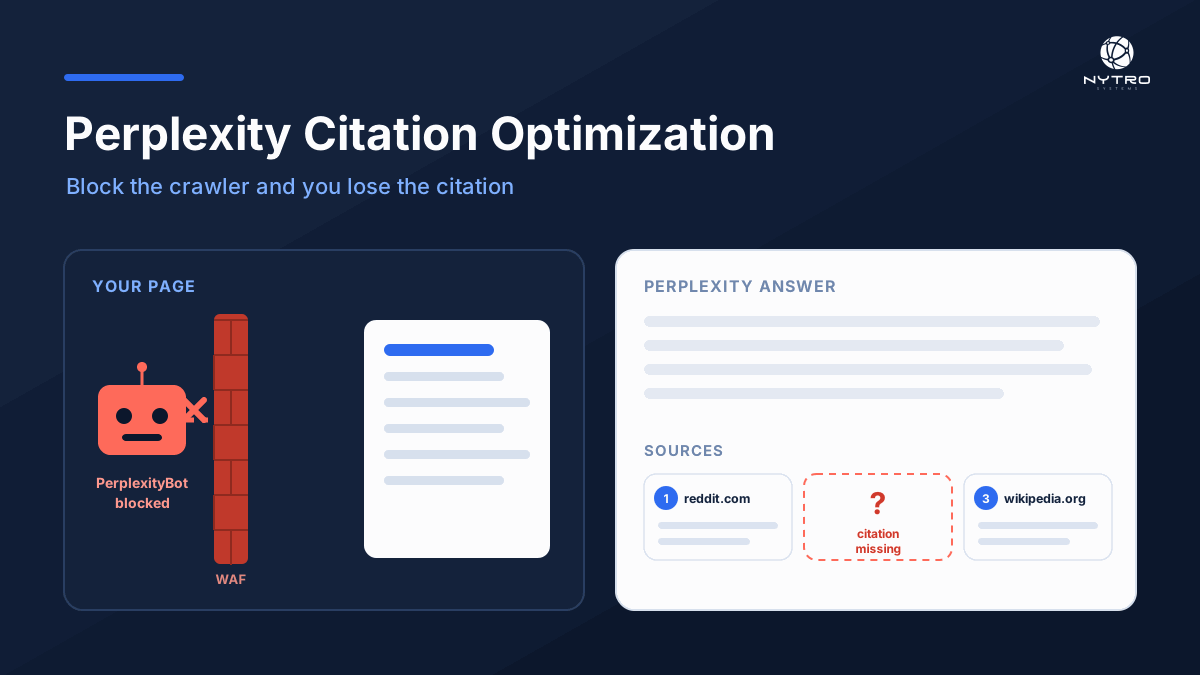
The first step in Perplexity citation optimization is confirming that Perplexity can reach your pages. Perplexity’s crawler documentation is explicit that its search crawler, PerplexityBot, is designed to surface and link websites in Perplexity’s search results, and that allowing it is recommended so your pages can appear. If PerplexityBot is blocked, your content cannot be surfaced or cited in Perplexity’s search answers — the citation slot is simply empty.
Access has two layers, and both matter. The first is robots.txt: make sure PerplexityBot is not disallowed, and add an explicit allowance if you want to be unambiguous. The second, and the one most teams miss, is everything above robots.txt — the CDN, WAF, and bot-management rules that can block a crawler by user agent or IP regardless of what robots.txt says. Perplexity publishes the IP ranges its agents use so you can verify and allow legitimate traffic rather than blocking it by accident. A crawler-access audit checks both layers: the file and the firewall.
This is the uncomfortable truth of Perplexity citation optimization, and of AI Search Ranking generally: reachability is a prerequisite, and reachability now depends on infrastructure that the content and SEO teams often do not control. If you set out to optimize website for AI search on the Perplexity surface while your firewall is quietly turning the crawler away, no amount of content work will produce a citation. Access first, content second.
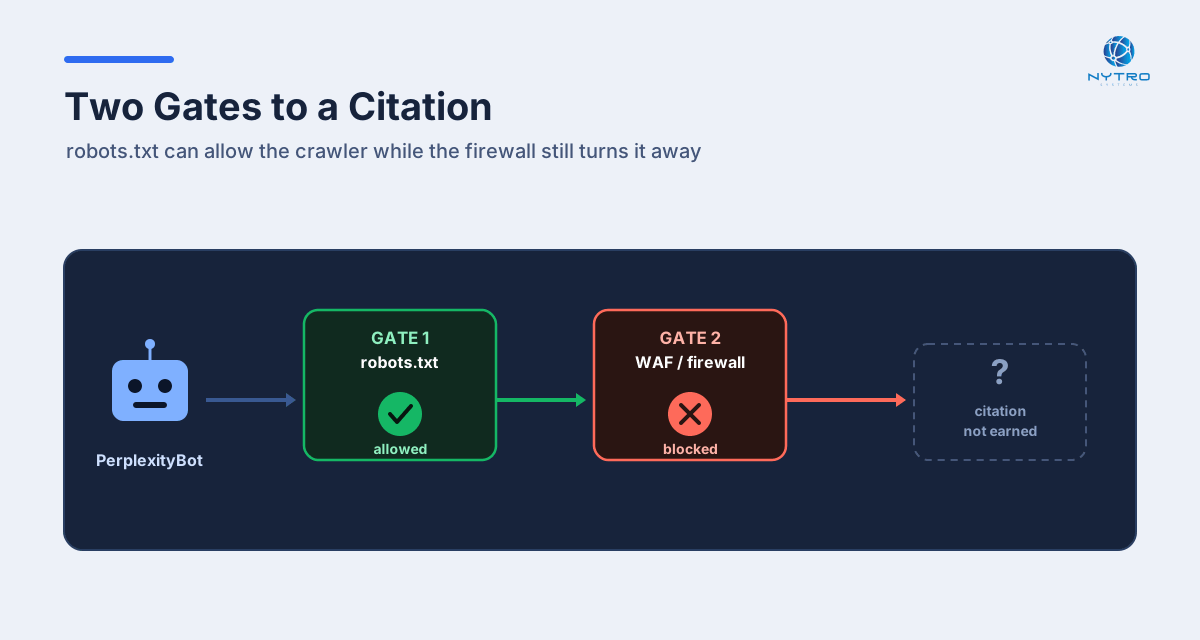
Access has two gates: robots.txt can allow the crawler while the firewall still blocks it — and a blocked crawler means an empty citation.
PerplexityBot vs Perplexity-User
A central source of confusion in Perplexity citation optimization is treating Perplexity’s two agents as one. They do different jobs, and controlling them works differently. Perplexity documents both.
PerplexityBot is the search crawler. Perplexity describes it as designed to surface and link websites in its search results, and says it is not used to crawl content for AI foundation models. It respects robots.txt, its user agent contains “PerplexityBot/1.0,” and Perplexity publishes its IP ranges. This is the agent that governs whether your pages can appear and be cited in Perplexity’s search answers, so for citation optimization it is the one to allow.
Perplexity-User is the user-triggered fetcher. Perplexity says it supports user actions: when someone asks a question that requires visiting a page, Perplexity-User may fetch it and link to it in the response, and it is not used for automatic crawling or training. Its user agent contains “Perplexity-User/1.0,” and Perplexity publishes its IP ranges too. One important nuance: because a real user requested the fetch, Perplexity states that this fetcher generally ignores robots.txt rules, so controlling it is done through user-agent matching, IP-based rules, or WAF configuration rather than robots.txt.
The practical rule for Perplexity citation optimization is to allow PerplexityBot so your content can be indexed and surfaced, and to be deliberate about Perplexity-User at the firewall level rather than assuming robots.txt governs it. Conflating the two — or assuming robots.txt controls everything — is how sites end up blocking the access they actually want.
The WAF and Cloudflare Problem for Perplexity Citation Optimization
No discussion of Perplexity citation optimization is complete without the firewall question, which became unavoidable after a public dispute. In August 2025, Cloudflare accused Perplexity of using stealth, undeclared crawlers to fetch content from sites that had blocked its declared bot — reportedly falling back to a generic browser user agent and rotating IP addresses to evade robots.txt and firewall rules. Cloudflare removed Perplexity from its verified bots list and added signatures to its managed AI-crawler blocking rules, available to all customers. Perplexity publicly disputed Cloudflare’s characterization of its crawling.
Whatever one makes of the dispute, its practical lesson for Perplexity citation optimization is clear: WAF and bot-management rules now actively shape whether AI crawlers can reach your site, and those rules can block the very crawler you want for citations. If you are using Cloudflare or another WAF with AI-bot controls, the default settings may be blocking or challenging PerplexityBot without anyone on the content team realizing it. A publisher who wants Perplexity citations has to make a deliberate choice to allow the legitimate, declared crawler — verifying it against Perplexity’s published IP ranges and user agent — rather than leaving a blanket AI-bot block in place.
This is genuinely new territory, and it cuts both ways: the same controls that protect a site from unwanted scraping can, if left on by default, quietly remove it from Perplexity’s answers. The point of a Perplexity citation optimization access audit is to make that an intentional decision rather than an accidental one.
Freshness and Extractable Answers for Perplexity Citation Optimization
Once access is confirmed, Perplexity citation optimization becomes an editorial problem: giving Perplexity a reason to cite you over the other reachable pages. Two qualities matter most here — freshness and extractability.
Freshness matters because Perplexity is frequently used for current questions, and visibly up-to-date content has an edge on time-sensitive queries. Keep dates and figures current, update guidance as things change, and do not let important pages go stale, because on a recency-sensitive query a fresher competitor will win the citation. Extractability matters because Perplexity composes answers from the content it retrieves, so a page that leads each section with a clear, self-contained answer gives the engine a clean passage to lift and attribute, where a buried or meandering answer sends it elsewhere.
Supporting both is the usual credibility work: claims backed by data and named sources, descriptive titles and meta descriptions, and clear, scannable structure. None of this is Perplexity-specific trickery — it is the discipline of being genuinely citable, applied to an engine that will display the citation. Pair fresh, extractable, credible content with confirmed crawler access and you have both halves of Perplexity citation optimization working together.
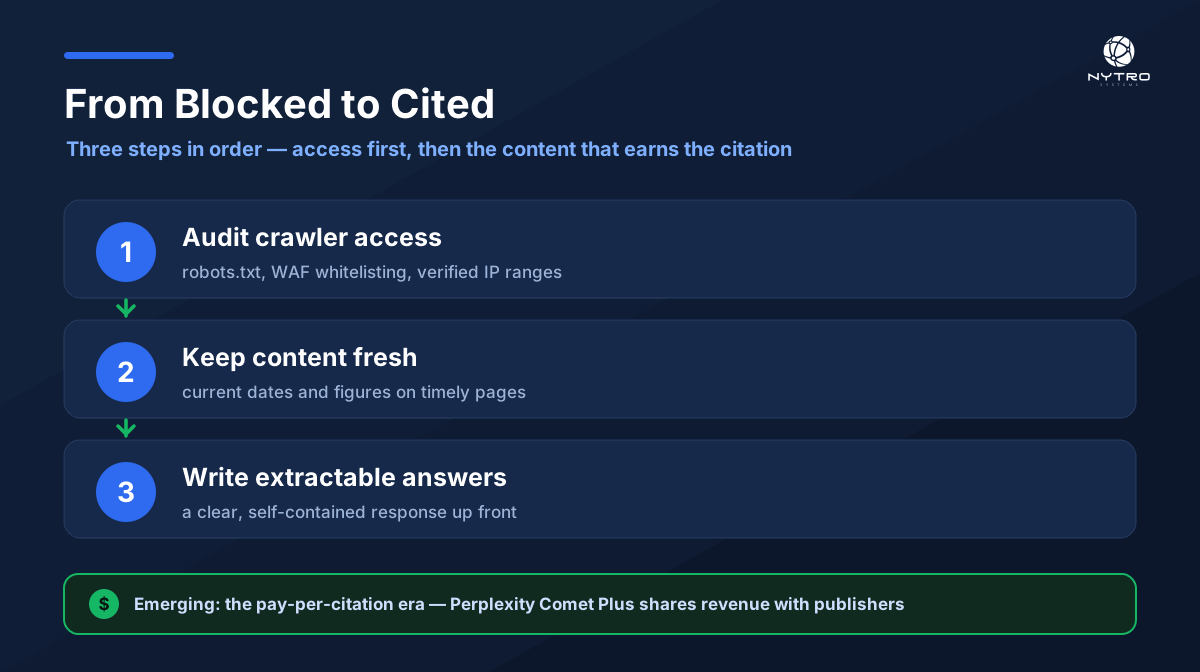
Perplexity citation optimization in order: audit access, keep it fresh, make it extractable.
Perplexity Citation Optimization and the Pay-Per-Citation Era
Perplexity citation optimization is also beginning to intersect with money, which changes the stakes. Perplexity’s Comet Plus program shares revenue with participating publishers: a monthly subscription whose payments go to partners when people read their work and when Perplexity’s systems use that work to answer questions. According to the reporting, publishers are paid for three kinds of activity — human visits, search citations, and agent actions — with a small portion retained to cover compute costs, and interested publishers can request to join by contacting Perplexity.
The significance for Perplexity citation optimization is that a citation is becoming a measurable, and potentially monetizable, outcome rather than a vanity metric. In the classic model, the only way content earned money from search was a click that led to a conversion or an ad impression. In an emerging pay-per-citation model, being used as a source — even inside an answer the user never clicks through — can itself carry value. That raises the return on getting the fundamentals right: access so you can be cited, and quality so you are.
It is early, and the economics will evolve, so treat this as a direction rather than a settled system. But it reinforces the core argument of Perplexity citation optimization: the work of being reachable and genuinely citable is no longer just about visibility — it is increasingly about participating in how answer engines value and compensate the sources they rely on.
A Perplexity Citation Optimization Checklist
Pulling the tactics into a sequence makes them repeatable. Run these in order, because the access steps gate everything after them.
First, audit robots.txt — confirm PerplexityBot is not disallowed, and add an explicit allowance if you want to be unambiguous. Second, audit the firewall — check your CDN, WAF, and bot-management rules (Cloudflare included) to ensure they are not blocking or challenging PerplexityBot, verifying legitimate traffic against Perplexity’s published IP ranges and user agents. Third, decide on Perplexity-User deliberately at the firewall level, since robots.txt generally does not govern it. Fourth, keep content fresh — update dates, figures, and guidance so time-sensitive pages stay competitive. Fifth, make answers extractable — lead each section with a clear, self-contained response. Sixth, support credibility — descriptive titles and descriptions, data and named sources, clear structure. Seventh, monitor by testing your target questions in Perplexity and recording whether and how you are cited. And if the economics fit your business, consider the Comet Plus publisher program as part of your strategy.
Worked in order, this checklist covers both halves of Perplexity citation optimization — access and content — and it front-loads the audits that most often explain a missing citation. The access steps are frequently one-time fixes with outsized impact; the content steps are the ongoing discipline that decides which reachable pages Perplexity actually cites.
Where NytroSEO Fits
Perplexity citation optimization asks a site to stay both reachable and genuinely citable — correct crawler access, fresh content, and clear, extractable answers — across potentially hundreds of pages. The content side, in particular, drifts: titles and descriptions go stale, and inconsistent metadata quietly costs citations even when access is fine.
That is the gap NytroSEO is built to close. Its Automatic SEO engine automatically generates and maintains optimized page titles and meta descriptions across an entire site, so the metadata that answer engines rely on to understand and summarize each page stays consistent and current without manual rework. For the deeper background, our overview of getting AI-search-ready walks through the metadata and structure AI retrieval depends on, our Ask Engine Optimization guide covers the extractable, answer-ready formatting that wins citations, and our LLM SEO strategies guide bridges classic ranking work into AI retrieval.
Want your site reachable and ready to be cited in Perplexity? Sign up free and explore the NytroSEO system, or book a free strategy session.