Last updated: October 20, 2026
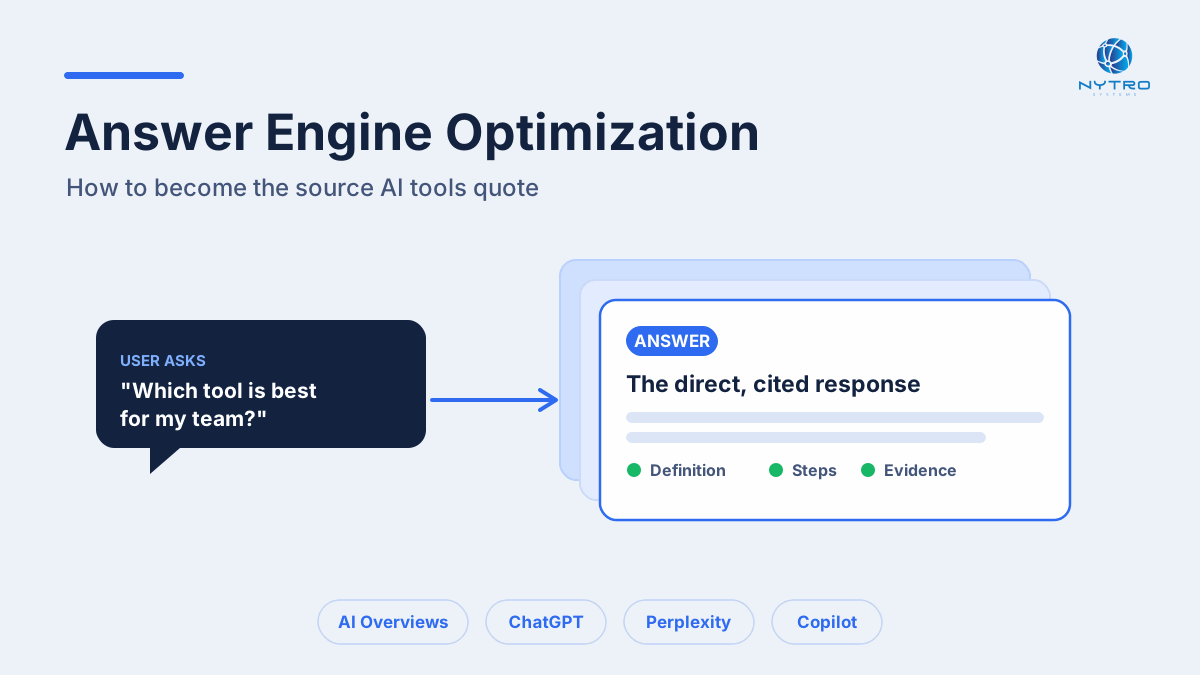
Ask ChatGPT, Google AI Overviews, or Perplexity a question your business can answer, and one of two things happens. Either the tool pulls a clear, well-structured passage from your page and names you as the source, or it reaches for a competitor who formatted the answer more cleanly. Answer Engine Optimization (AEO) is the practice of making sure it is consistently you.
The shift is already measurable. Google now defaults millions of queries to AI-generated answers, ChatGPT and Perplexity field hundreds of millions of questions a week, and a growing share of searches end without a single click to a website. In that environment, the win is no longer a blue link at position one, it is being the passage the answer engine quotes. This guide explains what Answer Engine Optimization is, how it differs from traditional SEO, how answer engines choose their sources, and the specific techniques that make your content the answer rather than a footnote.
Lee Agam, CEO of Nytro Systems, frames the discipline in practical terms: answer engines reward pages that have already done the reader’s thinking for them. A page that states a direct answer in its first two sentences, defines its terms, and backs claims with specific evidence is a page an AI can lift and attribute without rephrasing. His team’s experience across hundreds of client sites is that Answer Engine Optimization is less about chasing a new algorithm and more about structuring every page so the answer is impossible to miss, and that this is exactly the kind of work that pays off when it is applied consistently across a whole site rather than one hero article.
What Is Answer Engine Optimization?
Answer Engine Optimization is the process of structuring and writing content so that answer engines, AI Overviews, ChatGPT, Microsoft Copilot, Perplexity, and Claude, can extract a direct, accurate answer from your page and present it to a user. Where classic search returns a ranked list of links for a person to evaluate, an answer engine synthesizes a single response and, when it works well, cites the sources it drew from. AEO optimizes for that second surface: being selected, extracted, and attributed inside the generated answer.
The core idea is simple. An answer engine does not read your page the way a human browses it. It looks for self-contained units of meaning, a definition, a step list, a comparison, a statistic with a source, that it can reuse with confidence. If those units are buried in long paragraphs, implied rather than stated, or scattered across the page, the engine either skips your content or paraphrases it loosely without credit. If they are clear, labeled, and verifiable, your page becomes the path of least resistance to a good answer.
This is why AEO sits alongside, not against, established search work. You still need to be crawlable, indexed, and relevant. But answer engines add a new requirement on top: the answer has to be formatted before the AI has to work for it. Think of AEO as writing for a reader who has thirty seconds, no patience for preamble, and a habit of quoting you word for word.
Answer Engine Optimization vs Traditional SEO
Traditional SEO and Answer Engine Optimization share a foundation, a page has to be indexable and topically relevant to show up in either world, but they optimize for different moments. Understanding where they diverge keeps you from over-correcting in either direction.
Traditional SEO optimizes for the ranked results page. Its currency is position: title tags, internal links, backlinks, page speed, and keyword relevance that help a page climb toward the top ten. The user still does the final work of clicking, reading, and deciding. Much of AI Search optimization inherits these same fundamentals, because an engine cannot quote a page it never indexed.
Answer Engine Optimization optimizes for the extracted answer. Its currency is clarity and structure: a direct answer up front, defined terms, scannable steps, evidence the engine can verify, and schema that confirms what the page is. The user may never visit your site at all, the value is the citation, the brand mention, and the authority that comes from being the named source.
The practical consequence is that a page can rank well and still lose the answer. If your top-ranked guide buries its definition in the fourth paragraph while a competitor leads with a crisp one-sentence answer, the engine will often quote the competitor. Good AI Search Ranking gets you into the candidate pool; answer-ready structure decides who gets used. The most resilient strategy treats the two as one system: earn the ranking, then format the answer so you win the extraction.
How Answer Engines Choose and Cite Their Sources
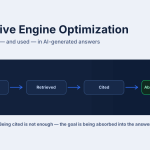
Every major answer engine runs a version of the same pipeline: understand the question, retrieve candidate passages from indexed or crawled content, and generate an answer grounded in the strongest of those passages. This pattern, fetching external text and conditioning the generated answer on it, is what the field calls retrieval-augmented generation, and it is the mechanism that gives your pages a path into the answer. The engines differ in their index and their tolerance for risk, but the selection logic rewards the same traits.
Google’s AI Overviews are grounded in the Search index and lean heavily on content that is already eligible for rich results and featured snippets. If your page is not indexed and snippet-eligible, it cannot appear in an overview at all, the entry ticket is ordinary technical health. Microsoft Copilot draws on the Bing index with a similar emphasis on authoritative, well-structured pages. Perplexity retrieves live from the web and is unusually transparent about citations, which makes clean, quotable passages especially valuable. ChatGPT, when browsing, and Claude both favor sources that state claims plainly and support them with specifics they can safely reproduce.
Across all of them, a few signals consistently raise the odds of being chosen. Pages that answer the exact question in the first sentence or two give the engine a ready-made response. Specific, attributed facts, a number, a date, a named standard, are safer to reuse than vague assertions, because the engine can ground its answer in something concrete. Consistent entity signals, where your brand, products, and positions are described the same way across your site and reinforced with structured data, help the engine trust that it understands who you are. And genuine topical depth, where a single page resolves the main question and the obvious follow-ups, beats a thin page that forces the engine to stitch an answer from several sources.
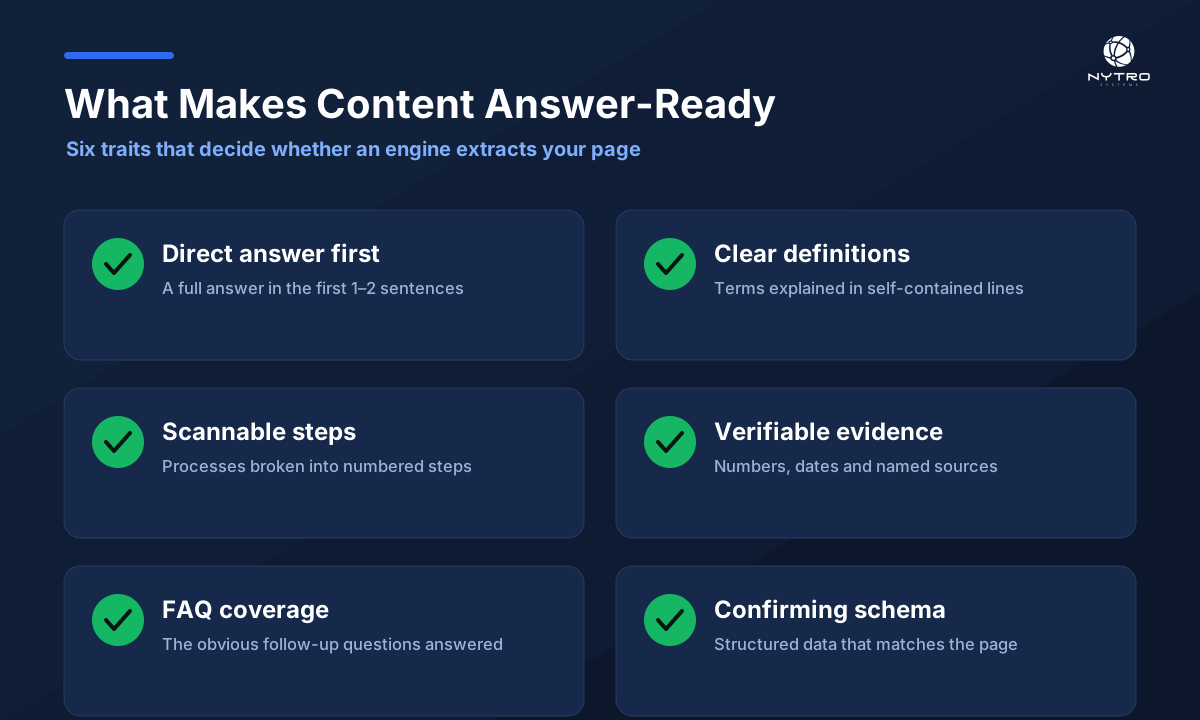
The six answer-ready traits that decide whether an engine extracts your page or skips it.
Answer Engine Optimization Techniques That Make Your Content the Answer
The techniques below turn the selection signals above into editable choices on the page. None of them require new markup languages or special access, they are writing and structure decisions you can apply to existing content today.
Lead with the answer
Put a direct, self-contained answer in the first one or two sentences under each heading, then expand. If the heading asks “What is answer engine optimization?”, the next sentence should define it plainly before any context. This single habit does more for AEO than any other, because it hands the engine a complete response it can quote without editing.
Write headings as the questions people actually ask
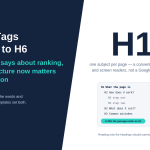
Answer engines match content to questions. Headings phrased as real questions, the kind that appear in “People also ask” and in conversational prompts, let the engine map a user’s query straight to the section that answers it. Use the natural phrasing a person would type or speak, not a compressed keyword string.
Make facts extractable
Break complex material into labeled parts: numbered steps for processes, short definition sentences for terms, and compact tables for comparisons. A three-column table comparing options is far easier for an engine to reuse accurately than the same information described in a paragraph. This is also the safest way to optimize website for AI search without resorting to tricks, because you are simply making real information easier to parse.
Support claims with specific, verifiable evidence
Replace “significantly faster” with a number and a source. Attributed specifics give the engine something concrete to ground its answer in, and they reduce the risk that it will paraphrase you into something you did not say. When you cite a study, a standard, or official documentation, link it, the engine and the reader both benefit.
Cover the follow-up questions on the same page
A question rarely arrives alone. Someone asking what AEO is will next ask how it differs from SEO and how to do it. A page that resolves the main question and the obvious follow-ups in clearly separated sections is the page an engine can lean on for a complete answer, instead of assembling one from several thin sources.
Keep the page crawlable and fast
None of the above matters if the engine cannot read the page. Server-rendered content, clean HTML, reasonable load times, and a crawlable structure are the baseline. If critical content only appears after heavy client-side rendering, assume some engines will miss it.
Structured Data and Schema for Answer Engine Optimization
Structured data does not write your answer for you, but it confirms what your content is so an engine can use it with confidence. For Answer Engine Optimization, a few schema types do most of the work.
FAQPage schema marks up genuine question-and-answer pairs, making each answer a discrete, labeled unit. QAPage, Article, and HowTo schema serve similar roles for their respective formats. Organization and Product schema reinforce your entity signals, helping engines connect a page to a coherent understanding of your brand. The markup should always describe content that actually exists on the page, schema that misrepresents the visible content is a liability, not an advantage, and Google is explicit that structured data must match what users see.
The reference implementations maintained at schema.org and the eligibility rules in Google’s structured data documentation are the authoritative sources for exactly how each type should be formatted. Treat schema as the layer that makes your already-clear content machine-confirmable, not as a substitute for clarity in the words themselves.
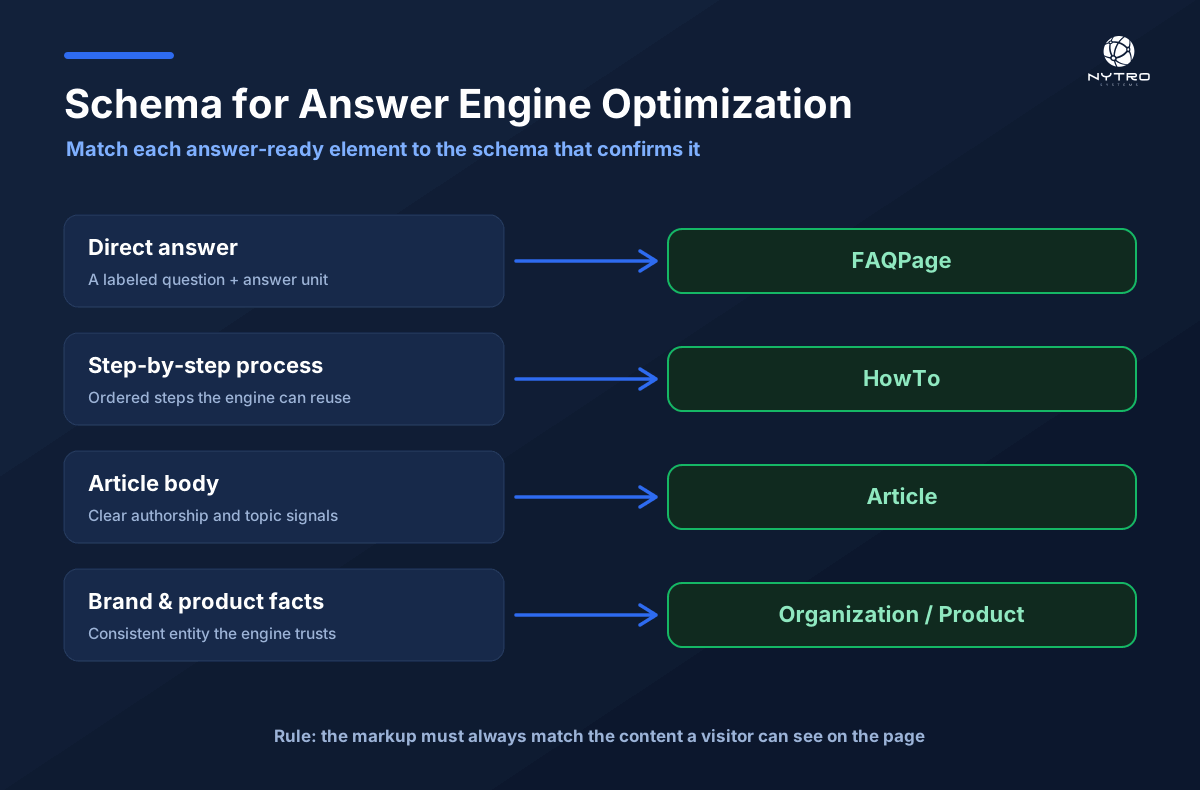
Match each answer-ready element to the schema type that confirms it, and keep the markup honest to the page.
How to Measure Answer Engine Optimization
Measuring AEO is harder than measuring rankings, because the “impression” often happens inside an answer the user never clicks. But it is far from unmeasurable, and a few practical signals tell you whether the work is landing.
Start with citation presence: periodically ask the major answer engines the questions your pages target and record whether you are cited, how you are described, and which passage was used. This manual audit is tedious but revealing, and it is still the most direct read on whether your content is being used. In Google Search Console, watch for impressions on query clusters where AI Overviews appear, a stable or rising impression share with a changing click pattern is often the fingerprint of being surfaced inside an overview rather than a classic result. Referral traffic from Perplexity, ChatGPT, and Copilot, where it shows up in analytics, is a direct signal that a citation converted into a visit. Finally, track brand mentions and branded search: when answer engines name you as a source, branded demand tends to follow.
No single metric captures AEO cleanly, so read them together. A page that holds its Search Console impressions, earns the occasional AI referral, and shows up by name when you test the target question is a page that is working as an answer source, even if its classic click numbers look flat.
Common Answer Engine Optimization Mistakes
Most AEO failures are not exotic. They are ordinary structure and trust problems that keep a perfectly good page out of the answer.
The most common is burying the answer. A page that spends three paragraphs on background before defining its topic forces the engine to work, and the engine will usually pick a source that did not. The fix is to lead with the answer under every heading. A second frequent mistake is writing for keywords instead of questions, so the page never matches the conversational phrasing people actually use. A third is making unverifiable claims, sweeping statements with no number, date, or source, which engines are increasingly reluctant to reproduce. A fourth is schema that overpromises, marking up content that is not really on the page, which erodes the trust that structured data is supposed to build. And a fifth, quieter failure is thin coverage: a page that answers the headline question but none of the follow-ups, leaving the engine to look elsewhere the moment the user digs deeper.
None of these require a rewrite from scratch. Each is a targeted edit, move the answer up, rephrase the heading, add a source, correct the markup, extend the coverage, and together they move a page from “indexed and ignored” to “quoted and attributed.”
Where NytroSEO Fits
Answer Engine Optimization is straightforward on one page and genuinely hard across a few hundred. The on-page traits that answer engines reward, accurate titles and descriptions, answer-ready metadata, consistent entity signals, and valid structured data, have to be present on every page, kept current, and aligned with how people actually ask. Doing that by hand across a large site is where most AEO programs stall.
This is the gap NytroSEO is built to close. Its Automatic SEO engine structures pages as answers at scale, generating and maintaining optimized titles, descriptions, and schema so that every page is answer-ready without manual rework, not just the one article a team had time to polish. For the deeper background on the discipline, our guide to Ask Engine Optimization walks through conversational-question formatting, and our overview of building AI brand visibility covers the entity signals answer engines rely on. Teams moving from traditional ranking work into AI surfaces will also find our LLM SEO strategies guide a useful bridge.
Ready to make every page answer-ready? Sign up free and explore the NytroSEO system, or book a free strategy session to map Answer Engine Optimization to your site.
Frequently Asked Questions
Answer Engine Optimization is the practice of structuring and writing content so that answer engines, such as Google AI Overviews, ChatGPT, Copilot, and Perplexity, can extract a direct, accurate answer from your page and cite it in a generated response. It focuses on being the source an AI uses, not just a link on a results page.
Traditional SEO optimizes for ranking position on a results page, where the user clicks and decides. Answer Engine Optimization optimizes for the extracted answer, where clarity, direct answers, verifiable evidence, and schema decide whether an engine quotes your page. The two share the same technical foundation, a page must be indexed and relevant, but AEO adds answer-ready structure on top.
AEO targets the major AI answer surfaces: Google AI Overviews, Microsoft Copilot, Perplexity, ChatGPT when browsing, and Claude. They differ in their underlying index and citation behavior, but all reward direct answers, extractable facts, and consistent entity signals.
You do not need a new markup language, but relevant structured data helps. FAQPage, HowTo, Article, Organization, and Product schema confirm what your content is so engines can use it confidently. The markup must describe content that actually appears on the page, schema that misrepresents the visible content works against you.
Combine several signals: manually test your target questions in each answer engine and record whether and how you are cited; watch Search Console impressions on query clusters where AI Overviews appear; track referral traffic from Perplexity, ChatGPT, and Copilot; and monitor brand mentions and branded search. No single metric captures AEO, so read them together.