Last updated: October 19, 2026
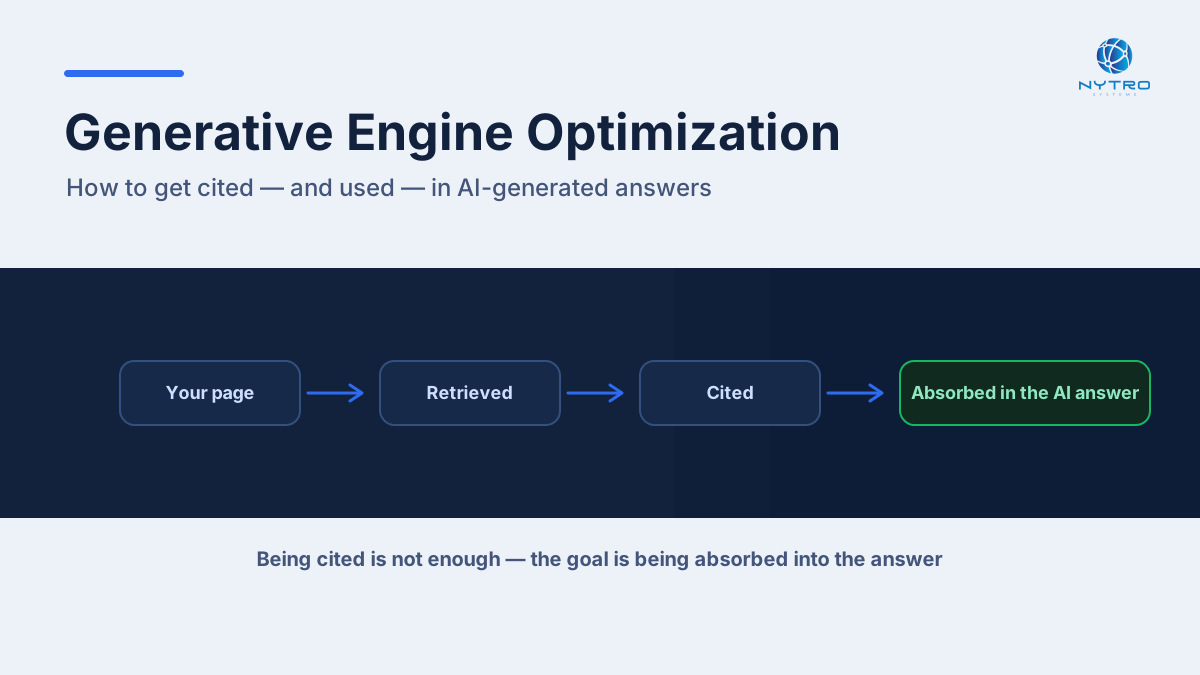
Getting cited by an AI tool feels like a win, your link shows up under the answer. But a citation is only half the story, and often the less valuable half. What actually moves buyers is whether the AI absorbs your content: whether your facts, framing, and recommendation get woven into the generated answer itself, not just listed as a footnote most people never click. Generative Engine Optimization, or GEO, is the practice of structuring your content so generative engines both cite it and use it when they build an answer. It is how a brand goes from “sometimes referenced” to “part of what the AI actually says.”
This is a different game from ranking a page, and it is grounded in real research rather than guesswork. Academic work on GEO, including a Princeton-originated line of research and a 2026 measurement framework that distinguishes citation selection from citation absorption, has shown that generative engines treat sources unevenly: some pages are merely cited, while others are pulled directly into the answer’s substance. GEO is about being in that second group. Done well, it builds on classic SEO, Google itself says optimizing for its AI features “is still SEO”, but it adds a layer focused on how machines read, trust, and reuse your content.
Lee Agam, founder and CEO of NytroSEO, puts the distinction plainly: in his experience across client sites, most brands obsess over whether they appear in an AI answer and never ask the harder question of whether the AI is using their actual expertise or just name-checking them on the way to a competitor’s framing. He argues that generative engine optimization is really about earning absorption, making your definitions, data, and structure so clean and trustworthy that the model reaches for your content as raw material for its answer. The brands that win, Lee Agam notes, are not the loudest; they are the clearest and the most consistently structured across every page, which is exactly what makes GEO a systems problem rather than a one-page trick.
What Is Generative Engine Optimization (GEO)?
Generative Engine Optimization is the process of optimizing content to be retrieved, cited, and absorbed by generative AI systems, ChatGPT, Google’s AI Mode and AI Overviews, Perplexity, Gemini, and Copilot, when they generate answers to user questions. Where traditional SEO aims to rank a page in a list, GEO aims to make a page part of the synthesized response.
The core idea, formalized in recent measurement research, is that there are two distinct outcomes. Citation selection is whether an engine chooses to reference your page at all. Citation absorption is how much of your content the engine actually incorporates into the answer, your phrasing, your statistics, your definition. The arXiv measurement framework on citation selection and absorption exists precisely because those two things diverge: a page can be cited without being used, and occasionally used without a prominent citation. Generative AI Optimization, as a discipline, targets both, but absorption is where influence over the final answer lives, because that is the text the user reads.
Generative Engine Optimization vs Traditional SEO
The GEO vs traditional SEO comparison is not a replacement story; it is a layering story. Traditional SEO gets you indexed, crawlable, and ranked, and that foundation still matters, because most generative engines, including Google’s AI features, draw candidate sources from the search index. If you are not eligible in classic search, you are usually not a candidate for the AI answer either.
What GEO adds is a focus on the properties that make content usable by a language model after it has been retrieved. Traditional SEO asks “will this page rank for this keyword?” GEO asks “if a model retrieves this page, will it trust and reuse this passage in its answer?” That shifts the emphasis from keyword targeting and link-based authority toward extractable structure, factual density, clear entities, and evidence a model can lift with confidence. The two share a foundation, which is why Google frames AI optimization as still being SEO, as documented in its guidance on AI features in Search, but the GEO layer is what determines whether you are used, not just ranked.
How Generative Engines Choose and Absorb Sources
To do generative engine optimization well, you have to understand the pipeline. When a user asks a generative engine a question, the system retrieves a set of candidate sources, evaluates them, and synthesizes an answer that may quote, paraphrase, or combine them. Three things decide whether your content makes it into that answer.
First, retrievability: the engine has to be able to find and read your page, which means crawlable, rendered, server-delivered content, not answers hidden behind client-side JavaScript that non-rendering AI crawlers never execute. Second, relevance and clarity: the engine favors passages that directly and unambiguously answer the sub-question it is working on, which is why a clean, self-contained answer beats a meandering one. Third, trust signals: evidence, specificity, consistent entities, and structured data all raise the odds that a model treats your content as reliable enough to absorb rather than skip. The practical takeaway from how generative engines work, and from the broader GEO literature catalogued on Wikipedia, is that absorption is earned by clarity and credibility, not by volume or keyword density.
A concrete example makes the difference obvious. Imagine two pages competing to answer “what is a good SaaS churn rate?” The first says churn “varies and depends on many factors” and buries the number in a long paragraph. The second opens with “A healthy annual SaaS churn rate is typically 5–7% for established B2B companies,” cites its source, and follows with a short table by company stage. A generative engine working that sub-question has almost nothing liftable from the first page and a clean, attributable statement from the second, so it absorbs the second page’s figure into the answer and may not even surface the first. Nothing about the first page’s underlying knowledge was wrong; it simply was not structured to be used. That gap between “knows the answer” and “is structured to be used” is the entire operating space of GEO.
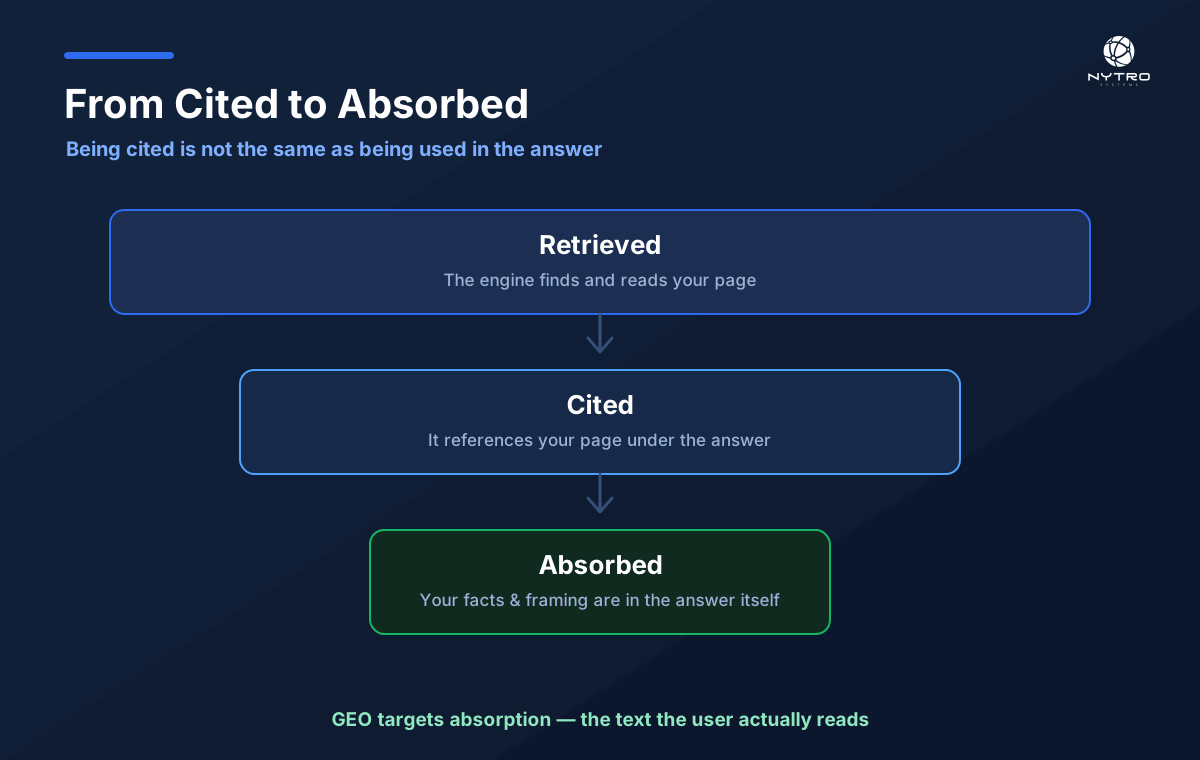
From cited to absorbed: GEO targets the text that ends up in the answer.
Generative Engine Optimization Best Practices
A handful of generative engine optimization best practices consistently improve both citation and absorption. None of them are tricks; they make genuinely authoritative content easier for a model to trust and reuse.
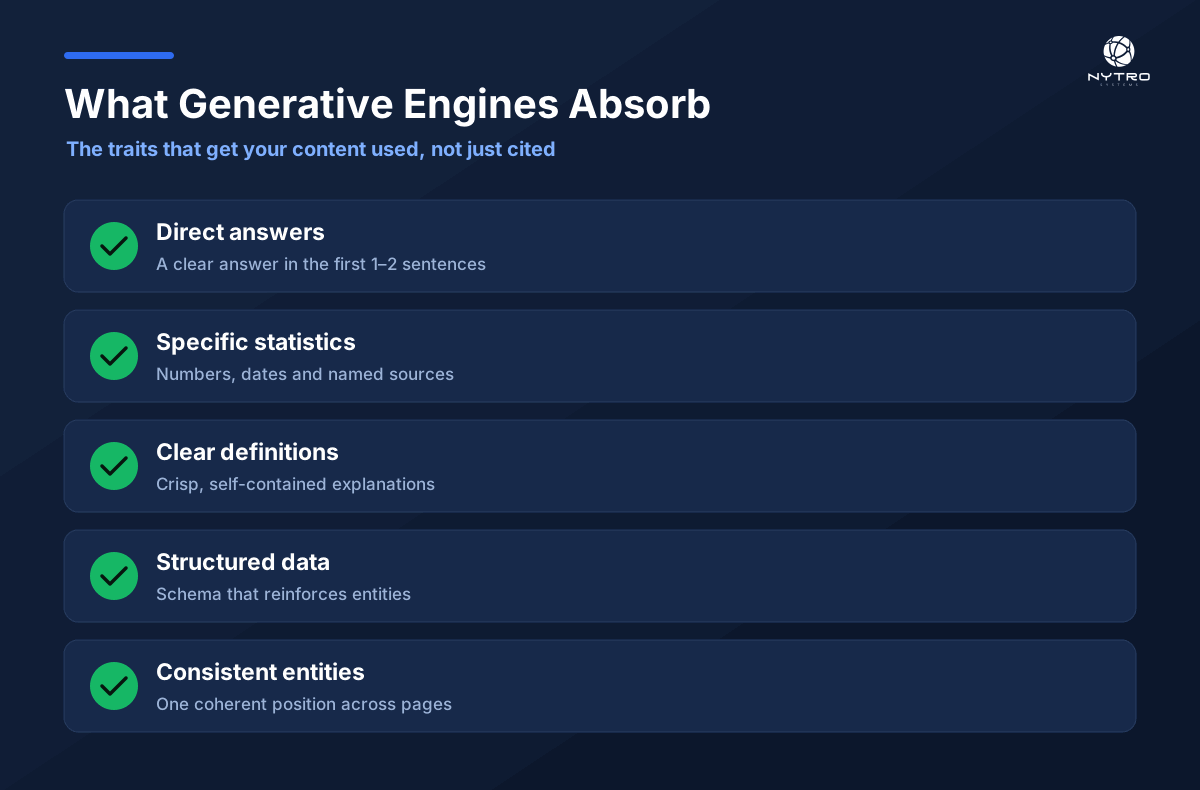
The traits that get your content used, not just cited.
Lead with direct, self-contained answers. State the answer in the first sentence or two under each question, in roughly 40 to 60 words, before the context. Models lift the clearest nearby statement, so put it where it can be found.
Add quotable evidence. Specific statistics, named sources, dates, and crisp definitions are far more likely to be absorbed than vague claims, because they give the model something concrete and attributable to carry into the answer.
Structure for extraction. Use question-shaped headings, short paragraphs, lists, and comparison tables so each fact sits in a clean, liftable unit rather than buried in prose.
Reinforce entities and authority. State clearly who you are and how key concepts relate, and back it with structured data (Organization, Article, FAQ, Product). Strong entity signals help a model trust and correctly attribute your content, a cornerstone of optimizing websites for generative search.
Keep content fresh and consistent. Generative answers lean toward current, internally consistent sources, so accurate dates and a coherent position across your pages help you get and stay absorbed. These practices are the substance behind effective llm optimization, and they compound when applied consistently across a whole site rather than a single page. For the technical groundwork, our guide to getting AI-search-ready with optimized meta tags and structured data covers the metadata layer in depth.
GEO Across Platforms: ChatGPT, Perplexity, and Google AI Mode
Generative engines are not identical, and part of GEO is understanding where they differ. Perplexity leans heavily on live retrieval and tends to cite sources prominently, which rewards clean, directly quotable pages. ChatGPT blends retrieval with its trained knowledge and can absorb content heavily into its phrasing when a source is clear and authoritative. Google’s AI Mode and AI Overviews draw from the Search index and favor pages that are both index-eligible and well-structured, tightly coupling GEO to classic technical SEO.
The common thread across all of them is that structure, evidence, and entity trust travel well, a page optimized along those lines performs across engines rather than for just one. That is why we treat GEO as a durable discipline rather than a per-platform hack, and why building lasting AI brand visibility matters more than chasing any single tool’s quirks. The platforms will keep changing; clarity and credibility keep paying off.
There is a practical consequence to this cross-platform reality: you should not build separate content for each engine. Teams that try to write one version for ChatGPT and another for Perplexity usually end up with thin, duplicated pages that underperform everywhere. The better move is to make a single authoritative page as clear, evidence-rich, and well-structured as possible, then verify how each engine actually treats it for your priority questions and adjust the source once. One strong page, optimized along GEO lines, is far more durable than a scatter of platform-specific variants, and far easier to keep accurate as the underlying facts change.
How to Measure Generative Engine Optimization
You cannot manage generative engine optimization with a rank tracker alone, because the outcome you want, being used in an answer, is not a position. The measurement research is explicit about this: you have to distinguish being cited from being absorbed, and track both.
A workable measurement approach has three layers. Track citation share: for your priority questions, how often do AI tools reference your pages, and which pages do they pull from? Track absorption qualitatively: when you are cited, is your framing, data, or definition actually in the answer, or are you a footnote while a competitor’s language dominates? And track the downstream signal: because many AI interactions end without a click, lean on branded search lift, assisted conversions, and direct traffic as proxies for the influence you are building. Measured this way, GEO becomes a visibility-and-trust metric, our broader work on LLM SEO for AI search expands on how to operationalize it.
A simple monthly cadence keeps this honest: choose ten questions that matter to your business, run each one across the major generative engines, and record three things, whether you are cited, whether your specific framing or data appears in the answer, and how the answer positions you relative to competitors. That qualitative log surfaces absorption gaps long before any traffic metric would, and it tells you exactly which pages to sharpen next. Over a few months it becomes the most useful GEO dashboard you have, because it measures the thing you actually care about: what the AI says about you.
Automating Generative Engine Optimization at Scale
Optimizing one flagship page for GEO is manageable. Making every page on a large site consistently extractable, evidence-rich, and entity-clear, and keeping it that way as the site changes, is where teams stall. This is where NytroSEO fits. Its Automatic SEO engine aligns the machine-readable traits that GEO research links to citation absorption, metadata freshness, structured data, and semantic tagging, across an entire site from a single JavaScript snippet in the header, so the signals that help models trust and reuse your content are applied everywhere, not just where someone remembered to add them. You can see how the engine works on the Automatic SEO software page.
An honest scope note belongs here, because GEO is bigger than any one tool. NytroSEO automates the metadata and structured-data layer that makes content trustworthy and extractable to generative engines; it does not write your evidence or manufacture the expertise a model is looking for, and it works best on content that is already server-rendered so AI systems can read it. Think of automation as what makes GEO repeatable: it turns a one-page experiment into a sitewide standard, which is the difference between an occasional citation and durable presence in AI answers.
The Bottom Line on Generative Engine Optimization
Generative Engine Optimization is SEO re-pointed at a harder, more valuable target: not just appearing near the answer, but being absorbed into it. Build on solid technical SEO so you are retrievable, then earn absorption with direct answers, quotable evidence, extractable structure, strong entities, and consistency, and measure success as citation and absorption, not rank. Apply it across your whole site rather than one page, and your content becomes the raw material generative engines reach for, which is the visibility that actually shapes what buyers hear.
Ready to make your site absorbable at scale? Sign up free and explore the NytroSEO system, or book a free strategy session to map generative engine optimization to your pages.
Frequently Asked Questions
Generative Engine Optimization (GEO) is the practice of structuring content so generative AI systems, like ChatGPT, Google’s AI Mode, Perplexity, and Gemini, retrieve, cite, and absorb it when they build answers. It goes beyond ranking a page to making your content part of the synthesized response. GEO builds on classic SEO fundamentals such as indexing and clean metadata rather than replacing them.
Traditional SEO optimizes a page to rank in a list of links for a keyword. GEO optimizes a page to be trusted and reused inside an AI-generated answer. They share a foundation, your page must be crawlable and index-eligible, but GEO adds a focus on extractable structure, quotable evidence, and entity trust that determine whether a model absorbs your content, not just whether it ranks.
Citation selection is whether a generative engine chooses to reference your page at all. Citation absorption is how much of your content, your phrasing, statistics, or definition, the engine actually incorporates into the answer. A page can be cited without being used, so GEO targets both, with absorption mattering most because it is the text the user actually reads.
Lead with direct, self-contained answers; add quotable evidence like specific statistics and clear definitions; structure content with question-shaped headings, lists, and tables; reinforce entities with structured data; and keep content fresh and consistent. Keep everything crawlable and server-rendered so AI systems can read it. These practices improve both whether you are cited and whether you are absorbed.
Measure citation share, how often AI tools reference your pages for your priority questions, and absorption, meaning whether your framing and data actually appear in the answer rather than a competitor’s. Because many AI searches end without a click, also track branded search lift, assisted conversions, and direct traffic as proxies for the influence GEO builds.