Last updated: October 18, 2026
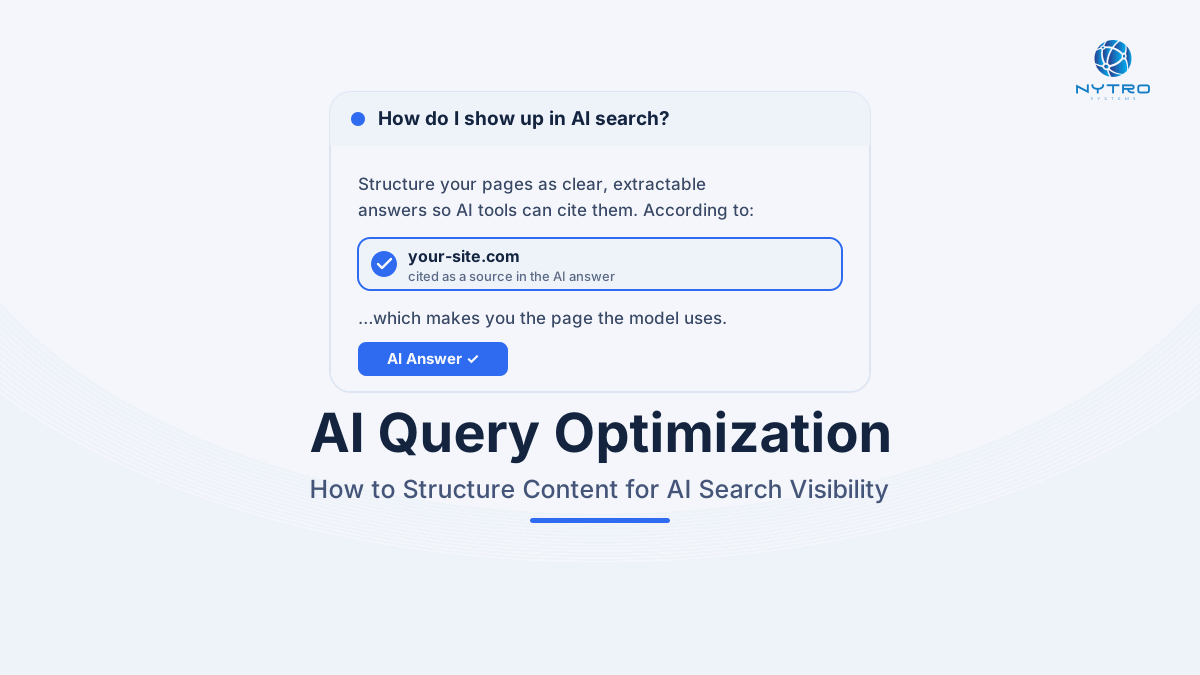
People do not search the way they did three years ago. Instead of typing “best crm small business,” they ask ChatGPT, Gemini, Google’s AI Mode, and Perplexity a full question, “what’s the best CRM for a 10-person services business that already uses Google Workspace?”, and they expect one synthesized answer, not ten blue links. AI query optimization is the practice of structuring your content for how people actually ask AI systems and for how those systems break a question apart, retrieve sources, and assemble an answer. Get it right and your pages become the material the answer is built from. Get it wrong and you are invisible in the exact moment a buyer is deciding.
This matters now because the surface has shifted under everyone’s feet. Google made AI Mode its default experience in 2026, AI Overviews appear on a large and growing share of searches, and a majority of searches now end without a click to any website. Keyword-only SEO was built for a world of ranked links; AI query optimization is built for a world where a model reads your page, decides whether it is clear and trustworthy, and either uses it or moves on. The two are not opposites, Google itself has said optimizing for its AI features “is still SEO”, but the emphasis has changed from ranking a page to being the source an answer cites.
Lee Agam, founder and CEO of NytroSEO, has spent the last two years watching this shift play out across hundreds of client sites, and his take is blunt: most pages that fail in AI search do not fail on content quality, they fail on structure. A model cannot cite what it cannot cleanly parse. When a page buries its answer three scrolls down, wraps key facts in vague marketing language, and signals its topic only through styling rather than real headings and structured data, the AI skips it for a competitor that stated the answer plainly in the first sentence under a clear question. Lee Agam frames AI query optimization as “making your expertise machine-extractable”, the same substance you already have, organized so a model can lift the right passage under the right question without guessing.
What Is AI Query Optimization?
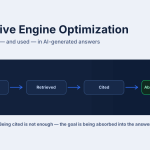
AI query optimization is the process of aligning your content with two things at once: the natural-language questions people ask AI tools, and the way AI systems decompose and answer those questions. Traditional SEO optimized a page for a short keyword string and a ranking position. AI query optimization optimizes a page to be retrieved and used inside a generated answer, which is a different target with different rules.
The practical difference comes down to three shifts. First, from keywords to questions: people phrase AI queries conversationally and specifically, so your content has to match intent and phrasing, not just a head term. Second, from pages to passages: AI systems extract and synthesize specific passages, so the unit that wins is a clear, self-contained answer block, not a whole document. Third, from ranking to citation: success is measured by whether the model uses and attributes your content, not only by where you sit in a list of links. None of this throws away classic SEO fundamentals, indexing, crawlability, and clean metadata are still the entry ticket, but it layers a new discipline on top of them.
Why AI Query Optimization Matters Now
The timing is not academic. Google’s AI Mode moved from experiment to the default search experience in 2026, a shift the company laid out at its I/O developer keynote, which means the generative answer is no longer a box at the top of the results, increasingly, it is the result. For publishers and brands, that reframes the whole goal: you are no longer only trying to rank above a competitor, you are trying to be one of the handful of sources the model trusts enough to build its answer from. Independent trackers reported AI Overviews appearing on roughly 43% of searches by mid-2026 (third-party estimate, figures vary by dataset and query mix), and multiple analyses put the share of searches that end without any click to a website around 60%. When the answer is delivered on the results surface itself, the only way to earn visibility is to be inside that answer.
This is why AI search optimization has become a board-level concern rather than a technical footnote. A brand can hold strong traditional rankings and still be absent from the AI answers its customers now rely on, because the model chooses sources on criteria that ranking alone does not guarantee: clarity, structure, evidence, and entity trust. The uncomfortable corollary is that visibility and traffic have partly decoupled, you can gain influence over what AI tells buyers while your raw click numbers fall, which is exactly why measurement has to change too. The brands adapting fastest treat AI query optimization as the way they protect demand that classic SEO can no longer fully capture.
How AI Query Optimization Works: Query Fan-Out and Sub-Queries
To optimize for AI query optimization, you have to understand what the system does with a question. When someone submits a prompt to Google’s AI Mode, the system does not run one search, it performs what Google calls query fan-out, issuing many related sub-queries across the question’s facets simultaneously, then synthesizing the results into one answer. A single prompt like “how do I make my Shopify store show up in AI search” can silently spawn sub-queries about Shopify technical SEO, structured data, AI crawlers, content structure, and more.
That mechanic changes what a well-optimized page looks like. Your page is no longer competing only for the headline question; it is competing for every hidden sub-question the model generates on the way to its answer. The winning response is a single, genuinely deep page that answers the main question and the predictable sub-questions around it, definitions, comparisons, steps, caveats, and evidence, rather than fifty thin pages each targeting one variation, an approach Google treats as scaled content abuse. Search Engine Land’s guide to query fan-out and Google’s own documentation on AI features in Search both point to the same conclusion: anticipate the sub-queries and cover them in one coherent, well-structured resource.
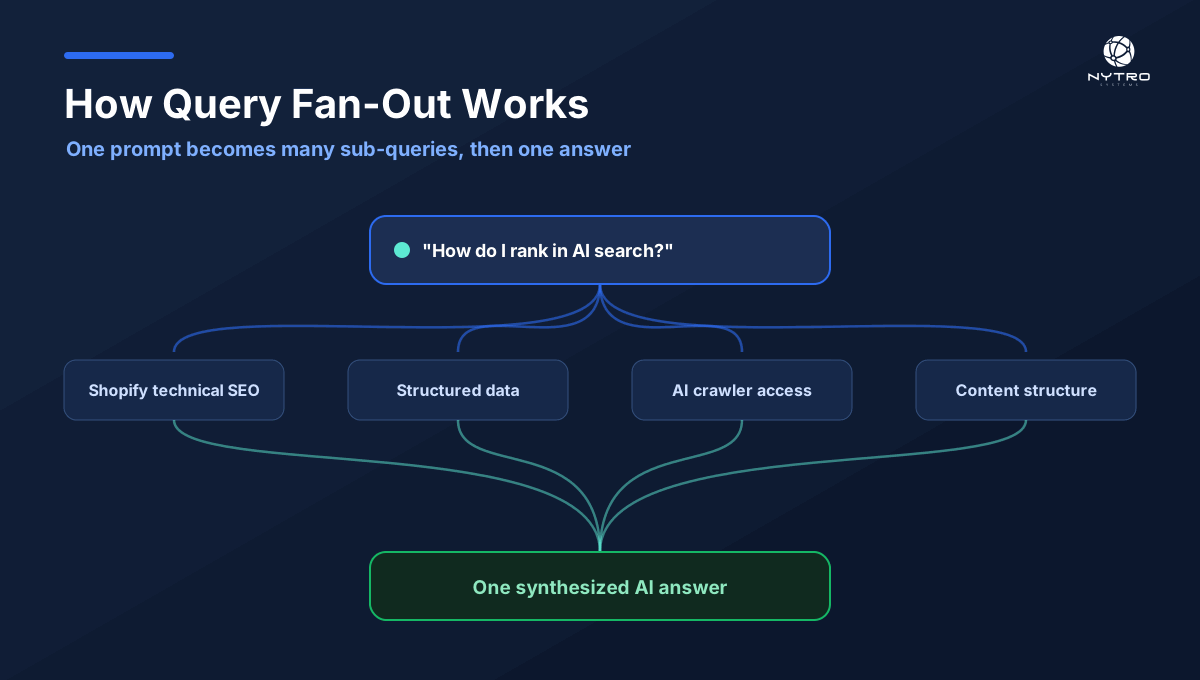
Query fan-out: one prompt becomes many sub-queries, so one deep, well-structured page wins.
AI Query Optimization Techniques: How to Structure Content
The heart of the discipline is structure, and a handful of AI search optimization techniques do most of the work. None of them require gaming anything, they make genuinely useful content legible to a machine, and each one maps to a decision the model is already making when it assembles an answer.
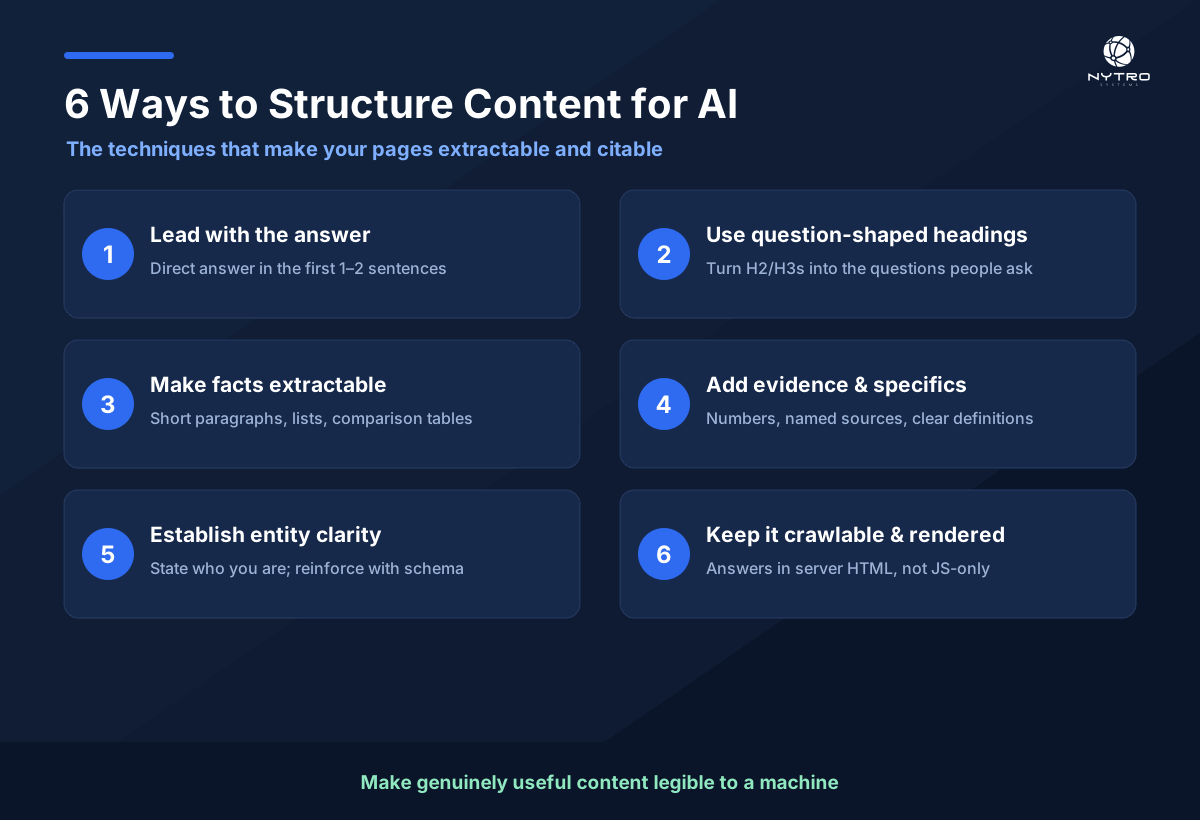
The six AI query optimization techniques that make a page extractable and citable.
Lead with the answer. Put a direct, self-contained answer in the first one or two sentences under each question, before the context and nuance. Models extract the clearest nearby answer to a question, and a 40-to-60-word definition near the top is far easier to lift than a conclusion buried at the bottom.
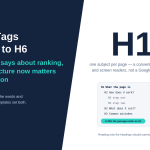
Use question-shaped headings. Turn H2s and H3s into the actual questions people ask, then answer each one immediately beneath it. This maps your page directly onto the sub-queries a fan-out produces and tells the model exactly what each section resolves.
Make facts extractable. Use short paragraphs, descriptive lists, and comparison tables for anything structured, specs, steps, pros and cons, pricing tiers. A table of options is dramatically easier for a model to quote accurately than the same information trapped in a long paragraph.
Add evidence and specificity. Concrete numbers, named sources, dates, and clear definitions signal reliability. Vague claims (“improves performance”) get skipped; specific, sourced statements (“reduced average response time by 30%, per the vendor’s 2026 benchmark”) get used.
Establish entity clarity. State plainly who you are, what you do, and how key concepts relate, and reinforce it with structured data (Organization, Article, FAQ, Product where relevant). Clear entities help models trust and correctly attribute your content, which is the foundation of conversational search SEO best practices.
Keep the content reachable. An AI cannot use what it cannot render. Make sure your answer lives in the server-delivered HTML, not only in client-side JavaScript that non-rendering AI crawlers never execute, a point we cover in depth in our guide to getting AI-search-ready with optimized meta tags and structured data.
AI Query Optimization for Google AI Overviews and AI Mode
Google AI Overviews and AI Mode are the highest-stakes surfaces for most sites, and they reward the structure above with one addition: they still run on the Search index. If a page is not crawlable, indexable, and snippet-eligible, it cannot appear in an AI Overview or AI Mode answer at all, because those features draw from the same index as classic results. That makes technical hygiene the non-negotiable base layer of AI query optimization, not an afterthought.
Beyond eligibility, optimizing for Google AI Overviews means earning the citation. In practice that comes from matching the specific intent of the question, providing the cleanest extractable answer among the candidates, and backing it with evidence and entity signals the model can verify. Our explainer on what AI brand visibility is and how to optimize for AI Overviews walks through how these signals compound, and the broader strategy sits inside LLM SEO for ranking in AI search. The throughline: AI Mode did not kill SEO, it raised the bar for clarity and made structure the deciding factor.
How to Measure AI Query Optimization and AI Search Ranking
You cannot manage AI query optimization with a traditional rank tracker alone, because the thing you are trying to win, being used in an answer, is not a blue-link position. AI search ranking in the generative era is better understood as citation share: how often your brand or page is cited, mentioned, or absorbed across AI answers for the questions that matter to you.
A practical measurement stack has three layers. Track citations and mentions: monitor whether AI tools reference your content for your priority prompts, and which pages they pull from. Track eligibility and coverage: use Search Console to confirm the pages you care about are indexed and appearing, and watch for the crawl and rendering issues that quietly remove you from candidacy. And track the business signal underneath: because many AI interactions end without a click, lean on assisted conversions, branded search lift, and direct traffic as proxies for influence you can no longer read from clicks alone. The goal is to see AI query optimization as a visibility-and-trust metric, not only a traffic metric, a theme we expand in our wider work on AI search visibility and measurement.
Automating AI Query Optimization at Scale
Doing all of this by hand on one page is straightforward. Doing it consistently across hundreds or thousands of pages, and keeping it correct as the site changes, is where teams fall behind. This is the problem NytroSEO was built to solve. Its Automatic SEO engine aligns the machine-readable layer of AI query optimization, titles, meta descriptions, canonical tags, and structured data, with conversational intent across an entire site from a single JavaScript snippet in the header, so every page ships answer-ready without manual rework on each one. You can see how the engine works on the Automatic SEO software page.
An honest scope note matters here, because AI query optimization is broader than any one tool. NytroSEO automates the metadata and structured-data layer that makes pages extractable and trustworthy to AI systems; it does not write your body content or invent expertise you do not have, and it works best on sites whose content is server-rendered so AI crawlers can actually read it. Think of automation as the force multiplier on top of genuinely useful, well-structured writing, it makes the discipline repeatable across a whole site instead of a one-page experiment, which is the difference between a lucky citation and durable AI search visibility.
The Bottom Line on AI Query Optimization
AI query optimization is not a reinvention of SEO; it is SEO re-pointed at a new target. Structure your content around the questions people actually ask AI, answer the hidden sub-queries a fan-out generates, lead with extractable answers, back them with evidence and clean entity signals, keep everything crawlable and rendered, and measure success as citation and visibility rather than clicks alone. Do that consistently, and your pages become the source AI tools reach for, which, in a search world that increasingly answers before it links, is the visibility that actually compounds.
Ready to make your site answer-ready at scale? Sign up free and explore the NytroSEO system, or book a free strategy session to map AI query optimization to your pages.
Frequently Asked Questions
AI query optimization is the practice of structuring your content for how people ask AI tools questions and for how those tools decompose and answer them. It aligns your pages with conversational, specific prompts and with AI retrieval, so your content is extracted and cited inside AI-generated answers. It builds on classic SEO fundamentals, indexing, crawlability, clean metadata, rather than replacing them.
Traditional SEO optimizes a page for a keyword and a ranking position in a list of links. AI query optimization optimizes a page to be retrieved and used inside a synthesized answer. The shifts are from keywords to questions, from whole pages to extractable passages, and from ranking to citation. The technical foundations overlap, but the target and the measurement change.
Query fan-out is Google’s technique of taking one prompt in AI Mode and issuing many related sub-queries across the question’s facets at once, then synthesizing the results into a single answer. For content, it means your page competes for the hidden sub-questions too, so one deep, well-structured resource that answers the main question and its sub-questions outperforms many thin pages.
Start with eligibility: AI Overviews draw from Google’s index, so your pages must be crawlable, indexable, and snippet-eligible. Then earn the citation by matching the question’s intent, leading with a clear extractable answer, using question-shaped headings, supporting claims with evidence, and reinforcing entity trust with structured data. Clean, server-rendered HTML is essential so AI systems can read the content.
Measure citation share, how often AI tools cite, mention, or use your content for your priority questions, alongside index coverage and eligibility in Search Console. Because many AI searches end without a click, track assisted conversions, branded search lift, and direct traffic as proxies for influence. AI search ranking in the generative era is about being used in answers, not only holding a link position.