Last updated: October 21, 2026
Three acronyms, one confused industry. GEO vs AEO vs SEO is the debate every content team has walked into over the past year: is Generative Engine Optimization a new discipline, is Answer Engine Optimization replacing search engine optimization, and do you now need three strategies where you used to have one? The short answer is calmer than the marketing around it suggests. These are three lenses on the same goal, being found and used when people look for what you offer, and they share far more foundation than the acronym wars imply.
This guide cuts through the terminology. It defines each term plainly, maps where GEO vs AEO vs SEO genuinely diverge and where they are the same work under different names, explains Google’s own position that AI optimization “is still SEO,” and gives you a practical way to decide what to actually prioritize. The aim is to leave you able to plan content without buying three separate playbooks for what is largely one job.
Lee Agam, CEO of Nytro Systems, is blunt about the framing: the GEO vs AEO vs SEO distinction is useful for describing where your content shows up, but dangerous if it convinces teams they need to rebuild everything three times. In his experience across hundreds of client sites, the pages that win in AI answers are overwhelmingly the pages that already had solid search fundamentals, they were indexed, structured, and clearly written, and the “new” acronyms mostly describe adding answer-ready structure on top of that base. His position is that the shared foundation, not the labels, is where teams should spend their effort, and that automating that foundation is what makes it realistic to do across a whole site instead of one showcase page.
What GEO vs AEO vs SEO Really Means
Before comparing them, each term needs a clean definition, because much of the confusion comes from people using the same words to mean different things.
Search Engine Optimization is the established practice of making a page discoverable and competitive in a search engine’s ranked results. It covers the fundamentals: crawlability and indexing, relevant content, title and description metadata, internal and external links, page speed, and the authority signals that help a page climb the results. The user still clicks a link and reads the page.
Answer Engine Optimization is the practice of structuring content so an answer engine, AI Overviews, ChatGPT, Perplexity, Copilot, can extract a direct, accurate answer and present it, ideally with a citation. AEO optimizes for being the quoted passage: a clear answer up front, defined terms, scannable steps, and schema that confirms what the page is.
Generative Engine Optimization is the practice of making your content likely to be retrieved, trusted, and reused inside a generated AI response. GEO overlaps heavily with AEO but leans toward the generative surfaces specifically, emphasizing extractable evidence, entity clarity, and content a model can absorb into its answer rather than merely link to.
Read those three definitions back to back and the pattern is obvious: SEO is about the ranked list, AEO is about the extracted answer, and GEO is about the generated response. They are three points on a single timeline of how people find information, not three competing religions.
GEO vs AEO vs SEO: The Core Differences
The clearest way to hold GEO vs AEO vs SEO in your head is by what each one optimizes for, where the result appears, and how you know it worked. The differences are real, even though the underlying work overlaps.
Search Engine Optimization optimizes for ranking position. The result appears as a link in the results page, and success is measured in rankings, organic clicks, and traffic. The user does the final work of clicking and reading.
Answer Engine Optimization optimizes for extraction. The result appears as a cited answer inside an AI answer box or assistant reply, and success is measured in citations, brand mentions, and the referral traffic that sometimes follows. The user may read the answer without ever visiting your site.
Generative Engine Optimization optimizes for inclusion in the synthesized response. The result appears as your facts and framing woven into a generated answer across AI surfaces, and success is measured in how often your content is absorbed and attributed. Like AEO, the value is often the citation and the authority rather than the click.
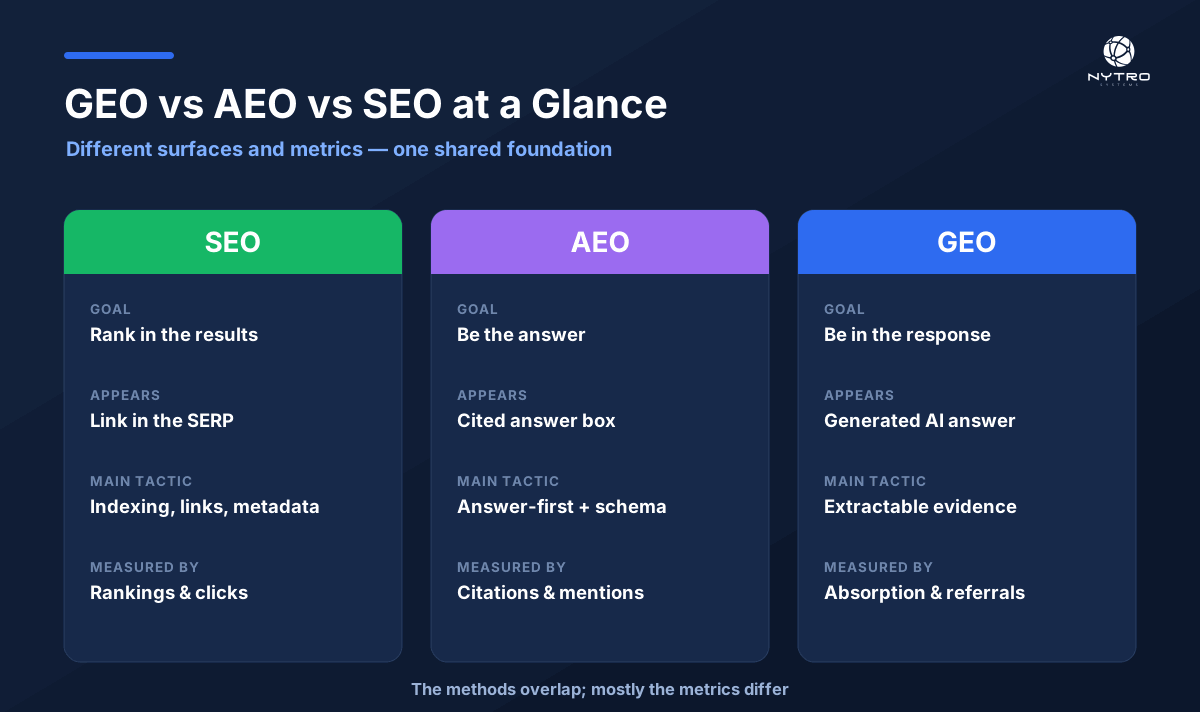
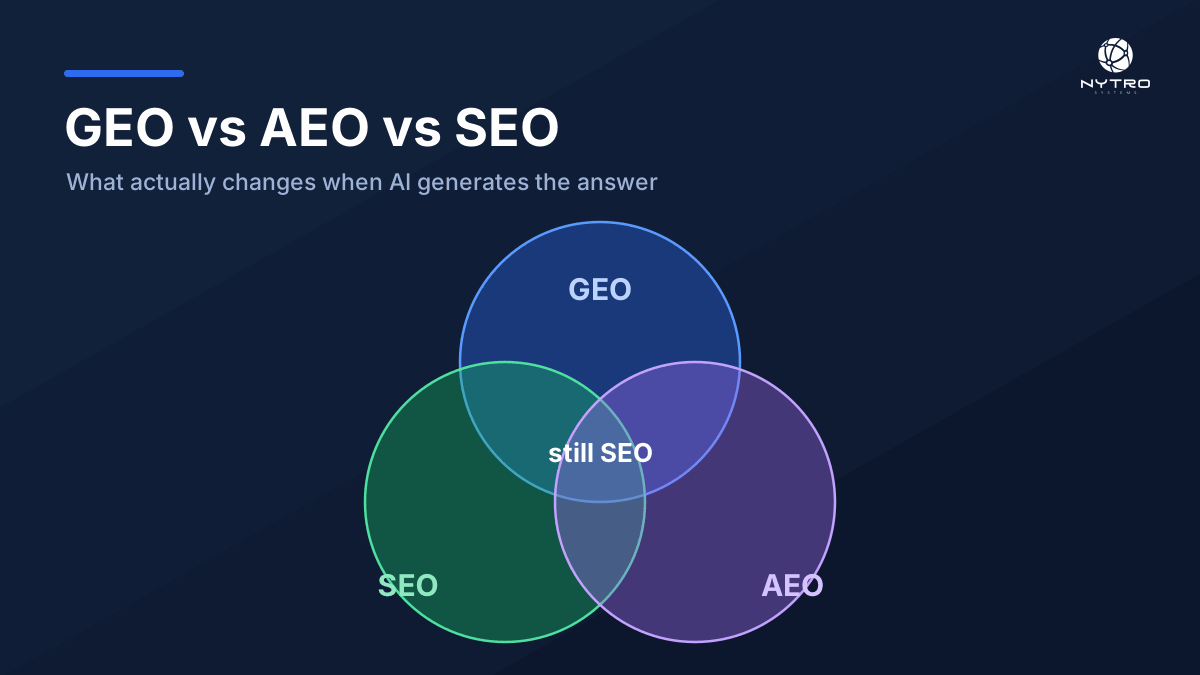
GEO vs AEO vs SEO at a glance: different surfaces and metrics, one shared foundation of clear, indexable, structured content.
The practical takeaway from the comparison is that the metrics diverge more than the methods do. The tactics that earn a ranking, clear writing, clean structure, strong metadata, topical depth, are largely the same tactics that earn an extraction or an absorption. What changes is where you look to confirm success, not the fundamental craft of the page.
GEO vs AEO vs SEO: Where They Overlap
The overlap between GEO vs AEO vs SEO is larger than the differences, and ignoring that is how teams waste budget. Every one of these approaches depends on the same base layer.
All three require that your page is crawlable and indexed. An answer engine cannot quote a page it never retrieved, and a generative response cannot absorb content it never found. AI Search optimization inherits this requirement wholesale, the AI surfaces are grounded in an index, so index eligibility is the entry ticket for all of them. All three reward clear, well-structured content: a page that states its answer plainly and organizes information into scannable units performs better in rankings, extractions, and generated answers alike. All three benefit from strong entity signals and trustworthy, accurate information, because engines and rankers both try to avoid surfacing unreliable sources.
What this means in practice is that roughly eighty percent of the work is shared. Get indexing, metadata, structure, and genuine quality right, and you have done most of GEO, most of AEO, and most of SEO at the same time. The remaining portion, leading with the answer, adding specific extractable evidence, confirming content with schema, is incremental structure layered onto that base, not a separate project.
A single example makes the overlap concrete. Imagine a page answering “how do I reduce cart abandonment.” The same page, written once, can rank in Google results because it is indexed, relevant, and well-linked; appear in an AI Overview because it leads with a clear answer and sound technical health; get quoted by Perplexity because it breaks its advice into extractable, evidence-backed steps; and get absorbed into a ChatGPT response because its definitions and statistics are specific enough to reuse. Nobody built four versions of that page. They built one good page and it qualified for four surfaces. That is the whole argument against treating GEO vs AEO vs SEO as three separate budgets, the duplication the acronyms imply rarely exists in the actual work.
Why Google Says GEO vs AEO vs SEO Is “All Still SEO”
The most grounding voice in the GEO vs AEO vs SEO debate is Google’s own. Google’s guidance on its AI features is consistent: there is no separate markup, no special program, and no new discipline required to appear in AI Overviews. The same fundamentals that help a page rank, helpful, reliable content, good technical health, and index eligibility, are what make it eligible to appear in AI experiences.
In other words, Google’s position is that optimizing for its AI surfaces is still search engine optimization. The company’s guidance on AI features and your site makes the point directly: focus on unique, satisfying content and sound technical foundations rather than chasing the AI layer as a separate target. This is a useful corrective to the acronym inflation, because it tells content teams where the leverage actually is.
That does not make AEO and GEO meaningless. The acronyms usefully name the new behaviors, formatting the answer, making evidence extractable, reinforcing entities, that matter more now that an engine, not a person, is often the first reader. But it reframes them as evolutions of SEO, not replacements for it. The debate about GEO, AEO, and traditional SEO resolves most cleanly when you treat them as one continuous practice adapting to a new kind of results page.
GEO vs AEO vs SEO: Which One Should You Focus On?
Because the foundation is shared, the honest answer to “which should I focus on” is “the foundation first, then the surfaces your audience actually uses.” A sequence works better than a choice.
Start by getting search engine optimization fundamentals right, because they are the entry ticket to every other surface. If your pages are not indexed, fast, and relevant, no amount of answer formatting will help, there is nothing for an engine to retrieve. Once the base is solid, layer on answer-ready structure: lead with the answer, phrase headings as real questions, break facts into extractable units, and add appropriate schema. This is where AEO and GEO earn their keep, and it is incremental work on pages you already have rather than a rebuild.
Then prioritize by where your audience searches. If your buyers increasingly ask ChatGPT and Perplexity, invest more in the extractable, evidence-rich structure those engines reward. If most of your demand still comes through Google results and AI Overviews, your existing SEO plus answer-ready formatting covers both at once, since AI Overviews draw from the same index. The point is that you are not choosing one acronym over the others, you are building one well-structured page that performs across all three surfaces.
Consider how this plays out for a mid-sized B2B site with a few hundred pages and a small team. Debating whether to launch a dedicated GEO program or an AEO program is the wrong question, the team does not have the capacity to run three parallel strategies, and they do not need to. The high-leverage move is to fix the shared foundation sitewide first: make sure every page is indexed and snippet-eligible, that titles and descriptions are accurate, and that structured data is valid. That single effort lifts rankings, AI Overview eligibility, and assistant citations together. Only after that base is solid does it make sense to hand-polish the handful of pages that drive the most demand with deeper answer-ready formatting. The sequence matters more than the label on it.
How to Apply GEO vs AEO vs SEO Together
Treating GEO vs AEO vs SEO as one workflow is more efficient than running three. The following sequence turns the shared foundation and the incremental layers into a single, repeatable page process.
First, confirm the technical base: the page is crawlable, indexed, reasonably fast, and served as clean HTML. Second, make it relevant and complete: it should genuinely answer the main question and the obvious follow-ups, with real depth rather than thin coverage. Third, format it for extraction: a direct answer under each heading, question-style headings, numbered steps, compact comparison tables, and specific evidence with sources. Fourth, confirm the content with structured data: FAQPage, HowTo, Article, and Organization schema that accurately describe what is on the page. Fifth, reinforce entities and authority: consistent descriptions of your brand and products across the site, and credible external and internal links. Sixth, measure across surfaces: rankings and organic clicks for the SEO layer, and citations, AI referral traffic, and brand mentions for the AEO and GEO layers.
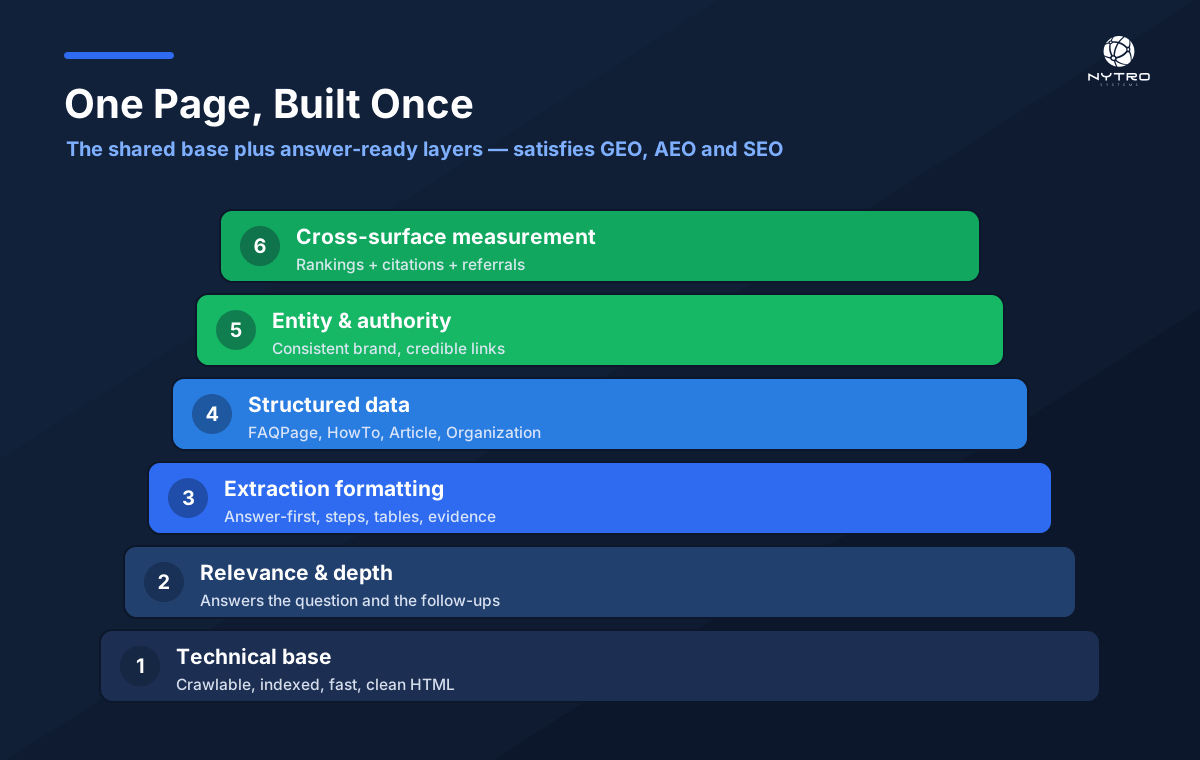
One page, built once, that satisfies GEO vs AEO vs SEO, the shared base plus the incremental answer-ready layers.
Run that sequence on every important page and you have covered search engine optimization, Answer Engine Optimization, and Generative Engine Optimization in a single pass. The acronyms stop being competing strategies and become a checklist for one well-made page.
Where NytroSEO Fits
The hard part of GEO vs AEO vs SEO is not understanding it, it is applying the shared foundation consistently across a site with hundreds of pages. Index hygiene, accurate titles and descriptions, answer-ready metadata, and valid structured data have to be present and current everywhere, not just on the pages a team had time to optimize by hand. That consistency is where most AI-search programs quietly fail.
That is the position NytroSEO takes: it is all still SEO at the core, so the platform automates the shared foundation that GEO, AEO, and SEO all depend on, generating and maintaining optimized titles, descriptions, and schema across the whole site so every page is index-eligible and answer-ready without manual rework. For the deeper background on the answer layer, our guide to Ask Engine Optimization covers conversational-question formatting, our LLM SEO strategies guide bridges traditional ranking work into generative surfaces, and our overview of getting AI-search-ready walks through the metadata and structured data that all three layers share.
Want to map GEO vs AEO vs SEO to your own site instead of debating the acronyms? Book a free strategy session, or sign up free and explore the NytroSEO system.
Frequently Asked Questions
Search engine optimization (SEO) optimizes a page to rank in a search engine’s results list, where the user clicks and reads. Answer engine optimization (AEO) structures content so an AI answer engine can extract and cite a direct answer. Generative engine optimization (GEO) makes content likely to be absorbed into a synthesized AI response. SEO targets the ranked list, AEO the extracted answer, and GEO the generated response, but all three depend on the same indexable, well-structured content.
No. GEO and AEO are better understood as evolutions of SEO than replacements for it. The AI surfaces they target are grounded in the same search index, so index eligibility and content quality, the heart of SEO, remain the entry ticket. GEO and AEO add answer-ready structure on top of that foundation.
Yes. Google’s guidance on its AI features states that there is no separate markup or program for appearing in AI Overviews, the same fundamentals of helpful content and sound technical health apply. In practice, optimizing for Google’s AI surfaces is still search engine optimization.
Prioritize the shared foundation first, indexing, relevance, metadata, and structure, because it is required for all three. Then layer on answer-ready formatting and schema, and weight your effort toward the surfaces your audience actually uses, whether that is Google results and AI Overviews or assistants like ChatGPT and Perplexity.
Not really. Roughly eighty percent of the work is shared: a crawlable, well-structured, genuinely useful page performs across rankings, extractions, and generated answers. The efficient approach is one page process that satisfies all three, not three separate playbooks.