Last updated: October 29, 2026
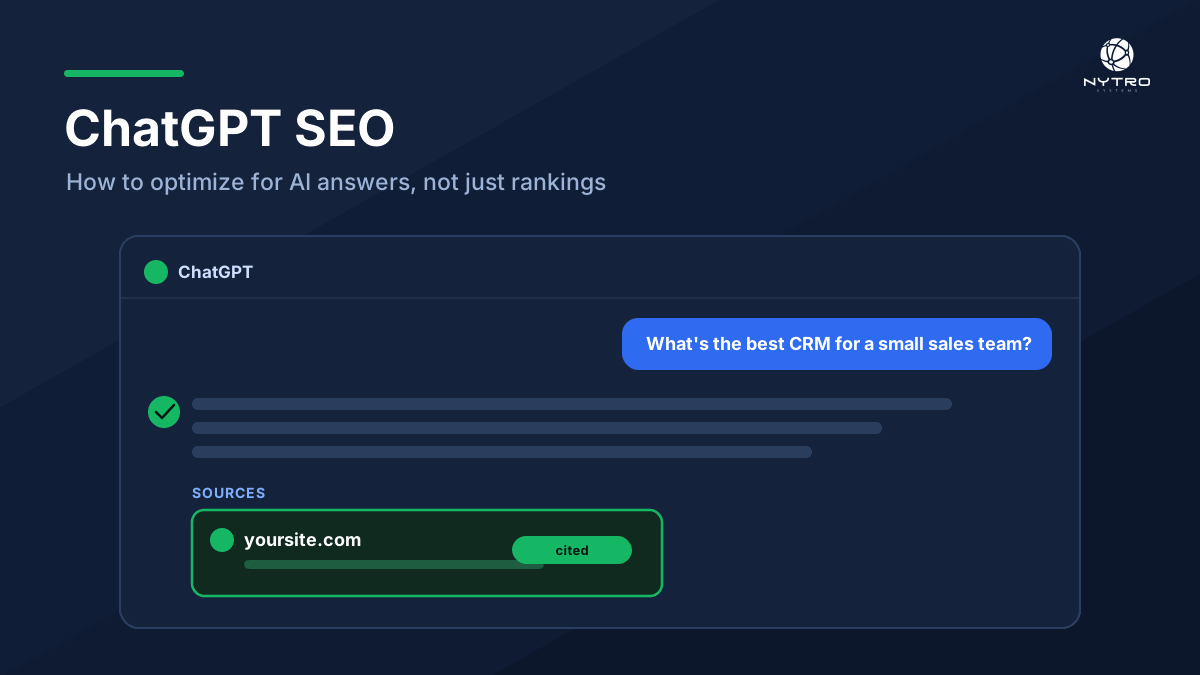
Hundreds of millions of people now ask ChatGPT questions they used to type into a search engine, and when ChatGPT answers with current information, it pulls from the web and points to the sources it used. ChatGPT SEO is the practice of making your site one of those sources: the content ChatGPT retrieves, trusts, and references in its answer. It is a different target from a classic ranking, and it rewards a different mix of signals.
This guide explains ChatGPT SEO without the hype. It covers what the term actually means, how ChatGPT’s integrated search retrieves and cites web content, why the goal is being used in the answer rather than just ranked, which content signals win citations, and how to measure something that often happens without a click. The aim is a clear, honest picture of how to show up when your customers ask an AI instead of a search box.
Lee Agam, CEO of Nytro Systems, is pragmatic about where ChatGPT SEO fits. In his view, it is not a separate universe from search, ChatGPT’s search feature still retrieves from the open web, so the pages that are crawlable, well-structured, and genuinely authoritative are the ones it can reach and reuse. His caution is against chasing rumors and vanity tactics: the durable move, he argues, is to publish content distinctive and clearly-written enough that an AI has a reason to quote it over a competitor, and to keep that quality consistent across the whole site rather than on a single showcase page. That consistency, he notes, is exactly what automation is for.
What Is ChatGPT SEO?
ChatGPT SEO is the practice of optimizing your content and site so that ChatGPT retrieves it, trusts it, and references it when it answers a user’s question. It applies most directly to ChatGPT’s search capability, the feature that lets ChatGPT look up current information on the web rather than relying only on its training data, and to the citations ChatGPT surfaces alongside those answers.
The target is worth stating precisely. When ChatGPT answers a question using live web content, it retrieves relevant pages and composes a response, surfacing links to sources it drew on. ChatGPT SEO aims to make your page one of those retrieved, referenced sources. That is a narrower and more specific goal than ranking in a classic results list: you are optimizing to be part of the answer, and to be named as a source the user can click through to.
Because of that, ChatGPT SEO overlaps heavily with Answer Engine Optimization and with AI Search optimization generally. The same instincts apply, be retrievable, answer the question directly, be trustworthy and distinctive, but ChatGPT SEO adds a platform-specific lens: how ChatGPT’s search retrieves content, what it tends to cite, and how its conversational, follow-up-heavy usage differs from a single search query.
How ChatGPT SEO Works: Retrieval and Citation
To optimize for ChatGPT, it helps to understand the mechanism. ChatGPT’s search feature, which OpenAI deployed in late 2024, lets ChatGPT search the web to give more accurate and up-to-date responses than its training data alone would allow. When a query benefits from current information, ChatGPT retrieves relevant web content, reads across it, and composes an answer that references the sources it used.
The retrieval-and-synthesis pattern is the same family of behavior seen across AI search: the system interprets the question, often breaks it into sub-questions, gathers content for each, and assembles a single response. Independent analysis of how AI engines decompose queries describes this sub-question expansion in depth, and it applies to ChatGPT’s conversational search as much as to any other surface. The practical implication for ChatGPT SEO is that a page which cleanly answers a question and its natural follow-ups has more chances to be retrieved and cited, because the conversation keeps generating new angles.
There is one more mechanical fact worth absorbing: ChatGPT can only use content it can actually reach. Pages that are crawlable and accessible are candidates; pages blocked from crawling or hidden behind heavy rendering are not. This is the same baseline Google documents for its own AI features, be indexable and genuinely useful, and it generalizes: across AI search surfaces, retrievability and quality are the entry requirements. ChatGPT SEO starts there and layers citation-worthiness on top.
Why ChatGPT SEO Is About Being Used, Not Just Ranked
The mental shift ChatGPT SEO demands is from ranking to being used. In classic Search Engine Optimization, the prize is a high position on a results page, and the user does the work of clicking and reading. In ChatGPT, there is no ranked list in the familiar sense, there is an answer, and a short set of sources behind it. The prize is being one of those sources.
This changes what “winning” looks like. A page can influence a buying decision inside a ChatGPT answer without ever earning a classic click, because the user reads the synthesized response and, at most, clicks through to confirm. The value moves toward the citation, the brand mention, and the authority of being named, the same shift that good AI Search Ranking has been pointing toward, now concentrated in a conversational interface where the answer, not the link list, is the product.
It also changes the cadence of the interaction. ChatGPT usage is conversational: people ask a question, then a follow-up, then another. That means a single session can surface many related sub-questions, and a page deep enough to answer several of them can be referenced repeatedly across the conversation. Optimizing to be used, not just to rank for one query, is what ChatGPT SEO is really about, and it rewards depth and clarity over keyword placement.
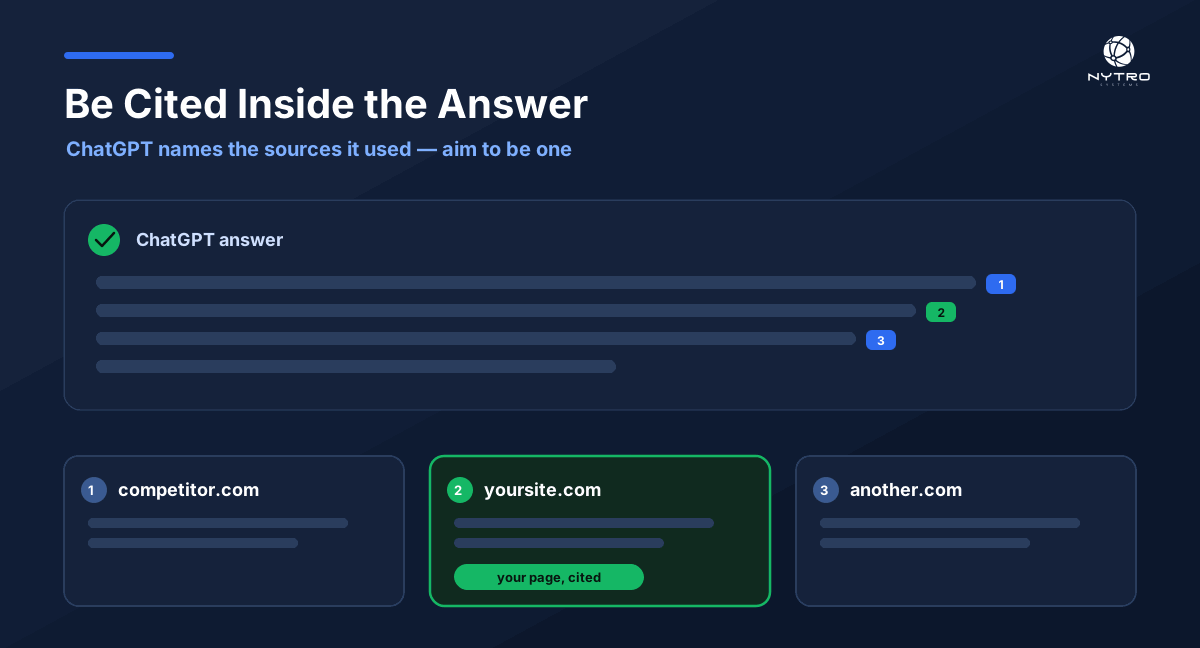
The goal of ChatGPT SEO: be the source card ChatGPT cites inside its answer.
ChatGPT SEO Content Signals That Win Citations
Being retrievable makes a page a candidate; specific content signals make it the one ChatGPT cites. Four signals do most of the work, and none of them require a special file or markup, they are editorial and structural choices.
The first is a direct, self-contained answer. A section that states its answer plainly in the first sentence or two gives ChatGPT a clean passage to lift and attribute, where a buried answer forces it to look elsewhere. The second is distinctive, non-commodity substance: original data, concrete specifics, named examples, and first-hand expertise give ChatGPT a reason to cite you rather than the dozen pages that all say the same generic thing. The third is clear structure and entity consistency, question-style headings, scannable sections, and a coherent, consistent description of who you are and what you offer, which help the model understand and trust what your page is. The fourth is genuine authority and trustworthiness: accurate, well-sourced, up-to-date content, because an AI reaching for a source it will name has an incentive to pick one that will not embarrass it.
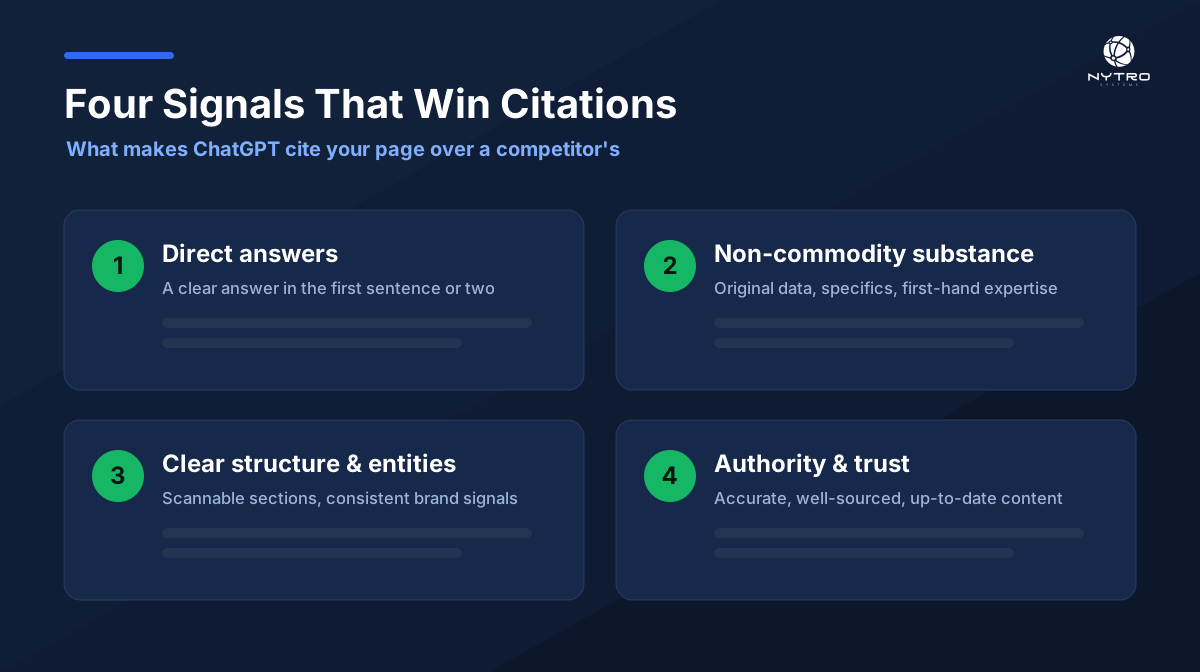
The four content signals that make ChatGPT cite your page instead of a competitor’s.
Put together, these signals describe a page that is easy to retrieve, easy to quote, and safe to attribute. That is the whole of ChatGPT SEO at the content level: say something distinctive, say it clearly and early, structure it so it can be lifted, and back it with enough authority that the model is comfortable naming you. A page that does all four is one ChatGPT can build an answer on; a page that does none is one it reads past.
ChatGPT SEO vs Traditional SEO
Setting ChatGPT SEO beside traditional SEO clarifies what carries over and what is genuinely different, so you can adapt rather than start from scratch.
Traditional SEO optimizes for a ranked results page and measures success in positions, clicks, and organic traffic. The match between query and page is fairly direct, and the user makes the final choice from a list. ChatGPT SEO optimizes for inclusion in a synthesized, conversational answer and measures success in citations, referral visits, and brand mentions. The match is indirect, your page can be used for questions phrased in ways you never targeted, and the model, not the user, does the first round of selection.
What carries over is the foundation. Both depend on content being accessible and crawlable, genuinely useful, well-structured, and authoritative. A page that is invisible to crawlers or thin and generic loses in both worlds. What is different is the emphasis: ChatGPT SEO leans harder on direct answers, distinctive substance, and trustworthiness, because those are what make content safe and worthwhile for a model to cite. The honest summary is that ChatGPT SEO is an evolution of good SEO aimed at a conversational answer, not a replacement for it, which is why the strongest classic sites tend to adapt fastest.
How to Measure ChatGPT SEO
Measuring ChatGPT SEO is harder than measuring rankings, because the key event, being cited inside an answer, does not show up in a rank tracker. But it is far from unmeasurable, and a few practical signals tell you whether the work is landing.
The most direct is manual testing: periodically ask ChatGPT the questions your pages target, with search enabled, and record whether you are cited, how your brand is described, and which source is used. It is tedious but it is the clearest read on reality. Referral traffic is the second signal, visits arriving from ChatGPT, where they appear in your analytics, are direct evidence that a citation converted into a click. Branded search and brand mentions are a third: when an AI names you as a source, downstream branded demand tends to rise, so a lift in branded queries can be a lagging indicator that your ChatGPT visibility is improving. And keeping your pages demonstrably crawlable and high-quality is a leading indicator, since retrievability and trust are the precondition for being cited at all.
No single number captures ChatGPT SEO, so read these together and over time. A page that shows up by name when you test the question, earns the occasional ChatGPT referral, and sits behind rising branded interest is a page working as a cited source, even though none of that appears on a classic rankings dashboard.
Common ChatGPT SEO Mistakes
Most ChatGPT SEO failures come from misunderstanding the target, not from missing a clever tactic. Naming the common mistakes is the fastest way to avoid wasting effort.
The first is treating ChatGPT SEO as entirely separate from search and neglecting the fundamentals, letting pages fall out of crawlability or publishing thin, generic content. If you try to optimize website for AI search while your important pages are blocked, slow, or indistinguishable from competitors, there is nothing for ChatGPT to reach or reason to cite. The second mistake is chasing rumors and unverified tactics, hunting for a magic file or a guaranteed-citation trick that does not exist, instead of investing in distinctive, trustworthy content. The third is writing for keywords rather than questions, so the page never matches the conversational, follow-up-heavy way people actually talk to ChatGPT. The fourth is making unverifiable or inflated claims, which a careful model is increasingly reluctant to reproduce and attribute. And the fifth is ignoring measurement entirely, never testing the target questions in ChatGPT, so you have no idea whether your content is being used.
Each of these is fixable with the same discipline the rest of this guide describes: be reachable, be distinctive, answer questions directly, stay accurate, and check your results. None of it is exotic, and all of it compounds.
Where NytroSEO Fits
ChatGPT SEO rewards sites that are consistently crawlable, well-structured, distinctive, and authoritative, and holding all of that true across a large site, continuously, is the hard part. Retrievability can lapse, structure can drift, and metadata can go stale, each quietly removing pages from the pool an AI can cite.
That is the gap NytroSEO is built to close. Its Automatic SEO engine keeps pages crawlable and index-eligible and maintains optimized titles, descriptions, and structured data across the whole site, so the conditions for being retrieved and cited stay met without manual rework. For the deeper background, our overview of getting AI-search-ready walks through the metadata and structure that AI retrieval depends on, our Ask Engine Optimization guide covers the answer-ready formatting that wins citations, and our overview of building AI brand visibility explains the entity signals that help models trust and name your brand.
Want to be a source ChatGPT cites? Sign up free and explore the NytroSEO system, or book a free strategy session.