Last updated: October 28, 2026
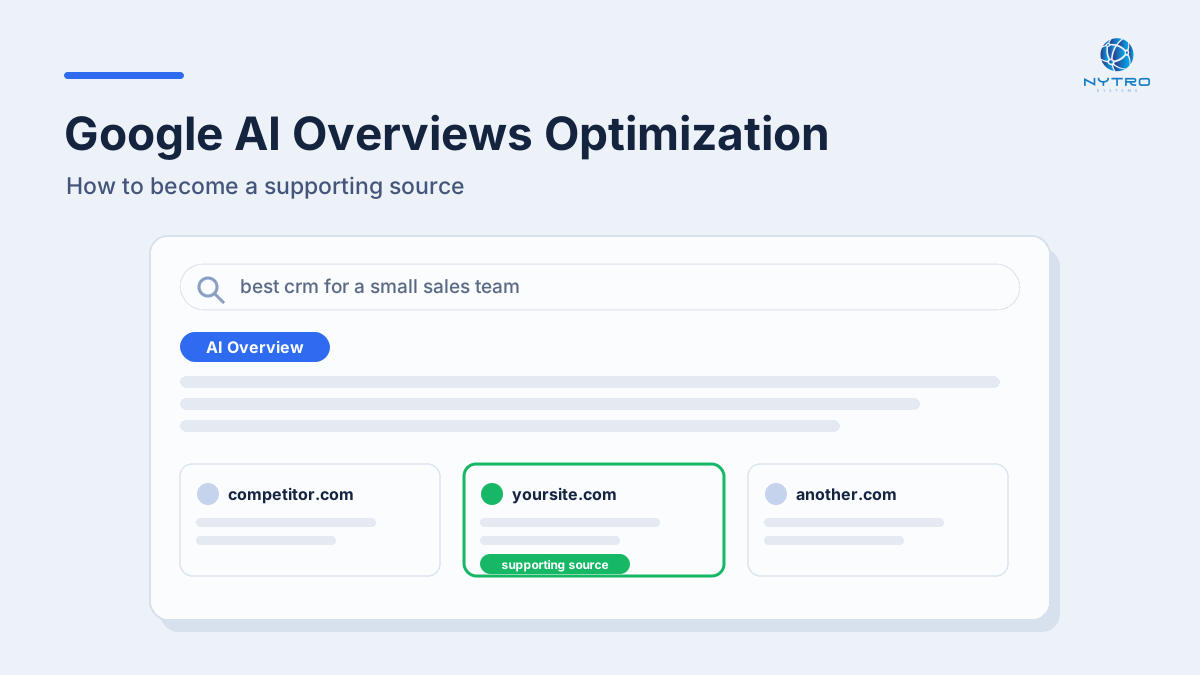
When Google answers a query with an AI Overview, it does not invent the answer from nothing. It assembles a response and links out to the pages it drew from, the supporting sources shown alongside the generated summary. Google AI Overviews optimization is the practice of making your page one of those supporting sources: the content Google trusts enough to build its answer on and cite. It is a narrower, more technical goal than “ranking,” and it rewards a specific mix of indexing hygiene, snippet control, and genuinely distinctive content.
This guide walks through that mix. It covers what Google AI Overviews optimization actually is, why it starts with being indexed and snippet-eligible, how the snippet-control directives like no-snippet and max-snippet let you shape what Google can use, why commodity content gets passed over, and how to read your performance in Search Console. The aim is practical: a clear path to being a page the AI Overview leans on rather than one it scrolls past.
Lee Agam, CEO of Nytro Systems, frames the opportunity plainly: an AI Overview is a shortlist, and the goal is to be on it. In his experience, most sites lose the supporting-source slot for unglamorous reasons, a page is not indexed, a snippet directive is accidentally suppressing the very text Google would have quoted, or the content is so generic that a dozen other pages say the same thing. His view is that Google AI Overviews optimization is less about a clever trick and more about removing the quiet blockers and then giving Google something specific and trustworthy to cite, and that keeping those conditions true across a large site is exactly the kind of maintenance worth automating.
What Is Google AI Overviews Optimization?
Google AI Overviews optimization is the practice of structuring and maintaining a page so it is eligible to be used, and cited, as a supporting source in Google’s AI Overviews, the AI-generated summaries that now appear above many search results. It combines ordinary technical SEO with deliberate control over how your content can be snippeted and a focus on content distinctive enough to be worth citing.
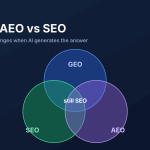
It helps to be precise about the target. An AI Overview is a synthesized answer that Google assembles from indexed web content and presents with links to the sources it used; these AI-generated summaries now sit above a large share of search results. Being optimized for it does not mean ranking first in the classic sense; it means being one of the handful of pages Google draws the answer from and shows as a reference. That is why Google AI Overviews optimization overlaps heavily with Answer Engine Optimization but adds a specifically Google-centric, technically grounded layer around snippets and indexing.
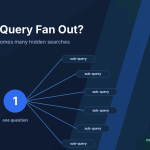
It also helps to understand how the overview is built, because that shapes what gets cited. An overview is typically assembled by breaking the query into several related sub-questions, retrieving content for each, and synthesizing a single answer, the query fan-out behavior that industry analysis has examined in depth. The practical upshot for Google AI Overviews optimization is that a page has multiple chances to be cited: it can be pulled in for the main question or for any of the sub-questions it answers cleanly. A page that resolves a topic and its obvious follow-ups has more surfaces the overview can grab, while a page that answers only the headline question competes for a single slot.
The discipline sits on the same foundation as all AI Search optimization: a page that is not indexed and eligible to be shown simply cannot appear. On top of that foundation, Google AI Overviews optimization adds three things, control over what Google may quote, content that is genuinely non-commodity, and measurement that tells you whether it is working. The rest of this guide takes those in turn.
How Google AI Overviews Optimization Starts with Indexing
Every path to an AI Overview runs through the Search index. AI Overviews are built from content Google has already crawled, indexed, and deemed eligible to show, so the first and non-negotiable step of Google AI Overviews optimization is ensuring the page is actually in the index and able to be displayed. Google’s own guidance on its AI features is explicit that standard SEO best practices still apply and that a page must be indexed and eligible to be shown in Search to appear in these experiences.
This has immediate, practical consequences. A page carrying a noindex directive cannot be a supporting source. A page blocked in robots rules cannot be crawled and therefore cannot be used. A page buried so deep that Google rarely recrawls it will lag behind fresher competitors. The ordinary work of technical Search Engine Optimization, clean crawl paths, resolved indexing issues, reasonable freshness, is the entry requirement, and it is where the first optimization effort should go.
It is worth stating the uncomfortable version plainly: if you are trying to optimize website for AI search while important pages sit un-indexed or snippet-suppressed, you are decorating a room no one can enter. Confirm indexation first. Use Search Console’s coverage and URL inspection to verify that each page you care about is indexed and eligible, and resolve anything excluded that should not be. Only once a page is reliably in the index does the rest of Google AI Overviews optimization become worth doing.
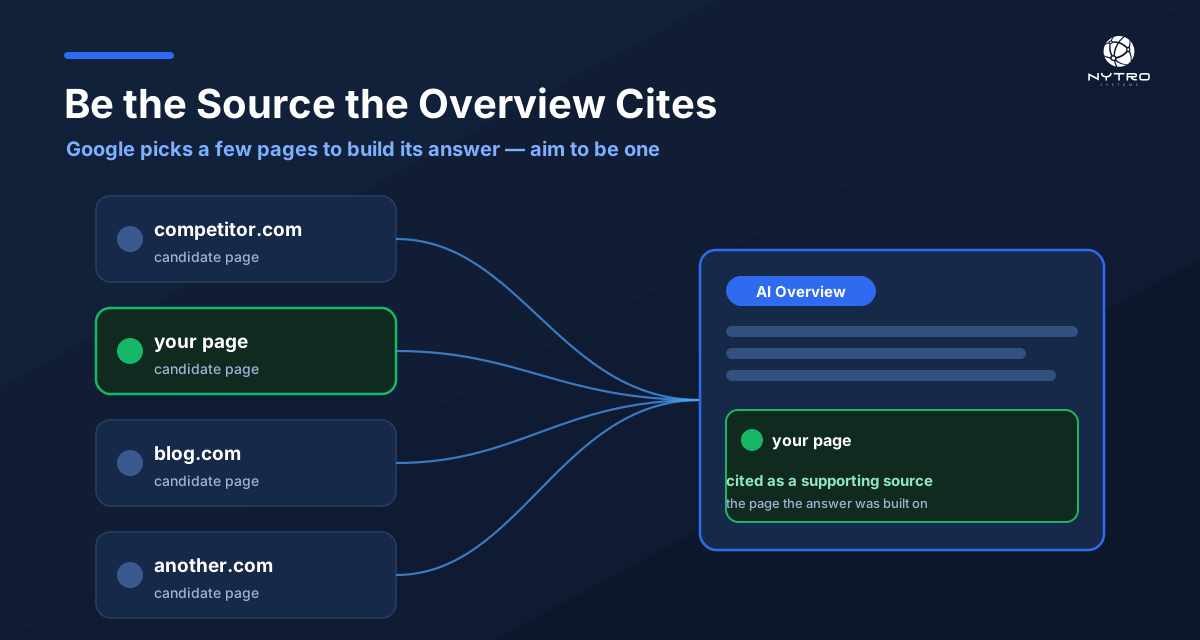
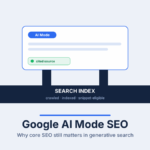
The goal of Google AI Overviews optimization: be the supporting-source card the overview cites.
Snippet Controls for Google AI Overviews Optimization
Once a page is indexed, the next lever is snippet control, and it is the most technical and most overlooked part of Google AI Overviews optimization. Because AI Overviews draw on the same snippet-eligible text that powers featured snippets and result descriptions, the robots directives that govern snippets also shape what Google can use in an overview.
Google documents three controls that matter here. The nosnippet directive tells Google not to show a text snippet or video preview for the page at all, which also removes the text Google would otherwise have to quote in an overview. The max-snippet:[number] directive limits the snippet to a maximum number of characters, which can constrain how much of your content is available to be surfaced. And the data-nosnippet HTML attribute lets you mark specific sections of a page as off-limits for snippeting, so you can exclude a particular passage while leaving the rest available.
Used carelessly, these directives quietly sabotage Google AI Overviews optimization: a site-wide nosnippet or an aggressive max-snippet limit can suppress exactly the answer-bearing text you want cited. Used deliberately, they are a scalpel. You might use data-nosnippet to keep a paywalled or boilerplate block out of snippets while leaving your clear, quotable answer fully available, or set a sensible max-snippet where you genuinely need to limit exposure. The optimization move is almost always to make sure your best answer text is snippet-eligible, and to reserve suppression for the narrow cases that truly need it. Audit your templates for inherited snippet restrictions before anything else, an accidental directive is one of the most common reasons a strong page never becomes a supporting source.
Google AI Overviews Optimization Needs Non-Commodity Content
Indexing and snippets make a page eligible; distinctive content is what gets it chosen. The hard truth of Google AI Overviews optimization is that commodity content, the same definitions, the same generic advice, phrased the same way as a hundred other pages, gives Google no reason to cite you specifically. If your page says exactly what everyone else says, the overview can be built without you.
Non-commodity content is the antidote, and it takes a few concrete forms. Original data and specifics, numbers, test results, named examples, concrete figures, give Google something to attribute that it cannot get elsewhere. A genuinely clear, self-contained answer to the exact question, stated in the first sentence or two of a section, is easier to lift and more likely to be chosen than the same point buried in throat-clearing. First-hand experience and expert perspective add signals of trustworthiness that generic content lacks. And depth that resolves the follow-up questions, not just the headline one, gives the overview more reasons to lean on your page across the sub-queries it generates.
This is where good AI Search Ranking and Google AI Overviews optimization converge: the qualities that make Google trust a page enough to rank it, originality, expertise, clarity, depth, are the same qualities that make it a safe supporting source to cite. The practical instruction is simple to say and harder to do: say something only you can say, and say it clearly enough to quote. A page that clears the technical gates but reads like every competitor will watch the overview cite those competitors instead.
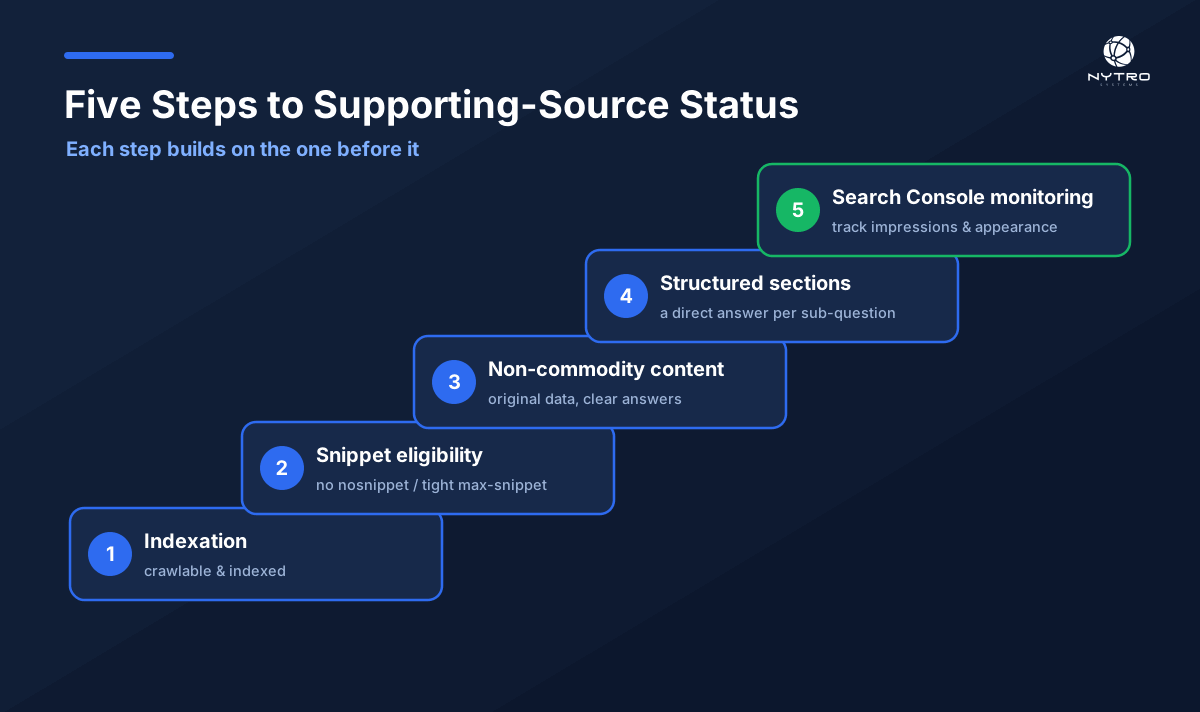
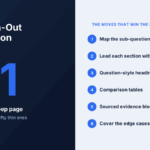
Five steps to supporting-source status, the Google AI Overviews optimization sequence.
Measuring Google AI Overviews Optimization in Search Console
You cannot manage what you cannot see, and AI Overviews make measurement harder because much of the value happens inside the overview rather than as a classic click. Still, Search Console remains the primary instrument for Google AI Overviews optimization, and a few readings tell you whether the work is landing.
Start with the Performance report. Google counts impressions and clicks from AI Overviews within the Performance report, so a page that is being surfaced in overviews will show impressions on the relevant query clusters even when click behavior shifts. Watch for a pattern where impressions hold or rise on your target queries while click-through changes shape, that is often the fingerprint of being surfaced in an overview rather than clicked as a classic result. Use URL inspection to confirm the specific pages you are optimizing are indexed and eligible, so you are never guessing about the foundation. And pair the Search Console data with direct observation: periodically run your target queries and record whether your page appears as a supporting source and which passage is used.
No single number proves Google AI Overviews optimization is working, so read these together. A page that holds its impressions on the target queries, stays indexed and eligible on inspection, and shows up by name when you test the question is a page functioning as a supporting source, even if its raw classic clicks look flatter than they used to.
Google AI Overviews Optimization: A Supporting-Source Checklist
Pulling the discipline into a sequence makes it repeatable. Run these steps on any page you want to become a supporting source, in order, because each depends on the one before it.
First, confirm indexation: the page is crawlable, indexed, and not carrying a stray noindex. Second, confirm snippet eligibility: no inherited nosnippet or over-tight max-snippet is suppressing your answer text, and data-nosnippet is used only where you truly need it. Third, make the content non-commodity: add original data, a first-sentence answer, genuine expertise, and depth that competitors lack. Fourth, structure the sections so each answers a clear sub-question with a direct answer up front, giving the overview clean passages to lift. Fifth, monitor in Search Console: track impressions on the target query clusters, confirm eligibility with URL inspection, and verify supporting-source appearance by testing the queries directly.
Worked in order, this checklist is the whole of Google AI Overviews optimization. The first two steps remove the quiet blockers, the middle two give Google something worth citing, and the last closes the loop so you know whether it worked. None of it is exotic, it is disciplined fundamentals aimed precisely at the supporting-source slot.
Where NytroSEO Fits
The checklist above is straightforward on one page and genuinely hard across hundreds. Indexation has to stay clean, snippet directives have to stay correct, metadata and structure have to stay current, and someone has to keep checking, continuously, everywhere. That maintenance, not any single tactic, is what keeps a site eligible to be a supporting source over time.
That is the gap NytroSEO is built to close. Its Automatic SEO engine keeps pages indexed and snippet-eligible and maintains optimized titles, descriptions, and structured data across the whole site, so the technical conditions for AI Overviews stay met without manual rework. For the deeper background, our overview of getting AI-search-ready walks through the metadata and structured data that eligibility depends on, our Ask Engine Optimization guide covers the answer-ready structure overviews reward, and our LLM SEO strategies guide bridges classic ranking work into AI retrieval.
Want to become a supporting source Google trusts? Sign up free and explore the NytroSEO system, or book a free strategy session.