Last updated: October 27, 2026
Every time Google changes how Search looks, someone declares SEO dead. AI Mode, Google’s generative search experience that answers a query with a synthesized response instead of a list of links, has triggered the loudest version of that claim yet. The reality is less dramatic and more useful: Google AI Mode SEO is not a new discipline bolted onto Search. It runs on the same index, the same crawling, and the same fundamentals that have always decided whether your content shows up. What changed is the target, not the rulebook.
This guide is objection-handling for anyone who has been told they need to start over. It explains what Google AI Mode SEO actually requires, why the Search index is still the foundation underneath the generative layer, which “you need new markup” myths to ignore, and what genuinely did change about how your content gets used. The through-line is simple and backed by Google’s own documentation: if you cannot be found in Search, you cannot be used in AI Mode, so core fundamentals are not optional, they are the entry ticket.
Lee Agam, CEO of Nytro Systems, has watched this cycle repeat for years and is unmoved by the latest obituary for SEO. In his view, AI Mode is the strongest argument for fundamentals, not against them: the generative answer is assembled from indexed, snippet-eligible pages, so the sites that keep their technical house in order are exactly the ones eligible to appear. His caution to teams is to resist the urge to chase a mythical “AI markup” or rebuild their stack for the new surface, and instead double down on indexing hygiene, clean metadata, and genuinely useful content, the unglamorous work that quietly determines who the AI can even consider. Automating that baseline, he notes, is what makes AI-Mode readiness realistic across a whole site rather than a one-page scramble.
What Is Google AI Mode SEO?
Google AI Mode SEO is the practice of making your content eligible to appear in, and be used by, Google’s AI Mode, the generative search experience that composes a direct answer to a query and draws on web sources to do it. It is not a separate program or a new set of ranking signals; it is ordinary search engine optimization aimed at a new surface that sits on top of the existing Search index.
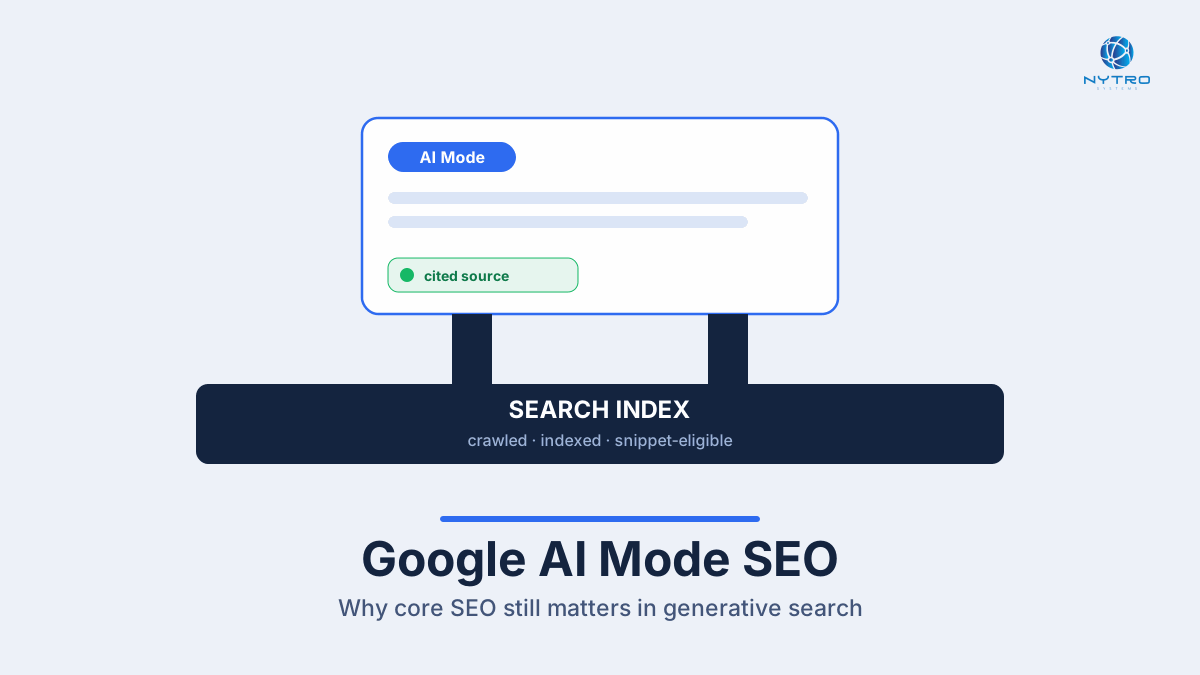
The key fact that defines the whole discipline comes straight from Google. Its documentation on AI features states plainly that the best practices for SEO remain relevant for AI features in Google Search, AI Mode and AI Overviews alike, and that to be eligible a page must be indexed and able to be shown in Search with a snippet. There is no AI-specific markup, no special file, and no separate submission process. The same crawling, indexing, and quality signals that govern classic results govern eligibility for the generative ones.
That is why Google AI Mode SEO looks so familiar once you strip away the hype. The work is making sure your pages are crawlable, indexed, snippet-eligible, genuinely helpful, and clearly structured. What AI Mode adds is a new way for that already-eligible content to be surfaced, synthesized into an answer rather than listed as a link, which raises the value of clear, extractable structure. But the eligibility gate itself is pure fundamentals.
Why Google AI Mode SEO Still Runs on the Search Index
The single most important thing to understand about Google AI Mode SEO is that AI Mode does not have its own secret web crawl or private database of approved sources. It is grounded in the Search index, the same search engine index that powers classic results. When AI Mode assembles an answer, it draws on pages that are already crawled, indexed, and eligible to be shown.
This has a blunt consequence. If a page is not indexed, it cannot appear in AI Mode at all, there is nothing for the system to retrieve. If a page is indexed but not eligible for a snippet, it is similarly handicapped, because the generative answer is built from the kind of content that would be eligible to be shown. Everything that keeps a page out of classic Search, noindex directives, blocked crawling, thin or duplicative content, severe technical problems, keeps it out of AI Mode too. The generative layer inherits the index’s gatekeeping wholesale.
This is also why AI Search optimization and ordinary indexing hygiene are the same work at the base. The entry requirements for the new surface are the old requirements: be crawlable, be indexed, be snippet-eligible. In practice, the first real move to optimize website for AI search is not an AI-specific tactic at all, it is confirming that every important page is indexed and snippet-eligible, because that is the condition AI Mode and AI Overviews both inherit. A team that keeps those green is already most of the way to AI-Mode readiness, while a team chasing AI-specific tricks on an un-indexed site is optimizing a storefront no one can enter.
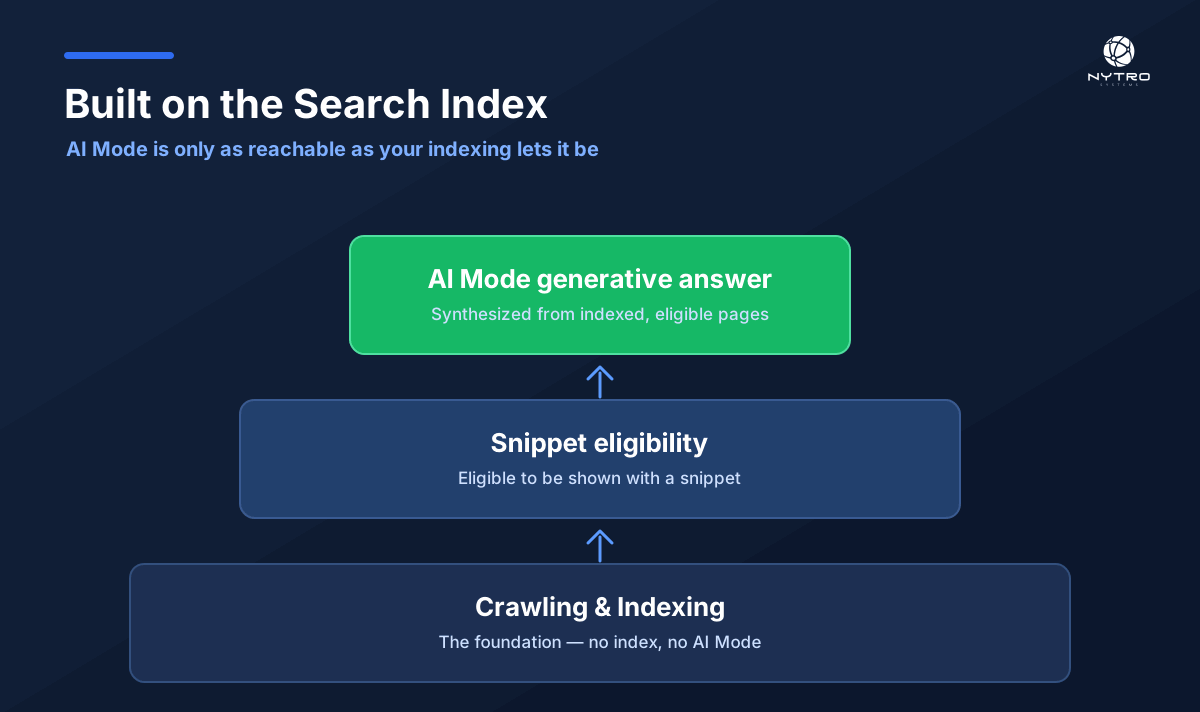
Google AI Mode sits on the Search index, if a page is not indexed and snippet-eligible, the generative layer never sees it.
Google AI Mode SEO Myths vs Facts
Much of the anxiety around Google AI Mode SEO comes from myths that do not survive contact with Google’s own guidance. Separating them from the facts is the fastest way to stop wasting effort.
The first myth is that SEO is dead. The fact is that Google explicitly states its SEO best practices remain relevant for AI features, the fundamentals still decide eligibility. The second myth is that AI Mode needs new, AI-specific markup or a special file. The fact is that Google requires no such thing; standard indexing and snippet eligibility are the requirements, and ordinary structured data continues to play its normal supporting role. The third myth is that AI Mode replaced the Search index with something new. The fact is that AI Mode is grounded in the same index, so classic crawling and indexing still gate everything. The fourth myth is that rankings no longer matter at all. The fact is more nuanced: classic position matters less as a direct endpoint, but the signals behind good AI Search Ranking, relevance, quality, structure, authority, are exactly what make content eligible and useful to the generative layer.
The pattern across all four is the same. The surface changed, so the way your content is presented changed. The machinery underneath, crawl, index, assess quality, serve, did not. Google AI Mode SEO is the discipline of keeping that machinery working in your favor.
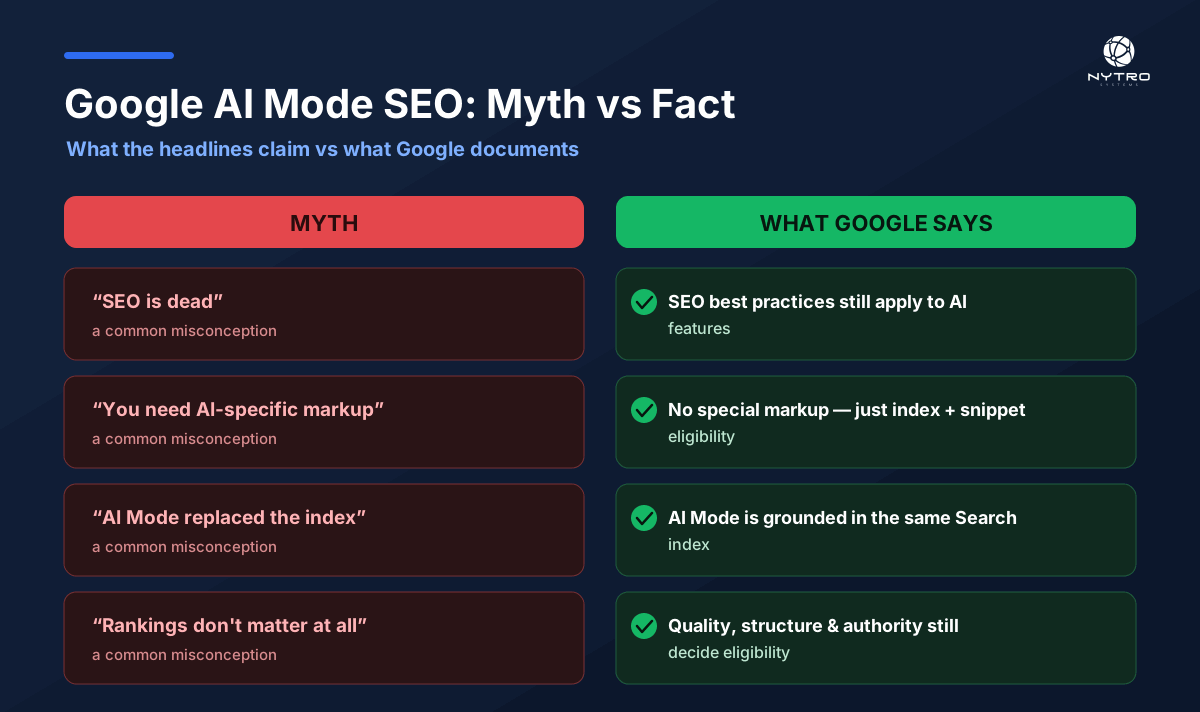
Four Google AI Mode SEO myths, and what Google’s own documentation actually says.
The Google AI Mode SEO Entry Checklist
Because eligibility is the whole game, Google AI Mode SEO starts with a short, unglamorous checklist. Clear these and your content is in the pool the generative answer can draw from; miss them and nothing else you do matters.
First, confirm the page is crawlable: no accidental blocks in robots rules, no broken rendering that hides the main content. Second, confirm it is indexed: check coverage in Search Console and resolve anything flagged as excluded that should be included. Third, confirm it is snippet-eligible: avoid directives that suppress snippets, since the generative answer draws on snippet-eligible content. Fourth, make the content genuinely helpful and clearly structured, because quality and clarity are what move a page from merely eligible to actually used. Fifth, keep technical health sound, reasonable speed, clean HTML, valid structured data where relevant, so nothing quietly disqualifies the page.
None of these is new, and that is the point. The Google AI Mode SEO checklist is the classic technical-SEO checklist, reframed as the entry requirement for the generative surface. The teams that already run this checklist are AI-Mode ready; the teams that skipped it have work to do before any AI-specific thinking is worthwhile.
How Query Fan-Out Shapes Google AI Mode SEO
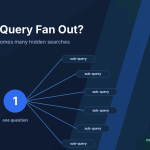
While the fundamentals are unchanged, one mechanism does shape how content gets used in AI Mode: query fan-out. AI Mode frequently takes a single question, breaks it into multiple sub-queries, runs them across the index, and synthesizes the results into one answer. Google has described this fan-out behavior as part of how AI Mode works, and independent analysis of query fan-out has explored what it means for content strategy.
For Google AI Mode SEO, the implication is practical rather than revolutionary. Because the system pulls from many sub-queries, a page that thoroughly answers a topic and its natural sub-questions has more chances to be one of the sources the answer is built from. That favors depth and clear sectioning, the same qualities that have always helped a page rank, rather than any new tactic. It also reinforces why thin, fragmented content struggles: there is less for the fan-out to grab, and fewer sub-queries it can satisfy.
So fan-out does not overturn the fundamentals; it amplifies the reward for doing them well. A deep, well-structured, indexed page is both easier to rank and more likely to supply passages to an AI Mode answer. That convergence, where good classic SEO and good AI-Mode performance ask for the same things, is the most reassuring fact in the whole discussion.
Google AI Mode SEO: What Actually Changed
It would be wrong to claim nothing changed. The honest position is that the fundamentals held while the outcomes shifted, and naming the real changes keeps Google AI Mode SEO grounded rather than dismissive.
What changed is how your content is presented and measured. More answers are now synthesized rather than listed, so a user can get what they need without clicking, which means a well-optimized page can influence a decision while earning fewer visits than it once did. The value of being cited or used as a source rose, and the value of a raw ranking position as an endpoint fell somewhat. Clear, extractable structure became more valuable, because the system has to locate the passage that answers each sub-query. And measurement got harder, since a page can contribute to answers without a clean click or ranking number to show for it.
What did not change is everything underneath: crawling, indexing, snippet eligibility, quality assessment, and the basic requirement to be genuinely useful. This is the balance Google AI Mode SEO has to hold, take the new presentation layer seriously, adapt structure and measurement to it, but refuse the false claim that the foundation was replaced. The target moved; the fundamentals that let you aim at it did not.
Common Google AI Mode SEO Mistakes
Most Google AI Mode SEO failures are not exotic AI problems, they are ordinary neglect of the fundamentals, now with higher stakes because the eligibility gate is the same one that feeds the generative answer.
The most common mistake is assuming the rules changed and abandoning the basics: letting indexing coverage slip, tolerating thin or duplicative pages, or ignoring crawl errors because “AI will figure it out.” It will not, an un-indexed page is invisible to AI Mode. A second mistake is chasing phantom tactics, spending effort hunting for a special AI markup or file that does not exist instead of fixing the indexing and quality issues that actually gate eligibility. A third is over-indexing on raw ranking position and declaring defeat when it moves, rather than tracking whether the page is being used as a source in answers. A fourth is fragmenting content into thin pages in the hope of matching more queries, which both weakens classic performance and gives the fan-out less to work with. And a fifth, quieter mistake is neglecting measurement entirely, never testing the target questions in AI Mode and AI Overviews, so the team has no idea whether its content is being surfaced at all.
Every one of these is fixable with fundamentals, which is the reassuring core of Google AI Mode SEO: the corrective actions are the ones good SEO teams already know how to take.
Where NytroSEO Fits
If Google AI Mode SEO is mostly fundamentals, the hard part is keeping those fundamentals green across an entire site, continuously. Every page needs to stay crawlable, indexed, snippet-eligible, and cleanly structured, and on a site with hundreds of pages, drift is constant. That maintenance, not any secret AI tactic, is what determines how much of your content AI Mode can actually use.
That is the gap NytroSEO is built to close. Its Automatic SEO engine keeps pages indexed and snippet-eligible automatically, maintaining titles, descriptions, and structured data so the entry requirements for AI Mode stay met sitewide, without manual rework. For the deeper background, our overview of getting AI-search-ready walks through the metadata and structured data that eligibility depends on, our LLM SEO strategies guide covers optimizing for AI-driven retrieval, and our Ask Engine Optimization guide explains the answer-ready structure that makes eligible content actually get used.
Want your site AI-Mode ready without chasing myths? Sign up free and explore the NytroSEO system, or book a free strategy session.