Last updated: October 30, 2026
Here is the most common way a site makes itself invisible to ChatGPT without realizing it: a single line in robots.txt that blocks the wrong crawler. ChatGPT citation optimization is the practice of making sure ChatGPT can reach your content and has a reason to cite it, and it begins with a technical detail most teams get wrong, because the crawler that matters for citations is not the one everyone has been busy blocking.
This guide is tactical. It covers what ChatGPT citation optimization actually is, why it starts with allowing OAI-SearchBot, the real differences between OpenAI’s three crawlers, GPTBot, OAI-SearchBot, and ChatGPT-User, and the source signals (extractable summaries, original data, freshness) that turn a reachable page into a cited one. By the end you should be able to audit your own robots.txt in five minutes and know exactly what to publish to earn citations.
Lee Agam, CEO of Nytro Systems, sees the same self-inflicted wound again and again: a site that wants to show up in ChatGPT has quietly blocked the exact crawler that would surface it, usually because someone pasted a broad “block the AI bots” rule to stop training use. His point is that ChatGPT citation optimization is two problems, not one, a permissions problem and a content problem, and that solving the first is often a one-line fix that instantly makes a site eligible again. The second, giving ChatGPT something distinctive and fresh enough to quote, is the ongoing work, and the one worth automating across a whole site.
What Is ChatGPT Citation Optimization?
ChatGPT citation optimization is the practice of making your website both reachable by ChatGPT’s search crawler and worth citing, so that ChatGPT references your pages as sources when it answers a question. It has two halves: a technical half, which is about letting the right crawler in and keeping pages accessible, and an editorial half, which is about publishing content distinctive and extractable enough that ChatGPT has a reason to quote it.
The technical half is where most citation problems actually live, which is why this guide leads with it. If OpenAI’s search crawler cannot fetch your page, no amount of great content will earn a citation, there is simply nothing for ChatGPT to retrieve. The editorial half then decides, among the reachable pages, which ones get used. ChatGPT citation optimization is getting both halves right at once.
This makes it a tactical sibling of broader AI Search optimization and Answer Engine Optimization: the content principles are shared across AI surfaces, but ChatGPT citation optimization adds a platform-specific layer around OpenAI’s crawlers and how ChatGPT’s search surfaces sources. The payoff is concrete, being the named, clickable source inside a ChatGPT answer, and the first step is almost always a robots.txt audit.
ChatGPT Citation Optimization Starts with OAI-SearchBot
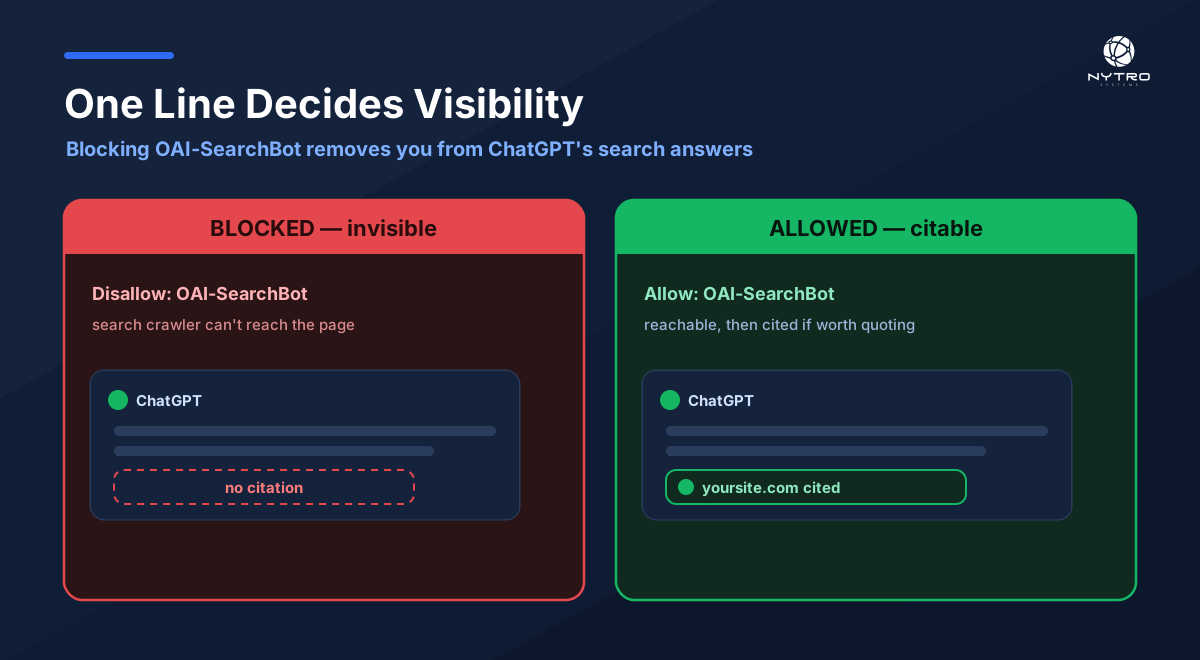
The crawler that matters for ChatGPT citation optimization is OAI-SearchBot. According to OpenAI’s own documentation, OAI-SearchBot is the crawler used for search, it is how OpenAI surfaces websites in ChatGPT’s search features. If you want ChatGPT to be able to cite your site in its search answers, OAI-SearchBot must be allowed to reach it.
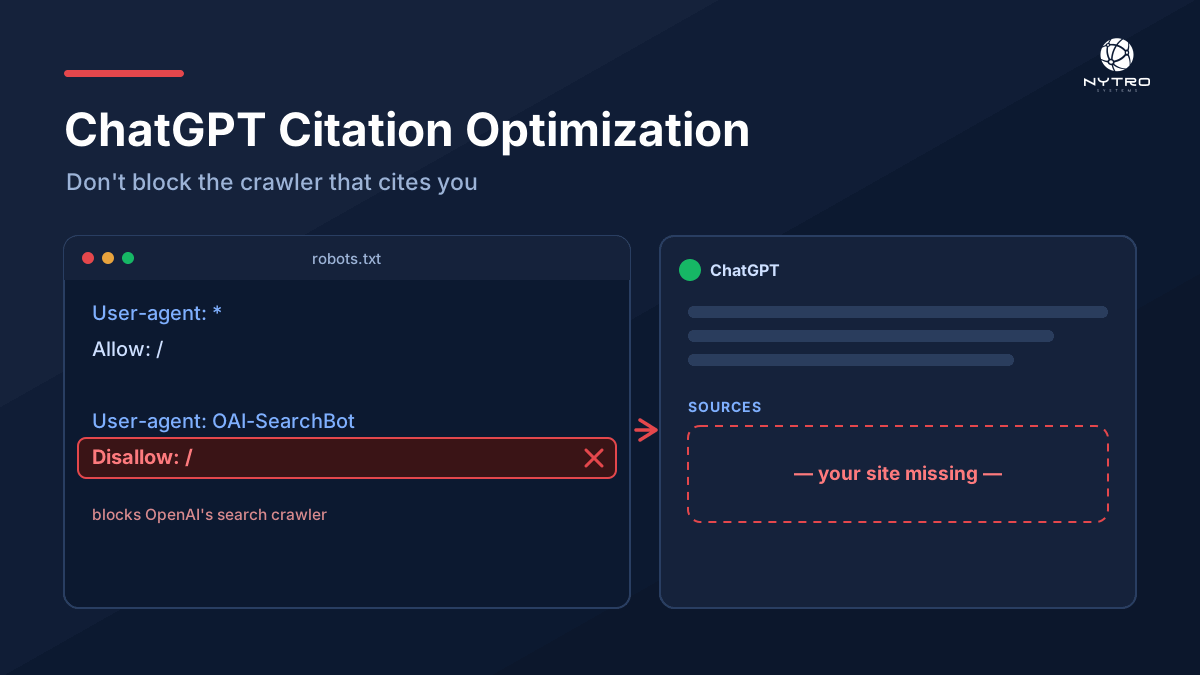
The failure mode is specific and common. OpenAI states that sites opted out of OAI-SearchBot will not appear in ChatGPT search answers, though they can still appear as navigational links. In other words, a robots.txt rule that disallows OAI-SearchBot removes your pages from the pool ChatGPT can cite in its generated answers. Many sites blocked this crawler by accident, sweeping it up in a broad “block the AI bots” rule meant to stop training use, and in doing so, they quietly disqualified themselves from citations they actually wanted.
The fix is a robots.txt audit. The file is the long-standing robots exclusion standard that tells crawlers which URLs they may access, and Google’s introduction to robots.txt is a clear primer on how the rules are written and interpreted. Make sure OAI-SearchBot is not disallowed; an explicit allowance is the clearest way to signal intent:
User-agent: OAI-SearchBot
Allow: /
Two practical notes from OpenAI’s guidance matter here. First, changes to robots.txt can take around 24 hours to take effect for search, so do not expect an instant result after unblocking. Second, being reachable is necessary but not sufficient, it makes you eligible, not cited. Once OAI-SearchBot can fetch your pages, the editorial signals later in this guide decide whether ChatGPT actually uses them. This is the same baseline that underpins all AI Search Ranking work: retrievability first, quality second.
The most common ChatGPT citation problem: a robots.txt line that blocks OAI-SearchBot leaves the citation slot empty.
GPTBot vs OAI-SearchBot vs ChatGPT-User
Much of the confusion in ChatGPT citation optimization comes from treating OpenAI’s crawlers as interchangeable. They are not, they do different jobs, and blocking one has very different consequences from blocking another. OpenAI documents three distinct agents.
GPTBot is the training crawler. OpenAI describes it as used to crawl content that may be used in training its generative AI foundation models. Disallowing GPTBot signals that your content should not be used for training, a legitimate choice for many publishers, but it does not control whether you can be cited in ChatGPT’s search answers. Blocking GPTBot is a training decision, not a citation decision.
OAI-SearchBot is the search crawler. As covered above, it surfaces sites in ChatGPT’s search features, and it is the one that governs citation eligibility. If citations are your goal, this is the crawler to allow.
ChatGPT-User is the user-triggered agent. It visits a page when a user asks ChatGPT or a Custom GPT a question that requires fetching it, or when a user interacts with external applications through GPT Actions. OpenAI is explicit that ChatGPT-User is not used for crawling the web in an automatic fashion, it acts on a specific user request. Allowing it lets ChatGPT fetch your page when a user’s question points at it.
The practical rule that falls out of this is clean: for ChatGPT citation optimization, allow OAI-SearchBot and ChatGPT-User so ChatGPT can both surface and fetch your content, and decide on GPTBot separately based on how you feel about training use. Conflating the three is exactly how sites block the wrong one.
Source Signals for ChatGPT Citation Optimization
Once your pages are reachable, ChatGPT citation optimization becomes an editorial problem: giving ChatGPT a reason to cite you over the other reachable pages. Three source signals do most of the work, and they map directly to how a model chooses what to quote and attribute.
The first is extractable summaries. A section that opens with a clear, self-contained answer, a crisp definition, a direct response to the question, a one-line takeaway, gives ChatGPT a passage it can lift and attribute cleanly. Content where the answer is implied, scattered, or buried forces the model to look for a cleaner source. Leading with the answer is the single most effective editorial move in ChatGPT citation optimization.
The second is original data and specifics. Numbers, firsthand results, named examples, and concrete details give ChatGPT something to attribute that it cannot get from a dozen generic pages. When your page is the origin of a specific fact, you become the natural citation for it. This is also the safest kind of content for a model to reuse, because it is verifiable and attributable.
The third is freshness. Up-to-date content signals current relevance, which matters especially for topics that change, and ChatGPT’s search exists precisely to surface current information. Visibly maintained pages, accurate dates, updated figures, current guidance, are more citable than stale ones, and freshness is often the tiebreaker between two otherwise similar sources.
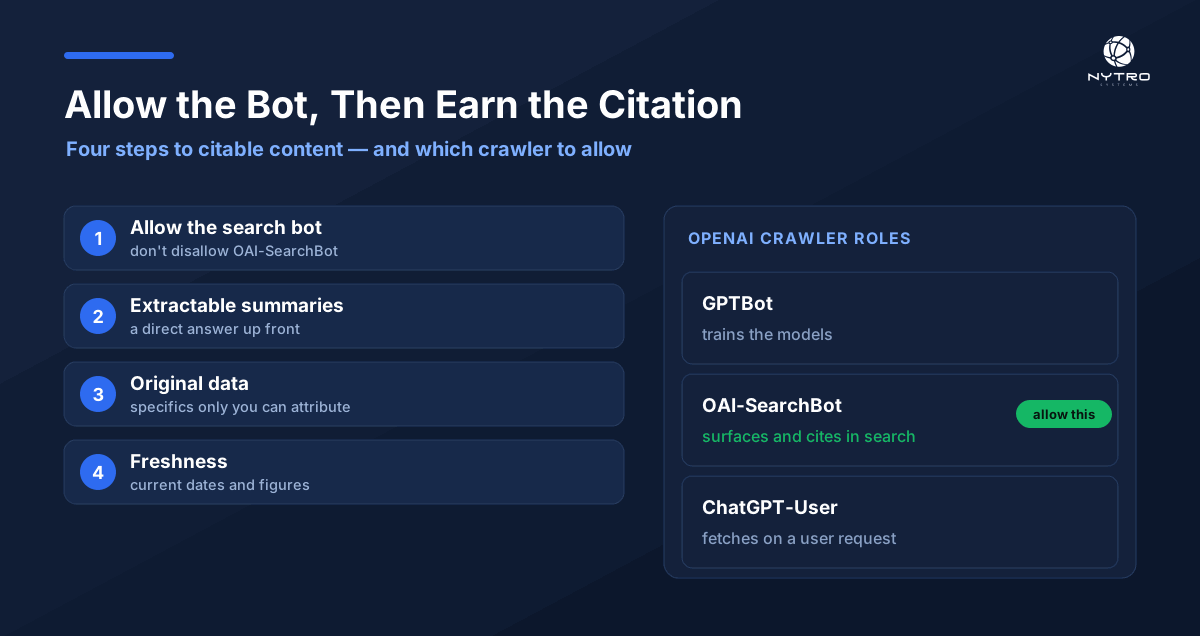
ChatGPT citation optimization: allow the search bot, then win the citation with extractable summaries, original data, and freshness.
A ChatGPT Citation Optimization Checklist
Pulling the tactics into a sequence makes them repeatable. Run these in order, because the permissions steps gate everything after them.
First, audit robots.txt for OAI-SearchBot, confirm it is not disallowed, and add an explicit allowance if you want to be unambiguous. Second, confirm ChatGPT-User is allowed too, so ChatGPT can fetch your page on a user’s direct request. Third, decide GPTBot deliberately, allow or disallow based purely on your stance on training use, knowing it does not affect citation eligibility. Fourth, confirm the pages are otherwise reachable: no accidental blocks, no content hidden behind heavy rendering, reasonable load times. Fifth, write extractable summaries, a direct answer at the top of each section. Sixth, add original data and specifics that make your page the natural source. Seventh, keep content fresh, with accurate dates and current figures. Eighth, monitor by testing your target questions in ChatGPT with search enabled and recording whether you are cited.
Worked in order, this checklist covers both halves of ChatGPT citation optimization, permissions and content, and it front-loads the one-line fixes that most often unlock citations immediately. Allow for the roughly 24-hour delay OpenAI notes before robots.txt changes take effect for search when you judge the results.
Common ChatGPT Citation Optimization Mistakes
Most ChatGPT citation optimization failures trace back to a handful of avoidable errors, and naming them is the fastest way to self-diagnose.
The most damaging is blocking the wrong crawler, disallowing OAI-SearchBot (often by accident, inside a broad AI-bot block) and thereby removing the site from ChatGPT’s search answers. The second is assuming that blocking GPTBot protects citations or that allowing it earns them; GPTBot governs training use, not search citation. The third is treating reachability as sufficient, unblocking the crawler but leaving thin, generic content that gives ChatGPT no reason to cite you over anyone else. The fourth is publishing undifferentiated commodity content with no original data, so there is nothing that is uniquely yours to attribute. The fifth is letting content go stale, which quietly loses the freshness tiebreaker to better-maintained competitors. And the sixth is never measuring, not testing the actual questions in ChatGPT, so a blocking mistake or a content gap can persist for months unnoticed.
Each of these is fixable with the checklist above. The permissions mistakes are usually one-line corrections; the content mistakes are the ongoing editorial discipline that, done consistently across a site, compounds into durable citation visibility.
ChatGPT Citation Optimization vs Traditional SEO
It helps to place ChatGPT citation optimization beside traditional Search Engine Optimization, because the two share a foundation but diverge in what they optimize and how they are measured.
Traditional SEO is built around a search engine’s crawler, index, and ranking algorithm: you make a page crawlable and indexable, earn relevance and authority, and the reward is a ranked position a user clicks. The crawler you care about is the search engine’s own, and success shows up as rankings and organic clicks. ChatGPT citation optimization keeps the crawlability principle but points it at a different crawler, OAI-SearchBot, and a different reward: being cited as a source inside a conversational answer, often with no classic ranking involved at all. When you set out to optimize website for AI search on the ChatGPT surface specifically, the first question is not “where do I rank” but “can OpenAI’s search crawler reach me, and is my content worth quoting.”
What carries over is the discipline: both reward accessible, well-structured, genuinely useful, authoritative content, and both punish thin or inaccessible pages. What differs is the plumbing and the scoreboard. In traditional SEO you watch rank trackers and Search Console; in ChatGPT citation optimization you audit crawler permissions, publish extractable and original content, and measure by testing whether ChatGPT actually cites you. Treating the two as one continuous practice, shared content quality, different access and measurement layers, is the pragmatic way to run both without doubling the work.
Where NytroSEO Fits
ChatGPT citation optimization asks a site to stay both reachable and genuinely citable, correct crawler permissions, accessible pages, extractable summaries, original data, and freshness, and to hold all of that true across hundreds of pages over time. The permissions can be fixed once, but the content conditions drift constantly, which is where most citation programs lose ground.
That is the gap NytroSEO is built to close. Its Automatic SEO engine keeps pages crawlable and index-eligible and maintains optimized titles, descriptions, and structured data across the whole site, so the conditions for being retrieved and cited stay met without manual rework. For the deeper background, our overview of getting AI-search-ready walks through the metadata and structure AI retrieval depends on, our Ask Engine Optimization guide covers the extractable, answer-ready formatting that wins citations, and our LLM SEO strategies guide bridges classic ranking work into AI retrieval.
Want ChatGPT to cite your site? Sign up free and explore the NytroSEO system, or book a free strategy session.