Last updated: November 1, 2026
When Claude answers a question using the web, it surfaces the sources it drew on, which means there is a specific, winnable slot: being one of the pages Claude references in its response. Claude AI optimization is the practice of making your content both reachable by Claude’s search crawler and trustworthy enough to be cited. It rewards a particular kind of content, verifiable, precise, and balanced, because that is the kind of content an accuracy-focused assistant is comfortable quoting.
This guide covers Claude AI optimization end to end: what it is, why it starts with allowing Claude-SearchBot, the real differences between Anthropic’s three crawlers, ClaudeBot, Claude-SearchBot, and Claude-User, and the content signals that make Claude cite your page. The emphasis throughout is on the things that distinguish Claude from other AI surfaces: a strong preference for claims that can be checked and language that does not overreach.
Lee Agam, CEO of Nytro Systems, frames Claude AI optimization as two linked jobs. The first is permissions: Claude cannot cite a page its search crawler was never allowed to read, and a broad “block the AI bots” rule often blocks exactly the crawler you want. The second is credibility: in his experience, the content that earns Claude citations is the content that states claims plainly, backs them with sources, and avoids hype, the opposite of thin, overstated marketing copy. His guidance is to fix the permissions once and then invest in verifiable, well-structured content, because that quality is what compounds across a whole site, and keeping it consistent everywhere is what automation is for.
What Is Claude AI Optimization?
Claude AI optimization is the practice of preparing your website so that Claude, Anthropic’s AI assistant, which added a web search feature in 2025, can retrieve your content and reference it as a source when it answers a user’s question. It has a technical half, which is about letting the right crawler reach your pages, and an editorial half, which is about writing content credible enough that Claude will cite it.
The target is specific. When Claude uses the web to answer, it surfaces the sources behind its response, so Claude AI optimization aims to make your page one of those cited sources. That is a different goal from classic ranking: there is no blue-link list to climb, only an answer and the references that support it. Being the reference is the prize.
This places Claude AI optimization alongside broader AI Search optimization and Answer Engine Optimization, the content fundamentals are shared across AI surfaces, but with a platform-specific character. Claude’s design leans heavily toward helpfulness, accuracy, and honesty, which in practice means it favors content that is verifiable and measured over content that is vague or overstated. Optimizing for Claude is, to an unusual degree, optimizing for trustworthiness.
Claude AI Optimization Starts with Claude-SearchBot
The crawler that matters most for Claude AI optimization is Claude-SearchBot. According to Anthropic’s own documentation, Claude-SearchBot navigates the web to improve search result quality for users, analyzing content to improve the relevance and accuracy of search responses. If you want Claude to be able to surface and cite your site in its search answers, this is the crawler that needs access.
The warning Anthropic attaches to it is the key fact. Blocking Claude-SearchBot, Anthropic states, may reduce your site’s visibility and accuracy in user search results. In other words, a robots.txt rule that disallows Claude-SearchBot can quietly remove your pages from what Claude can reference. As with other AI crawlers, many sites block this one by accident, sweeping it into a broad rule meant only to stop training use, and in doing so, they disqualify themselves from citations they would have wanted.
The fix is a robots.txt audit. Confirm Claude-SearchBot is not disallowed; an explicit allowance is the clearest signal of intent. Add a User-agent: Claude-SearchBot group with Allow: / to make the intent unambiguous.
Two practical points follow. First, being reachable makes you eligible, not cited, the content signals later in this guide decide whether Claude actually uses your page. Second, the same baseline applies here as everywhere in AI Search Ranking: retrievability first, credibility second. Get the crawler in, then give Claude a reason to trust and reference you.
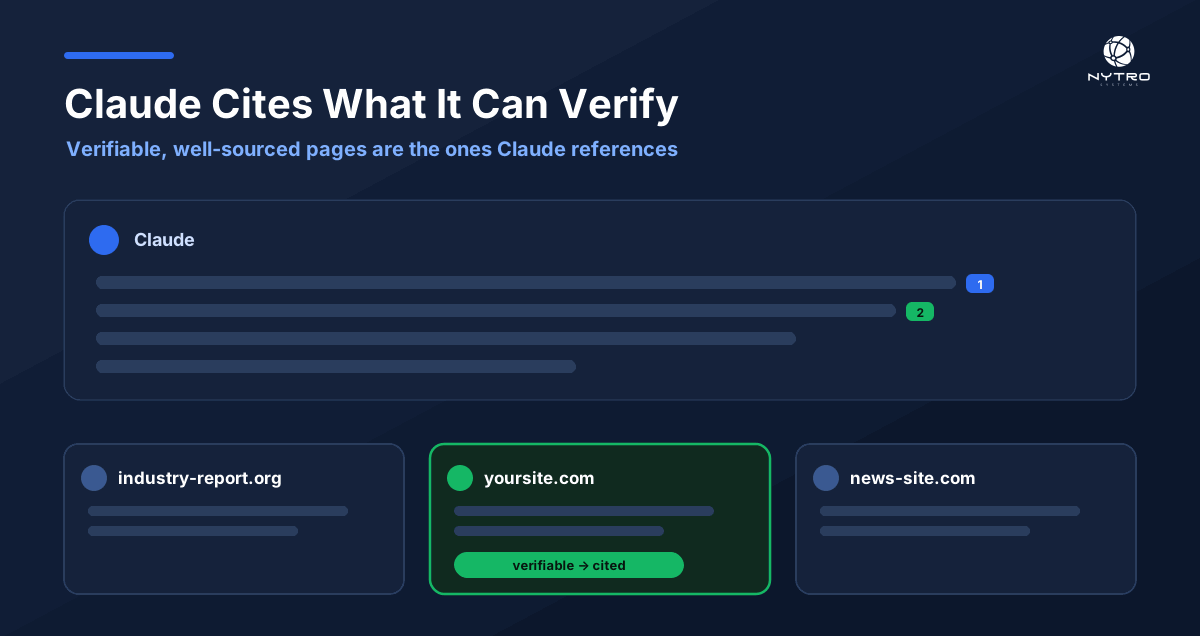
The goal of Claude AI optimization: be the evidence-rich page Claude cites in its answer.
ClaudeBot vs Claude-SearchBot vs Claude-User
Much of the confusion in Claude AI optimization comes from treating Anthropic’s crawlers as one thing. They are three, with distinct jobs, and blocking one has very different consequences from blocking another. Anthropic documents each separately, and independent coverage of the three Claude crawlers has summarized how they differ.
ClaudeBot is the training crawler. Anthropic describes it as helping enhance the utility and safety of its generative AI models by collecting web content that could potentially contribute to their training. Disallowing ClaudeBot signals that your material should be excluded from future training datasets, a legitimate choice, but it does not control whether Claude can cite you in search. Blocking ClaudeBot is a training decision, not a citation decision.
Claude-SearchBot is the search crawler. As covered above, it navigates the web to improve search result quality, and it governs whether your content can be surfaced and cited in Claude’s search answers. If citations are the goal, this is the crawler to allow.
Claude-User is the user-triggered agent. Anthropic says it supports Claude AI users: when someone asks Claude a question, Claude may visit websites through Claude-User to help answer it. Blocking it stops Claude from retrieving your content for those user queries, which Anthropic notes may reduce your site’s visibility in user-directed web search.
The practical rule is clean: for Claude AI optimization, allow Claude-SearchBot and Claude-User so Claude can both index and fetch your content, and decide on ClaudeBot separately based on how you feel about training use. Conflating the three is exactly how sites block the one that matters.
Content Signals for Claude AI Optimization
Once Claude can reach your pages, Claude AI optimization becomes a credibility problem. Claude is built to be helpful, accurate, and honest, so the content it is most comfortable citing shares those properties. Four signals do most of the work, and they lean harder on verifiability and balance than optimization for other surfaces does.
The first is verifiable claims. Statements that can be checked, tied to data, named sources, or concrete specifics, are safer for Claude to reproduce and attribute than sweeping assertions. A page full of unverifiable superlatives gives a careful assistant little it can confidently cite. The second is cited sources. Content that itself references credible, authoritative sources signals reliability, and a well-sourced page is a more comfortable citation than an unsupported one. The third is precise definitions and clear answers: a crisp, self-contained explanation of a term or a direct answer to the question gives Claude a clean passage to lift and attribute, where a vague or meandering one does not. The fourth is balanced language. Measured, non-overstated writing that acknowledges nuance and limits reads as more trustworthy than hype, and it aligns with the kind of careful framing Claude tends to prefer.
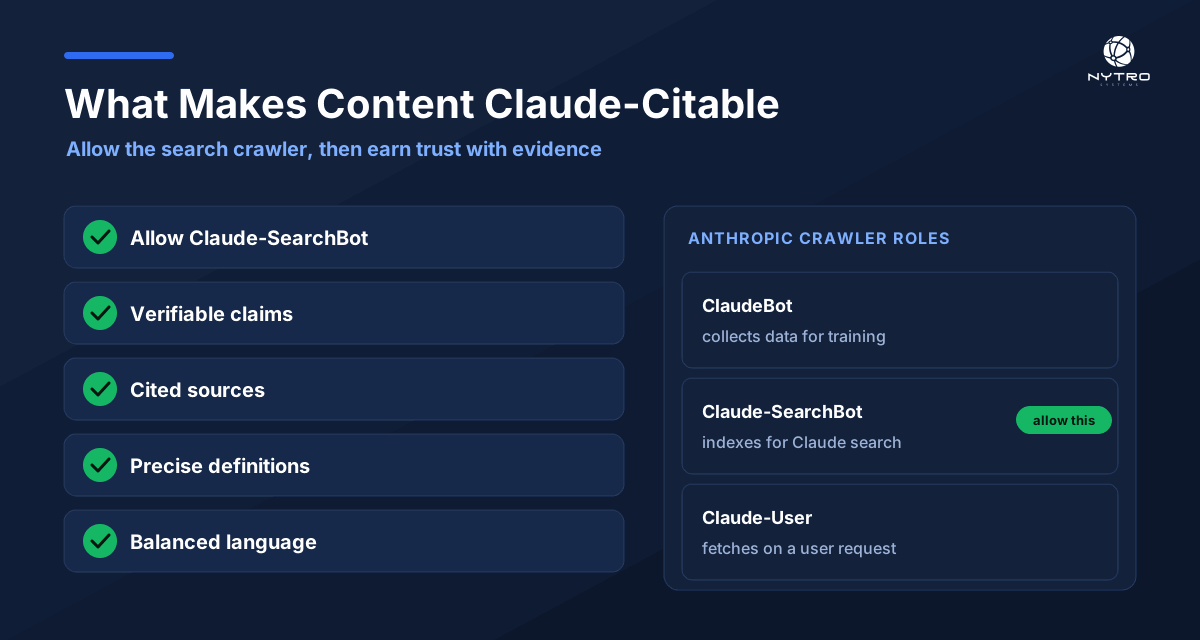
Claude AI optimization: allow the search crawler, then win citations with verifiable, well-sourced, precise, balanced content.
Put together, these signals describe a page that is easy to trust: factual, sourced, clearly defined, and measured. That is the heart of Claude AI optimization at the content level, and it is a slightly different emphasis from optimizing for engines that reward confident, punchy phrasing. With Claude, restraint and evidence are features, not weaknesses, the page that overstates its case is the page Claude is least likely to cite.
A Claude AI Optimization Checklist
Turning the tactics into a sequence makes them repeatable. Run these in order, because the permissions steps gate everything after them.
First, audit robots.txt for Claude-SearchBot, confirm it is not disallowed, and add an explicit allowance if you want to be unambiguous. Second, confirm Claude-User is allowed too, so Claude can fetch your page when a user’s question points at it. Third, decide ClaudeBot deliberately, allow or disallow based purely on your stance on training use, knowing it does not affect citation eligibility. Fourth, confirm the pages are otherwise reachable: no accidental blocks, no content hidden behind heavy rendering, reasonable load times. Fifth, make claims verifiable, tie assertions to data, sources, or concrete specifics. Sixth, cite your own sources, so the page signals reliability. Seventh, write precise definitions and lead sections with a direct answer. Eighth, keep the language balanced and measured, avoiding hype. Ninth, monitor by testing your target questions in Claude with web search and recording whether and how you are cited.
Worked in order, this checklist covers both halves of Claude AI optimization, permissions and credibility, and it front-loads the one-line robots.txt fix that most often unlocks eligibility. The credibility steps are the ongoing editorial discipline, and they happen to be good writing practice regardless of platform.
Common Claude AI Optimization Mistakes
Most Claude AI optimization failures trace to a few avoidable errors, and naming them is the fastest way to self-diagnose.
The most damaging is blocking the wrong crawler, disallowing Claude-SearchBot, often by accident inside a broad AI-bot block, and thereby reducing your visibility in Claude’s search answers. The second is assuming that blocking ClaudeBot protects or earns citations; ClaudeBot governs training use, not search citation. The third is treating reachability as sufficient, unblocking the crawler but publishing thin or unverifiable content Claude has no confident reason to cite. The fourth is leaning on hype and unsupported superlatives, which an accuracy-focused assistant is especially reluctant to reproduce. The fifth is omitting sources, leaving claims unverifiable and the page less citable. And the sixth is never measuring, not testing the actual questions in Claude, so a blocking mistake or a credibility gap can persist unnoticed. When you set out to optimize website for AI search on the Claude surface specifically, these are the errors to rule out first.
Each is fixable with the checklist above. The permissions mistakes are usually one-line corrections; the credibility mistakes are the editorial discipline, verifiable, sourced, measured content, that compounds into durable citation visibility.
Claude AI Optimization vs Traditional SEO
It helps to set Claude AI optimization beside traditional Search Engine Optimization, because the two share a foundation but optimize for different outcomes and are measured in different ways.
Traditional SEO is built around a search engine’s crawler, index, and ranking algorithm: you make a page crawlable and indexable, earn relevance and authority, and the reward is a ranked position a user clicks. The crawler you care about is the search engine’s, and success shows up as rankings and organic clicks. Claude AI optimization keeps the crawlability principle but points it at a different crawler, Claude-SearchBot, and a different reward: being cited as a source inside Claude’s answer, often with no classic ranking involved. It also tilts the content emphasis: where classic SEO tolerates, and sometimes rewards, confident marketing language, Claude AI optimization specifically favors verifiable, balanced, well-sourced writing.
What carries over is the discipline. Both reward accessible, well-structured, genuinely useful content, and both punish thin or inaccessible pages. What differs is the plumbing and the scoreboard, a different crawler to allow, and a different definition of success, plus Claude’s unusually strong preference for evidence over assertion. Treating the two as one continuous practice, with shared content quality and a Claude-specific credibility layer, is the efficient way to run both without doubling the work.
Where NytroSEO Fits
Claude AI optimization asks a site to stay both reachable and genuinely credible, correct crawler permissions, accessible pages, verifiable and well-sourced content, precise definitions, and balanced language, and to hold all of that true across hundreds of pages over time. The permissions can be set once, but the content conditions drift, which is where most citation programs lose ground.
That is the gap NytroSEO is built to close. Its Automatic SEO engine keeps pages crawlable and index-eligible and maintains optimized titles, descriptions, and structured data across the whole site, so the conditions for being retrieved and cited stay met without manual rework. For the deeper background, our overview of getting AI-search-ready walks through the metadata and structure AI retrieval depends on, our Ask Engine Optimization guide covers the precise, answer-ready formatting that wins citations, and our overview of building AI brand visibility explains the entity signals that help assistants trust and name your brand.
Want Claude to cite your site? Sign up free and explore the NytroSEO system, or book a free strategy session.