Last updated: November 2, 2026
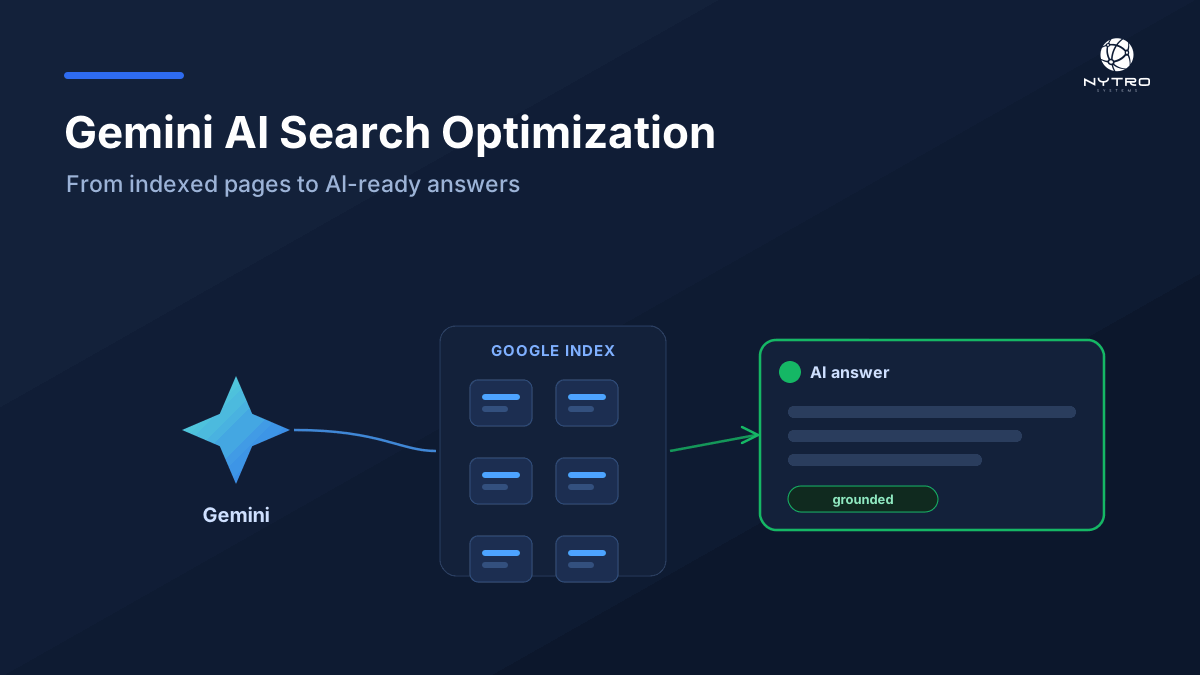
Gemini, Google’s AI assistant, does not answer current questions from memory alone, when it needs live information, it draws on Google’s web search, which means the path to showing up in Gemini runs through the same index that powers Google Search. Gemini AI search optimization is the practice of preparing your content so Gemini can find it, trust it, and use it in an answer. The reassuring part is that it does not start with a new, Gemini-specific tactic. It starts with fundamentals you may already have: being indexed, structured, and clear about who you are.
This guide maps Gemini AI search optimization from the ground up. It explains what the term means, why Gemini’s grounded answers depend on Google’s index, how the same foundation serves every Google AI surface, Gemini Apps, AI Overviews, AI Mode, and Deep Research, and the specific fixes that turn an indexed page into an AI-ready answer: indexing, structure, entities, and schema. The goal is a clear foundation-first plan rather than a scramble for platform tricks.
Lee Agam, CEO of Nytro Systems, is blunt about where the leverage is. In his view, Gemini AI search optimization is mostly Google SEO wearing a new label: because Gemini’s web answers lean on Google’s index, the sites that are cleanly indexed, well-structured, and entity-clear are the ones Gemini can actually reach and reason about. His caution is against teams treating each AI surface as a separate project, the same foundation feeds all of them, and his advice is to fix that shared base once, keep it healthy everywhere, and let one investment pay off across Gemini, AI Overviews, and classic Search alike. Automating that consistency, he notes, is what makes it realistic at scale.
What Is Gemini AI Search Optimization?
Gemini AI search optimization is the practice of preparing your website so Google’s Gemini can retrieve it, understand it, and use it when it answers a user’s question with live web information. It spans the places Gemini draws on current information, the Gemini apps, Deep Research, and Google’s broader AI search surfaces, and it rests on the same foundation that governs classic Google visibility.
The target is worth being precise about. When Gemini needs up-to-date information, it reaches into Google’s web search rather than relying only on what it learned in training. Gemini integrates with Google Search, for example, offering to verify its responses against Search, and its Deep Research feature autonomously browses and synthesizes information across sources. In every case, the content Gemini can use is content Google has crawled and indexed. Gemini AI search optimization aims to make your pages part of that reachable, trustworthy set.
This makes it a close relative of broader AI Search optimization and of ordinary Search Engine Optimization, with a Google-centric character. Because Gemini’s grounding runs through Google’s index, optimizing for Gemini is, to a large degree, doing excellent Google SEO and then adding the structure and entity clarity that help an AI understand and reuse your content. The fundamentals are not a prerequisite you rush past; they are the substance of the work.
Why Gemini AI Search Optimization Depends on Google’s Index
The single most grounding fact about Gemini AI search optimization is that Gemini’s web answers depend on Google’s index. Google’s own guidance on its AI features is explicit that its AI experiences, such as AI Overviews and AI Mode, are built on the Search index, that standard SEO best practices still apply, and that a page must be indexed and eligible to be shown to appear. Gemini’s grounded, up-to-date answers sit on that same foundation.
The consequence is blunt and clarifying. If a page is not indexed, it cannot be retrieved or used in a grounded Gemini answer, there is nothing for the system to reach. If it is blocked from crawling, carries a stray noindex, or is buried and rarely recrawled, it is handicapped before any AI-specific consideration applies. This is why the first move in Gemini AI search optimization is not a Gemini tactic at all: it is confirming your important pages are crawlable, indexed, and eligible to be shown. When teams try to optimize website for AI search while their key pages sit un-indexed, they are decorating a room the AI cannot enter.
It is also why good AI Search Ranking and Gemini readiness ask for the same things. The signals that help a page earn visibility in Google, crawlability, relevance, quality, authority, are the signals that make it reachable and trustworthy for Gemini. Rather than a separate discipline, Gemini AI search optimization is the familiar foundation, maintained well, with a few AI-aware additions layered on top.
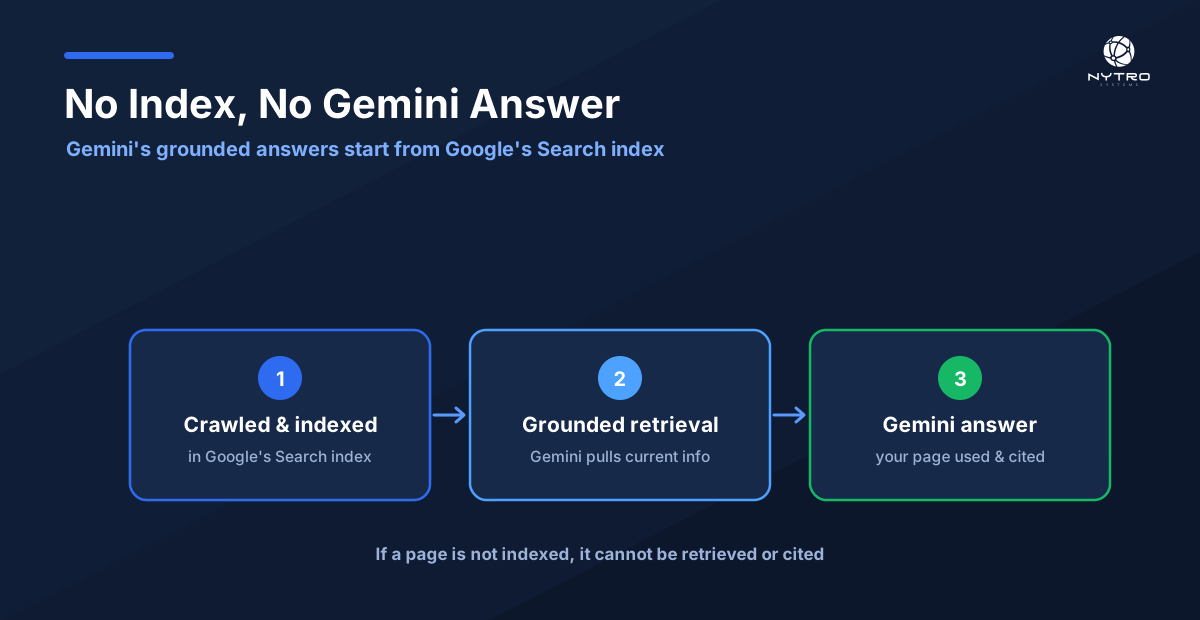
Gemini AI search optimization: Gemini’s grounded answers are built from Google’s index, so indexing is the entry point.
Gemini AI Search Optimization Across Google’s AI Surfaces
One of the most practical things about Gemini AI search optimization is that the work is shared across Google’s AI surfaces. The same indexed, well-structured content that helps Gemini also feeds AI Overviews, AI Mode, and Deep Research, because they all draw on the same underlying Search index. You are not optimizing four times; you are optimizing one foundation that surfaces in four places.
Consider the surfaces in turn. The Gemini apps answer conversational questions and, when needed, ground responses in current web information. AI Overviews present synthesized summaries above many search results, built from indexed, snippet-eligible pages. AI Mode composes generative answers to queries, grounded in the same index. And Deep Research autonomously browses and synthesizes across many sources to produce longer, structured reports. Different experiences, different interfaces, but one dependency on crawlable, indexed, trustworthy content.
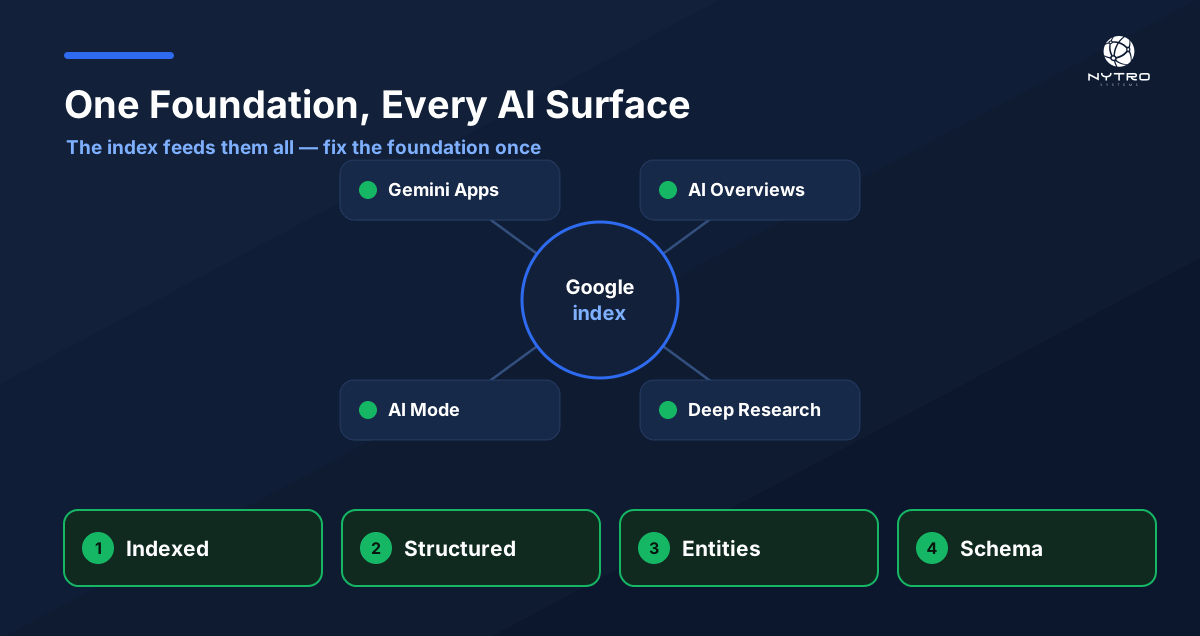
One foundation, many surfaces: Google’s index feeds Gemini, AI Overviews, AI Mode, and Deep Research.
The strategic payoff is efficiency. Because the surfaces share a foundation, improvements compound: making a page cleanly indexed, well-structured, and entity-clear raises its chances across all of them at once. That is the opposite of the exhausting “a new strategy for every AI tool” treadmill, and it is the most reassuring argument for treating Gemini AI search optimization as foundation work rather than platform chasing.
Entities and Structured Answers for Gemini AI Search Optimization
Once a page is reachable, Gemini AI search optimization becomes a question of comprehension: helping the system understand what your content is about and lift a clean answer from it. Two things do most of that work, entity clarity and structured answers.
Entity clarity means describing your brand, products, people, and key concepts consistently and unambiguously across your site, so the system can connect your pages to a coherent understanding of who you are and what you cover. Consistent naming, clear “about” and product information, and structured data that reinforces those entities all help an AI resolve ambiguity and trust that it understands your content. When your entities are muddled or described differently on every page, the system has less confidence to reason with and less reason to rely on you.
Structured answers mean organizing content so a specific answer is easy to locate and reuse: a direct response in the first sentence or two of a section, question-style headings, scannable steps, compact comparison tables, and relevant schema that confirms what the page contains. This is the same answer-ready structure that helps across every AI surface, and it is what turns an indexed page into one Gemini can actually quote. Together, entity clarity and structured answers are the comprehension layer that sits on top of the indexing foundation, the difference between being reachable and being usable.
A Gemini AI Search Optimization Checklist
Pulling the discipline into a sequence makes it repeatable. These four foundation fixes, run in order, cover the bulk of Gemini AI search optimization, because each builds on the one before it.
First, get indexed. Confirm that your important pages are crawlable, free of stray noindex directives, and actually indexed in Google, verify coverage and eligibility in Search Console, and resolve anything wrongly excluded. Nothing else matters until this is true. Second, structure the content. Lead each section with a direct answer, use question-style headings, and break information into scannable units so an AI can locate and lift a response. Third, clarify entities. Describe your brand, products, and key concepts consistently across the site, with clear “about” and product information, so the system understands who you are. Fourth, add schema. Use relevant structured data, Organization, Product, FAQPage, Article, and the like, that accurately reflects the visible content and reinforces your entities.
Worked in order, these four fixes, indexed, structured, entities, schema, are the core of Gemini AI search optimization, and they pay off across every Google AI surface at once. None of them is a Gemini-only trick; they are the shared foundation, done well, which is exactly why the investment is so efficient.
Common Gemini AI Search Optimization Mistakes
Most Gemini AI search optimization failures are ordinary foundation problems with higher stakes, because the same index that gates classic visibility now also gates the AI surfaces.
The most common is neglecting indexing, assuming the AI will “figure it out” while key pages sit un-indexed, blocked, or rarely recrawled. It will not; an un-indexed page is invisible to Gemini. The second is treating each AI surface as a separate project and spreading effort thin, instead of investing in the shared foundation that feeds all of them. The third is muddled entities, describing your brand and products inconsistently across pages, so the system cannot build a confident understanding of who you are. The fourth is thin or unstructured content that gives the AI nothing clean to lift, even when the page is technically reachable. The fifth is schema that misrepresents the page, which erodes rather than builds trust. And the sixth is never measuring, not watching Search Console or testing your target questions in Gemini and AI Overviews, so a foundation gap can persist unnoticed.
Each is fixable with the checklist above. The reassuring pattern is that the corrective actions are the ones good SEO teams already know how to take, indexing hygiene, clear structure, consistent entities, valid schema, now aimed at a foundation that serves Gemini and classic Search together.
How to Measure Gemini AI Search Optimization
Measuring Gemini AI search optimization is harder than tracking a classic ranking, because much of the value happens inside a grounded answer or a Deep Research report rather than as a conventional click. But a few signals, read together, tell you whether the foundation work is landing.
Start with Search Console, since Gemini’s grounding and Google’s other AI surfaces all draw on the same index. Use coverage and URL inspection to confirm your important pages are indexed and eligible, the non-negotiable precondition, and watch impression trends on your target query clusters, since surfacing in AI experiences often shows up as held or rising impressions even when click behavior shifts. Then test directly: periodically ask Gemini and check AI Overviews for your target questions, recording whether your content is used or cited and how your brand is described. Because these systems frequently decompose a question into several sub-queries before answering, a retrieval pattern industry analysis has examined in depth, a page that covers a topic and its natural sub-questions has more chances to be surfaced, so track coverage across a cluster rather than a single phrase. Finally, watch referral traffic and branded search, which tend to rise as your visibility in AI answers improves.
No single number captures Gemini AI search optimization, so read these together and over time. A page that stays indexed and eligible, holds its impressions on the target cluster, and shows up when you test the questions is a page the foundation is working for, across Gemini and every other surface the index feeds.
Where NytroSEO Fits
Gemini AI search optimization rests on a foundation that has to stay healthy across an entire site, continuously: pages indexed and eligible, content structured, entities consistent, schema valid. On a large site, that foundation drifts, and drift is what quietly removes pages from everything the index feeds, Gemini, AI Overviews, AI Mode, and classic results alike.
That is the gap NytroSEO is built to close. Its Automatic SEO engine keeps pages indexed and snippet-eligible and maintains optimized titles, descriptions, and structured data across the whole site, so the shared foundation that feeds Gemini and every other Google AI surface stays met without manual rework. For the deeper background, our overview of getting AI-search-ready walks through the metadata and structured data that eligibility depends on, our Ask Engine Optimization guide covers the answer-ready structure these surfaces reward, and our overview of building AI brand visibility explains the entity signals that help AI understand and trust your brand.
Want your site ready for Gemini and Google’s AI surfaces? Sign up free and explore the NytroSEO system, or book a free strategy session.