Last updated: July 16, 2026
Ask ChatGPT, Perplexity, or Google’s AI Overviews to recommend a tool, and they answer with brand names, not a list of ten links. The brands that get named are the ones these systems recognize and trust as distinct, well-understood entities. That recognition is not luck. It is the product of entity based ai seo: the practice of making your brand a clear, connected, well-supported entity that AI systems can identify and cite with confidence. This guide explains what an entity is, why AI search increasingly runs on entities rather than keywords, and exactly how to build your brand entity and scale the work across a large site. We optimize on-page signals across thousands of pages, so the advice here focuses on concrete moves you can implement and measure.
What Is an Entity, Really?
An entity is a distinct, uniquely identifiable thing, a person, company, product, place, or concept, that a machine can tell apart from everything else. “NytroSEO” is an entity. “Lee Agam” is an entity. “Automatic SEO” is a concept entity. Search engines store these in a knowledge graph, a giant network of entities and the relationships between them, so they can reason about the world rather than just matching strings of text.
The shift matters because keywords are ambiguous and entities are not. The word “apple” could mean a fruit or a company; the entity resolves which one you mean based on context and connections. Google has organized information around entities since it launched its Knowledge Graph, and you can even query it through the Google Knowledge Graph Search API. AI systems inherit this entity-first view. When they compose an answer, they are reasoning over entities and their attributes, so being a recognized entity is the price of admission to being named at all.
A quick example shows why this matters for your brand. If an AI system knows “NytroSEO” only as a string of characters that sometimes appears near the words “SEO” and “automation,” it will hesitate to recommend you, because it cannot confidently say what you are. If instead it holds you as an entity, an automatic SEO platform, founded by a named person, used by agencies, connected to the concept of on-page automation, it can slot you into an answer the moment a relevant question appears. The difference between those two states is not more keywords. It is a clearer, better-connected identity, which is exactly what entity work builds.
What Entity Based AI SEO Actually Means
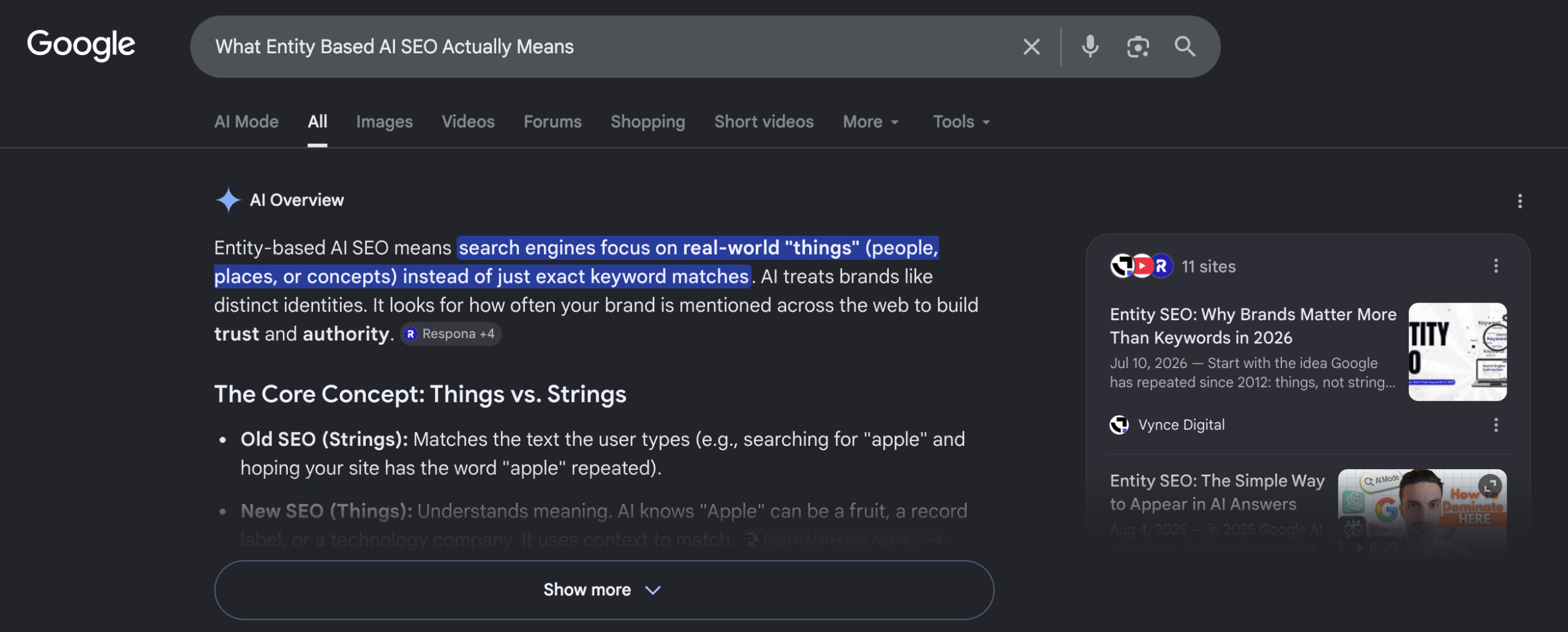
Entity based ai seo is the discipline of establishing your brand, people, and products as recognized entities, then reinforcing the relationships and attributes that let AI systems describe you accurately. It is a meaningful evolution of Semantic AI SEO, which focuses on meaning and context rather than exact-match keywords; entity work takes that a step further by making the underlying things themselves machine-identifiable.
In practice, entity based ai seo answers three questions on a machine’s behalf. Who or what is this brand? What is it associated with, its category, products, people, and topics? And can that be trusted, based on consistent, corroborated information across the web? Get those right and an AI system can confidently say “NytroSEO is an automatic SEO platform founded by Lee Agam” instead of omitting you because it is unsure who you are. This is the foundation beneath AI brand visibility: you cannot be a visible brand in AI answers if the system cannot first resolve you as an entity.
Why Entity Based AI SEO Beats Keyword-Only Optimization
Keyword-only optimization tries to match the words in a query. Entity based ai seo builds the underlying understanding that lets a system answer questions it was never explicitly optimized for. That difference is decisive in AI search, where answers are synthesized across many related sub-questions rather than served from a single ranked page.
Consider User Search Intent Optimization, which aligns content with what a searcher actually wants. Entities supercharge it: when a system understands that your brand is an automatic SEO platform used by agencies, it can surface you for intent-rich prompts like “tools that help agencies scale on-page SEO” even if those exact words never appear on your page. Keywords match phrasing; entities match meaning and relationships. As AI systems handle more varied, conversational queries, the brands defined as clear entities get pulled into more answers, while keyword-only pages are limited to the phrases they explicitly target. This is also why entity work compounds your ai search visibility over time, each reinforced relationship makes you eligible for a wider set of questions.
There is a trust dimension too. AI systems are cautious about recommending things they cannot verify, because a confident answer built on a misidentified brand is a costly error. A well-formed entity, corroborated by consistent information across many independent sources, lowers that risk for the system, it can name you because it can stand behind the description. This is the same logic behind experience, expertise, authoritativeness, and trust: a recognized entity with credentialed people and corroborated facts is simply safer to cite than an ambiguous string of text. In that sense, entity work is not a separate tactic from building authority; it is the machine-readable expression of it, which is why the two reinforce each other and compound.
How to Build Your Brand Entity: Entity Based AI SEO in Practice
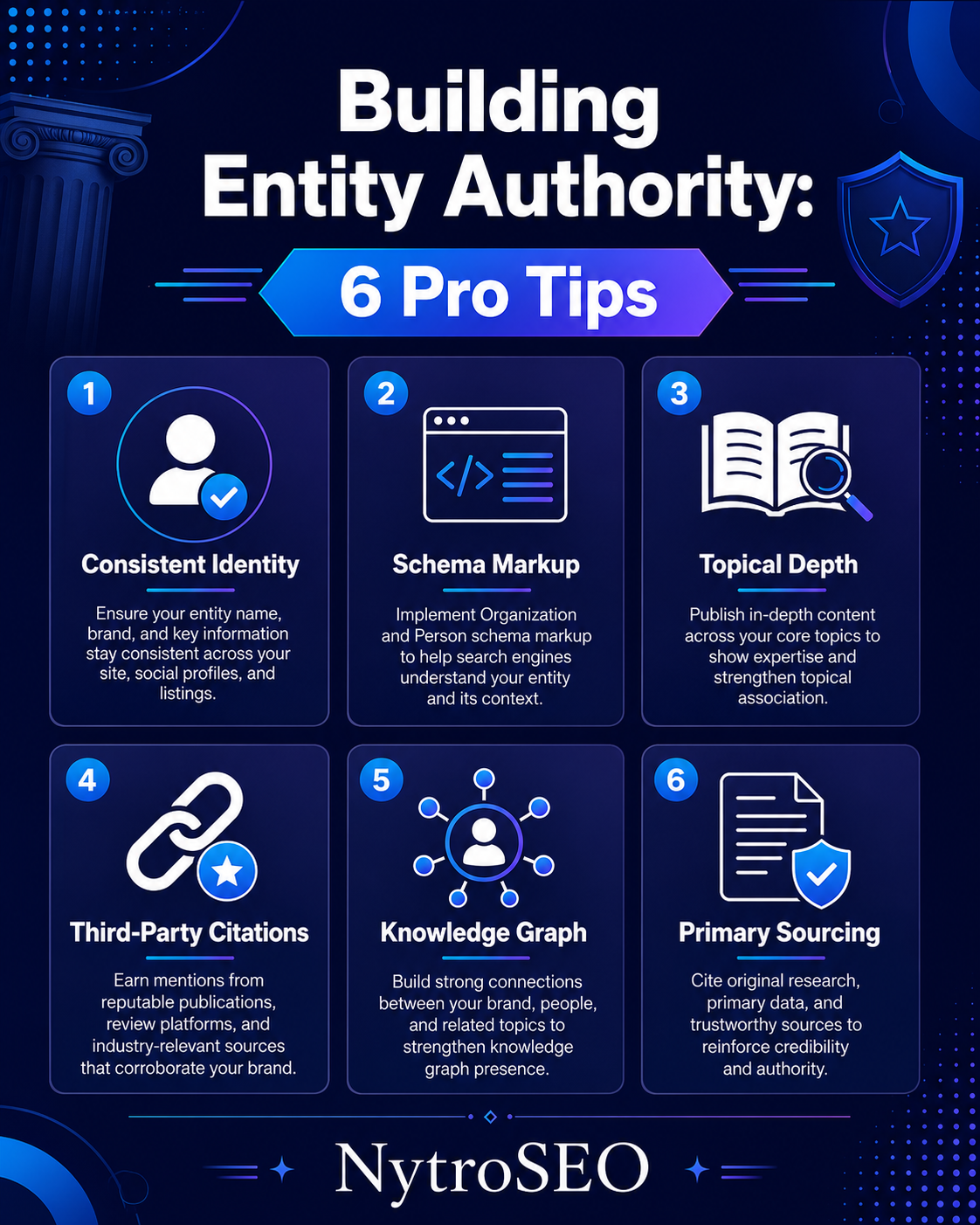
Building a brand entity is methodical, not mysterious. The goal is consistent, corroborated, machine-readable information that resolves who you are and what you are connected to. Here is the practical sequence.
- Establish a canonical identity. Add Organization schema to your site with structured data that names your brand, logo, founding, and social profiles, and connect people with Person schema. This gives machines an explicit, structured statement of who you are. Our explainer on how structured data works covers the mechanics, and the vocabulary itself is defined at schema.org/Organization.
- Claim and align your presence across the web. Ensure your brand name, description, and details are consistent on your site, your social profiles, review platforms, and business listings. Inconsistency confuses entity resolution; consistency reinforces it.
- Earn corroboration from authoritative sources. Entities become trusted when independent sources describe them the same way. A Wikipedia article and a Wikidata record, where your brand qualifies, are strong signals, as are mentions in credible publications.
- Build out your people as entities. Name your authors, give them real bios and credentials, and link their profiles. A recognized author entity, like our founder profile for Lee Agam, strengthens the experience and expertise signals AI systems weigh.
- Connect your entity to its topics. Publish depth across your core subjects so the graph associates your brand with them. The more consistently you cover automatic SEO, the more firmly you are linked to that concept.
Do this and you give AI systems a coherent, corroborated picture: a named brand, real people, clear associations, and trustworthy support.
Entity Based AI SEO Content Patterns That Work
Beyond schema and profiles, the way you write reinforces or weakens your entity. A few content patterns consistently help.
- Define entities explicitly. When you introduce your brand, product, or a key concept, state plainly what it is in one clean sentence, the way a reference would. This gives machines a liftable definition and reduces ambiguity.
- Use consistent naming. Refer to your brand and products the same way every time. Switching between variants (“NytroSEO,” “Nytro,” “the Nytro tool”) dilutes the signal that these all point to one entity.
- Show relationships. Connect your entity to related ones in context, the category you belong to, the people behind you, the problems you solve, the platforms you integrate with. These co-occurrences are how a graph learns your associations.
- Support claims with evidence. Cited sources and specific data raise trust, which matters for entities as much as for pages. Research on generative engines found that adding cited sources and statistics measurably increased content’s visibility in AI answers; you can read the GEO study on arXiv. An entity described with corroborated facts is one a system will cite with confidence.
A Quick Worked Example
Suppose an AI system keeps recommending competitors when users ask for automatic SEO tools, and your brand is absent. Entity based ai seo gives you a diagnosis and a fix.
You add Organization and Person schema so the system has an explicit statement of who you are and who founded you. You align your brand description across your site, social profiles, and listings so they all say the same thing. You publish depth on automatic SEO so the graph associates your brand with the concept. You earn a few corroborating mentions and, where you qualify, a Wikidata record. You name your authors and give them credentialed bios. Over time, the system’s uncertainty about you resolves. Where it once skipped you because it could not confidently say what you were, it now describes you accurately and includes you in relevant answers. Nothing here was a trick, it was giving machines a clear, corroborated identity to reason about.
How to Measure Your Brand Entity Strength
You can track whether your entity is getting clearer to machines, rather than guessing. A few practical checks tell you where you stand. Search your brand name in Google and see whether a knowledge panel appears; a panel is direct evidence that Google recognizes you as an entity. Query the Google Knowledge Graph Search API for your brand to see whether it is resolved and how it is described. Validate your Organization and Person schema in Google’s Rich Results Test so you know the structured statements are being read. Then run a monthly prompt sample across ChatGPT, Perplexity, and AI Overviews, asking questions where your brand should appear, and log whether the systems describe you accurately, mention you, or confuse you with something else.
Track the trend: as your schema, consistency, and corroboration improve, the descriptions should get more accurate and the mentions more frequent. Two signals matter most, recognition (does the system know what you are?) and accuracy (does it describe you correctly?). Watching both turns entity based ai seo from an abstract idea into a measurable program tied to your ai search visibility.
Common Mistakes in Entity Based AI SEO
A few errors quietly keep brands invisible as entities.
- Inconsistent naming and details. If your brand name, description, or founder vary across the web, entity resolution stays fuzzy. Standardize everything.
- Skipping structured data. Without Organization and Person schema, you leave machines to infer your identity from prose. Make it explicit.
- No author entities. Anonymous content weakens experience and expertise signals. Name and credential your authors.
- Chasing keywords instead of associations. Stuffing terms does not build an entity. Depth and consistent relationships do.
- Treating it as a one-page task. Entity signals live across your whole site and the wider web. Consistency at scale is what makes the identity stick.
How to Scale Entity Based AI SEO Across Your Whole Site
The identity work above is straightforward on your homepage and a few key pages. The difficulty is consistency at scale: entity signals depend on the same names, descriptions, structured data, and associations appearing coherently across hundreds or thousands of pages. Maintaining that by hand is where teams stall.
This is where automation earns its place. Our automated SEO software applies consistent, keyword-aligned metadata and structured signals across an entire site through a JavaScript snippet, without editing the CMS. It keeps titles, descriptions, and on-page signals aligned with your entity on every page, so your brand is described the same way sitewide rather than drifting page to page. For agencies and large-site owners, that consistency is what turns scattered mentions into a coherent, recognizable entity.
Automation does not replace the strategic work of earning corroboration and building authority, but it removes the manual bottleneck that lets entity signals drift page to page on a large site. The strategic playbook for the brand-level payoff lives in our guide to improving AI brand visibility for agencies, and the local dimension in our walkthrough of adding local business schema.
The Bottom Line on Entity Based AI SEO
AI search names brands it recognizes and trusts as entities. Establish a canonical identity with structured data, align your presence everywhere, earn corroboration, build your people as entities, and connect your brand to its topics, then keep it all consistent at scale. Do that and you move from a string of text a system is unsure about to a recognized entity it can confidently describe and cite.
Want to see how clearly AI systems can identify your brand today? Run a free visibility check and we will show you your structured-data, consistency, and authority gaps, and the fastest fixes to strengthen your brand entity. The brands that win in AI search are not always the ones with the most content; they are the ones a machine can identify with certainty and describe without hesitation.
Frequently Asked Questions
Entity based AI SEO is the practice of establishing your brand, people, and products as distinct, recognized entities that AI systems can identify, understand, and trust. Instead of matching keywords, it builds the machine-readable identity and relationships – through structured data, consistent information, and corroboration – that let AI search describe and cite your brand accurately.
Keyword SEO optimizes pages to match the words in a query. Entity based AI SEO builds the underlying understanding of who your brand is and what it is connected to, so AI systems can surface you for questions you never explicitly targeted. Keywords match phrasing; entities match meaning and relationships, which is what AI answers rely on.
Start with Organization and Person structured data that state who you are, then align your brand name and description consistently across your site, social profiles, and listings. Earn corroborating mentions from authoritative sources, add a Wikidata record where you qualify, name and credential your authors, and publish depth that links your brand to its core topics.
Structured data does not create authority by itself, but it is foundational. Organization and Person schema give machines an explicit, unambiguous statement of who you are and how you connect to people and topics. That clarity makes entity resolution easier and reliable, which is why structured data is a core, near-mandatory part of any entity based AI SEO program.
Yes. Named authors with real bios and credentials establish people as recognized entities and strengthen experience and expertise signals that AI systems weigh when deciding whom to trust. Anonymous content leaves those signals blank. Giving each author a credentialed profile, linked consistently, reinforces both the author entity and the brand entity behind them.