Last updated: July 16, 2026
Google now answers a large share of searches before a user scrolls to a single blue link. The AI Overview sits at the top of the page, summarizes an answer, and cites a handful of sources, and if your site is not among them, you lose the most valuable real estate on the results page. For anyone doing SEO in 2026, learning how to earn a place in Google AI Overviews is no longer optional. This guide explains what these overviews are, how Google assembles them, what Google itself recommends, and how to optimize your pages so they stay retrievable as the search experience keeps shifting. We optimize on-page signals across thousands of pages, so the advice here focuses on concrete moves rather than speculation about a black box.
What Are Google AI Overviews?
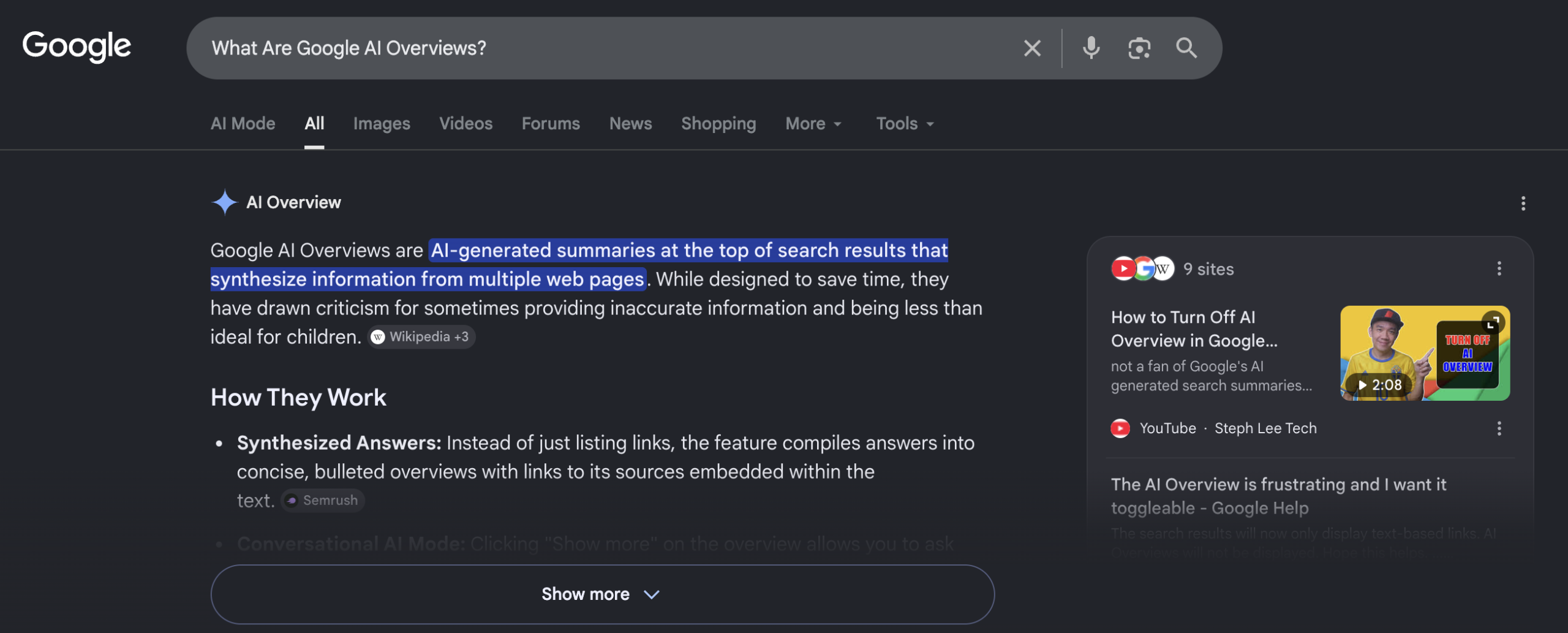
Google AI Overviews are AI-generated summaries that appear at the top of many search results, answering the query directly and linking to supporting sources. They evolved from what Google originally launched as the Google Search Generative Experience, an experiment in Search Labs, and have since rolled out broadly as a standard feature of the results page. The key thing to understand is that an overview is not a separate index. It is generated from the same web Google already crawls and ranks, layered with a generative model that composes the summary. So the pages eligible to appear are, broadly, the pages that already rank and earn trust for the query.
Content optimization for SGE, as the discipline was first called, has simply matured into optimizing for AI Overviews, and the fundamentals carry over. If your page is crawlable, relevant, authoritative, and clearly structured, it is a candidate. If it is blocked, thin, or buried, it is not. For the brand-level view of why appearing here matters, our guide on what AI brand visibility is and how to optimize for AI Overviews is a useful companion.
How Google AI Overviews Work: Query Fan-Out Explained
The mechanic that trips up most SEO teams is query fan-out. When you ask a question, Google does not just answer the single query you typed. It generates a set of related sub-questions behind the scenes, retrieves information for each, and synthesizes them into one overview. A search for “how to automate on-page SEO” might quietly spawn sub-queries about what on-page SEO includes, which tasks can be automated, what tools exist, and what the risks are.
This changes what “optimizing” means. A page targeting one narrow keyword can answer one sub-query, but a page that comprehensively covers a topic and its natural follow-ups can be pulled into many parts of the synthesized answer. That is why topical depth now beats single-keyword targeting, and why building clusters of related content is the strongest structural response to Google AI Overviews. We explore this shift in detail in our overview of LLM SEO strategies for AI search. The practical implication is direct: cover the whole question, not just the headline keyword, and you become eligible for more of every overview.
You can approximate the sub-questions Google generates without guessing. The “People also ask” box, the related searches at the bottom of the page, and autocomplete suggestions all surface the adjacent questions Google associates with a topic. Build a page (or a cluster) that answers those adjacent questions directly, each under its own clear subheading, and you cover more of the fan-out surface. A single pillar page that resolves the headline query plus six related sub-questions is far more likely to be drawn into an overview than six thin pages that each answer one. Map the questions first, then structure the content to answer each one cleanly, and the topical depth follows naturally.
What Google Says About Optimizing for Google AI Overviews
It is worth grounding strategy in Google’s own guidance rather than folklore. In its documentation on AI features and your website, Google is consistent and blunt: there is nothing special to do for AI features beyond following its long-standing best practices. The same crawlable, helpful, reliable, people-first content that ranks well is what feeds AI Overviews.
A few points from Google’s position are worth internalizing. First, do not write separate content “for AI.” Chunking pages into machine-only fragments or spinning up thin AI-targeted variants can trip Google’s scaled-content-abuse policies and rarely helps. Second, structured data is not required to appear in AI Overviews, though it remains good practice for clarity and eligibility for other features. Third, the fundamentals, helpful content, sound technical SEO, and demonstrated experience and expertise, are the levers. Google reiterated much of this when it broadened the feature from the Google Search Generative Experience into general availability, which it covered on the Google Search blog. The reassuring takeaway is that you do not need a parallel strategy. You need one strong set of pages that Google can read and trust.
Do Google AI Overviews Reduce Clicks?
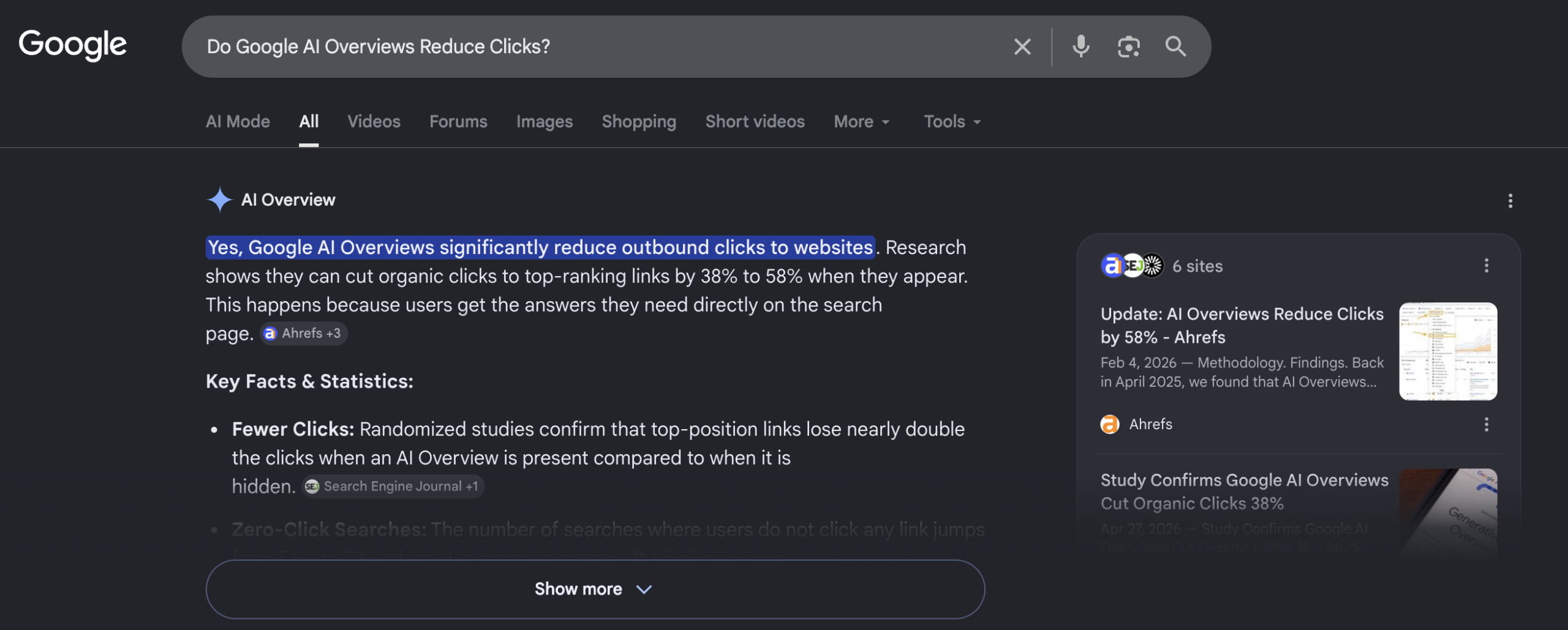
This is the anxious question behind every AI Overviews discussion, and the honest answer is that it depends on the query. For purely informational searches where the overview fully answers the question, click-through to sites can drop, because the user’s need is met on the results page. For commercial, comparison, and complex queries, the overview often acts as a starting point, and being cited within it can still drive qualified visits and brand exposure.
What is clear is that the results page changed shape, and some sites felt it sharply. We documented one such shift in our analysis of how more than 77% of sites lost visibility after Google’s 2025 SERP changes and the num100 update. The strategic response is not to fight the format but to earn presence inside it: if the overview is where attention concentrates, being a cited source there is the goal. Optimizing for zero-click visibility, brand mentions and citations that build recognition even without a click, becomes part of the plan.
It helps to reframe the metric you optimize for. In a world of overviews, impressions and citations matter alongside clicks, because a searcher who reads your brand as the cited authority inside an overview may return later through a direct or branded search, even if they did not click this time. That is the compounding value of appearing in overviews: repeated exposure as a trusted source shapes which brands people remember and seek out. Treating a citation as a win in its own right, not a consolation for a lost click, aligns your strategy with how people now research. The click may come later, on a higher-intent query, precisely because the overview introduced you first.
How to Optimize for Google AI Overviews: A Practical Framework
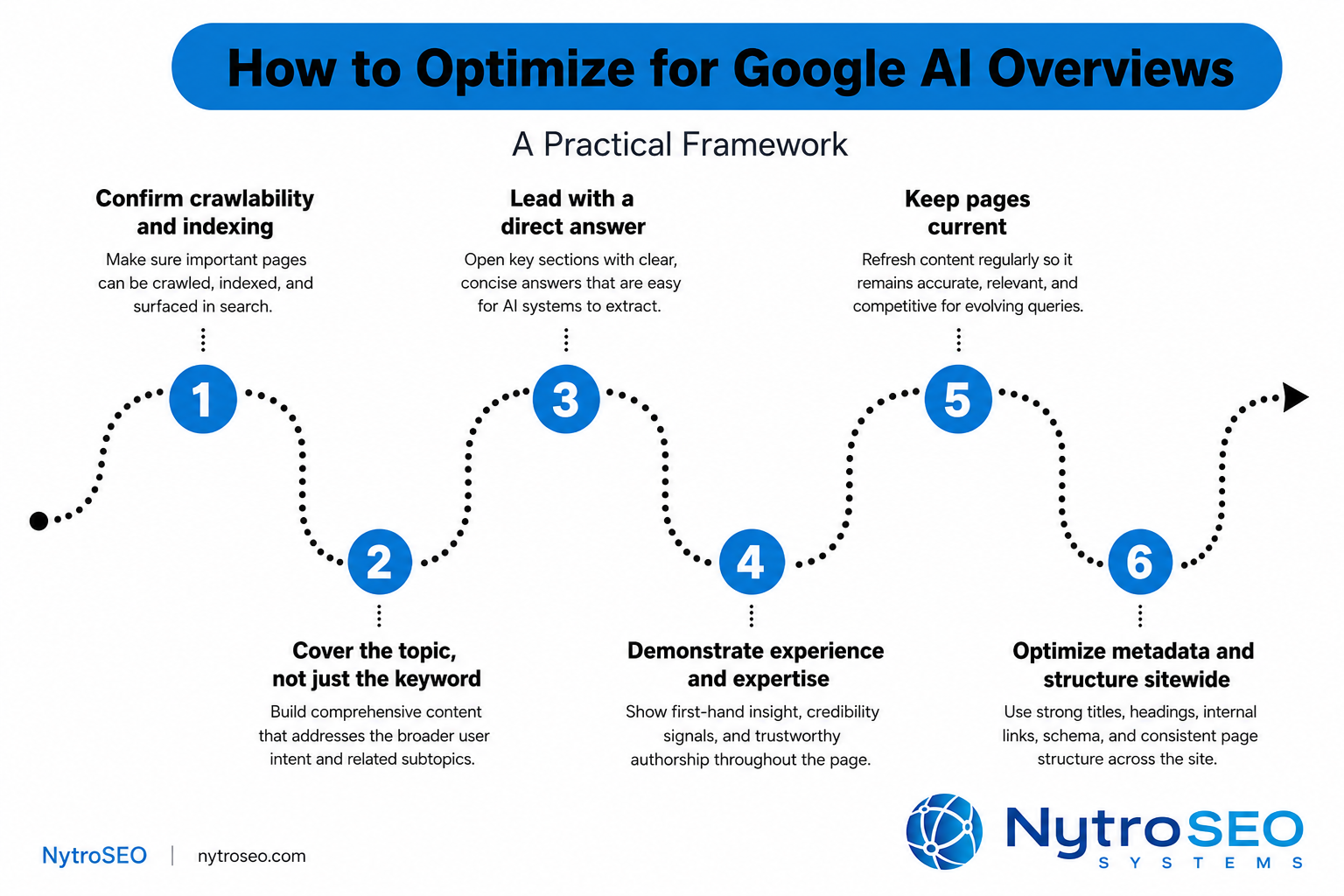
Here is a concrete framework for earning and keeping a place in Google AI Overviews. It answers the broader question of how to optimize website for AI search engines by focusing on the signals that actually move eligibility.
- Confirm crawlability and indexing. If Google cannot crawl and index a page, it cannot appear in an overview. Verify your priority pages are indexed and that no stray robots rule blocks Googlebot or Google-Extended.
- Cover the topic, not just the keyword. Build cluster content that answers the natural sub-questions query fan-out generates. Depth and internal linking make you eligible across more of the overview.
- Lead with a direct answer. Open each section with a clear, self-contained response of roughly 40 to 60 words, then expand. Overviews lift concise, well-formed answers.
- Demonstrate experience and expertise. Add original data, named authors, cited sources, and concrete examples. Research on generative answers found that cited sources and statistics measurably raise visibility; you can read the GEO study on arXiv.
- Keep pages current. Update statistics and examples on a schedule so your content reflects the present. Freshness supports eligibility across AI features.
- Optimize metadata and structure sitewide. Clear titles, meta descriptions, headings, and structured data help Google understand and select your content.
Follow this and you are, in effect, doing the work to optimize website for AI search across Google’s entire AI surface, not just the classic ten links. For the on-page mechanics, our guide to getting AI search ready with optimized meta tags, structured data, and high-performing content goes deeper.
A Quick Worked Example
Imagine you want your page to appear when someone searches “best way to automate meta tags on a large site.” Run the framework. You confirm the page is indexed and Googlebot is not blocked. You expand the page so it covers the whole question, what meta-tag automation is, how it works, the risks, and how it scales, so it can feed several fan-out sub-queries. You open the page with a 50 word direct answer, add a comparison table of approaches, and include two current, sourced statistics. You add named authorship and a visible update date. Then you apply the same structure across your related pages so the whole cluster reinforces the topic.
Over the following weeks, your page starts surfacing as a cited source within the overview for that query and several related ones. Nothing here gamed the system. It was eligibility, depth, structure, and trust, the exact signals Google says power its AI features.
How to Measure Your Presence in Google AI Overviews
You cannot manage what you do not track, and AI Overviews are harder to measure than classic rankings because Google does not itemize them in a dedicated report. Build a simple loop so you can see whether your presence is growing.
Start with a fixed list of 15 to 20 priority queries where an overview is likely to appear. Each month, run them in a logged-out session and record three things: whether an AI Overview shows for the query, whether your site is cited within it, and which competitors appear. Because overviews vary, track the trend across months rather than reacting to a single result. In Google Search Console, watch for shifts in impressions and average position on those queries, since overview appearances influence how your listings behave even though they are not broken out separately. The goal is a clear read on your citation rate inside overviews and your share against competitors, so you can tie changes to the specific pages and clusters you have improved. Thirty minutes a month is enough to know whether your Google AI Overviews strategy is working.
Common Mistakes With Google AI Overviews
A handful of errors keep good pages out of overviews.
- Writing separate “AI content.” Thin, machine-only variants can breach Google’s policies and rarely earn a place. Build one strong page for people.
- Targeting single keywords in isolation. A narrow page answers one sub-query; query fan-out rewards pages that cover the whole topic.
- Burying the answer. If the key point sits far down the page, the overview may skip it. Lead with a direct response.
- Ignoring technical health. Blocked crawlers, unindexed pages, and slow rendering remove you from consideration before content even matters.
- Optimizing a few pages by hand. Overviews draw on deep, specific pages across your site, so consistency at scale is what compounds.
Scaling Your Google AI Overviews Optimization
The framework is straightforward on a few flagship pages. The challenge is that AI Overviews reward depth and consistency across an entire site, which for most brands means hundreds or thousands of pages. Manually maintaining clean structure, current content, and optimized metadata everywhere is where teams stall.
This is where automation earns its place. Our automated SEO software applies answer-ready, keyword-aligned optimization across an entire site through a JavaScript snippet, without editing the CMS. It keeps titles, meta descriptions, alt text, and structured signals consistent on every page, so the depth and structure that make you eligible for Google AI Overviews are not limited to the handful of pages you can touch by hand. For agencies and large-site owners, that consistency is the difference between appearing in overviews for a few queries and being retrievable across your whole domain. For a deeper look at winning clicks and visibility in the AI-powered results page, our session on AI Overviews SEO optimization walks through the tactics.
The Bottom Line on Google AI Overviews
Google AI Overviews run on the same fundamentals that have always powered good SEO, amplified by query fan-out and generative synthesis. Make your pages crawlable, cover topics in depth, lead with direct answers, demonstrate real expertise, keep content current, and apply it all consistently at scale. Do that and you stay eligible for the most prominent space on the results page, cited at the exact moment a searcher gets their answer.
Want to know whether your pages are eligible for AI Overviews today? Run a free visibility check and we will show you your crawlability, structure, and depth gaps, and the fastest fixes to start earning placements. The format will keep evolving, but the underlying requirement will not: pages that are easy to crawl, genuinely helpful, and clearly the most trustworthy answer are the ones Google chooses to feature.
Frequently Asked Questions
Google AI Overviews are AI-generated summaries that appear at the top of many search results, answering the query directly and linking to supporting sources. They grew out of the Google Search Generative Experience and are generated from the same web Google already crawls and ranks, so pages that are crawlable, relevant, and authoritative are the ones eligible to appear.
Largely, yes. AI Overviews are generated from Google’s existing index and lean on the same core ranking and quality systems that power regular Search, with a generative layer that composes the summary. That is why standard SEO fundamentals – crawlability, helpful content, and demonstrated expertise – remain the levers for appearing in them.
Query fan-out is the process where Google expands your single query into several related sub-questions, retrieves information for each, and synthesizes them into one AI Overview. It rewards pages that cover a topic and its natural follow-ups in depth, because a comprehensive page can be pulled into more parts of the generated answer than a narrow page.
No. Google advises against creating separate content for AI, and thin, machine-only variants can trigger its scaled-content-abuse policies. The same helpful, well-structured, people-first pages that rank in Search are what feed AI Overviews. Build one strong set of pages rather than a parallel AI-only version of your site.
It depends on the query. For simple informational searches, an overview may fully answer the question and reduce clicks. For commercial, comparison, and complex queries, it often acts as a starting point, and being cited within it can still drive qualified visits and brand exposure. Earning a place inside the overview is the goal.