Last updated: August 28, 2026
If your rankings fell after a broad update, you are not imagining the scale of it. During the March 2026 core update, one industry analysis found that nearly 80% of top-three results changed positions, up from roughly 67% a few months earlier. A core update does not tweak one ranking factor; it recalibrates the entire system at once, which is why the movement ripples across every query and vertical. The good news is that to recover from search engine core updates you do not need to reverse a penalty — there is no penalty. You need to clear a quality bar, and this guide shows you how.
We will separate what a core update actually is from the myths, show you how to diagnose whether you were really hit, walk through the recovery playbook Google’s own guidance points to, and explain where automation genuinely helps. If your pages have quietly lost ground across both classic search and AI answers, our breakdown of how more than 77% of sites lost visibility in recent SERP and index changes is a useful companion.
What a Core Update Is, and What It Isn’t
A Google core update is a broad change to Google’s ranking systems designed to better surface relevant, satisfying content. It is not a manual action or a spam penalty. This distinction matters, because the fix for a penalty is to remove a violation, while the response to a google core algorithm update is to improve the relative quality of your pages. Google is explicit that a ranking drop after an update does not necessarily mean anything is wrong with your pages — sometimes a competitor simply improved, and the system now prefers their page. This reframing changes how you should respond. If you go looking for a rule you broke, you will invent fixes that do not help, because there was no rule and no penalty. The productive question is not “what did I do wrong?” but “which of my pages is now less clearly the best answer, and why?” That question leads to real improvements; the hunt for a penalty leads to wasted motion.
There is a second thing a core update now affects that many teams miss. Google has stated that its generative AI features are rooted in the same core ranking and quality systems and pull pages from the same index. So the same update that moved your blue-link rankings can change which pages get retrieved and cited in AI Overviews and AI Mode. You can rank well and still go uncited, and a broad update can widen or close that gap. Recovering well now means watching both surfaces, because the quality work that earns one increasingly earns the other. Google’s official core updates guidance is the authoritative reference for how these updates behave.
“When a core update hits, the instinct is to hunt for the rule you broke. There usually isn’t one. A core update isn’t a penalty, it’s Google re-deciding which page is the best answer. Chasing a phantom violation wastes weeks; asking honestly why a competitor’s page is now clearer is what earns the recovery.” — Lee Agam, founder and CEO of NytroSEO.
How to Diagnose a Hit Before You Recover From Search Engine Core Updates
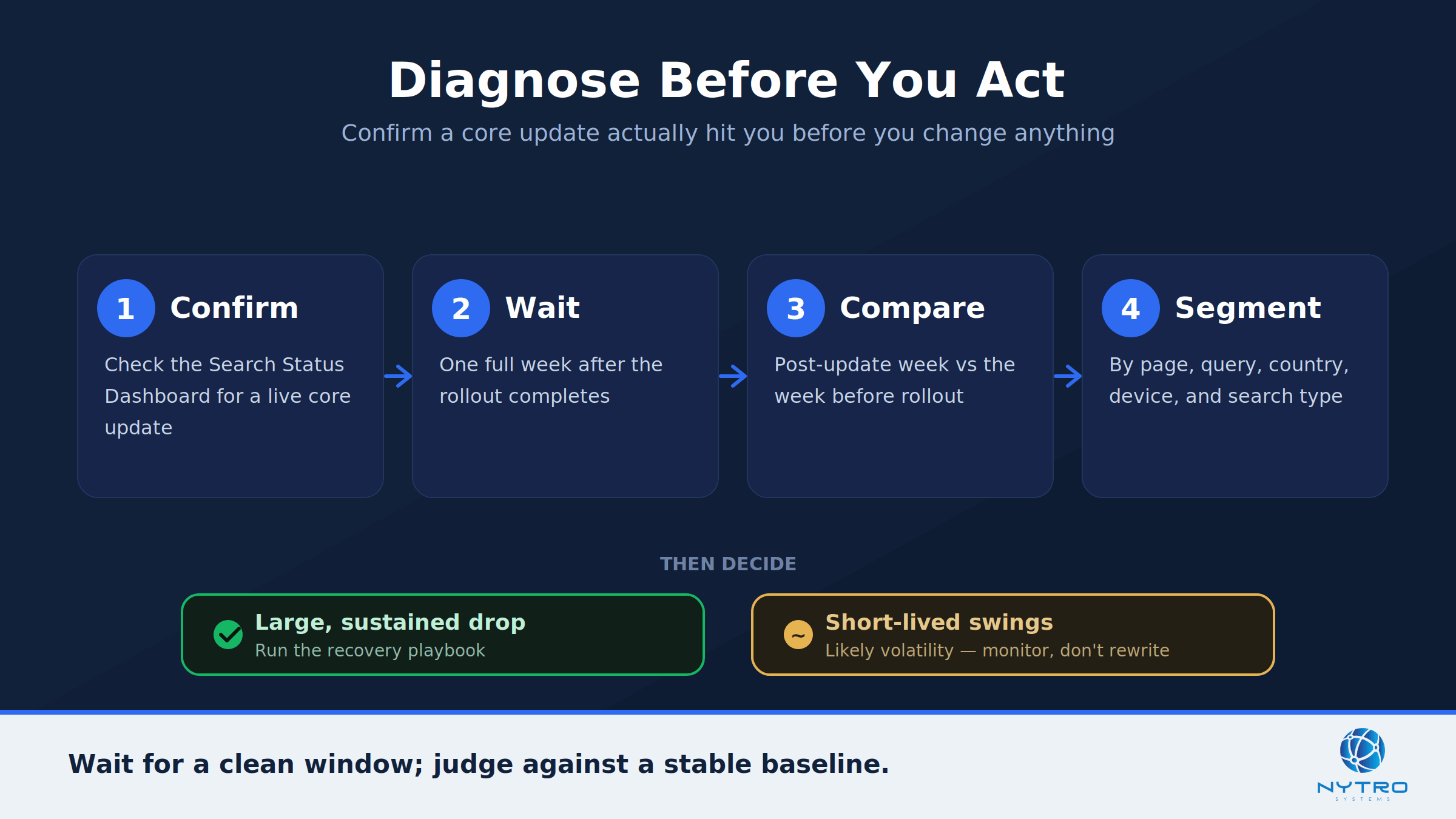
Diagnose before you act: confirm, wait, compare, and segment before deciding a core update hit you.
Before you change anything, confirm you were actually affected — and by what. Acting mid-rollout, or on a drop that was never a core update at all, wastes effort and muddies your data. Work through a short diagnosis.
Confirm the update and wait for a clean window. Check the Google Search Status Dashboard to verify a broad core update is running and when it completes. Rollouts in 2026 have run close to two weeks — the March update took about twelve days and the May update just under twelve — and Google advises waiting at least a full week after completion before judging results, because single-day readings during the rollout are unreliable. Industry rollout trackers, like those maintained by Search Engine Land, are useful for pinning down when a rollout starts and ends, but treat them as context around Google’s own dashboard rather than a substitute for it.
Compare the right time periods. Put the week after completion next to the week before the rollout began, rather than cherry-picking the most dramatic day. Then segment Search Console by page, query, country, device, and search type, so a sitewide average does not hide which pages actually won or lost.
Separate a real hit from noise. A large, sustained drop concentrated on specific pages points to a core update. Short-lived swings that settle within days are usually serp volatility — the normal churn that spikes while rankings resettle. This kind of Google Core Updates Volatility is expected during a rollout and is not, by itself, a reason to rewrite anything. And remember that not every decline is an update at all: seasonality, a tracking change, a technical regression, or a manual action can all look similar, so rule those out before you act.
The four-step diagnosis below is the sequence to run before you touch anything, ending in the decision that matters — a sustained drop to act on, or volatility to wait out.
The Playbook to Recover From Search Engine Core Updates
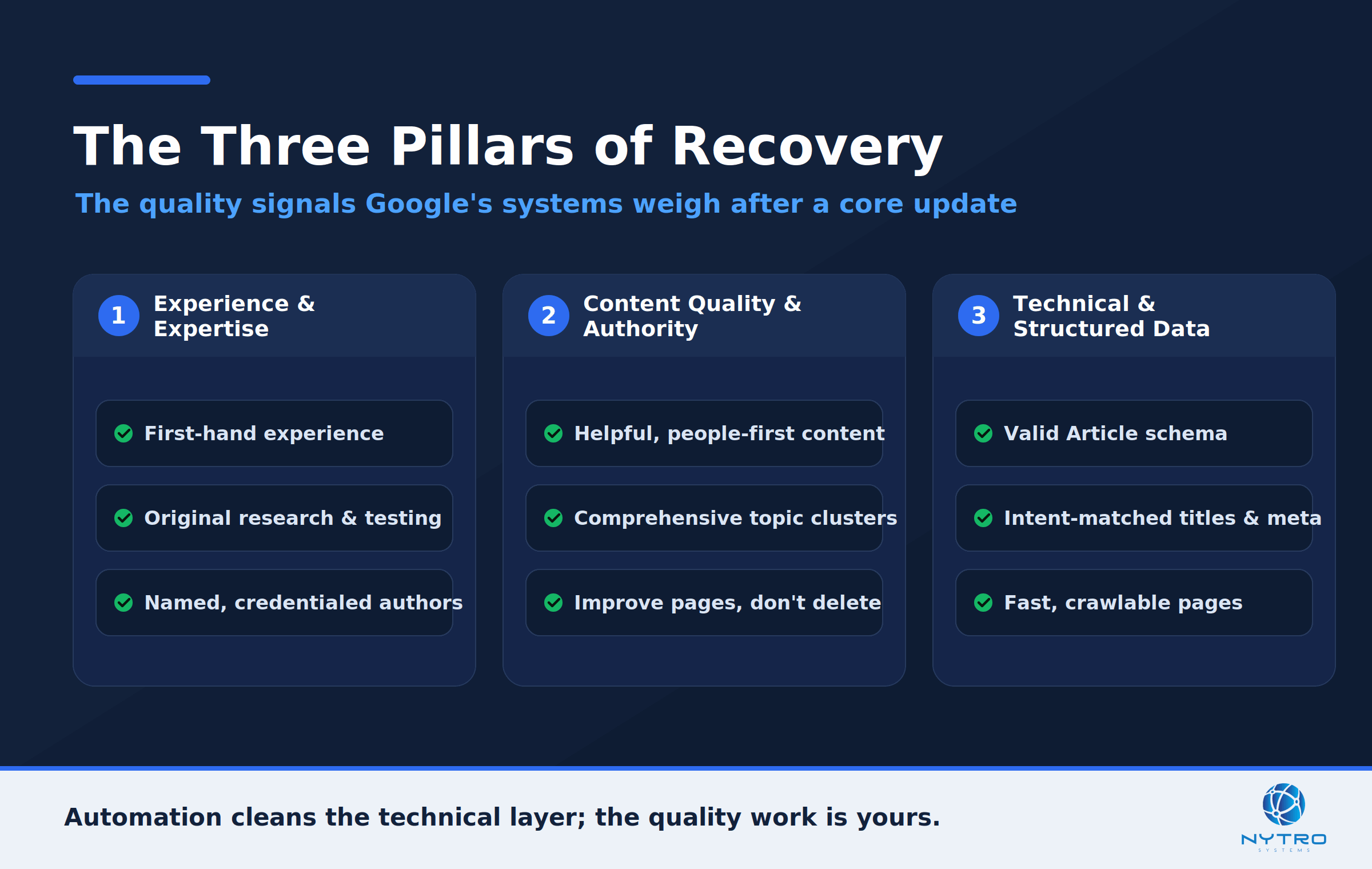
The three pillars of core-update recovery: the quality signals Google’s systems weigh.
Once you have confirmed a genuine, sustained drop, the work is to raise the quality signals Google’s systems weigh. Google points site owners to the self-assessment questions in its people-first content guidance, and the pattern in every recent update points the same way. Three areas carry most of the weight.
Strengthen experience and expertise. The pages gaining ground after the latest google algorithm update tend to show first-hand experience — original research, real testing, case studies, and named, credentialed authors — rather than generic summaries a model could synthesize on its own. Add what only you can: your data, your examples, your results.
Deepen content quality and topical authority. Comprehensive, interconnected coverage of a topic is outperforming isolated pages that chase single keywords. Build clusters that genuinely answer the questions around a subject. And improve rather than delete: Google treats pruning as a last resort for pages built for search engines instead of people, so your default should be to make thin pages genuinely better.
Clean up the technical and structured-data layer. Valid Article structured data — accurate author, datePublished, and dateModified — does not directly lift rankings, but it helps Google re-evaluate your page correctly instead of guessing during a reshuffle. Titles and meta descriptions that match real search intent, sound internal linking, and fast, crawlable pages all help the system read your improvements accurately. Our Automatic SEO software keeps this layer consistent across an entire site.
To see how the three areas work together, consider a mid-sized B2B blog that lost about a third of its search visibility across a core update. A page-by-page read showed the damage was concentrated in thin, near-duplicate posts targeting slight keyword variations of the same question. Rather than delete them, the team consolidated each cluster into one genuinely comprehensive guide, added a named author with real credentials and first-hand examples, and corrected the Article structured data so authorship and dates were accurate. They made no changes during the rollout itself. Over the following two months, impressions recovered first, then positions on the consolidated guides, and by the next update most of the lost visibility had returned. Nothing exotic happened: they raised the quality bar on the specific pages that had fallen below it and let Google re-evaluate.
The three pillars below summarize what to strengthen — the quality signals Google’s systems weigh when they re-evaluate your pages.
How to Recover From Search Engine Core Updates Without Guesswork
Turned into a sequence you can actually run, the recovery process looks like this.
- Confirm the update on the Search Status Dashboard and wait a full week after it completes.
- Compare the post-update week against the week before rollout, segmented by page and query.
- Identify the specific pages and clusters with large, sustained drops.
- Diagnose why each lost ground — thin content, weak experience signals, intent mismatch, or technical issues.
- Improve those pages substantively: add experience, depth, and accuracy; fix structured data and metadata.
- Request indexing, then monitor over 30, 60, and 90 days rather than expecting overnight change.
The discipline is to make substantive changes, not cosmetic ones, and then give Google’s systems time to re-evaluate. Panic edits and random “SEO fixes” during a rollout are how teams make things worse.
A Realistic Recovery Timeline After a Core Update
Set expectations before you start, because unrealistic timelines make teams abandon good work too early. In the first week after a rollout completes, wait — do not read too much into the initial numbers while the index settles. Over the following weeks, once you have made substantive improvements and requested indexing, watch Search Console for early signals: impressions and average position often move before clicks do. Google’s own guidance is that some changes register within days, while confirming that a site is producing helpful, people-first content can take weeks or months.
In practice, treat recovery as a 30-, 60-, and 90-day process. At 30 days you are looking for direction, not full recovery. At 60 days you want a clearer trend on the specific pages you improved. At 90 days you want a stable picture against a clean baseline. And frequently, the largest recovery lands with the next core update, when Google’s systems confirm the improvement is sustained — that is normal, and not a sign your work failed.
Why Adaptive Automation Helps You Recover From Search Engine Core Updates Faster
Here is where honesty matters. No tool can manufacture first-hand experience or write the substantive, people-first content that core updates reward — that work is editorial, and it is yours. What automation can do is remove the technical drag from recovery so your quality improvements are recognized sooner.
That is the role of adaptive automation. Instead of hand-editing titles, meta descriptions, and structured data across thousands of pages after every update, NytroSEO keeps that metadata layer optimized and consistent sitewide, and re-optimizes it continuously as search results shift — which is what “adaptive” means here. When Google re-evaluates your pages, the signals it reads are clean and current rather than stale, so the editorial improvements you make land faster and are not undercut by mismatched tags or broken structured data. You can see how this works in our guide to adaptive SEO automation and real-time recovery from core updates, and in the NS3 webinar on staying ahead of Google updates. To be clear about limits: automation shortens the technical half of recovery and keeps it adaptive; it does not replace the content quality work, and Google’s timelines still apply.
What SERP Volatility Is and Why It Spikes During Updates
It helps to name the thing you are watching. SERP volatility is the degree to which rankings move across search results over a given period. It is always present at a low level, because Google runs smaller adjustments continuously, but it spikes sharply during a broad core update as the system resettles which pages best satisfy each query. Volatility trackers flagged several distinct spikes during both the March and May 2026 rollouts rather than one smooth curve.
The practical lesson is patience. High volatility during a rollout tells you the system is still moving, not that your recovery has failed or succeeded. That is exactly why the diagnosis step above insists on waiting for a clean window: a page that looks lost on day three of a rollout may settle higher by the end, and a page that spikes up mid-rollout may give some of it back. Judge your position after the dust settles, against a stable baseline, not in the middle of the storm.
Common Mistakes After a Core Update
A few errors recur and are worth avoiding.
Editing during the rollout. Changes made mid-rollout cannot be cleanly attributed, so you lose the ability to learn what worked. Wait for completion plus a week.
Chasing the drop with cosmetic tweaks. Swapping a few words or adding keywords does not address why a page lost ground. Make substantive improvements to helpfulness and experience instead.
Mass-deleting pages in a panic. Pruning is a last resort. Improving underperforming pages is almost always the better first move.
Assuming every drop is a core update. Confirm it on the Status Dashboard first, and rule out seasonality, technical faults, and manual actions.
Expecting instant recovery. Google says improvements can take weeks to months, and full recovery may only register with a later core update once the change is confirmed as sustained.
The Bottom Line: How to Recover From Search Engine Core Updates in 2026
To recover from search engine core updates, stop looking for a penalty to lift and start clearing the quality bar. Confirm the hit against a clean window, diagnose the specific pages that dropped, and rebuild them around genuine experience, depth, and accurate structured data — then give Google’s systems time to re-evaluate. Keep your metadata and structured-data layer clean and adaptive so your improvements are read correctly the moment they are crawled, and watch both classic and AI search, because the same quality work increasingly earns both.
Want to see how your site is positioned right now, across search and AI answers? Run a free visibility check, or talk to us about a recovery plan built around adaptive automation.
Frequently Asked Questions
There is no penalty to lift, so recovery means improving the relative quality of your pages. Confirm the update completed, wait a week, and compare the right time windows. Then identify the specific pages that lost ground and improve them substantively — stronger first-hand experience, deeper and more accurate content, and clean structured data — and give Google’s systems time to re-evaluate.
Google says some changes can take effect within days, but confirming that a site is producing helpful, people-first content can take weeks or months. Full recovery often registers only with a later core update once your improvements are confirmed as sustained. Plan for a 30-, 60-, and 90-day monitoring window rather than expecting an overnight rebound after you make changes.
SERP volatility is the degree to which rankings shift across search results over a period of time. A low level is always present because Google makes continuous small adjustments, but it spikes sharply during a broad core update while the system resettles which pages best answer each query. High volatility during a rollout signals movement in progress, not a final result.
Automation cannot write the substantive, experience-rich content that core updates reward — that work is editorial. What it can do is keep your titles, meta descriptions, and structured data optimized and consistent across the whole site, and re-optimize them as results shift, so your editorial improvements are read accurately and land faster. It shortens the technical half of recovery, not the content half.
Generally no. Editing mid-rollout means you cannot cleanly attribute any change to your edits versus the algorithm still settling. Wait until Google confirms the rollout is complete, give it about a week, then analyze against a stable baseline and make your substantive improvements. The exception is fixing a clear technical fault or error, which you should always correct promptly.