Last updated: September 4, 2026
Internal links are infrastructure. They decide how search engine crawlers and real people move through your site, which pages get discovered, and how authority flows between them. On a ten-page brochure site, keeping that infrastructure healthy is housekeeping you can do by hand. On a site with tens or hundreds of thousands of URLs, it becomes architecture — and it is impossible to maintain manually. That gap is why internal linking automation exists, and this guide explains how to do it well without introducing the problems that careless automation creates.
The scale of the problem is real: analyses of large sites suggest a large share of pages receive too few internal links to be reliably discovered, and roughly a quarter get none at all. Those orphaned and under-linked pages are invisible no matter how good their content is. If you are still weighing whether this work is worth it, our explainer on whether internal links help SEO makes the case; here we focus on automating it at scale.
Why Internal Linking Automation Matters for SEO and AI
Internal links do three jobs, and internal linking automation exists to keep all three working as a site grows.
The first is discovery and crawling. Googlebot finds pages primarily by following links, so a page with no internal links pointing to it may never be crawled. Google is explicit that every page you care about should have a link from at least one other page on your site, and that links must use proper HTML markup to be crawlable — a point Google documents in its link best practices. The second is authority flow: links pass ranking signals from strong pages to the pages they point to, so a deliberate structure sends equity to the pages that matter most. The third is meaning. Descriptive anchor text and dense links between related pages tell search engines — and increasingly AI answer engines — what your pages are about and how they relate, building the topical authority that both reward. A page that is well-linked internally is easier to crawl, easier to rank, and easier to cite.
The AI dimension deserves emphasis because it is new. Answer engines like ChatGPT, Perplexity, and Google’s AI features build their understanding of your site from the same crawlable structure, and they lean heavily on how entities and topics connect. A dense, well-organized web of internal links does not just move authority; it teaches these systems that your pages form a coherent body of expertise on a subject. Isolated pages, however good, read as one-off answers. Clusters of interlinked pages read as authority — and authority is what gets surfaced and cited. Internal linking, once a purely technical concern, is now part of how you show up in AI answers at all.
“People treat internal links as an afterthought, but on a large site they’re infrastructure — they decide what gets crawled, ranked and cited. You can’t maintain that by hand past a few thousand pages. The win isn’t automating links for their own sake; it’s encoding an editor’s judgment so every new page joins the graph the moment it publishes.” — Lee Agam, founder and CEO of NytroSEO.
The Manual Bottleneck That Makes Internal Linking Automation Necessary
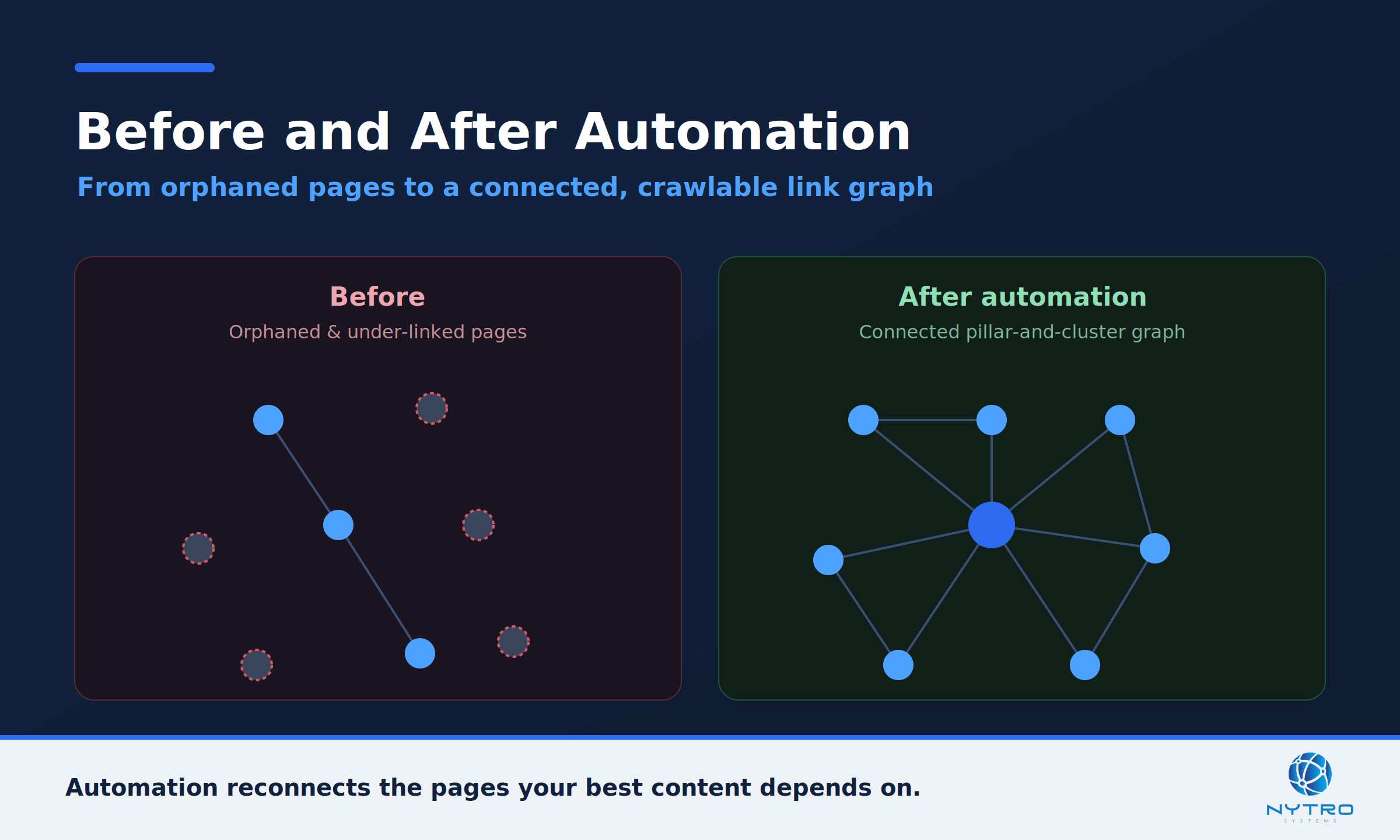
On a small site you can add links by hand and remember what points where. That breaks down fast as the page count climbs. Every new page you publish should receive links from existing relevant pages and should link out to others, but doing that manually across thousands of URLs means someone has to know the whole catalog and update it every time anything changes. They cannot, so pages ship as orphans, older pages never get updated to point at newer ones, and the link graph slowly decays.
Large ecommerce and content sites feel this most acutely, because their page counts grow constantly and their templates repeat across thousands of near-identical pages — the dynamics we cover in what large ecommerce sites do differently at scale. At that size, keeping the internal link graph current is exactly the kind of repetitive, rules-driven work that should be automated. The goal is to make automatic seo changes at scale that a human would make if a human had unlimited time — not to replace judgment, but to apply consistent judgment everywhere at once.
There is a compounding cost to leaving this manual, too. Every week the link graph goes unmaintained, the backlog of orphaned and under-linked pages grows, and the newest content — often the most commercially important — is exactly what lands without support because no one has circled back to link to it yet. Manual linking also tends to be front-loaded: a page gets its links on publish day and then never again, even as dozens of newer, more relevant pages appear that should point to it. The link graph a large site actually needs is a living thing that updates whenever anything changes, and that is simply not a shape of work humans can sustain past a few thousand pages.
How Rules-Based Internal Linking Automation Works
Good automated internal linking is not random link injection. It is a rules engine that applies the same decisions a careful editor would, across every page. A sound system works along a few dimensions.
Relevance matching comes first. The engine identifies topically related pages — by shared keywords, entities, categories, or embeddings — and only proposes links between pages that genuinely belong together. Irrelevant links help no one. Anchor text is next: automated links should use descriptive, varied anchor text that reflects the target page, not one repeated exact-match phrase, since reusing the same anchor for many destinations confuses search engines. Then come limits and priorities. The system caps how many links a page carries so equity is not diluted, links from high-authority pages toward priority pages, keeps links direct rather than chaining through redirects, and only points at pages that return a 200 status and are indexable. Done this way, your internal seo links reinforce a clean pillar-and-cluster structure instead of creating noise. Reference guides from Moz and Ahrefs go deeper on the underlying principles that any automation should encode.
To make this concrete, picture how the engine handles a newly published article on a large site. It scans the catalog for pages that share the new article’s core entities and keywords, ranks those candidates by topical closeness and page authority, and selects a handful of the strongest, most relevant matches. For each, it drafts a descriptive anchor from the target page’s own subject rather than a generic phrase, checks that the target returns a 200 status and is indexable, confirms neither page already exceeds its link budget, and only then places the link in context. The same pass adds links from the new page back out to relevant pillars and clusters, so the article is woven into the site’s structure the moment it goes live rather than sitting orphaned until someone remembers it. Every one of those steps is a decision a careful editor makes by instinct; automation just makes the same decision reliably, thousands of times.
The Pitfalls of Internal Linking Automation
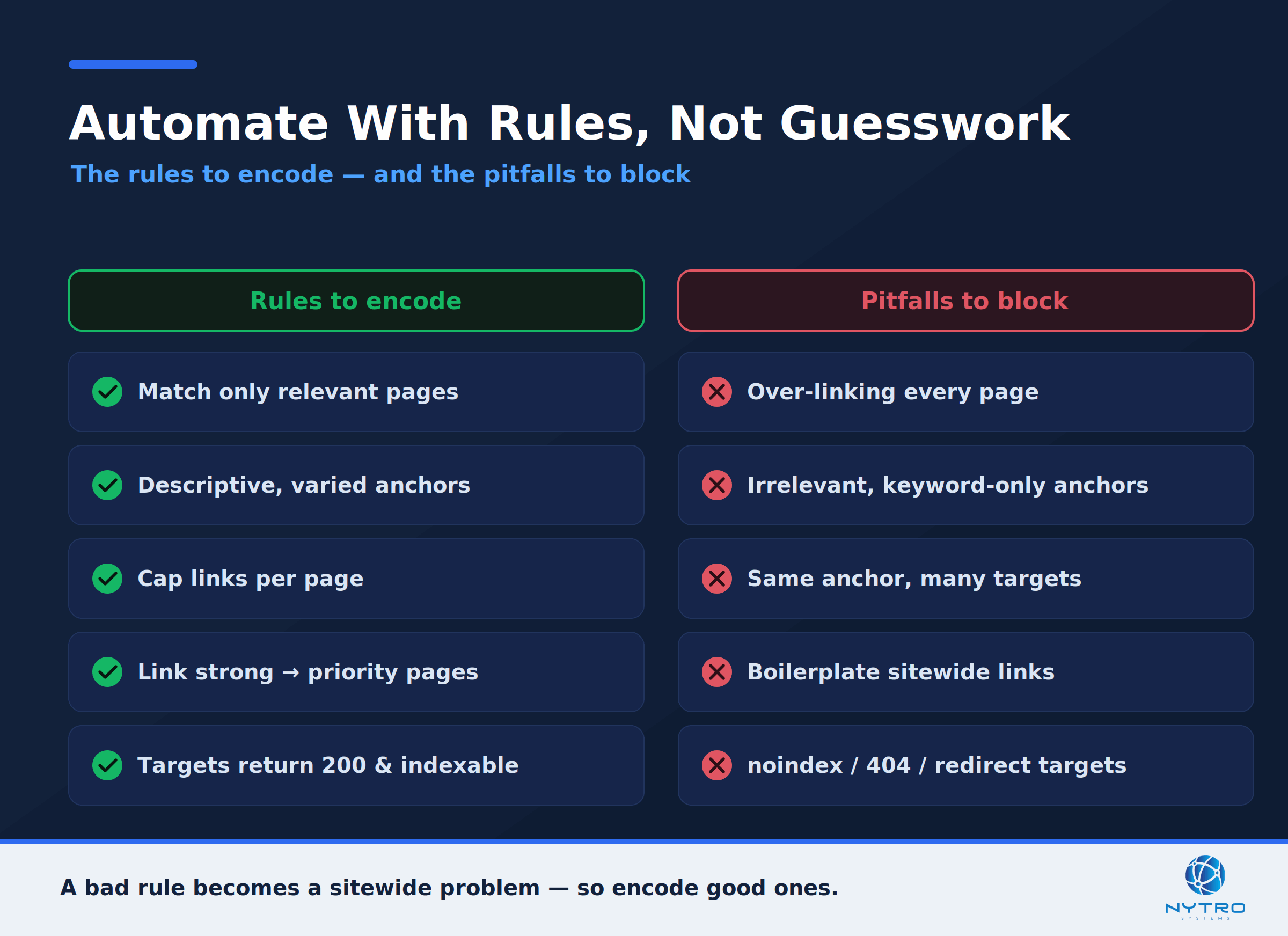
Automation applies whatever rules you give it to every page, which means a bad rule becomes a sitewide problem. A few pitfalls recur and are worth designing against.
Over-linking is the most common. Stuffing a page with dozens of automated links dilutes the value of each and reads as spam; Google’s own guidance is that if the number of links feels like too much, it is. Irrelevant anchors are next: links generated purely by keyword matching, with no relevance check, send confusing signals and frustrate readers. Repetitive anchor text — the same phrase pointing at many different pages — muddies which page should rank for that term. Boilerplate sitewide links that appear in every footer or sidebar add little and can drown out the contextual links that matter. And automation that ignores status codes will happily generate links to redirected, noindexed, or 404 pages, wasting crawl budget and hurting users. None of these are reasons to avoid automating your seo links; they are reasons to automate with relevance checks, anchor variation, per-page caps, and status validation built in.
Governance: Keeping Automated Links Safe Over Time
Automation is not set-and-forget. Because a single rule change propagates everywhere, internal linking automation needs governance to stay healthy — the guardrails that keep a scaled system from drifting into the pitfalls above.
Three practices matter most. First, keep human overrides: editors should be able to pin, block, or hand-place links on important pages, so automation handles the long tail while people control the pages that most deserve care. Second, monitor the distribution. Watch how many internal links point to each URL, which anchors are being used, and whether any single page or anchor is being over-used, so you catch imbalances before they become problems — some evidence suggests the benefit of additional internal links to a URL flattens out past a few dozen, so more is not always better. Third, audit continuously: schedule checks for orphaned pages, broken or redirected link targets, and links pointing at noindexed URLs, and feed the findings back into the rules. Treated this way, automation becomes a system you steer rather than a machine you switch on and hope for the best. The larger the site, the more this governance layer, not the initial rollout, determines long-term results. A rollout is a single event; governance is what keeps the link graph healthy through every future change to the site.
Deploying Internal Linking Automation Sitewide Without Editing Every Page
The last challenge is delivery. Even with perfect rules, editing tens of thousands of pages by hand to add links defeats the purpose. This is where sitewide internal linking automation earns its place: the rules are defined once and applied across the whole site programmatically, so new pages are linked the moment they publish and the graph stays current as the site changes. Importantly, Google confirms that links inserted with JavaScript are crawlable as long as they use proper HTML anchor markup, which makes snippet- and module-based delivery viable rather than requiring a full CMS rebuild.
This is the same philosophy behind how NytroSEO handles on-page SEO. Rather than editing every page, it applies rules through a header snippet to keep the on-page layer — titles, meta descriptions, and structured data — correct and consistent across an entire site, which is what makes automatic seo changes at scale practical. To be clear about scope: NytroSEO’s automation centers on that metadata and structured-data layer, which is complementary to your internal link graph rather than a replacement for a dedicated linking module. A strong internal link structure decides how authority and crawlers move through your site; a clean, automated metadata layer makes each of those linked pages unambiguous to search and AI engines. You can see how the on-page automation works on our Automatic SEO software page. Together, a well-linked architecture and a consistent metadata layer are what let a large site stay optimized without anyone editing pages one at a time.
A Worked Example: Reconnecting an Orphaned Catalog
Consider a content site with about forty thousand pages that had grown by accretion over several years. An audit found that nearly a third of its pages had two or fewer internal links pointing to them, and several thousand had none at all — a large, well-written archive that Google rarely crawled and almost never ranked. Hand-fixing it was hopeless; at a minute per page, the work alone would have taken months.
Instead, the team defined rules: match pages by shared category and entities, draft descriptive anchors from each target’s title, cap in-content links per page, link only to indexable pages returning a 200 status, and route links from high-traffic hubs toward the neglected archive. Applied across the site, the rules rebuilt the link graph in a single pass and kept it current as new pages published. Over the following weeks, previously orphaned pages began getting crawled and indexed, impressions rose across the reconnected sections, and the archive that had been dead weight started contributing traffic. Nothing about the content changed — only whether the rest of the site pointed to it.
The Bottom Line on Internal Linking Automation
Internal links are too important to leave to chance and too numerous, on a large site, to manage by hand. Internal linking automation solves that by encoding an editor’s judgment — relevance, descriptive anchors, sensible limits, links from strong pages to priority ones, and valid targets — and applying it everywhere at once. Build those rules carefully, watch for over-linking and irrelevant anchors, deliver the changes sitewide rather than page by page, and keep your metadata layer just as consistent. Do that, and every page you publish joins a link graph that helps it get crawled, ranked, and cited from day one. On a large site, that is the difference between content that quietly disappears and content that pulls its weight the moment it goes live.
Want to see how your on-page SEO holds up across your whole site? Run a free visibility check, or talk to us about automating on-page SEO at scale.
Frequently Asked Questions
Yes. Internal links help search engines discover pages, pass ranking authority between them, and understand how your content relates through anchor text and structure. A page with no internal links pointing to it may never be crawled or ranked, while a well-linked page is easier to find, rank, and cite in AI answers. They are one of the most reliable on-page levers you control.
Yes, when the automation encodes real editorial rules. Safe automated internal linking matches only topically relevant pages, uses descriptive and varied anchor text, caps the number of links per page, links from strong pages to priority ones, and points only at indexable pages that return a 200 status. The risk comes from automating without those checks, not from automation itself.
There is no official limit. Google says there is no magic number, but that if the number feels like too much, it probably is. Common guidance is a handful of contextual links per typical article — often cited as a few per thousand words — placed where they genuinely help the reader. Navigation and template links are separate; focus on keeping in-content links relevant and useful rather than hitting a target.
Descriptive, varied anchor text that reflects the target page. Avoid vague phrases like “click here,” and avoid using the same exact-match phrase for many different destinations, which confuses search engines about which page should rank. A natural mix of exact, partial, and descriptive anchors reads better for users and sends clearer signals than one repeated keyword.
Automated linking itself is not penalized, but the patterns careless automation creates can hurt you. Over-linking, spammy repetitive anchors, and links to irrelevant or broken pages degrade quality signals and user experience. Automation built with relevance checks, anchor variation, per-page limits, and status validation stays well within Google’s guidance and simply applies good linking practice consistently.