Last updated: November 2, 2026
Microsoft Copilot does not search a private web of its own. When it answers a question using live information, it turns that question into search queries, sends them to Bing, and composes its answer from what Bing returns — titles, snippets, and the sources it cites. That single fact sets the whole agenda for Microsoft Copilot SEO: if you want to be cited by Copilot, you have to be findable in Bing first, and then be the kind of page Bing’s grounding is comfortable quoting.
This guide is practical and Bing-centric. It covers what Microsoft Copilot SEO is, why Bing indexing is the non-negotiable prerequisite, how Copilot’s Bing grounding turns a prompt into cited answers, how the IndexNow protocol keeps your content fresh across Bing-powered experiences, and how to think about measuring citation visibility. The throughline is simple: Copilot citations are won in Bing, so the work is getting Bing right.
Lee Agam, CEO of Nytro Systems, is direct about why this one trips teams up. Years of SEO attention went almost entirely to Google, so many sites have never checked whether they are properly indexed in Bing at all — and a page Bing has not indexed simply cannot be grounded into a Copilot answer. In his view, Microsoft Copilot SEO is mostly disciplined Bing fundamentals: confirm indexing, keep content fresh, and structure pages so the answer is easy to lift. His advice is to treat Bing as a first-class surface rather than an afterthought, and to keep metadata consistent and current across the whole site so every Bing-indexed page is answer-ready.
What Is Microsoft Copilot SEO?
Microsoft Copilot SEO is the practice of preparing your website so Microsoft Copilot can find it in Bing, ground an answer on it, and cite it as a source. It has a technical half — being indexed in Bing and keeping that content fresh — and an editorial half — structuring pages so Copilot can extract a clean, citable answer.
The target is specific. Copilot grounds its web answers through Bing: Microsoft’s documentation describes how its Copilot grounding uses Bing Search — generating a keyword query from the user’s question, sending it to Bing, and using the returned titles, snippets, and citations to compose the response. Microsoft Copilot SEO aims to make your pages part of that Bing-grounded, citable set. It is a narrower goal than ranking: you are optimizing to be one of the sources Copilot’s Bing grounding surfaces and quotes.
This makes Microsoft Copilot SEO a close relative of broader AI Search optimization and Answer Engine Optimization, with a Bing-specific foundation. The content principles are shared across AI surfaces, but the plumbing is Microsoft’s: Bing’s index, Bing’s grounding, and Bing’s tooling. If your Bing presence is weak, the best content in the world cannot be cited, because Copilot never retrieves it.
Microsoft Copilot SEO Starts with Bing Indexing
The first and most overlooked step in Microsoft Copilot SEO is being indexed in Bing. Because Copilot grounds through Bing, a page Bing has not crawled and indexed is invisible to Copilot — there is nothing for the grounding step to retrieve or cite. Years of Google-first habits mean many sites have simply never verified their Bing indexing, and that gap is the most common reason a site is absent from Copilot answers.
The fix is to treat Bing as a first-class channel. Verify your site in Bing Webmaster Tools, submit your sitemap, and confirm that your important pages are actually indexed in Bing rather than assuming Google coverage carries over. Resolve anything Bing reports as excluded that should be included, and make sure nothing — a stray disallow, a noindex, heavy client-side rendering — is blocking Bing’s crawler specifically. This is the same ordinary Search Engine Optimization discipline you apply to Google, pointed at an engine many teams have neglected.
It is worth stating the uncomfortable version plainly: if you try to optimize website for AI search on the Copilot surface while your pages are missing from Bing’s index, you are optimizing a storefront Copilot cannot enter. Bing indexing is the entry ticket, and confirming it is where the first effort belongs — before any Copilot-specific tactic is worth doing.
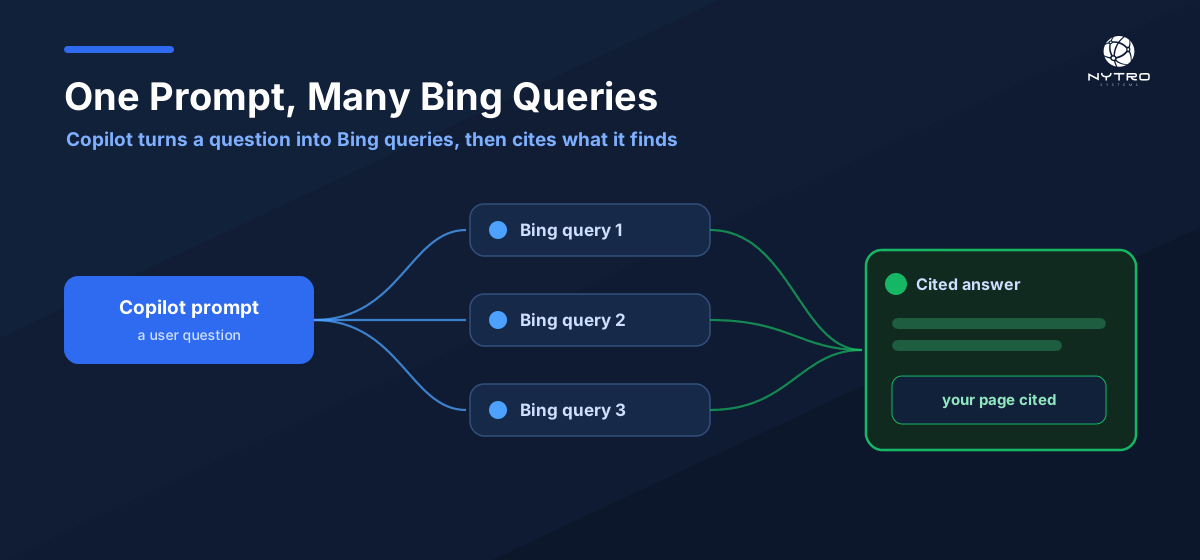
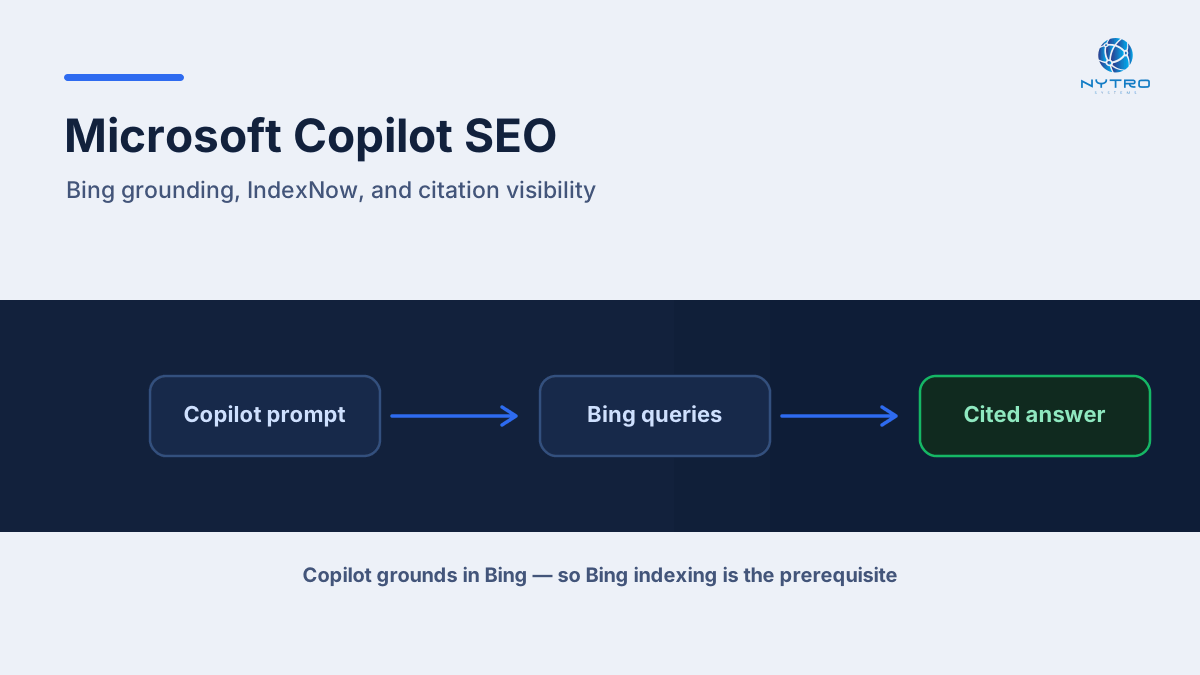
Microsoft Copilot SEO: a prompt becomes Bing grounding queries, then a cited answer — so Bing indexing is the prerequisite.
How Bing Grounding Shapes Microsoft Copilot SEO
Understanding Copilot’s grounding mechanism makes the editorial half of Microsoft Copilot SEO concrete. The flow is consistent: Copilot interprets the user’s question, generates one or more keyword queries from it, sends those to Bing, reads the returned results, and composes an answer that cites the sources it leaned on. The queries Bing actually runs may differ from the user’s exact words — they are Bing’s interpretation of the intent.
That has two practical implications. First, because the grounding runs on queries Bing generates, you are optimizing for the intent behind a question, not a single literal phrase — a page that answers a topic and its natural sub-questions has more ways to match the grounding queries. Second, because Copilot composes its answer from titles, snippets, and the content behind them, the pages that get cited are the ones that present a clear, extractable answer: a direct response up front, descriptive titles and meta descriptions, and well-structured sections Bing can summarize cleanly.
This is where Microsoft Copilot SEO and good AI Search Ranking converge. The signals that help a page perform in Bing — relevance, clarity, descriptive metadata, structure, authority — are the same signals that make it a comfortable source for Copilot’s grounding to quote. You are not learning a new discipline so much as doing solid Bing SEO and then making the answer easy to lift.
It also pays to remember that the title and meta description do double duty here. Because Copilot’s grounding reads the titles and snippets Bing returns before it ever opens the full page, a vague or missing description can cost you a citation even when the underlying content is excellent. Descriptive, accurate metadata is not a cosmetic detail in Microsoft Copilot SEO — it is part of what the grounding step actually sees and summarizes, which is why keeping it optimized across every page matters as much here as the body content does.
IndexNow for Microsoft Copilot SEO
Freshness matters for Microsoft Copilot SEO, because Copilot’s value is often in current information, and that is where IndexNow earns its place. IndexNow is a protocol created by Microsoft and Yandex that lets you notify participating search engines — Bing, Yandex, and others — the moment content is created, updated, or deleted, so they can recrawl and refresh their index quickly rather than waiting to discover the change on their own.
Its design has a convenient property: under the sharing policy, a URL you submit to one participating engine is passed along to the others, so you notify a single endpoint and the change propagates. For Microsoft Copilot SEO, that means a newly published or freshly updated page can be re-indexed by Bing sooner, which in turn makes it eligible to be grounded into a Copilot answer sooner. On a site that changes often, IndexNow shortens the gap between “we updated the page” and “Bing knows about it.”
IndexNow does not replace any of the fundamentals — the page still has to be crawlable, indexable, and worth citing — but it removes a specific source of lag. Pair it with the Bing indexing hygiene above and you have the technical foundation of Microsoft Copilot SEO: reachable in Bing, and kept current so the freshest version of your content is the one Copilot can reach.
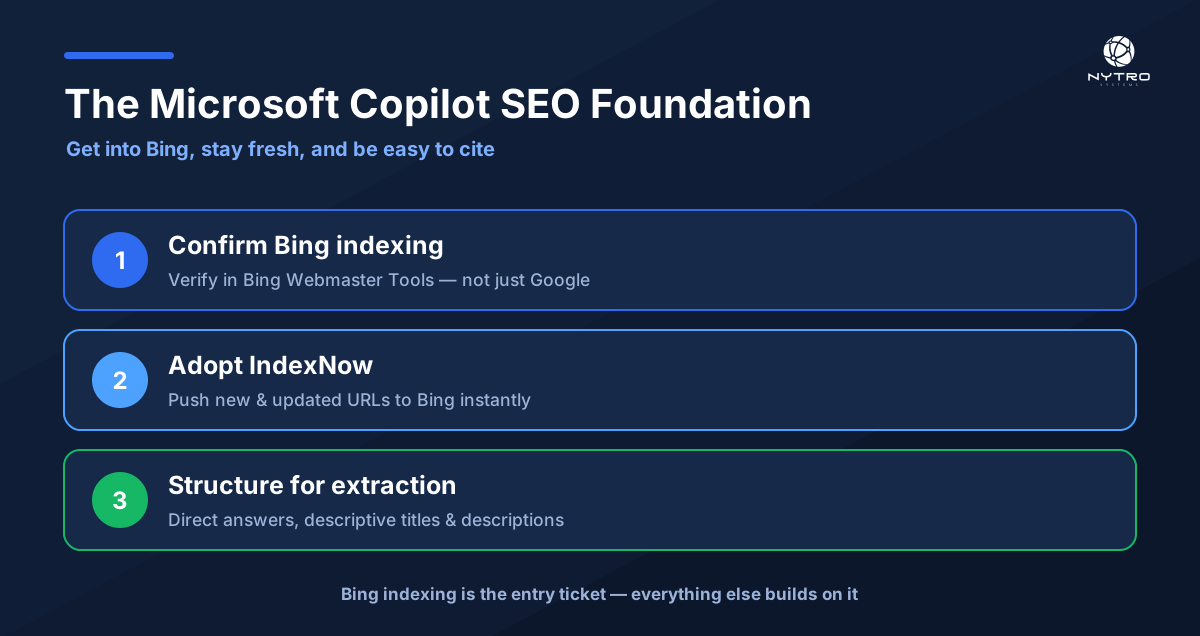
The Microsoft Copilot SEO foundation: indexed in Bing, kept fresh with IndexNow, and structured to be cited.
A Microsoft Copilot SEO Checklist
Pulling the discipline into a sequence makes it repeatable. Run these in order, because the Bing-foundation steps gate everything after them.
First, confirm Bing indexing. Verify your site in Bing Webmaster Tools, submit your sitemap, and check that your important pages are actually indexed in Bing — not just Google. Second, clear the blockers. Make sure no disallow, noindex, or heavy rendering is keeping Bing’s crawler out of pages you want cited. Third, adopt IndexNow. Use the protocol so new and updated URLs are submitted to Bing promptly, keeping your freshest content eligible for grounding. Fourth, structure for extraction. Lead each section with a direct answer, write descriptive titles and meta descriptions, and organize content into clear, summarizable sections. Fifth, strengthen the usual trust signals — accurate, well-sourced, genuinely useful content — since quality still decides which eligible page gets cited. Sixth, monitor your Bing and Copilot visibility and test your target questions in Copilot to see whether you are cited.
Worked in order, this checklist is the whole of Microsoft Copilot SEO: get into Bing, stay fresh, be extractable, and keep quality high. The first three steps are technical and often one-time or automated; the rest are the ongoing editorial discipline that decides which reachable pages Copilot actually quotes.
Measuring Microsoft Copilot SEO
Measuring Microsoft Copilot SEO is harder than tracking a Google ranking, because the key event — being cited inside a Copilot answer — does not show up in a classic rank tracker. The good news is that Microsoft has started to surface citation data directly.
Bing Webmaster Tools has been testing an AI Performance Report that reports how your site shows up in AI experiences like Copilot. According to reporting on the beta, it shows citations of your site by Copilot and partners by day, the number of distinct pages cited, the grounding queries Bing generated, the query intent, and the specific pages Copilot cited. It is worth being precise about its limits: the report is an early, limited beta that Microsoft has not broadly announced, and — per that reporting — it does not show how many people clicked through from those Copilot citations to your site. Treat it as a promising but still-maturing signal rather than a finished analytics suite.
Alongside it, use the measures you already have. Confirm your pages are indexed in Bing, watch Bing Webmaster Tools for coverage and traffic, and periodically test your target questions directly in Copilot to record whether and how you are cited. No single number captures Microsoft Copilot SEO today, so read these together: indexed in Bing, appearing in the citation data where it is available, and showing up by name when you test the questions.
Microsoft Copilot SEO vs Traditional SEO
Placing Microsoft Copilot SEO beside traditional Search Engine Optimization clarifies what carries over and what is genuinely different, so you can adapt rather than start from scratch.
The biggest practical difference is the engine. Most teams’ traditional SEO is built almost entirely around Google — Google’s crawler, Google’s index, Google’s ranking. Microsoft Copilot SEO forces attention onto Bing, because Copilot grounds through Bing rather than Google. The same discipline applies — crawlability, indexing, relevance, quality — but pointed at an engine many sites have never seriously checked. The reward also differs: instead of a ranked position a user clicks, the prize is being cited as a source inside a Copilot answer, which may happen without a classic click at all.
What carries over is almost everything about craft. Descriptive titles and meta descriptions, clear structure, genuinely useful content, and sound technical health help in Bing exactly as they help in Google, and they are what make a page easy for Copilot to ground and cite. What is new is the plumbing — Bing indexing, IndexNow for freshness, and Bing’s emerging citation reporting — and the mindset shift of treating Bing as a first-class surface. Teams that already do good SEO usually find Microsoft Copilot SEO is less a new skill than a neglected channel, finally given the attention it needs.
Where NytroSEO Fits
Microsoft Copilot SEO rests on a foundation that has to stay healthy continuously: reachable in Bing, kept fresh, and structured so pages are easy to cite. The part that quietly erodes on a large site is the metadata — the titles and descriptions that help Bing understand and summarize each page. Keeping those optimized and consistent across hundreds of pages, by hand, is where most programs lose ground.
That is the gap NytroSEO is built to close. Its Automatic SEO engine automatically generates and maintains optimized page titles and meta descriptions across an entire site, so the metadata that search engines and AI grounding rely on stays consistent and current without manual rework. For the deeper background, our overview of getting AI-search-ready walks through the metadata and structure AI retrieval depends on, our Ask Engine Optimization guide covers the extractable, answer-ready formatting that wins citations, and our LLM SEO strategies guide bridges classic ranking work into AI retrieval.
Want your pages ready to be cited in Copilot? Sign up free and explore the NytroSEO system, or book a free strategy session.