Last updated: November 3, 2026
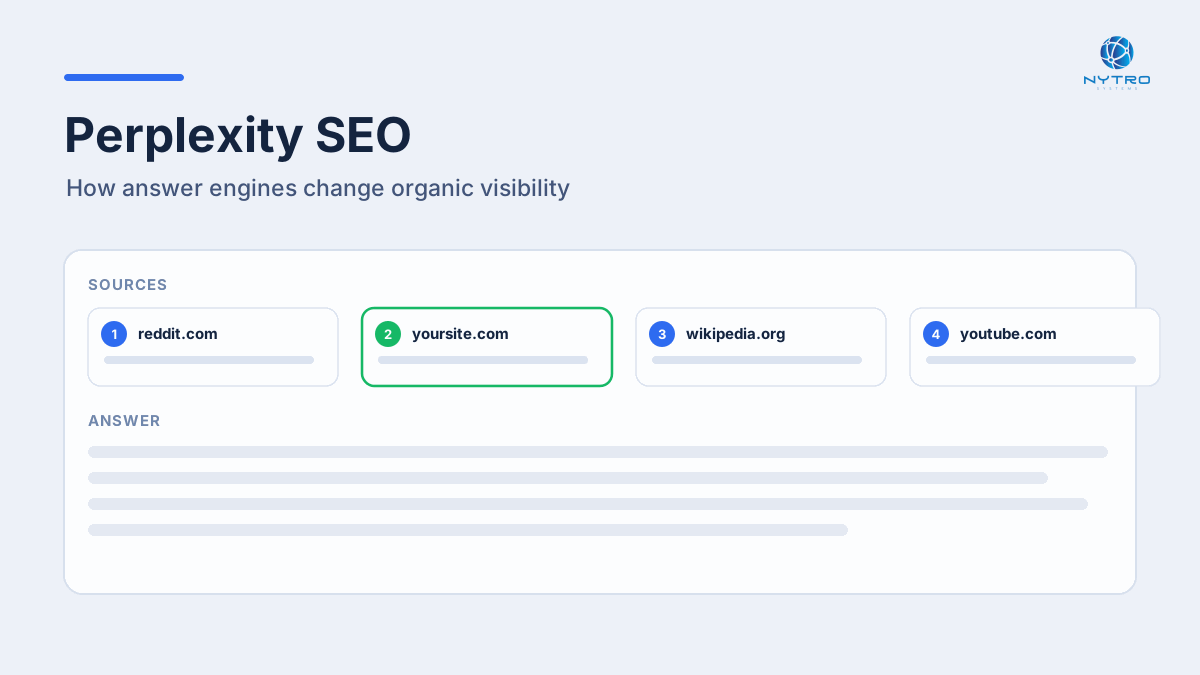
Perplexity does not return ten blue links. It answers the question and puts its sources right at the top, as numbered references you can click. That design choice — an answer engine built to show its work — is why Perplexity SEO is a genuinely different exercise from classic search optimization. The prize is not a ranking a user scrolls to; it is being one of the cited sources the answer is built from. This guide explains what Perplexity SEO is, why a source-first engine changes organic visibility, what it rewards, and how to become a source it cites.
Perplexity bills itself as an answer engine, and the framing matters. Analysis of its citations describes a product designed to respond to questions with linked references up front and “unusually candid about sourcing.” For a marketer, that candor is an opportunity: when an engine shows exactly which pages it used, the path to visibility is clear — be one of those pages. Perplexity SEO is the practice of earning that spot.
Lee Agam, CEO of Nytro Systems, sees Perplexity as the clearest case of a shift the whole industry is making. Because Perplexity surfaces its sources so openly, it removes the mystery: you can literally see who got cited for a query and ask why. In his experience, the pages that win are the ones that answer the question directly, back claims with evidence, and stay current — the same qualities that make any content trustworthy, now rewarded explicitly. His advice is to stop thinking only in rankings and start thinking in citations: who is the answer engine quoting for the questions your business should own, and what would it take to be quoted instead.
What Is Perplexity SEO?
Perplexity SEO is the practice of optimizing your content and site so Perplexity retrieves it, trusts it, and cites it as a source in its answers. Because Perplexity is a source-first answer engine that shows its references prominently, the goal is specific: to be one of the numbered sources behind a Perplexity answer, not merely to rank somewhere a user might eventually find.
The target reframes the whole exercise. In classic search, success is a position in a list and a click. In Perplexity, success is a citation — your page named and linked as part of the answer, often read by the user without a separate visit. That makes Perplexity SEO a close cousin of Answer Engine Optimization and broader AI Search optimization: the content principles are shared, but Perplexity’s unusually transparent sourcing makes the feedback loop tighter, because you can see which sources it actually used.
It also raises the stakes on content quality in a particular way. An engine that puts its sources on display has an incentive to cite pages it can stand behind — clear, accurate, well-supported content — because the citation is visible to the user. Perplexity SEO, then, is less about gaming a ranking and more about being genuinely citable: the kind of page an answer engine is comfortable showing as its source.
Why Perplexity SEO Is Different: A Source-First Answer Engine
The defining feature of Perplexity SEO is that the engine is source-first by design. Where a traditional search engine returns links for you to evaluate and a generative chatbot may answer with no visible sources at all, Perplexity sits in between: it composes an answer and shows the references up front. That architecture changes what “visibility” even means.
Two consequences follow. First, visibility is measured in citations rather than positions. A page can be influential in Perplexity — shaping the answer a user reads — without ever earning a classic ranking or click, because the value is the citation and the credibility of being named. Second, the mix of what gets cited can look different from a Google results page. Analysis of Perplexity’s citations across millions of US queries found community and reference sources heavily represented — with reddit.com, youtube.com, and en.wikipedia.org among the most-cited domains — which tells you the engine often reaches for firsthand discussion, demonstrations, and reference material, not just commercial pages.
For Perplexity SEO, the lesson is to meet the engine where it looks. That means being genuinely useful and quotable, being present where relevant discussion happens, and making your own pages the clear, authoritative answer for the questions you should own. Good AI Search Ranking still helps — a page has to be retrievable and credible — but the destination is a citation, and the content that earns one is content a transparent engine is happy to show.
How Perplexity SEO Changes Organic Visibility
Perplexity SEO forces a shift in how you think about organic visibility, because the funnel changes shape. In the classic model, a search returns links, the user clicks, and your analytics record a visit you can attribute. In Perplexity, the answer often satisfies the user in place, and your “appearance” is a citation that may never become a click. The influence is real; the measurement is just less direct.
This has three practical implications. The value of being a cited source rises, because a citation shapes the user’s understanding and carries brand credibility even without a visit. The value of a raw ranking as an endpoint falls, since there is no ranked list to top in the familiar sense. And attribution gets harder, because much of the impact happens inside the answer rather than in a click you can see. Teams used to judging success by sessions have to add citation presence to the scorecard.
It also changes the competitive picture. Because Perplexity shows its sources, you can study them: run the questions your business should own, see who gets cited, and work out what those pages do that yours does not. That transparency is the upside of the shift — Perplexity SEO is one of the few AI-visibility exercises where the engine tells you, query by query, exactly who the competition is.
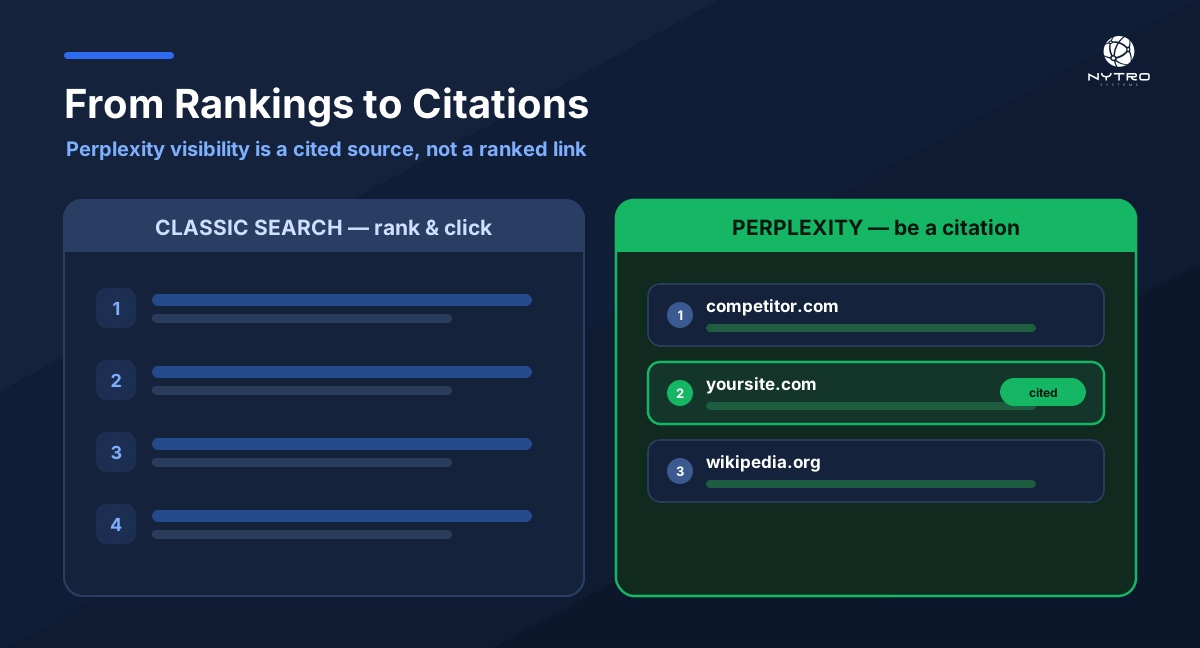
Perplexity SEO shifts the prize from a ranked link to a numbered citation shown up front.
What Perplexity SEO Rewards
Because Perplexity shows its sources, Perplexity SEO rewards content an engine is comfortable displaying as a reference. A few qualities do most of the work, and they are editorial more than technical.
The first is a direct, self-contained answer. A page that states the answer plainly and early gives Perplexity a clean passage to cite, where a buried or meandering answer sends it elsewhere. The second is evidence and credibility: claims backed by data, named sources, and concrete specifics are safer to cite and more convincing when displayed, which is why well-supported pages tend to be favored. The third is freshness. Perplexity is often used for current questions, so visibly up-to-date content — accurate dates, current figures, maintained guidance — has an edge, and stale pages lose ground on time-sensitive queries. The fourth is clarity and structure: question-style headings, scannable sections, and a clear focus make it easy for the engine to match a query to the right passage and lift it.
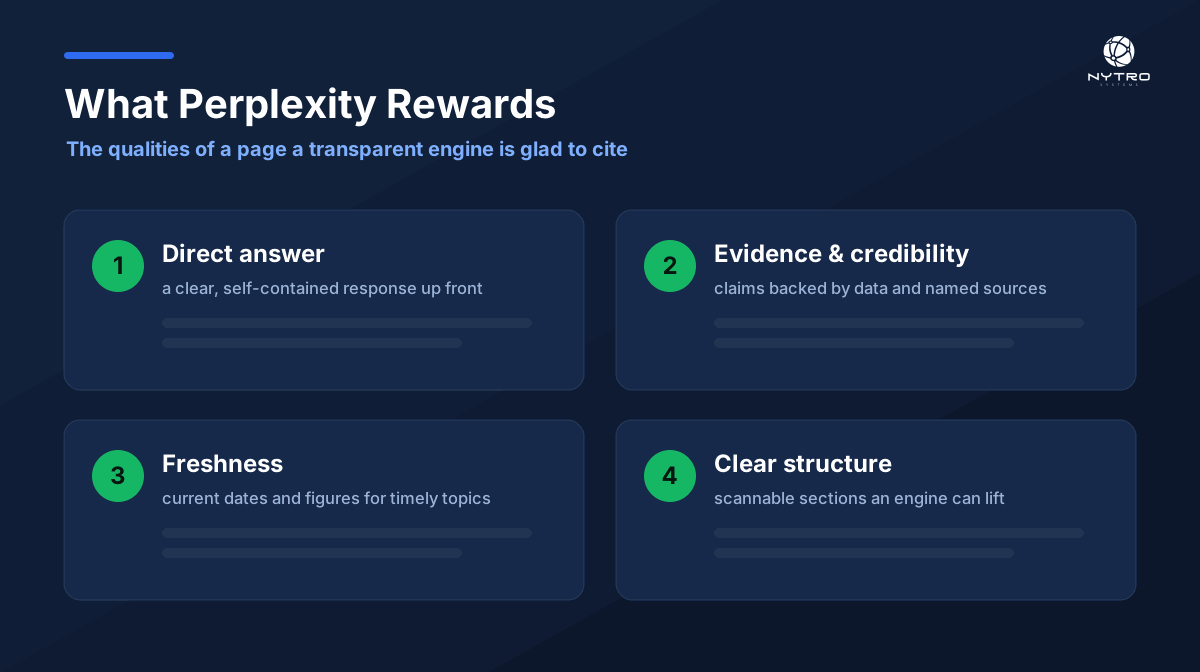
What Perplexity rewards: direct answers, evidence, freshness, and clear structure — content it is comfortable citing.
Taken together, these describe a page that is genuinely citable: it answers the question, proves its claims, stays current, and is easy to extract from. That is the heart of Perplexity SEO at the content level — not a trick, but the discipline of being the source a transparent engine is glad to show. It is worth noting how closely these qualities track plain editorial quality: there is no Perplexity-specific markup to add and no secret signal to chase, only the work of making a page accurate, clear, current, and worth displaying. Teams that already publish that way have less to change than they fear; teams that lean on thin, undifferentiated content have the most ground to make up, because a transparent engine has every reason to cite someone better.
Perplexity SEO Tactics: How to Become a Source
Turning those qualities into action gives a short, practical playbook for Perplexity SEO. None of it is exotic; it is disciplined answer-engine work.
First, be reachable. Allow Perplexity’s search crawler, PerplexityBot, so your pages can be surfaced and linked in Perplexity’s results — Perplexity recommends allowing it for exactly that reason. Second, lead with the answer. Put a clear, self-contained response at the top of each section so the engine has something clean to cite. Third, prove it. Add original data, specifics, and credible sources so your claims are safe to display and convincing when shown. Fourth, keep it fresh. Update time-sensitive pages and keep dates and figures current, because Perplexity leans toward recency for questions that call for it. As a practical extension, go where the relevant conversation and reference material already live — if the engine frequently cites community and reference sources for your topics, a presence in those places complements your own citable pages.
Run that playbook on the questions your business should own and you cover both halves of Perplexity SEO: reachable and citable. The first three tactics are mostly one-time or ongoing hygiene; the fourth, freshness, is the continuous discipline that keeps you competitive on the current questions where Perplexity is used most.
Measuring Perplexity SEO
Measuring Perplexity SEO is more direct than measuring some AI surfaces, precisely because Perplexity shows its sources. The most reliable method is manual testing: ask Perplexity the questions your business should own and record whether you are cited, how your brand is described, and which of your pages is used. Because the sources are displayed, this audit is unusually informative — you see your competitors for each query at the same time.
Beyond that, watch referral traffic from Perplexity where it appears in your analytics, since a citation that converts into a click is direct evidence of impact. Track branded search and mentions, which tend to rise as your citation presence grows. And keep your pages demonstrably reachable and current, because retrievability and freshness are the preconditions for being cited at all. The emerging citation economy adds another dimension: Perplexity’s Comet Plus program shares revenue with participating publishers for human visits, search citations, and agent actions — a sign that being cited is becoming a measurable, and potentially monetizable, outcome in its own right.
No single number captures Perplexity SEO, so read these together: cited when you test the questions, earning the occasional referral, and backed by rising branded interest. A page that does all three is working as a source, even if its classic click numbers look flat.
Perplexity SEO vs Traditional SEO
Setting Perplexity SEO beside traditional Search Engine Optimization clarifies what carries over and what genuinely changes, so you can adapt rather than start from scratch.
Traditional SEO optimizes a page to rank in a list of links, where the user clicks and decides, and success is measured in positions, clicks, and organic traffic. Perplexity SEO optimizes a page to be cited as a source inside a synthesized answer, where the engine displays its references and the user often reads the answer in place. Success is measured in citations and the credibility of being named, not in a ranked position. The match between query and page is also looser: Perplexity composes answers from the sources it judges most useful and trustworthy, so you are optimizing to be citable for an intent, not to rank for a single phrase.
What carries over is almost all of the craft. Being reachable, genuinely useful, well-structured, and authoritative helps in both worlds, and a thin or inaccessible page loses in both. When you set out to optimize website for AI search on the Perplexity surface specifically, the first questions are simply whether the engine can reach your page and whether your content is citable — reachability and credibility, the same foundation classic SEO rests on, pointed at a new kind of result. Teams that already do good SEO usually find Perplexity SEO is less a new discipline than a new scoreboard: citations instead of rankings, transparency instead of guesswork.
Where NytroSEO Fits
Perplexity SEO rewards sites that are reachable, clearly structured, credible, and current — and holding all of that true across a large site is the hard part. The metadata that helps an engine understand and summarize each page drifts, and stale or inconsistent titles and descriptions quietly cost citations.
That is the gap NytroSEO is built to close. Its Automatic SEO engine automatically generates and maintains optimized page titles and meta descriptions across an entire site, so the metadata that search and answer engines rely on stays consistent and current without manual rework. For the deeper background, our overview of getting AI-search-ready walks through the metadata and structure AI retrieval depends on, our Ask Engine Optimization guide covers the extractable, answer-ready formatting that wins citations, and our overview of building AI brand visibility explains the entity signals that help engines trust your brand.
Want to be a source Perplexity cites? Sign up free and explore the NytroSEO system, or book a free strategy session.