Last updated: October 22, 2026
You ask an AI search tool one question. Behind the scenes, it quietly runs many. That hidden behavior is query fan out, and it is one of the most important shifts in how search actually works now that AI generates the answer. Understanding it changes how you plan content, because your page is no longer competing for a single query, it is competing for every sub-question the engine invents on the way to its answer.
This guide explains query fan out in plain terms: what it is, what Google has said about it, how it works from prompt to synthesized answer, and what it means for SEO and AI search teams who have to plan content around it. The goal is practical. By the end you should be able to look at a topic and see not just the headline question, but the cluster of hidden searches your content needs to satisfy to be useful.
Lee Agam, CEO of Nytro Systems, is pragmatic about the hype around the term. In his view, query fan out is a genuinely useful lens for content planning, but it is not a reason to panic or to reinvent your process. The teams that handle it well, he notes, are the ones that already wrote deep, well-structured pages answering a main question and its natural follow-ups, fan out simply rewards that discipline more explicitly than keyword-era search did. His caution is the mirror image: fan out is not a license to spin up a thin page for every sub-query, because that is exactly the behavior search engines penalize. The win is depth on one page, not breadth across fifty.
What Is Query Fan Out?
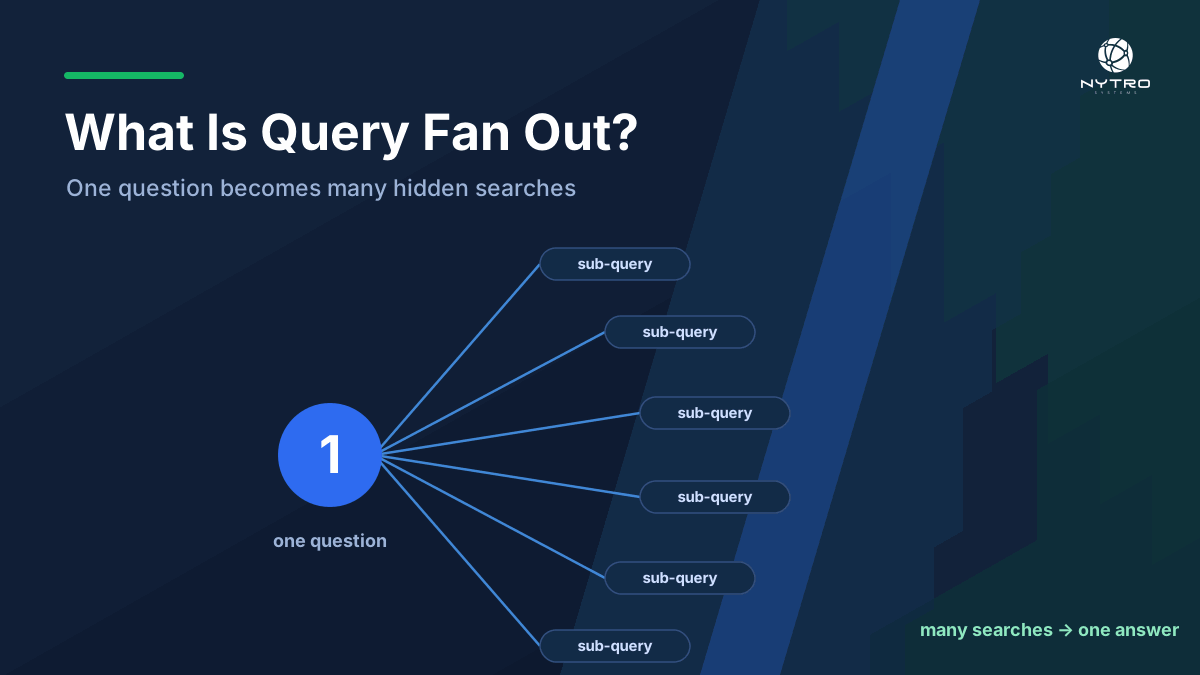
Query fan out is a retrieval technique in which an AI search system takes a single user question, breaks it into multiple related sub-queries, runs those searches at the same time, and synthesizes the results into one generated answer. Instead of matching your page against one query, the system assembles its response from many smaller searches across subtopics.
Google named the technique publicly when it launched AI Mode. In Google’s own framing, AI Mode uses a query fan-out technique that breaks your question down into subtopics and issues a multitude of queries simultaneously on your behalf, then brings the results back together into a single response. Google’s Search Central documentation on its AI features confirms the same thing: AI Overviews and AI Mode may use a query fan-out technique to surface relevant content. The exact number of sub-queries is not disclosed, Google describes it only as “a multitude.”
Conceptually, query fan out is a descendant of a much older idea in information retrieval: reformulating and expanding a query to capture more of what a searcher actually means. What is new is the scale and the automation. The engine, not the user, decides which sub-questions are worth asking, runs them in parallel, and reads across the results to compose an answer. For the person searching, it feels like one question and one answer. Underneath, it is many.
How Query Fan Out Works: From One Prompt to Many Searches
The mechanics of query fan out follow a consistent sequence, whether the surface is AI Overviews, AI Mode, or an assistant like Perplexity. Understanding the sequence is what makes the implications concrete.
First, the system interprets the intent behind the prompt, not just the words, but the underlying goal. Second, it decomposes that intent into sub-queries covering the subtopics, comparisons, and clarifications a thorough answer would need. Third, it runs those sub-queries in parallel against its index and other data sources. Fourth, it reads across the retrieved results, selecting passages that answer each sub-question. Fifth, it synthesizes those passages into a single generated answer, often citing the sources it leaned on most.
The consequence for your content is direct: a page can be pulled into the final answer because it cleanly answers a sub-query the user never explicitly typed. A well-structured page about choosing a product, for example, might be cited for its comparison table, its definition of a key term, or its answer to an edge-case question, none of which were the user’s literal query. Query fan out widens the number of doors through which your content can enter the answer, but only if your content is structured so each door is clearly marked.
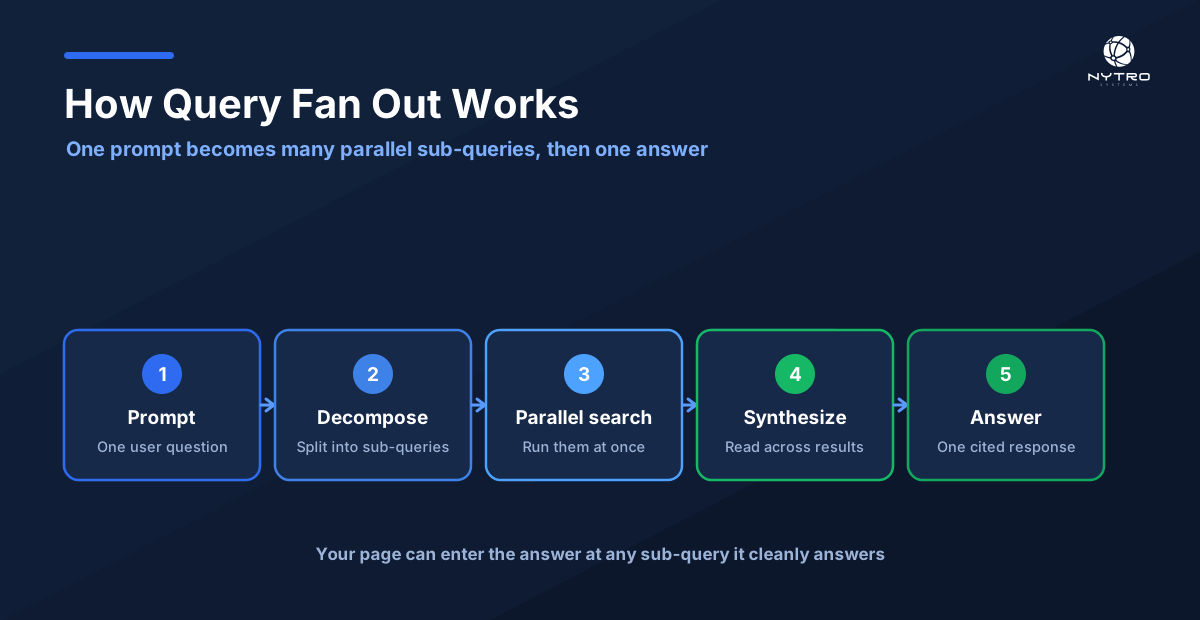
Query fan out in sequence: one prompt becomes many parallel sub-queries, then one synthesized answer.
A Worked Example of Query Fan Out
A concrete illustration makes the pattern obvious. The following example is illustrative, it is not a specific case published by Google, but it reflects how the technique is documented to behave.
Imagine someone asks an AI search tool, “what’s the best running shoe for flat feet if I’m training for a half marathon?” On the surface that is one question. A query fan out system is likely to decompose it into several sub-queries before answering: what features matter in a running shoe for flat feet; which shoes offer strong arch and stability support; what mileage and cushioning a half-marathon plan demands; how specific popular models compare for overpronation; and perhaps what reviewers with flat feet report about durability. The engine runs those searches, gathers the best passages for each, and composes a single recommendation.
Notice what that means for a content team. A thin page that only says “the best shoe for flat feet is Model X” answers one sub-query and nothing else. A deep, well-structured page that defines the relevant features, compares several models, addresses the half-marathon training angle, and includes real durability detail can be pulled in for several of the sub-queries at once. The deep page does not just rank better, it has more surfaces that the fan out can grab. That is the entire strategic point of understanding the technique.
Why Query Fan Out Matters for SEO and AI Search Teams
Query fan out reframes the unit of competition. In keyword-era Search Engine Optimization, you optimized a page for a primary query and a handful of variants, and success was a ranking. Under query fan out, your page is evaluated against a shifting set of sub-queries the engine generates on the fly, and success is being one of the passages the answer is built from.
This changes three things for SEO and AI search teams. It raises the value of topical depth, because a page that answers the main question and its natural sub-questions qualifies for more of the fan out than a shallow one. It raises the value of clear structure, because the engine has to be able to locate the passage that answers each sub-query, buried answers get skipped. And it changes measurement, because a page can contribute to an answer without earning a classic top ranking or even a click. Good AI Search optimization now means planning for the cluster of questions behind a topic, not just the headline keyword. The same discipline improves AI Search Ranking in the conventional sense too, since depth and structure have always helped there.
Crucially, query fan out does not make traditional fundamentals obsolete. The sub-queries are still answered from indexed content, so being crawlable, indexed, and snippet-eligible remains the entry ticket. Query fan out raises the ceiling on what good content can achieve; it does not lower the floor of what technical health requires.
The measurement shift deserves its own attention, because it is where teams most often get discouraged. Under keyword targeting, a page either ranked or it did not, and the number was easy to read. Under query fan out, a page can quietly contribute a sentence or a table to a generated answer dozens of times a day without that showing up as a ranking or a click. The practical response is to widen what you watch: track impression trends on the query clusters where AI Overviews appear, test your target topics directly in the AI surfaces and note which of your passages get used, and watch referral traffic and brand mentions from assistant tools. None of these is as clean as a rank-tracking number, but read together they tell you whether your content is actually being pulled into answers, which, under fan out, is the thing that matters.
How to Spot the Sub-Queries Behind a Topic
Because query fan out rewards pages that answer the hidden sub-questions, the most useful planning skill is learning to see those sub-questions before you write. The method is low-tech and repeatable.
Start with the main question a page targets, then ask what a genuinely thorough answer would have to cover for a reader to walk away satisfied. The sub-questions almost always fall into a few predictable buckets: definitions of the key terms involved, comparisons between the obvious alternatives, the steps or process to actually do the thing, the edge cases and exceptions, the common objections or mistakes, and the evidence a skeptical reader would want. Pull real phrasing from the “People also ask” boxes and related-search suggestions for your topic, because those are a public window into the kinds of sub-queries engines already associate with it. Group what you find by intent, drop anything off-topic, and you have the outline of a page that answers the main question and the fan-out around it in one place, which is exactly the shape query fan out rewards.
How to Optimize for Query Fan Out Without Spamming
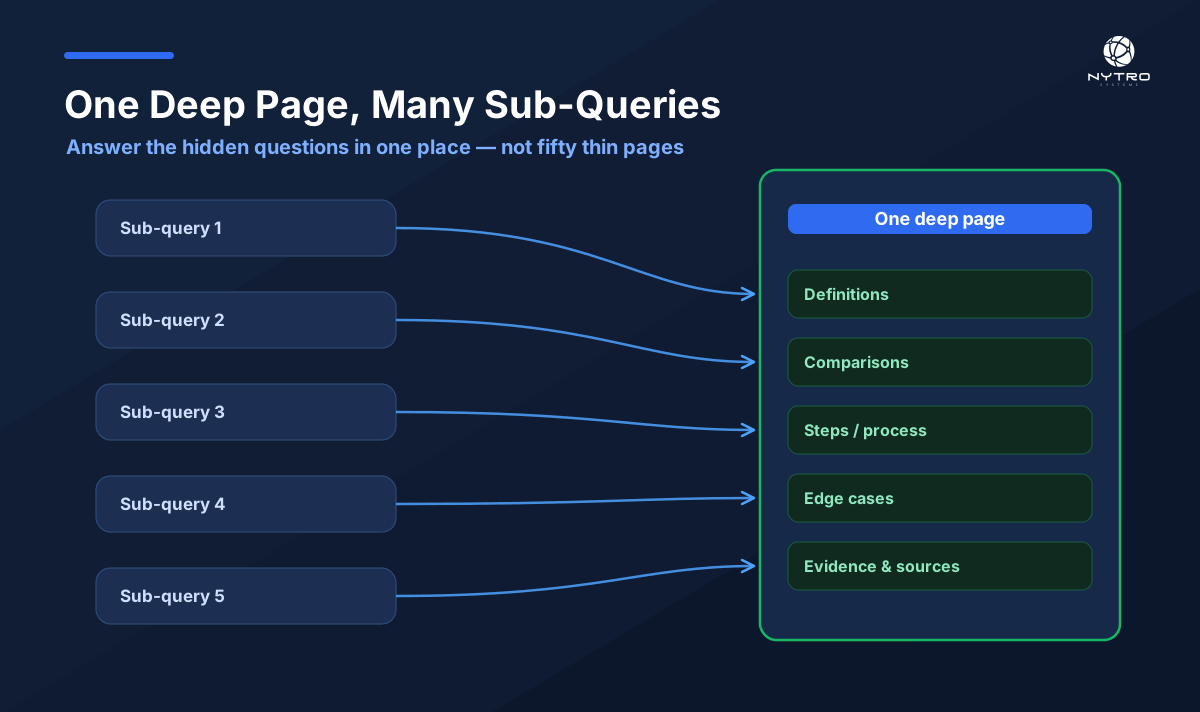
The temptation query fan out creates is obvious and dangerous: if the engine asks many sub-questions, why not make one page per sub-question? The answer is that search engines treat mass-produced, thin pages as scaled content abuse, and the tactic backfires. The right response is depth and structure on fewer pages, not a page explosion. To optimize website for AI search under fan out, the move is to make one strong page answer many sub-queries cleanly.
In practice that means a few disciplined habits. Map the real sub-questions behind a topic before writing, the comparisons, definitions, edge cases, and follow-ups a thorough answer would need. Give each sub-question its own clearly labeled section with a direct answer up front, so the engine can locate and lift it. Use question-style headings that mirror how people actually ask. Include the extractable units fan out loves: compact comparison tables, short definitions, numbered steps, and specific evidence with sources. And keep the page genuinely useful to a human reader, because the same clarity that helps a person find an answer helps an engine find the passage.
Done this way, one deep page qualifies for many of the sub-queries in a fan out while staying firmly on the right side of quality guidelines. That is the difference between riding the technique and getting penalized by the overreaction to it.
Query Fan Out vs Traditional Keyword Targeting
Setting query fan out beside old-style keyword targeting clarifies what has actually changed and what has not.
Traditional keyword targeting starts from a keyword and its variants, builds a page to rank for them, and measures success by position and clicks. It assumes a direct match between the user’s typed query and the page that answers it. Query fan out starts from an intent, generates its own set of sub-queries, and measures your content by whether it supplies passages to the synthesized answer. The match is indirect: your page can be used for questions the user never typed.
What has not changed is the underlying craft. Deep, clearly structured, genuinely useful content wins in both models, fan out just makes the reward for depth more explicit and the penalty for thinness more automatic. As one widely-read industry analysis notes, query fan out is still best treated as a concept for planning rather than a proven, dial-it-in optimization tactic. The sensible posture is to let it shape how broadly you think about a topic, while keeping your actual methods grounded in the fundamentals that have always worked.
Where NytroSEO Fits
Query fan out rewards breadth of coverage held together by clean structure, and doing that consistently across a whole site is the hard part. Every important page needs accurate metadata, answer-ready structure, and valid schema so the engine can locate the passage that answers each sub-query, and that has to be maintained everywhere, not just on a few flagship articles.
That is the gap NytroSEO is built to close. Its Automatic SEO engine keeps titles, descriptions, and structured data optimized across the whole site, so pages stay index-eligible and clearly structured, matching fan-out breadth through depth and metadata rather than spawning thin pages. For the deeper background, our LLM SEO strategies guide covers optimizing for AI-driven retrieval, our Ask Engine Optimization guide walks through answer-ready formatting, and our overview of building AI brand visibility explains the entity signals that help engines trust your pages.
Want your pages ready for the hidden searches behind every prompt? Sign up free and explore the NytroSEO system, or book a free strategy session.