Last updated: June 1, 2026
Adaptive AI SEO Automation is the practice of using artificial intelligence to continuously analyze search signals, page metadata, keyword intent, and content relevance, then recommend or apply on-page optimization updates as conditions change. Instead of treating optimization as a one-time checklist, it turns SEO into a self-adjusting feedback loop that keeps every page aligned with current search demand.
For SEO agencies, SMBs, developers, and large website owners, this matters because search behavior now moves faster than any manual workflow can follow. A single page must be understandable to traditional search engines, AI answer engines like Google AI Overviews and ChatGPT, social previews, image search, and people asking full conversational questions. Google’s SEO Starter Guide defines SEO as helping search engines understand content and helping users find a site — and adaptive SEO keeps that understanding fresh instead of letting it decay against yesterday’s keyword map.
This guide explains what Adaptive AI SEO Automation is, how it works, the signals it monitors, how it differs from older automation, and how to implement it responsibly. NytroSEO is referenced throughout as a real-world example of an automated on-page SEO and answer engine optimization (AEO) platform built for this exact workflow. By the end, you will have a practical framework you can apply to one landing page or to a library of one million URLs.
What Is Adaptive AI SEO Automation?
Adaptive AI SEO Automation is an AI-driven optimization model that detects changes in search demand and page performance, then adjusts SEO elements — titles, meta descriptions, image alt text, link anchors, Open Graph tags, and conversational question signals — to improve relevance, visibility, and click potential without requiring manual edits on every page.
The simplest way to understand it: traditional SEO sets a plan, while adaptive SEO keeps checking whether that plan is still correct. A static workflow researches keywords, writes metadata, publishes a page, and reviews it months later. An adaptive workflow analyzes the page, monitors search behavior, detects gaps, and refreshes page-code signals only when evidence shows a reason to change.
That qualifier matters. Good Adaptive SEO does not change content randomly or chase volume. It avoids unnecessary churn and acts only on a signal-based reason: a new query pattern, duplicated metadata, weak image alt text, poor anchor context, or copy that no longer reflects how users search. Done well, adaptive SEO optimization makes good pages easier to discover, classify, and match with the right intent — it does not replace strategy or editorial judgment, it removes the operational drag that slows those strategies down.
It also helps to be precise about terminology. “Adaptive SEO algorithms” describe the underlying logic that evaluates signals and decides what to change. “Adaptive SEO automation” describes the workflow that carries those decisions into production. “Adaptive AI SEO Automation” is the combination: machine intelligence plus automated implementation, governed by human strategy. Keeping those layers distinct makes it easier to decide what to automate and what to keep under manual control.
Why Adaptive SEO Matters in the AI Search and Answer Engine Era
Search is no longer limited to matching a short keyword to a ranked list of blue links. Users now search with longer questions, comparison prompts, and problem-specific queries, and AI systems increasingly summarize answers before a user ever clicks. According to Google’s guidance on AI features and your website, generative AI experiences in Search are still rooted in core ranking and quality systems — which means crawlable, helpful, technically sound pages remain the foundation for appearing in AI answers.
This raises the stakes for consistency. A page that was perfectly optimized last quarter can quietly fall behind as competitors publish fresh resources, as query phrasing evolves, and as answer engines reweight what they consider a trustworthy source. Manual teams simply cannot re-audit every page often enough. Adaptive SEO closes that gap by treating optimization as ongoing maintenance rather than a launch-day event.
Answer Engine Optimization (AEO) adds another layer. Instead of focusing only on ranking position, AEO improves the chance that a page can serve as a concise, extractable answer source. That requires direct definitions, clear headings, strong metadata, relevant schema, image context, internal links, and language that mirrors how real people ask questions. Adaptive algorithms help maintain that alignment automatically, comparing page-level signals with current search behavior and flagging anything weak, outdated, duplicated, or incomplete.
How Adaptive AI SEO Automation Works
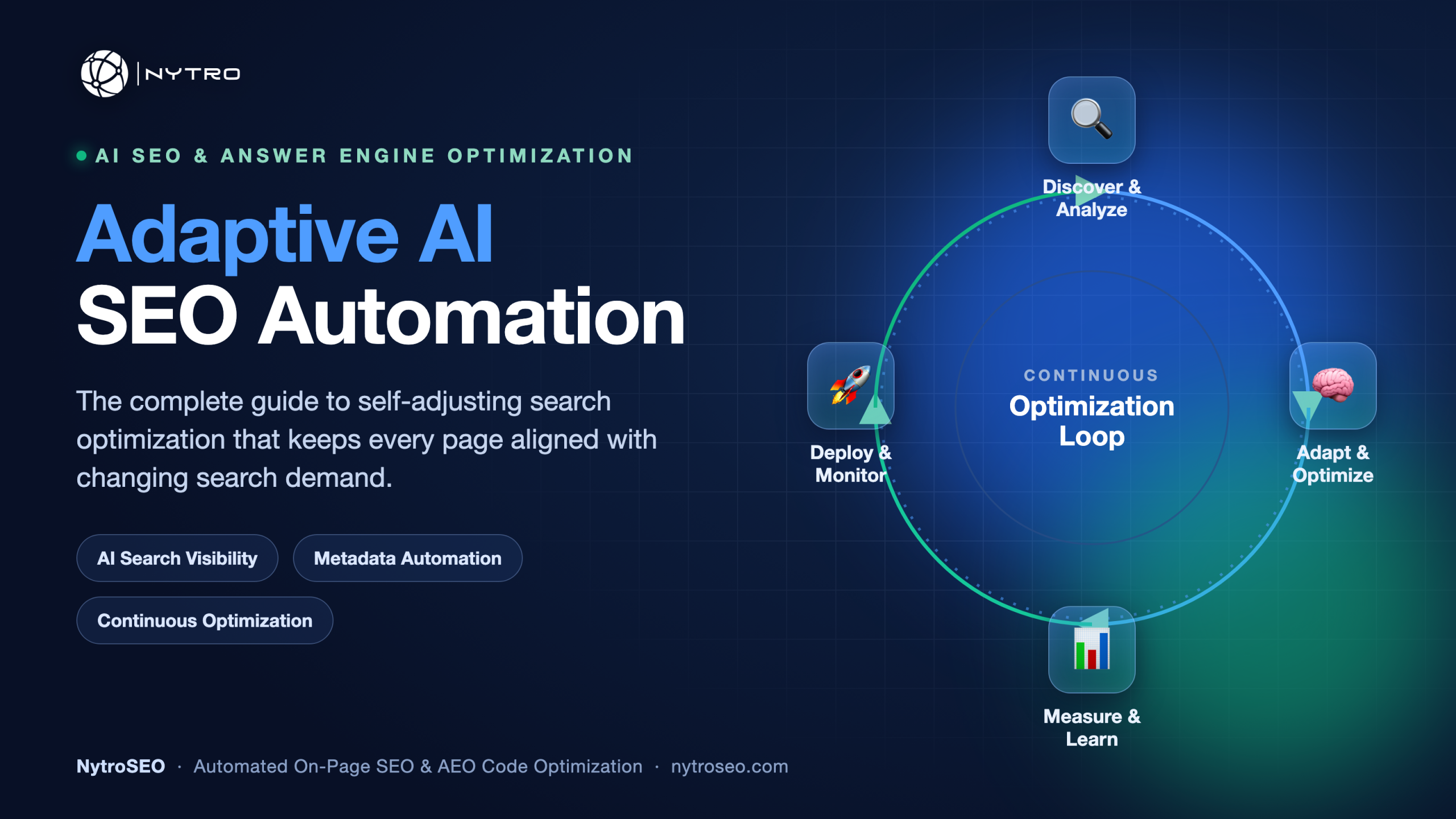
Adaptive AI SEO Automation works as a continuous optimization loop with four repeating stages. Each cycle feeds the next, so pages improve over time rather than drifting out of date.
- Discover & analyze. The system crawls pages and reads search trends, SERP features, metadata, and content signals to understand what each page is about and which queries it should serve.
- Adapt & optimize. It assigns relevant search terms, generates intent-aware metadata, and prepares on-page improvements — title tags, descriptions, alt text, anchors, and conversational question signals.
- Deploy & monitor. Approved changes are applied through a controlled implementation layer (NytroSEO uses a lightweight header JavaScript snippet) so updates roll out without editing every CMS page by hand.
- Measure & learn. The platform watches impressions, clicks, average position, and AI-visibility indicators, then uses that feedback to decide what to refine in the next cycle.
Because the loop never truly “finishes,” the approach scales: one specialist can keep thousands of URLs aligned with shifting demand instead of manually rewriting tags page by page. This is the core promise of Adaptive SEO automation — operational leverage with human oversight retained. The implementation layer is what separates adaptive SEO from a simple reporting tool: reports tell you what is wrong, while an adaptive system helps you act on it safely and at scale.
What Adaptive SEO Algorithms Monitor
Adaptive SEO algorithms can track many signals, but the most useful ones fall into five groups. Understanding them helps teams decide where automation adds value and where human review is still essential.
1. Query and keyword intent signals
Search intent shifts over time. A phrase that once meant “research” can become a buying query as a market matures, and short keywords increasingly turn into full conversational questions inside AI tools and voice-style search. Adaptive systems watch for new long-tail variations, seasonal demand, question-based searches, location and language signals, and movement between informational, commercial, and transactional intent. For example, “adaptive SEO” may attract strategy-minded readers, while “adaptive SEO automation” tends to attract agencies and enterprise teams evaluating software.
2. Page metadata quality
Title tags, meta descriptions, image alt attributes, Open Graph tags, and anchor titles help machines and people interpret a page. When these are missing, duplicated, or misaligned, visibility suffers. Adaptive SEO reviews whether metadata uses the most relevant language, matches the page topic, supports click-through, avoids duplication across the site, and reflects the conversational questions users actually ask. Metadata is often too time-consuming to optimize manually across thousands of URLs, yet too important to ignore — which is exactly why it is one of the highest-leverage targets for automation.
3. Content-to-intent alignment
A page can rank for the wrong audience when its content and metadata drift apart. Adaptive SEO algorithms compare the page’s main topic, headings, internal links, and metadata against the intent searchers actually show — flagging pages that need clarification before they lose relevance. A page about “SEO automation software,” for instance, should explain what the software automates, who uses it, how it handles metadata, and how it fits into technical SEO and AI search visibility.
4. Technical and structural clarity
Search systems must crawl, render, and interpret pages. Adaptive SEO does not replace technical SEO, but it supports it by surfacing weak elements: missing title tags, thin descriptions, absent alt text, poor anchor context, inconsistent language cues, or missing structured-data opportunities. These are precisely the issues that erode AI extractability, because an answer engine cannot cite what it cannot confidently parse.
5. Competitive and market movement
Results change when competitors publish, refresh, or restructure content, build better internal links, or target new questions. Adaptive SEO algorithms help teams respond to these shifts continuously instead of waiting for a manual quarterly audit, so hard-won visibility does not silently erode between reviews.
Adaptive AI SEO Automation vs. Traditional SEO Automation
Adaptive AI SEO Automation differs from traditional SEO automation because it does not simply complete repetitive tasks — it uses feedback from search behavior and performance to decide what should change. The table below makes the distinction clear.
| Area | Traditional SEO automation | Adaptive AI SEO Automation |
| Main purpose | Save time on repetitive tasks | Keep SEO signals aligned as conditions change |
| Timing | Batch-based or one-time | Continuous and regularly refreshed |
| Inputs | Keyword lists, templates, rules | Keywords, page context, user intent, search shifts |
| Output | Generated tags, reports, or tasks | Updated recommendations and live page-code improvements |
| Best use | Speeding up execution | Maintaining relevance at scale |
The key difference is feedback. Traditional automation may generate a meta description once. An adaptive system asks whether that description still matches the best opportunity, whether the page is missing a stronger conversational query, and whether the title could communicate more value. For a deeper applied walkthrough, see our guide to adaptive AI Nytro SEO automation for scalable search visibility.
Benefits of Adaptive AI SEO Automation for Agencies, SMBs, and Large Sites
The benefits of Adaptive AI SEO Automation are clearest when you map them to the operational bottleneck each audience faces: too many pages, too little time, and search demand that never stops moving.
- SEO agencies reduce repetitive metadata work across many client sites, improving margins while freeing specialists for strategy, content, and reporting.
- SMBs keep optimization active without hiring a large in-house team, so pages stay current after every product or market change.
- Large publishers and ecommerce sites maintain search-readiness across thousands of URLs that would otherwise be neglected.
- Developers apply on-page improvements through a controlled layer instead of shipping risky template edits on every release.
There is also a measurable AI-search payoff. The Google AI features and your website guide confirms that generative AI features still rely on core Search ranking, crawlable content, and helpful information — so structurally sound, consistently maintained pages remain the foundation for citation in AI answers. Independent research into generative engine optimization reinforces the structural angle: studies found that citing authoritative sources and adding relevant statistics can raise the likelihood of being referenced in AI-generated answers by roughly 30–40%, while keyword stuffing actively reduces it. Adaptive SEO optimization keeps those positive signals fresh at scale, which is difficult to sustain by hand. Explore the full platform context on the SEO solutions for website optimization page.
How to Implement Adaptive AI SEO Automation: A Step-by-Step Checklist
Implementing Adaptive AI SEO Automation is most effective when you start with strategy and let automation handle the repeatable layer. Use this checklist to evaluate or deploy it on any website.
- Clarify the audience. Define whether each page serves business owners, agencies, developers, enterprise teams, or local marketers.
- Map the intent. Identify the primary question, secondary questions, and commercial intent the page should answer.
- Audit metadata. Review titles, descriptions, image alt text, Open Graph tags, and anchor titles for gaps and duplication.
- Check page structure. Use one H1, logical H2/H3 headings, direct-answer blocks, and scannable sections.
- Add internal links. Connect each page to relevant product, solution, and resource pages to strengthen topical authority.
- Use trusted outbound links. Support technical claims with authoritative sources such as Schema.org and official search documentation.
- Use schema carefully. Add FAQPage JSON-LD only for FAQ content that is genuinely visible on the page.
- Monitor search volatility. Track impressions, rankings, CTR, and important query variations.
- Refresh based on evidence. Adjust page-code signals when data shows a real gap or opportunity, not on a fixed schedule.
- Review strategic pages manually. Keep humans in control of high-value pages and sensitive claims.
Adaptive SEO Optimization Best Practices (Without Over-Optimizing)
Adaptive SEO optimization should make pages more useful and easier to understand — it should never create keyword stuffing, constant unnecessary edits, or thin AI-generated pages. Google’s helpful content guidance is explicit that people-first content wins, so restraint is a feature, not a limitation.
Keep people-first content at the center. Use automation for repeatable tasks — metadata, alt text, anchors, Open Graph tags — and keep strategic content human-written and human-reviewed. Important product claims, pricing, comparisons, and case studies should always pass through a person who understands the business and the audience.
Change only with a reason. More edits do not mean better SEO. Adaptive systems should use signals and thresholds so they act on meaningful opportunities, not activity for its own sake. Unnecessary churn can destabilize pages that were already performing well.
Validate outcomes with data. Review impressions, clicks, average position, CTR, conversions, indexed pages, and AI-visibility indicators. The goal is better qualified visibility and stronger page understanding — not movement on a dashboard.
How to Measure Results From Adaptive SEO
Measuring adaptive SEO requires looking beyond a single ranking number, because the system is optimizing many pages and many signals at once. Track a small set of metrics consistently and compare month over month rather than day to day.
- Visibility: impressions and average position across the page set, segmented by intent type.
- Engagement: click-through rate and qualified clicks, which reveal whether metadata is resonating.
- Coverage: the number of indexed pages and the share of pages with complete, non-duplicate metadata.
- AI visibility: whether your pages appear or are cited in AI Overviews and answer engines for priority questions.
- Conversions: the business outcomes that justify the program, not just traffic.
Because there is no AI-specific reporting inside Search Console, treat standard SEO metrics as your source of truth for Google and use dedicated AI-visibility monitoring to understand citation behavior on ChatGPT, Perplexity, and similar engines.
Common Mistakes to Avoid With AI SEO Automation
Even strong adaptive SEO programs can go wrong when automation is pointed at the wrong goal. Avoid these common mistakes:
- Automating strategy instead of execution. Let the system handle metadata and signals; keep positioning and messaging human.
- Optimizing for robots over readers. Content written to game an algorithm rarely gets cited or converts.
- Ignoring freshness. Undated, stale pages lose to recently maintained ones because AI systems weight recency.
- Blocking AI crawlers. If answer-engine bots cannot access your pages, they cannot cite you.
- Skipping measurement. You cannot improve what you do not track; review AI visibility at least monthly.
Real-World Examples of Adaptive SEO Automation
Adaptive SEO automation becomes concrete when applied to real situations. These examples show how the same loop adapts to different website types.
An ecommerce site with thousands of product and category pages can refresh category titles around seasonal demand, add specific image alt text, align descriptions with commercial intent, improve internal anchor signals, and detect pages with missing metadata — all without manual rewrites.
An SEO agency managing dozens of clients can scale metadata generation across accounts, identify weak or duplicate page-code signals, support local-market variations, reduce repetitive work for specialists, and give strategists more time for content and link work.
A SaaS company or publisher with older evergreen pages can detect outdated metadata, add stronger conversational query signals, improve image alt text, and route internal links from new content to high-value resources. To see how AI-search readiness ties in, read our guide on how llms.txt unlocks full AI analysis and discoverability and the original Nytro SEO adaptive SEO automation overview.
Frequently Asked Questions About Adaptive SEO
Adaptive AI SEO Automation is the use of AI to continuously analyze search signals, page metadata, and content relevance, then recommend or apply on-page optimization updates as conditions change. It turns SEO from a one-time checklist into a self-adjusting feedback loop that keeps pages aligned with current search demand.
Traditional SEO automation completes repetitive tasks once, such as generating tags or reports. Adaptive SEO automation uses ongoing feedback from search behavior and page performance to decide what should change, refreshing metadata and page-code signals continuously instead of on a one-time basis.
No. Adaptive SEO algorithms support specialists, they do not replace them. Humans are still needed for strategy, positioning, content quality, technical judgment, and client communication. Automation handles the repetitive page-level tasks that slow teams down, freeing experts for higher-value work.
Yes, when it keeps content helpful and people-first. Google states that AI search features still rely on core Search ranking, crawlable content, and useful information. Adaptive SEO optimization keeps metadata, structure, and conversational signals current, which helps both traditional search and AI answer engines interpret a page.
Timelines vary by site size, authority, and competition. Because adaptive SEO optimization works as a continuous loop, improvements compound over weeks and months as the system refreshes signals and learns from performance data, rather than producing a single one-time spike.
NytroSEO is an automated on-page SEO and AEO platform that dynamically optimizes metadata, image alt text, link anchors, Open Graph elements, and conversational question signals through a lightweight header snippet, helping websites stay aligned with search intent and AI-driven discovery at scale.