Last updated: June 11, 2026
Perplexity answers almost every question with a short, sourced summary, and unlike a traditional search engine, it shows its citations right in the response. That single design choice changes the game. If your page is one of the numbered sources under a Perplexity answer, you earn visibility and a click at the moment a buyer is deciding. If it is not, you are absent from a fast-growing research habit. Perplexity AI Search Optimization is the practice of earning those citations on purpose.
This guide is practical and specific. It explains how Perplexity chooses its sources, why freshness and structure matter more here than almost anywhere else, how to confirm PerplexityBot can read your site, and how to apply the work at scale.
How Perplexity AI Search Optimization Works
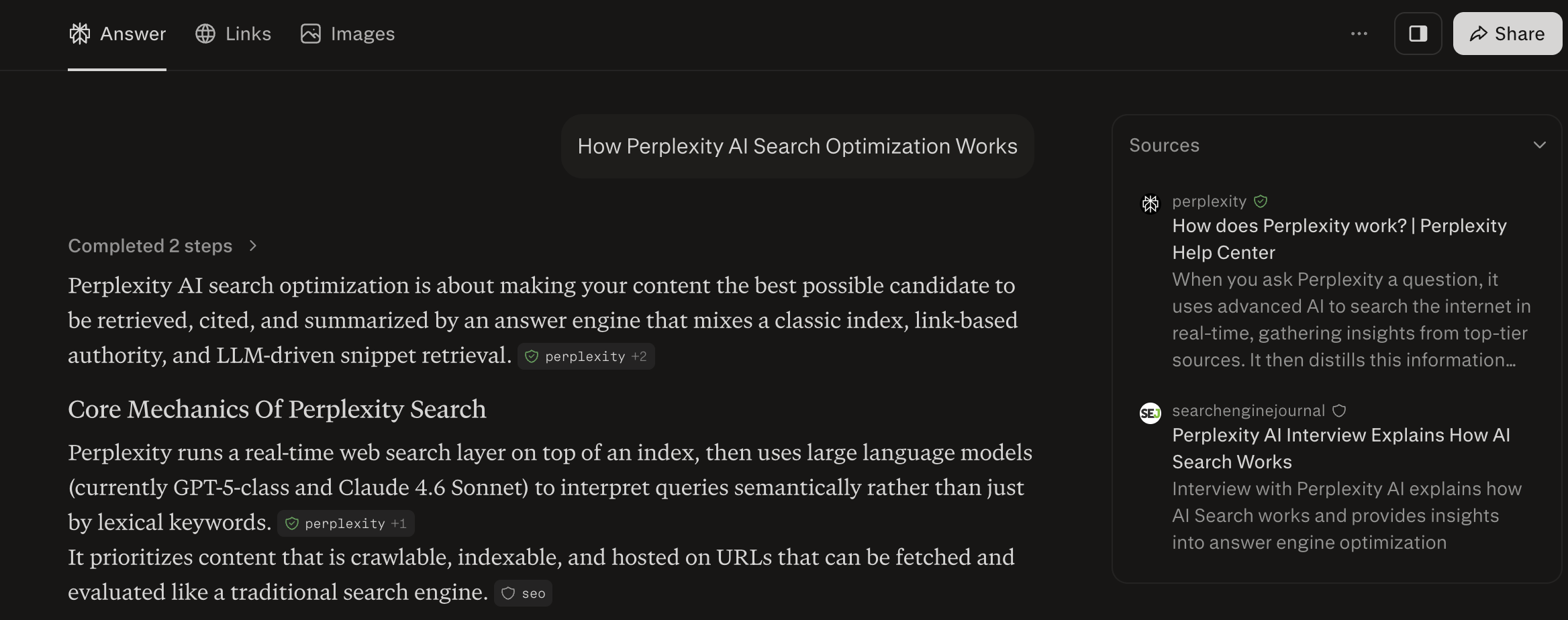
Perplexity is an answer engine, not a link directory. For each query it retrieves a set of candidate pages, ranks them for relevance and reliability, and composes a concise answer with inline citations pointing back to the sources it used. Because it almost always cites, the competition is not for a ranking slot but for a spot in that citation list.
Three factors consistently influence which sources make the cut. Relevance comes first: the page has to answer the specific question directly. Reliability comes next: Perplexity favors sources that read as authoritative and well-supported. Recency is the third, and it carries unusual weight here — Perplexity leans toward current information, which is why freshness is such a strong lever.
The citation interface itself is the opportunity. Because each answer displays its sources as numbered chips a user can click, a citation is a direct referral path back to your site plus a credibility signal that your brand was trusted enough to inform the answer. It also means your results are auditable: you can look at any answer and see exactly whether you were cited, which competitors were, and what page earned the slot.
Perplexity AI Search Optimization Starts With Crawler Access
None of the optimization below matters if Perplexity cannot read your site. Perplexity uses a crawler, PerplexityBot, to index content for its answers, plus an on-demand fetcher that retrieves pages when a user’s query triggers live browsing. If your robots.txt blocks these agents, you remove yourself from the candidate pool before the contest even starts.
Check your robots.txt first, at yourdomain.com/robots.txt, and confirm there is no rule disallowing PerplexityBot. If you are unsure how allow and disallow rules are interpreted, Google’s introduction to robots.txt is a clear primer, and the same syntax governs AI crawlers. For the current user-agent names and IP ranges, consult Perplexity’s own documentation on its crawlers. One careless line can undo everything — the same principle drives our guide to allowing AI crawlers while blocking training bots. If you want the benefits of Perplexity AI Search Optimization, the first non-negotiable is letting PerplexityBot in.
Freshness: The Most Overlooked Perplexity AI Search Optimization Lever
If there is one signal that separates Perplexity from older search behavior, it is the premium on recency. Perplexity is built to surface current information, and it visibly favors pages that appear up to date. That makes freshness one of the highest-return moves in Perplexity Answer Engine Optimization.
Freshness is not just a publish date; it is a set of habits. Show a clear, honest “last updated” date on pages you genuinely maintain. Revisit your priority pages on a schedule — quarterly at minimum for fast-moving topics — and update statistics, examples, and references so they reflect the current state. When two pages are otherwise comparable, the fresher one tends to win the citation, so a disciplined refresh cadence quietly compounds into more citations over time. This is also why a large site struggles to compete manually: keeping hundreds of pages genuinely current is a scale problem, not a writing problem.
Be honest about what “fresh” means, though. Simply changing a date without touching the content erodes trust and can backfire. Real freshness means the substance is current: the statistics reflect this year, the examples reference current tools and behavior, and any claim that has changed since publication is corrected.
Structure for Perplexity AI Search Optimization: Tables, Stats, and Definitions
Perplexity rewards content it can extract cleanly and trust quickly. Lead each section with a direct, self-contained answer of roughly 40 to 60 words. Use question-style headings that mirror how people actually ask. Add an FAQ, because question-and-answer pairs are easy for an answer engine to lift verbatim. And lean on the formats Perplexity clearly likes: comparison tables, concrete statistics, and crisp definitions.
There is evidence behind these choices. The 2024 study “GEO: Generative Engine Optimization” from researchers at Princeton and collaborators found that adding cited sources raised visibility in generative answers by roughly 40 percent, adding statistics by about 37 percent, and including expert quotations by around 30 percent, while keyword stuffing reduced visibility. You can read the GEO research on arXiv. For a deeper treatment of framing content around real questions, our guide on how to optimize content for questions pairs well with this section, and the strategic context lives in our overview of AI visibility in the age of synthetic search.
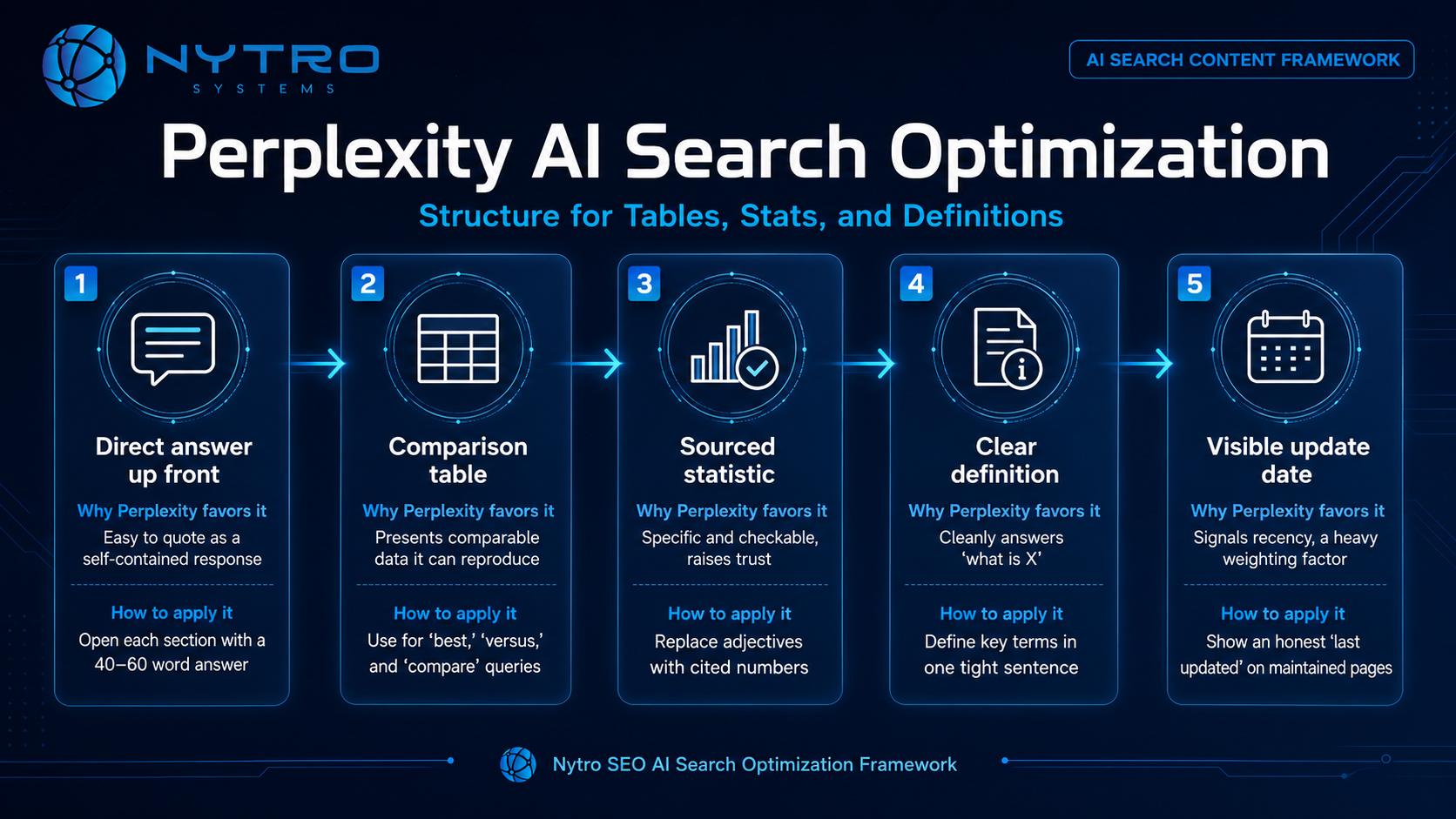
To make the format point concrete, the table below shows which content elements Perplexity tends to reward and why — the kind of structured summary an answer engine can lift directly.
| Content element | Why Perplexity favors it | How to apply it |
| Direct answer up front | Easy to quote as a self-contained response | Open each section with a 40–60 word answer |
| Comparison table | Presents comparable data it can reproduce | Use for “best,” “versus,” and “compare” queries |
| Sourced statistic | Specific and checkable, raises trust | Replace adjectives with cited numbers |
| Clear definition | Cleanly answers “what is X” | Define key terms in one tight sentence |
| Visible update date | Signals recency, a heavy weighting factor | Show an honest “last updated” on maintained pages |
A page built from these elements gives Perplexity something to cite in almost any answer format, which is exactly what raises your citation rate.
A Quick Worked Example
Suppose you want to appear when someone asks Perplexity, “What’s the best way to automate on-page SEO for a large site?” First, you confirm PerplexityBot is allowed — it was not, so that fix alone makes you eligible. Next, you restructure your pillar page to open with a 50-word direct answer, add a comparison table of automation approaches, and include two current statistics with sources. You add a visible “last updated” date and commit to refreshing the page quarterly. Within a few weeks of consistent checking, your page begins appearing as a numbered citation under Perplexity’s answer, alongside one or two competitors. Notice what did the work: eligibility, recency, and a structure Perplexity could quote.
How to Appear in AI Search Results Beyond Perplexity
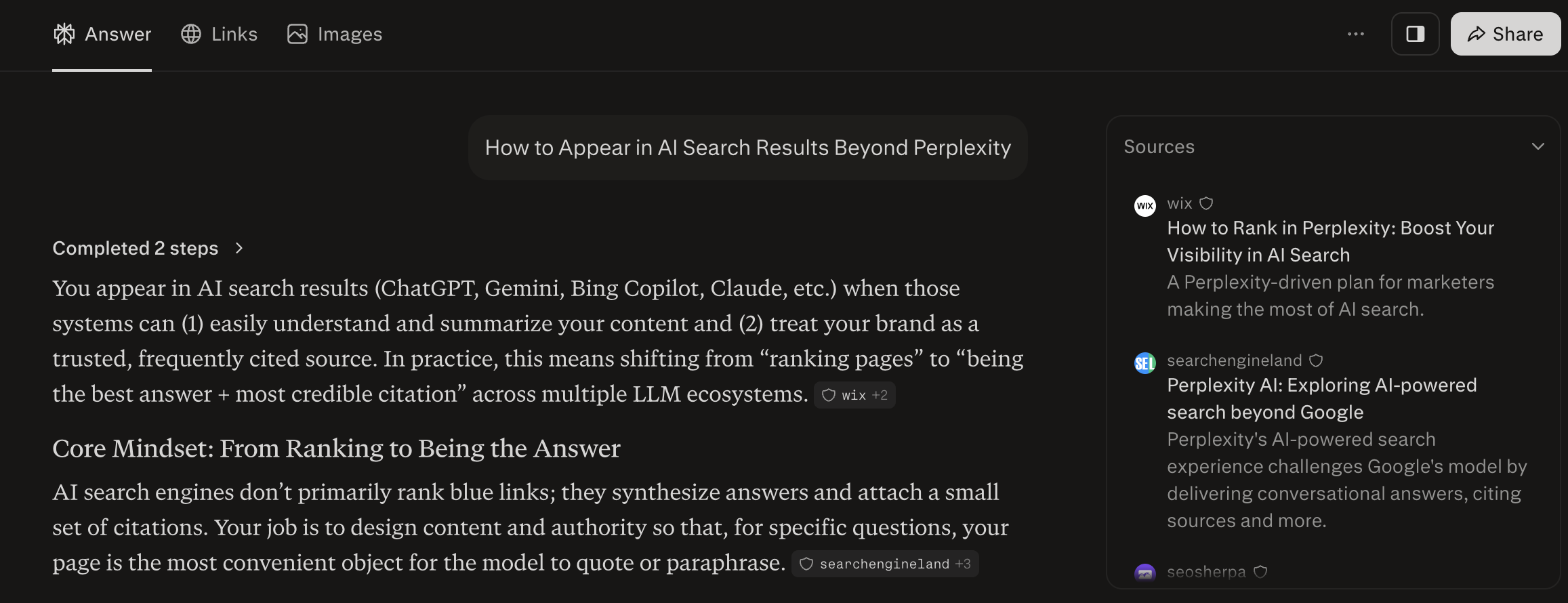
The habits that win on Perplexity travel well. Ask how to appear in AI search results as a general goal, and the answer overlaps almost entirely with good Perplexity practice: be crawlable, be current, be structured, and be trustworthy. ChatGPT, Google’s AI Overviews, and other engines weigh these signals differently, but none of them rewards blocked crawlers, stale pages, or vague, unsourced claims.
There is one meaningful difference worth planning for. Perplexity’s citation model makes your wins visible, so it is an excellent place to test what earns citations before rolling the same changes out everywhere. Treat Perplexity as your measurement lab: when a restructured page starts getting cited there, the same page usually strengthens across other engines too.
Scaling Perplexity AI Search Optimization Across Your Whole Site
Everything above is achievable on a few flagship pages by hand. The difficulty is that citations come from deep, specific pages, and answer engines reward consistency across the whole site — which for most brands means hundreds or thousands of pages. Manually maintaining fresh dates, clean structure, and optimized metadata across all of them is where teams stall.
This is where automation earns its keep. Our automated SEO software applies answer-ready, keyword-aligned optimization across an entire site through a JavaScript snippet, without editing the CMS. It keeps titles, meta descriptions, alt text, and structured signals consistent on every page, so the extraction-friendly structure and freshness discipline are not limited to the handful of pages you can touch by hand. The strategic playbook for getting found and cited by AI engines is covered in our LLM search readiness session, and the brand-level payoff in our guide to AI brand visibility.
How to Measure Your Perplexity AI Search Optimization Progress
Because Perplexity shows its sources, it is the easiest engine on which to prove your work is paying off. Start with a fixed list of 15 to 20 buyer questions where your brand should appear. Each month, ask them in Perplexity and log three things: whether your site shows up as a numbered source, which competitors are cited, and which of your URLs earned the slot. Because answers are probabilistic, track the trend across months instead of reacting to any single response.
Two numbers tell you most of the story: your citation rate — the share of your question set where you appear as a source — and your share against competitors on those same questions. When a restructured or refreshed page starts getting cited, you have direct evidence of what worked, and a template to apply to the next set of pages. Thirty minutes a month is enough to turn Perplexity AI Search Optimization from guesswork into a measured, repeatable process.
Common Mistakes in Perplexity AI Search Optimization
A few errors quietly cost citations.
- Blocking PerplexityBot by accident. A stray robots.txt rule is the most common reason a site never appears. Verify access before anything else.
- Letting pages go stale. Because Perplexity prizes recency, an outdated page loses to a fresher competitor even when your content is stronger.
- Burying the answer. If your key point sits three paragraphs down, an answer engine may skip it. Lead with the direct answer.
- Skipping tables and statistics. Prose-only pages give Perplexity less to quote with confidence. Add comparison tables and concrete, sourced numbers.
- Optimizing one page and stopping. Citations come from many specific pages. Apply the structure and freshness discipline across your priority content, not just the homepage.
The Bottom Line on Perplexity AI Search Optimization
Perplexity shows its sources, which makes it the clearest place to prove that AI visibility can be earned. Let PerplexityBot in, keep your priority pages genuinely current, structure content for clean extraction with tables and sourced statistics, and apply all of it consistently at scale. Do those things and you move from absent to cited — named as a source at the exact moment someone is researching a decision.
Want to know whether Perplexity can read and cite your site today? Run a free visibility check and we will show you your crawler access, freshness gaps, and the structural fixes most likely to earn citations.