Last updated: July 16, 2026
On a ten-page site, writing title tags and meta descriptions by hand is a morning’s work. On a ten-thousand-page site, it is a project that never finishes, and by the time you reach the last page, the first one is out of date. This is the exact problem meta tags automation for large websites solves: it applies consistent, optimized metadata across every page, and keeps it current, without a team of editors touching the CMS one page at a time. We built our Automatic SEO platform around this problem, so this guide is practical. It explains why manual metadata work collapses at scale, how a JavaScript snippet optimizes tags across an entire site, how automation matches the keywords already in your content, the guardrails that keep it safe, and how to measure the result in search visibility.
Why Manual Meta Work Breaks: The Case for Meta Tags Automation for Large Websites
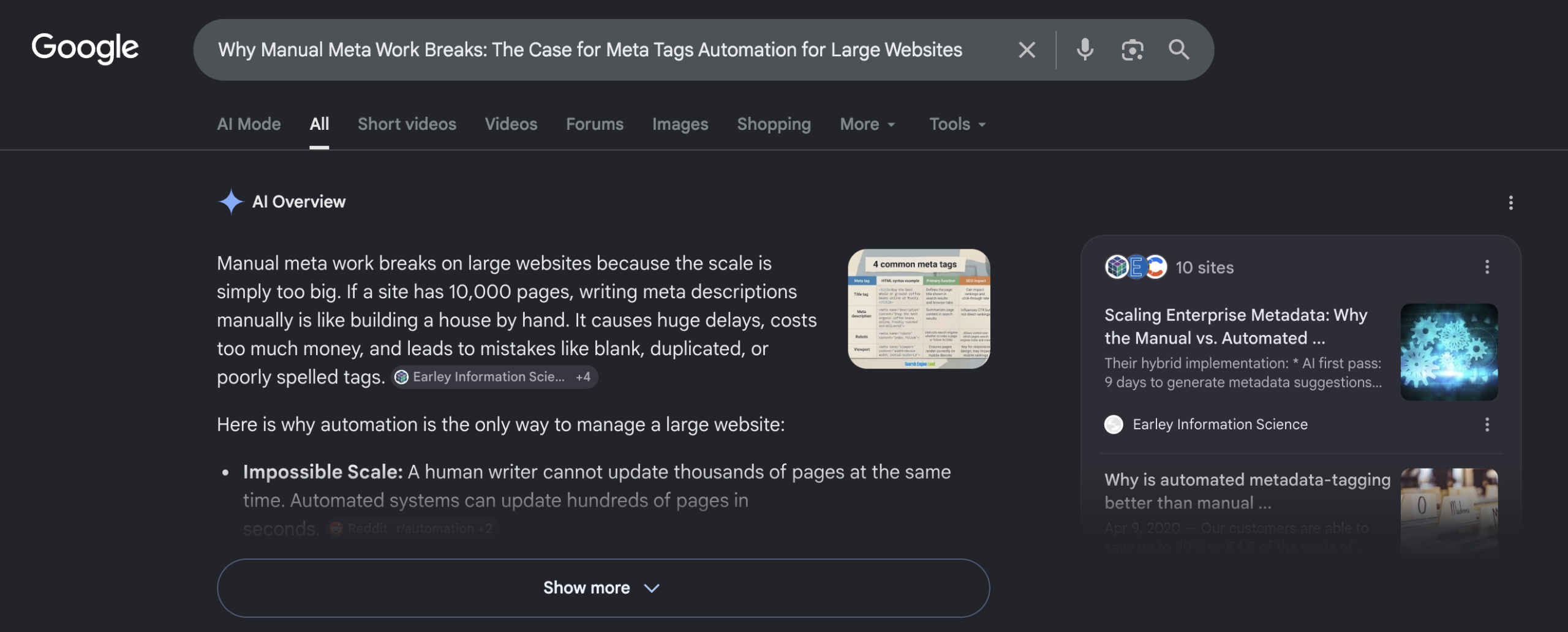
Metadata still matters. Title tags and meta descriptions influence how your pages appear in search results and how often people click, and they help both traditional search and AI search understand what a page is about. The problem is not importance; it is volume.
Do the arithmetic. Writing and deploying one well-optimized title and description takes a few minutes per page once you include research, writing, and publishing. At an illustrative five minutes per page, an estimate that varies by team and CMS, ten thousand pages is more than 800 hours of work, and a hundred-thousand-page catalog is out of reach entirely. Worse, the work is never done: products change, content is updated, and templates shift, so metadata drifts out of date the moment you stop. Manual effort also produces inconsistency, with different writers using different patterns across sections. This is why meta tags automation for large websites is not a convenience but a necessity for enterprise and large-catalog sites. For the strategic view of how big sites handle this, our piece on SEO at scale and what large sites do differently is a useful companion, as is our overview of AI-based SEO for large website owners.
The contrast is stark when you lay the two approaches side by side.
| Factor | Manual, page-by-page | Snippet-based automation |
|---|---|---|
| Time to cover 10,000 pages | Hundreds of hours over weeks | One pass, applied as pages load |
| Consistency | Varies by writer and section | Uniform pattern sitewide |
| Staying current | Drifts stale as content changes | Updates continuously |
| Pages with no metadata | Often left blank | Auto-generated from page content |
| Control over flagship pages | Full, but slow | Full, via overrides |
| Rollback | Manual re-editing | Adjust or remove the snippet |
The table makes the point plain: manual work wins only on the handful of flagship pages you want to hand-craft, and automation wins everywhere else, which, on a large site, is almost everything.
How Meta Tags Automation for Large Websites Works
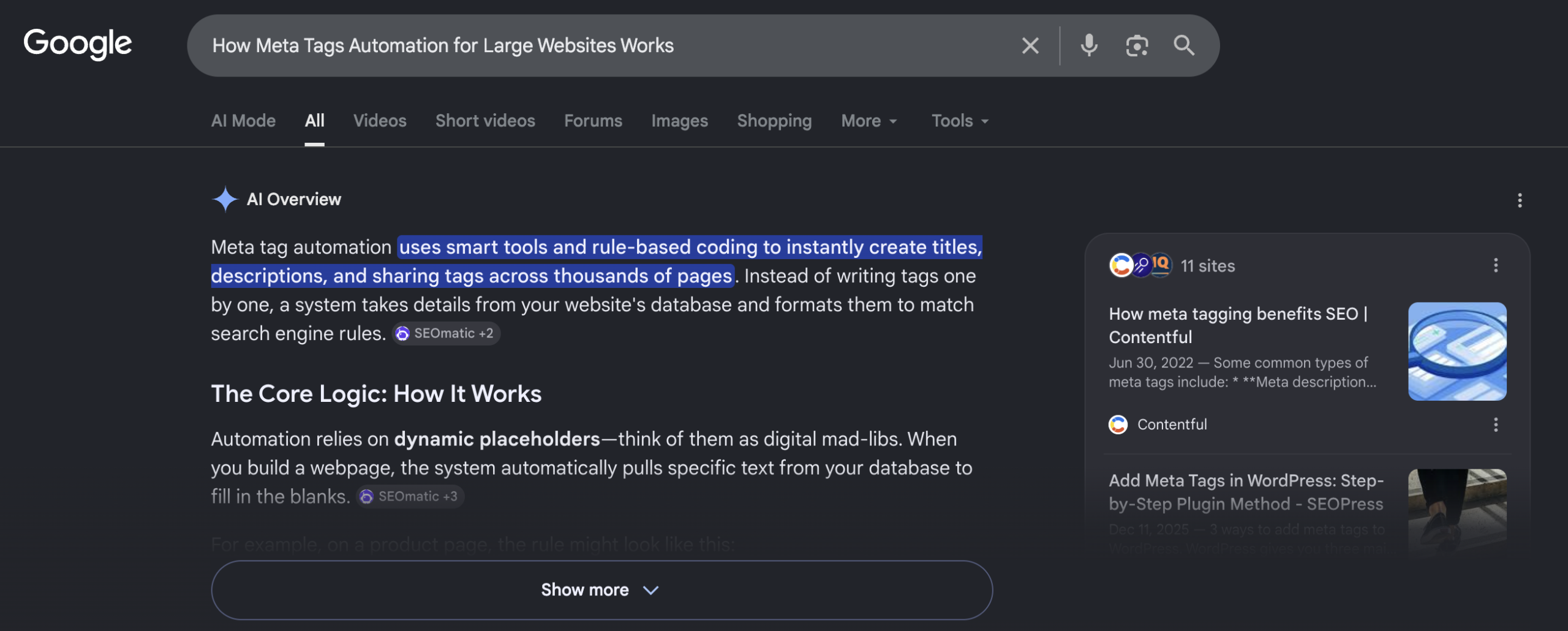
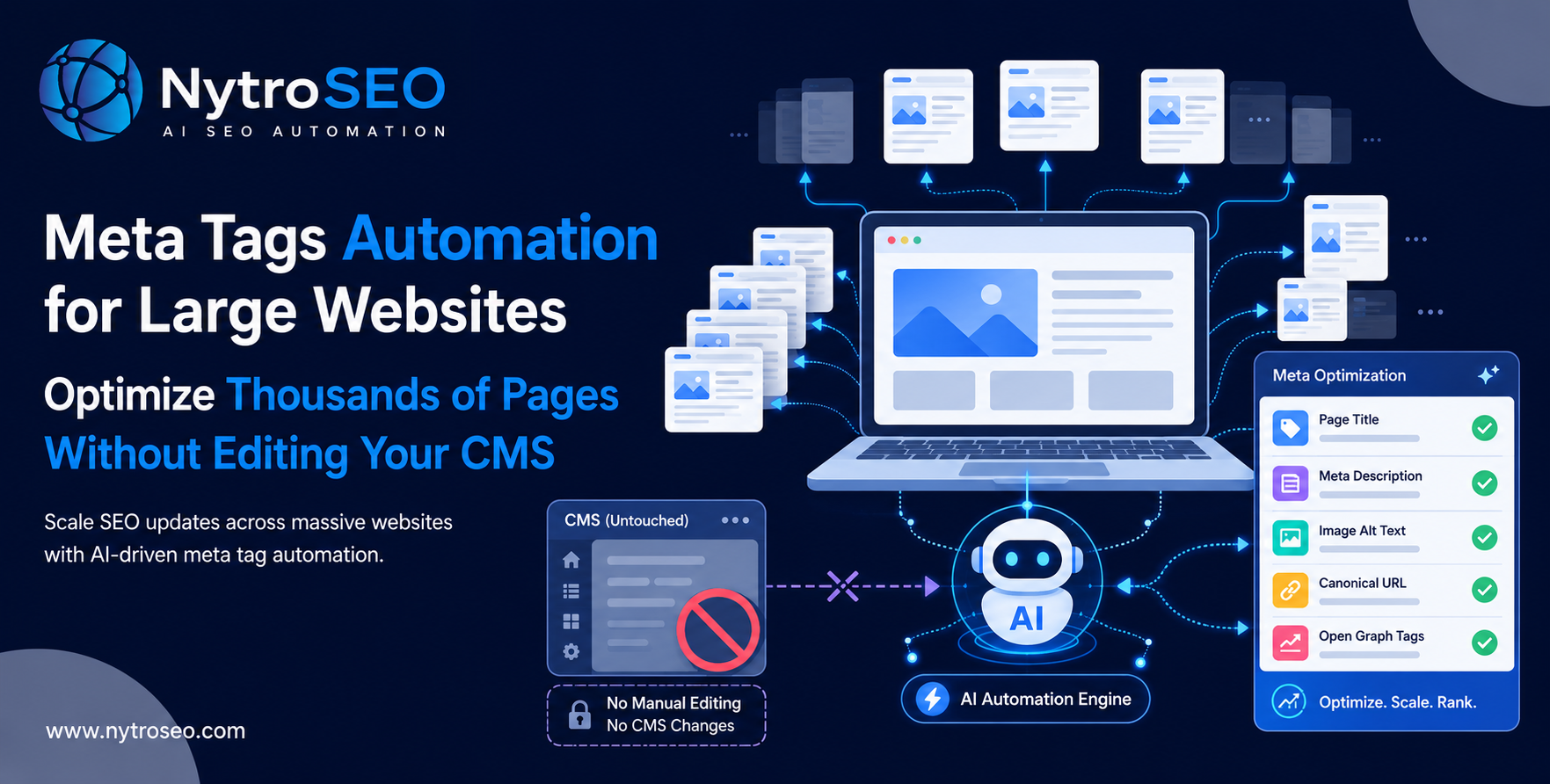
The most flexible approach to meta tags automation for large websites does not require editing your CMS at all. Instead, a small JavaScript snippet is added once to your site’s header, through your template or a tag manager, and it applies optimized titles and descriptions as pages load. Because the logic lives in the snippet rather than in thousands of individual page edits, you can roll out sitewide meta tag updates from one place.
This is how our platform delivers automated meta tags across any content management system, whether the site runs on WordPress, a custom stack, or a no-code builder. You install the snippet once, define the scope, and the system handles the rest, applying automatic seo changes at scale rather than page by page. It can auto generate SEO meta tags for pages that have none, and improve weak or duplicated ones that already exist. We walk through the mechanics of the header snippet in our guide to installing the NytroSEO JavaScript snippet, and the broader concept in our simple guide to SEO automation meta tags.
The practical benefit is speed and reach. A change to your metadata strategy propagates across the whole site at once, instead of waiting on a backlog of manual edits. For a large site, that difference is the gap between metadata that is perpetually behind and metadata that is always current.
The rollout itself is short. In practice it follows a simple sequence:
- Install the snippet once in your site’s header, directly or through a tag manager.
- Define scope, typically restricting optimization to the URLs in your sitemap.
- Let the system analyze each page and generate unique, relevant titles and descriptions from that page’s own content.
- Review and set manual overrides for flagship pages you want to control by hand.
- Monitor results in Search Console and adjust the strategy from one place.
Because every step after installation is centralized, a large site can go from inconsistent, partly blank metadata to complete, current coverage in a single day rather than a multi-month editing project.
Matching Keywords: Meta Tags Automation for Large Websites in Practice
Automation is only valuable if the tags it produces are relevant. Effective meta tags automation for large websites does not invent random keywords; it identifies the high-value terms already present in each page’s content and builds titles and descriptions around them. The page tells the system what it is about, and the system expresses that clearly in the metadata.
This matters because relevance is what search engines and AI search reward. A title that accurately reflects the page’s actual content earns clicks and trust; a mismatched or stuffed title does neither. That is also why bulk automation must be careful about keyword density. Research on generative engines found that keyword stuffing actually reduced content’s visibility in AI answers, while clear, relevant language helped; you can read the GEO study on arXiv. Good automation writes for clarity, not repetition. For the fundamentals of writing effective tags, which the automation then applies at scale, our guide on how to auto-generate effective title tags and meta descriptions goes deeper, and Google’s own guidance on controlling your title links and the underlying meta element is worth reading alongside it.
A quick before-and-after shows the difference. A weak, templated title reads “Product Page | Category | Store Name”, generic, duplicated across thousands of pages, and telling neither a human nor a machine what the page is about. A relevant automated title reads “Waterproof Hiking Boots for Men, Sizes 7–14 | Store Name”, drawn from the page’s own content, specific, unique, and clickable. Multiply that improvement across an entire catalog and the effect on click-through rate and relevance is substantial.
The point is not that automation writes cleverer copy than a skilled human on a single page; it is that automation applies that quality consistently across every page, which no human team can do at large-site scale.
Guardrails for Meta Tags Automation for Large Websites
Automation without control is a liability, so responsible meta tags automation for large websites builds in guardrails. These are the ones that matter most.
- Human override. Automation should set a strong default, not lock you out. You keep the ability to override any specific page, your homepage, flagship landing pages, or brand-critical copy, while the system handles the long tail.
- Scope control. You decide which pages the automation touches, typically restricting it to the URLs in your sitemap so it never optimizes pages you did not intend to expose.
- No duplication. Titles and descriptions should be unique per page, derived from each page’s own content, so bulk automation does not create the duplicate-metadata problems that hurt search visibility.
- No stuffing. The system should favor clear, relevant language over repeated keywords, because stuffing hurts both traditional and AI search.
- Reversibility. Because the logic lives in a snippet rather than baked into your database, changes are easy to adjust or roll back without a painful migration.
With these guardrails, bulk meta description updates and title changes become a controlled, auditable process rather than a risky mass edit.
What Automation Covers Beyond Titles and Descriptions
Titles and descriptions are the headline case, but metadata at scale is broader, and good automation handles more of it.
Image alt text is a common gap on large sites: thousands of product and content images ship with no descriptive alt attribute, which weakens both accessibility and image search. Automation can generate relevant alt text from surrounding context so every image is described, not blank.
Open Graph and social tags are another. When these are missing or generic, your pages share poorly on social platforms and messaging apps, costing you clicks that have nothing to do with search rankings. Consistent, per-page social metadata keeps shared links looking intentional rather than broken.
Then there is consistency itself. On a large site maintained by many hands over years, metadata patterns drift, different separators, different brand placements, different lengths. Centralized automation enforces one coherent pattern, which is exactly the signal that reinforces your brand as a recognizable entity across search and AI search. Handling titles, descriptions, alt text, and social tags together, from one snippet, is what turns scattered, half-finished metadata into a complete, coherent layer across the whole site.
A Quick Worked Example
Imagine a retailer with 40,000 product and category pages. Many products share near-identical auto-generated titles from the platform, and thousands of pages have no meta description at all. Writing them by hand is not realistic. The team installs the header snippet once and restricts scope to the sitemap. The system generates unique, relevant titles and descriptions for every page, drawn from each page’s own content, and flags the handful of flagship pages the team wants to write manually. Within a day, 40,000 pages have current, differentiated metadata instead of duplicates and blanks. When the catalog changes next quarter, the automation keeps pace instead of falling behind. The manual alternative, thousands of hours spread across months, never had a chance of staying current.
Common Mistakes in Large-Site Metadata
A few errors undermine even well-intentioned metadata programs at scale.
- Leaving duplicates in place. Duplicate titles and descriptions across thousands of pages dilute relevance. Ensure each page gets unique metadata from its own content.
- Editing page by page. Manual edits cannot keep pace with a large, changing site. The backlog guarantees that some portion of your metadata is always stale.
- Ignoring pages with no description. Blank descriptions let engines pull arbitrary text. Auto-generating a relevant one gives you control over the snippet.
- Over-optimizing with repeated keywords. Stuffing reduces visibility in AI search and reads poorly to humans. Favor clarity.
- Setting and forgetting. Metadata needs to stay current as content changes. Automation should be continuous, not a one-time pass.
Measuring Meta Tags Automation for Large Websites
The point of automation is not tidy tags for their own sake; it is search visibility. So measure the outcome. Track impressions and click-through rate in Google Search Console before and after rollout, segmented by the page groups the automation affected. Rising impressions suggest better relevance and coverage; rising click-through rate suggests more compelling titles and descriptions. Watch average position on your priority page groups, and sample your presence in AI search by checking whether your pages are surfaced and cited for relevant questions.
Give it time and segment cleanly. Metadata changes take a few weeks to be recrawled and reflected, and isolating the affected pages keeps other changes from muddying the read. A practical way to prove the impact is a simple cohort comparison: pick a group of pages the automation optimized and a comparable group it did not touch yet, then watch how impressions and click-through rate diverge over the following weeks. If the optimized cohort pulls ahead, you have direct evidence the automation is working, and a clear case to expand it.
Done well, meta tags automation for large websites turns a perpetual manual backlog into a measurable, compounding gain across the whole site. Our Automatic SEO software is built to deliver exactly this, and you can see the full rollout process in our walkthrough of optimizing any website’s SEO automatically in about an hour.
The Bottom Line on Meta Tags Automation for Large Websites
On a large site, metadata is not a writing problem; it is a scale problem. Manual editing cannot keep thousands of pages relevant and current, and stale or duplicated tags quietly cost you search visibility. A snippet-based approach applies consistent, relevant, unique metadata across every page, keeps it current as content changes, and leaves you full control over the pages that matter most. That is how large sites turn metadata from a backlog into an advantage.
Ready to see how many of your pages have weak, missing, or duplicated metadata? Run a free visibility check and we will show you the gaps across your site, and how automation can close them without touching your CMS.
Frequently Asked Questions
Yes. A JavaScript snippet added once to your site’s header – through your template or a tag manager – can apply optimized titles and descriptions as pages load, without editing individual pages in the CMS. This is how meta tags automation for large websites works across any platform, including custom stacks and no-code builders, from a single point of control.
You install a small snippet in your site’s header once. As each page loads, the snippet applies optimized title and meta description tags based on that page’s own content, drawing on the high-value keywords already present. Because the logic lives in the snippet rather than in the database, updates roll out sitewide from one place and are easy to adjust.
Not when done correctly. Good automation generates unique titles and descriptions for each page from that page’s own content, which reduces duplication rather than creating it. Duplicate metadata usually comes from templated CMS defaults; relevant, per-page automation replaces those with differentiated tags that strengthen search visibility instead of diluting it.
No. Stuffing repeated keywords into titles and descriptions hurts more than it helps. Research on generative engines found that keyword stuffing reduced content’s visibility in AI answers, and it reads poorly to humans, lowering click-through rate. Effective automation favors clear, relevant language that accurately reflects each page, not repetition of the same term.
There is no practical page limit with a snippet-based approach, because the automation applies as pages load rather than requiring individual edits. Sites with tens or hundreds of thousands of pages can be covered from a single installation, with scope typically restricted to the URLs in your sitemap so only intended pages are optimized.