Last updated: July 17, 2026
The debate over whether to automate SEO usually gets framed as all or nothing: either machines take over or people do everything by hand. That framing is wrong, and it costs teams both money and results. The useful question is not whether to automate, but which specific tasks to automate and which to keep human. Get that split right and you cut cost, increase output, and free your specialists for the work that actually moves search visibility. We build Automatic SEO tools, so we spend a lot of time on exactly this boundary. This guide gives you a practical test for where the line sits, a clear list of what belongs on each side, and a hybrid model that gets the best of both. Every recommendation is about matching the task to the method, not about automating for its own sake.
What Is SEO Automation, and What It Is Not
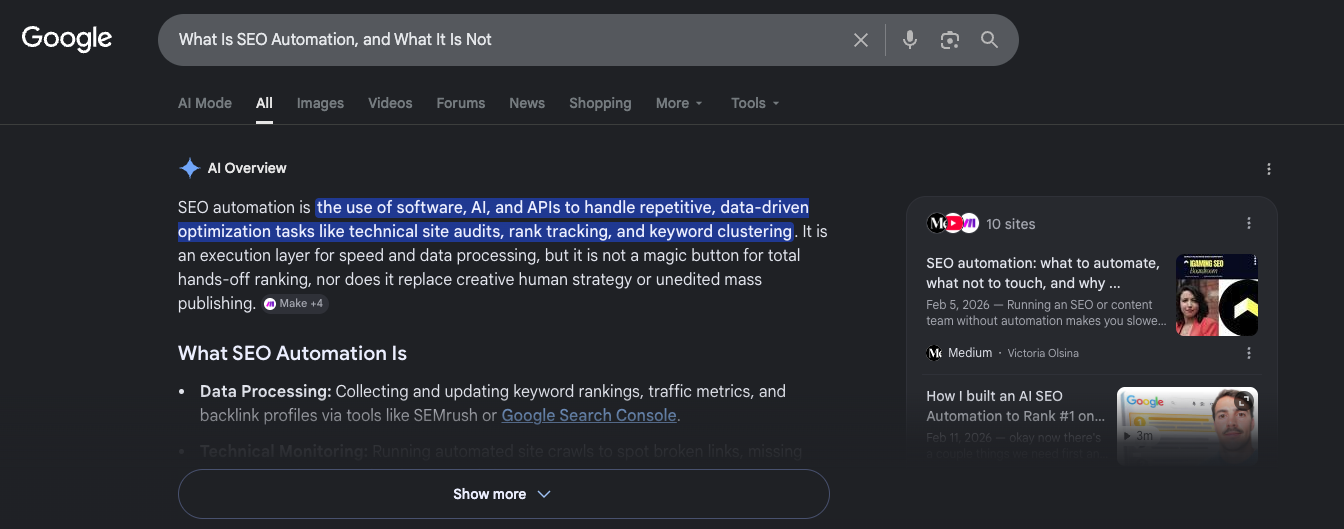
Before drawing the line, it helps to define the term. So what is seo automation? It is the use of software to perform SEO tasks that are repetitive, rules-based, and high-volume, things like generating meta tags, adding image alt text, monitoring rankings, and producing reports, without a person doing each one by hand. It is not a robot that replaces an SEO strategist, and it is not a promise that you can ignore quality. The role of automation in seo is to remove repetitive execution so people can focus on judgment. That distinction matters, because the failures people associate with automation almost always come from automating the wrong thing, trying to fully automate strategy or original content, rather than from automation itself. Used correctly, automated seo tasks handle volume reliably and consistently, which is exactly what humans do poorly at scale. For a grounding in what SEO actually involves before you decide what to hand off, Moz’s beginner’s guide to SEO is a solid reference, and Google’s Search Essentials defines the fundamentals every approach has to satisfy.
The Fit Test: When to Automate SEO
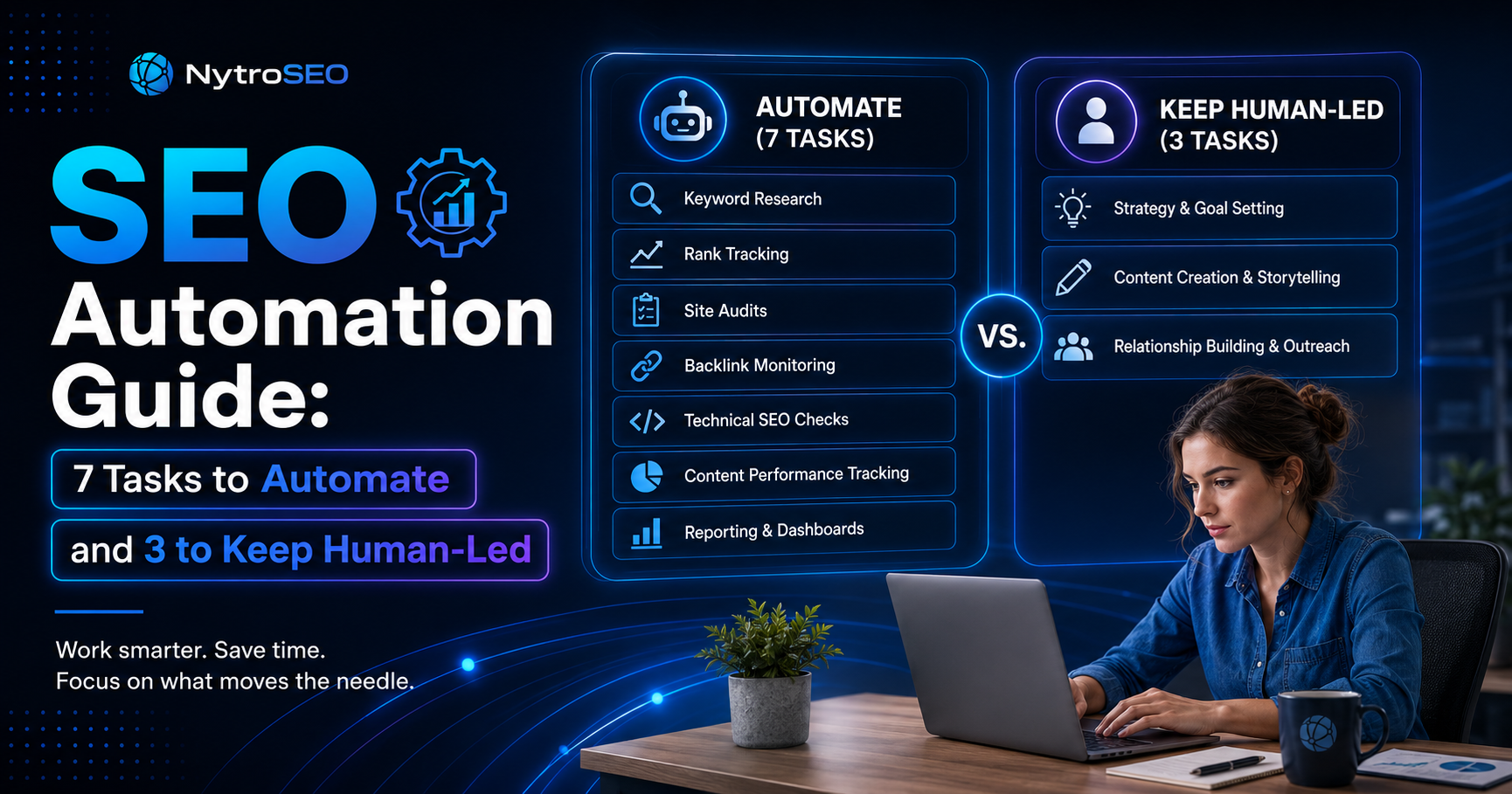
You do not need a long checklist to decide what to hand off. A task is a strong candidate to automate SEO work when it meets three conditions at once. First, it is repetitive, the same operation performed over and over. Second, it is rules-based, the right output can be determined from clear inputs rather than requiring original judgment. Third, it is high-volume, there is enough of it that doing it by hand is slow or impractical. When a task hits all three, automation is almost always the better choice, because machines excel at exactly this profile and humans get bored, inconsistent, and expensive doing it. When a task fails the test, because it requires creativity, strategy, relationships, or nuanced judgment, it belongs with a person. Most of the confusion in the automate seo debate disappears once you apply this test task by task instead of arguing about SEO as a whole. Our breakdown of the SEO tasks that take the most time is a useful place to spot your own strongest automation candidates.
Run two examples through the test to see how cleanly it sorts things. Writing a meta description for a product page is repetitive (you do it for every product), rules-based (a good description follows a clear pattern derived from the page), and high-volume (there may be thousands of products), three for three, so automate it. Deciding which product category to prioritize next quarter is none of those things: it happens rarely, depends on business judgment and market context, and has no fixed rule, so it stays with a person. The same test applied to any task on your list gives you an immediate, defensible answer, which is far more useful than a general opinion about whether “SEO should be automated.”
The Strong Case to Automate SEO Work
Several tasks pass the fit test cleanly and are safe, high-return candidates to automate. These are the ones to hand off first.
- On-page metadata. Title tags and meta descriptions are repetitive, rules-based, and high-volume, the textbook case. Automation can generate and maintain them from each page’s own content across an entire site.
- Image alt text. Thousands of images with missing alt attributes is a volume problem automation solves well, improving both accessibility and image search.
- Internal linking at scale. Applying consistent, relevant internal links across a large site by hand is impractical; rules-based automation handles it.
- Monitoring and alerts. Tracking rankings, indexation, and technical issues is continuous, data-heavy work ideal for software.
- Reporting. Assembling recurring performance reports is repetitive and time-consuming, and automating it recovers hours of specialist time.
These are the automated seo tasks with the clearest payoff. Our simple guide to SEO automation meta tags goes deeper on the biggest of them, and our Automatic SEO software is built to handle this repetitive layer across any site. Notice what these tasks have in common: none of them require original judgment, and all of them get worse when a tired human does them at volume. A person writing their four-hundredth meta description of the week is slower, less consistent, and more error-prone than software applying the same clear rules. That is the real argument for automating this layer, not that machines are smarter, but that consistency at scale is precisely where human effort breaks down and where automation is strongest. Hand these tasks off and the quality of your metadata actually rises, because every page gets the same careful treatment instead of the first hundred getting attention and the rest getting rushed.
When Not to Automate SEO
Just as important is knowing what to keep human. These tasks fail the fit test because they depend on creativity, judgment, or relationships, and trying to fully automate them costs more in quality than it saves.
- Strategy and prioritization. Deciding what to target, in what order, and why is judgment work that shapes everything else. It needs a human who understands the business.
- Original content and brand voice. Genuinely useful, original content, and the voice that makes it yours, comes from people. Thin, machine-only content can even breach search engine policies, and it rarely earns trust. Research on generative engines reinforces the point: it found that keyword stuffing reduced content’s visibility in AI answers, as the GEO study on arXiv documents, so mass-produced, over-optimized text works against you rather than for you.
- Link building and relationships. Earning links and partnerships is relationship work. Automation can support outreach logistics, but the relationship itself is human.
- Nuanced technical decisions. Diagnosing an unusual crawl or architecture problem often requires judgment that rules cannot capture.
This is why full seo automation, in the sense of removing people entirely, is not the goal and never should be. The aim is to automate the repetitive layer so humans have more time for exactly this work.
The Hybrid Model: Automate SEO, Keep Humans on Strategy
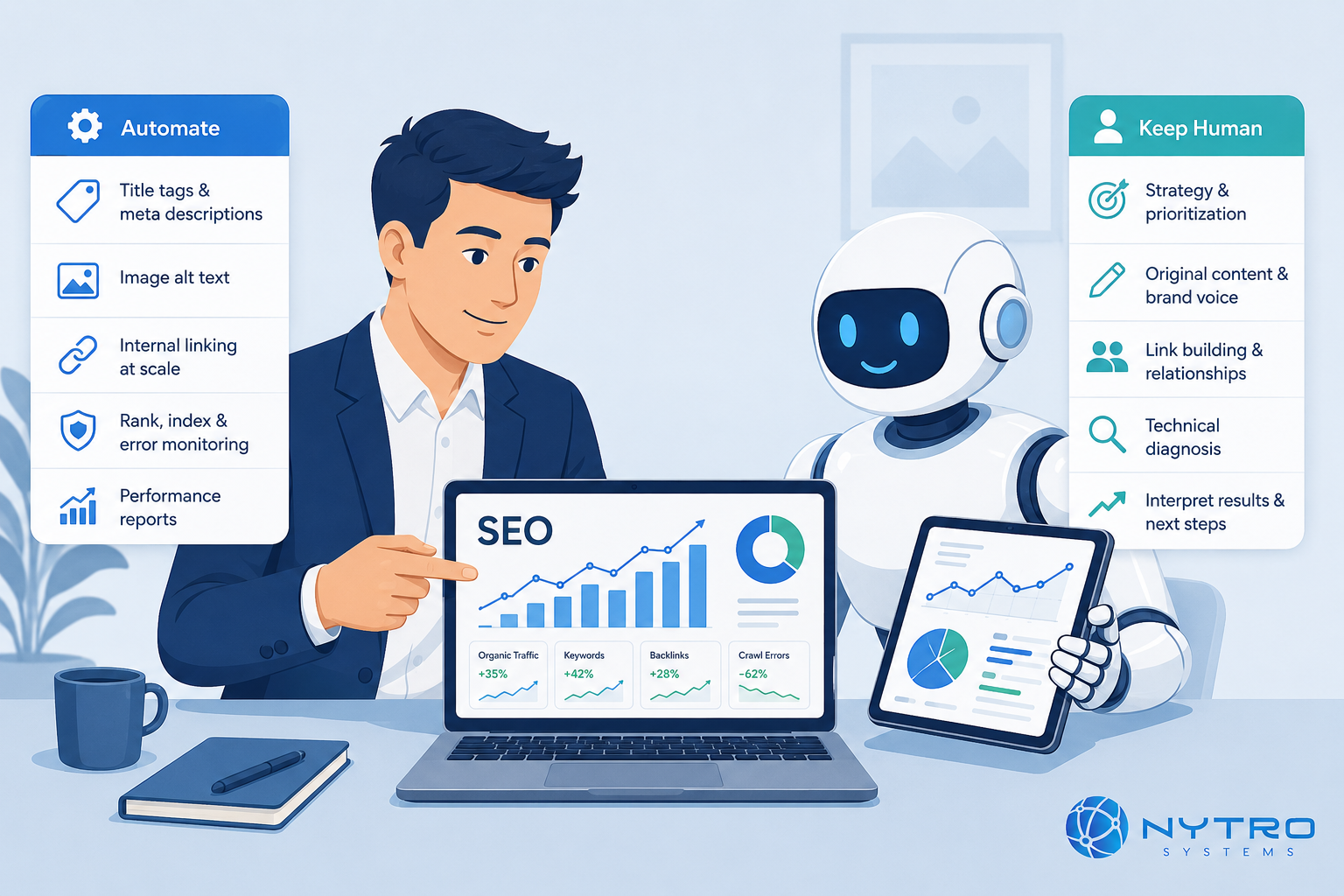
The best-run SEO programs are not manual or automated; they are hybrid. They automate the repetitive execution layer and concentrate human effort on strategy, creativity, and relationships. Each side does what it is good at.
In practice, the hybrid model looks like this: automation maintains your metadata, alt text, internal links, monitoring, and reporting continuously and consistently across the whole site, while your specialists spend their recovered hours on keyword and market strategy, original content, link building, and interpreting results. A good seo automation service is designed to support this division, setting strong defaults while leaving humans full override control over anything brand-critical. The result is lower cost, higher and more consistent output, and specialists doing work they are actually good at instead of retyping tags. Our comparison of manual versus automated SEO services walks through how the two approaches combine, and for agencies specifically, our overview of AI for SEO agencies shows how the hybrid model reshapes delivery.
The split is easy to summarize at a glance.
| Automate (machine-friendly) | Keep human (judgment-heavy) |
|---|---|
| Title tags and meta descriptions | Strategy and prioritization |
| Image alt text | Original content and brand voice |
| Internal linking at scale | Link building and relationships |
| Rank, index, and error monitoring | Complex, one-off technical diagnosis |
| Recurring performance reports | Interpreting results and deciding next steps |
The left column is repetitive, rules-based, and high-volume; the right column depends on creativity, judgment, and relationships. Sort your own task list into these two columns and your automation plan writes itself.
How to Move to a Hybrid SEO Model
If your program is mostly manual today, the transition is straightforward and low-risk when you take it in order. You do not have to change everything at once. Start by auditing your current tasks against the three-part fit test and sorting them into the two columns above. Next, pick the single highest-volume repetitive task, usually metadata or reporting, and automate that first, because it delivers the largest, safest win and builds confidence. Then measure the recovered time and results over a few weeks, and reinvest those hours deliberately into strategy or content rather than letting them get absorbed by other busywork. From there, extend automation to the next repetitive task on the list. Throughout, keep human overrides on brand-critical pages so nothing important is ever on autopilot without oversight. This staged approach lets you capture the cost and capacity benefits quickly while keeping full control, and it avoids the mistake of trying to automate everything in one disruptive move. Within a couple of cycles, most teams settle into a stable hybrid where the repetitive layer runs itself and people focus on the work that actually differentiates their results.
A Quick Worked Example
Consider a five-person agency serving 30 clients. Before automation, each specialist spends most of their week on repetitive on-page work and reporting, leaving little time for strategy. Client results are inconsistent because there are never enough hours to keep every page optimized. The agency applies the fit test. Metadata, alt text, internal linking, monitoring, and reporting move to automation, applied across every client site. Strategy, content, and link building stay with the team. Within weeks, specialists have their weeks back: metadata is consistently maintained on all 30 sites, reports generate themselves, and the team spends its time on the strategic work that differentiates results. The agency did not replace anyone, and it did not choose between manual and automated. It matched each task to the right method, which is the entire point.
Common Mistakes in the Automate-or-Not Decision
A few errors derail the decision.
- Treating it as all or nothing. The question is never “automate everything or nothing.” It is task by task. Framing it as a binary leads to bad choices on both ends.
- Automating strategy or original content. These fail the fit test. Automating them produces generic output and can hurt search visibility.
- Leaving obvious volume work manual. Doing metadata and reporting by hand on a large site wastes expensive specialist time on machine work.
- Automating without overrides. Good automation sets defaults but always lets a human take control of specific pages. Systems that lock you out are a liability.
- Judging automation by the worst tools. Poor automation that stuffs keywords or produces generic tags gives the whole category a bad name. Judge it by quality and control, not by the weakest example.
How to Automate SEO Across a Large Site
On a small site, the split matters less because the volume is manageable by hand. On a large or fast-changing site, applying the fit test rigorously is what keeps quality high and cost under control, because the repetitive layer is enormous and the strategic layer is where your advantage lives. The practical path: audit your tasks against the three-part fit test, move everything that passes to automation, and protect your specialists’ time for everything that fails. Start with the highest-volume repetitive work, metadata and reporting, where the payoff is largest and the risk is lowest. Our walkthrough of optimizing any website automatically in about an hour shows how quickly the repetitive layer can be handled once you decide to automate it.
The Bottom Line on When to Automate SEO
The automate-or-manual question has a clear answer: automate what is repetitive, rules-based, and high-volume, and keep what needs creativity, strategy, or relationships with people. Applied task by task, that test cuts cost, raises consistency, and frees your best people for their best work. The hybrid model is not a compromise between manual and automated SEO, it is what a well-run program looks like.
Want to see which of your SEO tasks are strong candidates to automate? Run a free visibility check and we will show you where repetitive on-page work is costing you time, and how automation can take it off your team’s plate. The teams that get this balance right are not the ones that automate the most; they are the ones that automate the right things and protect their people’s time for everything else.
Frequently Asked Questions
Tasks that are repetitive, rules-based, and high-volume are safe to automate: title tags and meta descriptions, image alt text, internal linking at scale, monitoring and alerts, and recurring reports. These pass the fit test because the right output can be determined from clear inputs, and machines handle them more consistently than people can by hand across a large site.
Original, useful content should stay human. It depends on creativity, expertise, and brand voice that automation cannot reliably reproduce, and thin machine-only content can breach search engine policies and erode trust. Automation is well suited to the metadata and structure around content – titles, descriptions, and alt text – but the substance of genuinely valuable content belongs to people.
No, when it is applied correctly. Automating repetitive, rules-based tasks like metadata improves consistency and coverage, which supports search visibility. Problems arise only when teams automate the wrong things – trying to mass-produce content or stuff keywords. Reliable automation generates relevant output from each page’s own content and keeps humans in control of anything strategic.
Partly. Automation is excellent at the repetitive, monitorable parts of technical SEO – tracking indexation, flagging errors, applying consistent metadata and internal links, and generating alerts. It is less suited to diagnosing unusual, one-off architecture or crawl problems, which often need human judgment. The best approach automates the routine monitoring and leaves complex diagnosis to a specialist.
Keep the voice-dependent work human and automate the structural layer around it. Automation handles titles, descriptions, and alt text consistently, while your team writes the original content and messaging that carry your voice. Good automation also offers human overrides, so you can hand-craft brand-critical pages while the system maintains the repetitive long tail.