Last updated: August 29, 2026
Open the Page indexing report in Google Search Console and you may find a status that sets off alarm bells: “Crawled – currently not indexed.” Google visited the page, read it, and then deliberately chose not to add it to the index — so it will not appear in search for any query. The count next to it might be ten URLs or ten thousand. Often it is completely normal; sometimes it is a real signal worth acting on. The whole game is telling those two apart and then fixing only the pages that deserve it.
This guide explains what the status means, how it differs from its cousin, why Google applies it, and a clear order of operations to fix crawled currently not indexed pages that should be earning traffic. It matters more than ever, because a page Google never indexes cannot rank and cannot be cited by AI answers either — the exact problem we cover in why your best pages cannot rank if Google never indexes and sees them.
What Crawled Currently Not Indexed Actually Means
Crawled currently not indexed is an excluded status in the Google Search Console Page indexing report. It means Googlebot fetched and read your page, and Google’s systems then made a deliberate decision not to store it in the index. Google describes it plainly in its help documentation: the page was crawled but not indexed, it may or may not be indexed in the future, and there is no need to resubmit the URL for crawling. The official Page indexing report documentation is the authoritative reference.
Two things matter in that description. First, this is a status, not a penalty — a page being crawled but not indexed does not mean you did something against the rules. Second, the decision is a judgment about value: unlike “Excluded by noindex tag,” which reflects an explicit directive you gave, crawled currently not indexed reflects Google deciding your page did not currently clear the bar for inclusion. That distinction shapes the entire fix: you are not removing a violation, you are raising the page’s value and clarity until Google changes its mind. Our complete guide to the crawled currently not indexed solution walks through the same territory with more examples.
“Crawled, currently not indexed panics people, but it isn’t a penalty, it’s Google saying a page didn’t clear the value bar. Before you fix anything, ask whether the page was ever meant to rank. Most excluded URLs shouldn’t be indexed at all. Triage first, then raise the value of the pages that genuinely deserve a place.” — Lee Agam, founder and CEO of NytroSEO.
When Crawled Currently Not Indexed Is Perfectly Normal
Before you treat the status as a problem, accept that a large share of it is expected and healthy. Most sites generate URLs that were never meant to rank: faceted-navigation combinations, internal search results, tag and filter pages, paginated archives, thank-you and confirmation pages, and duplicate parameter variants. Google crawling those and declining to index them is the system working correctly, not a failure.
A useful mental model is to divide the report into two piles. The first pile is pages you never wanted in the index — leave them alone, or block them with noindex or robots rules if they are wasting crawl. The second pile is pages you do want ranking that Google passed on anyway. Only the second pile deserves your time. Teams that skip this split end up “fixing” hundreds of utility URLs that should stay excluded, and burn out before they reach the handful of real pages that matter. Triage is not a preliminary step you can skip; it is most of the job.
Discovered vs Crawled: The Two States That Look Similar
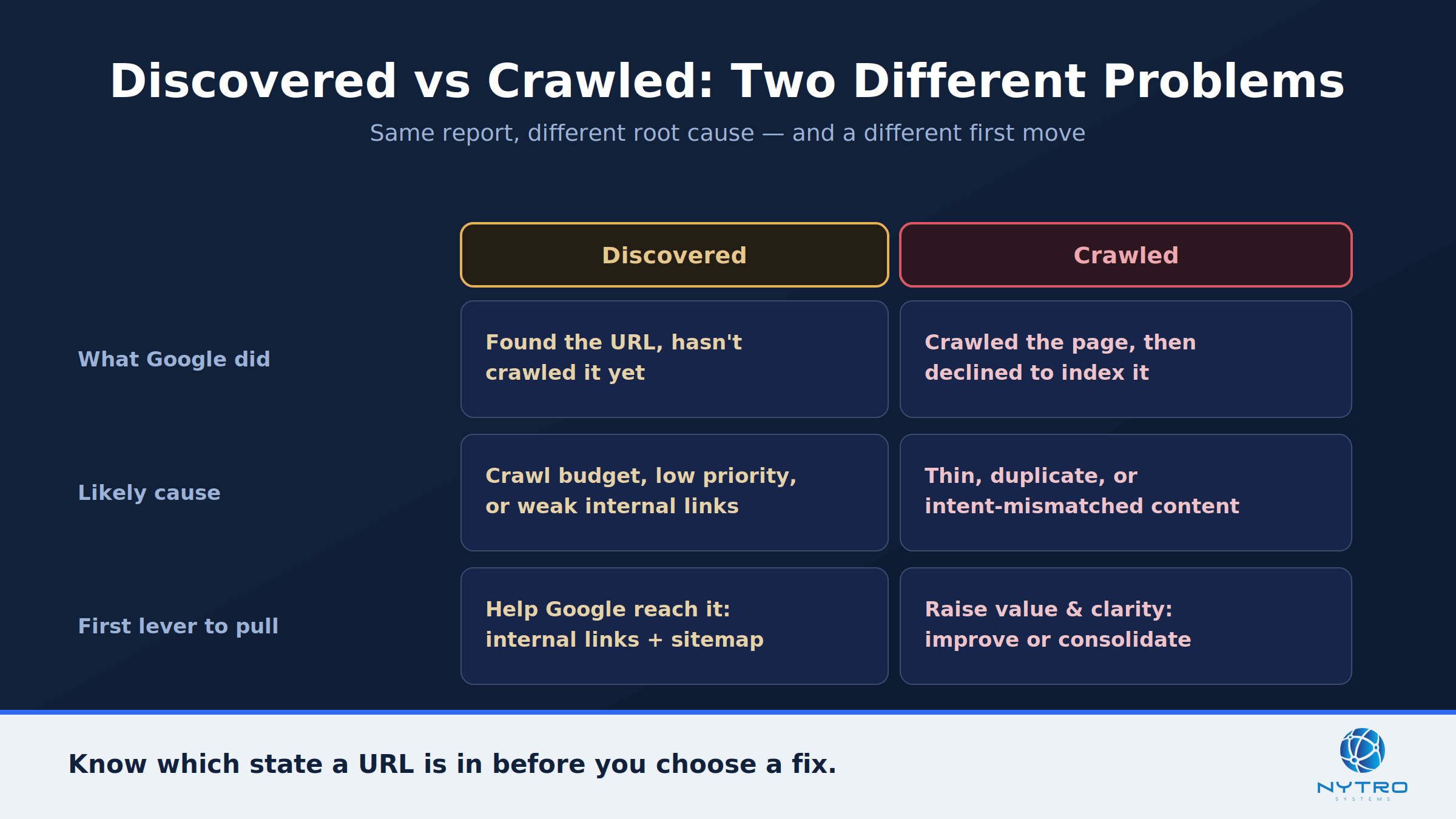
Discovered vs crawled: same report, different root cause, and a different first move.
It is easy to confuse two Search Console statuses, and the fix differs for each. The related status, discovered currently not indexed, means Google knows the URL exists but has not crawled it yet. That is often a scheduling and crawl-prioritization issue: on large sites, Google allocates a finite crawl budget and may defer low-priority URLs, so they sit in “discovered” limbo waiting to be fetched. Crawled currently not indexed is the next step along: Google did spend the crawl to fetch the page, evaluated it, and still declined to index it.
The practical implication is that “discovered” points you toward crawl budget, internal linking, and sitemap priority — helping Google reach the page — while “crawled” points you toward quality, uniqueness, and intent, because Google already reached the page and was unconvinced. Knowing which bucket a URL sits in tells you which lever to pull first. Our guide to crawl efficiency and prioritizing non-indexed URLs goes deeper on the discovery side.
The table below sums up the difference and the first move each state calls for.
Why Google Leaves Pages Crawled Currently Not Indexed
When Google crawls a page and declines to index it, the reason almost always traces to value, duplication, or clarity. A handful of causes account for most cases.
Thin or low-value content. If a page does not offer enough unique substance to justify a slot in the index, Google passes. In 2026, this includes scaled, lightly edited AI content that adds nothing beyond what is already indexed — Google does not ban AI content, but it declines pages that merely restate what exists.
Duplicate and near-duplicate pages. Fifty product variants or near-identical posts targeting slight keyword variations compete with each other and dilute value. Google often indexes one and leaves the rest crawled but not indexed.
Search intent mismatch. If every result for a query is a how-to guide and your page is a product listing, Google may decide your page does not fit what searchers want and skip it.
Weak internal linking and orphan pages. A page that no strong, topically related page links to looks unimportant. If it is reachable only by its URL and not through your crawl path, Google has little reason to value it.
Technical confusion. Conflicting canonical tags, soft 404s, expired or out-of-stock pages, and invalid structured data all send mixed signals that can tip a borderline page out of the index.
Crawl budget on large sites. On very large sites, low-value pages compete for a finite crawl and indexing allocation. This is rarely the issue on small sites, where crawl budget almost never limits indexing. If you do run a large site, Google’s guide to managing crawl budget explains how to keep Googlebot focused on the URLs that matter rather than spending fetches on filler.
How to Fix Crawled Currently Not Indexed, Step by Step
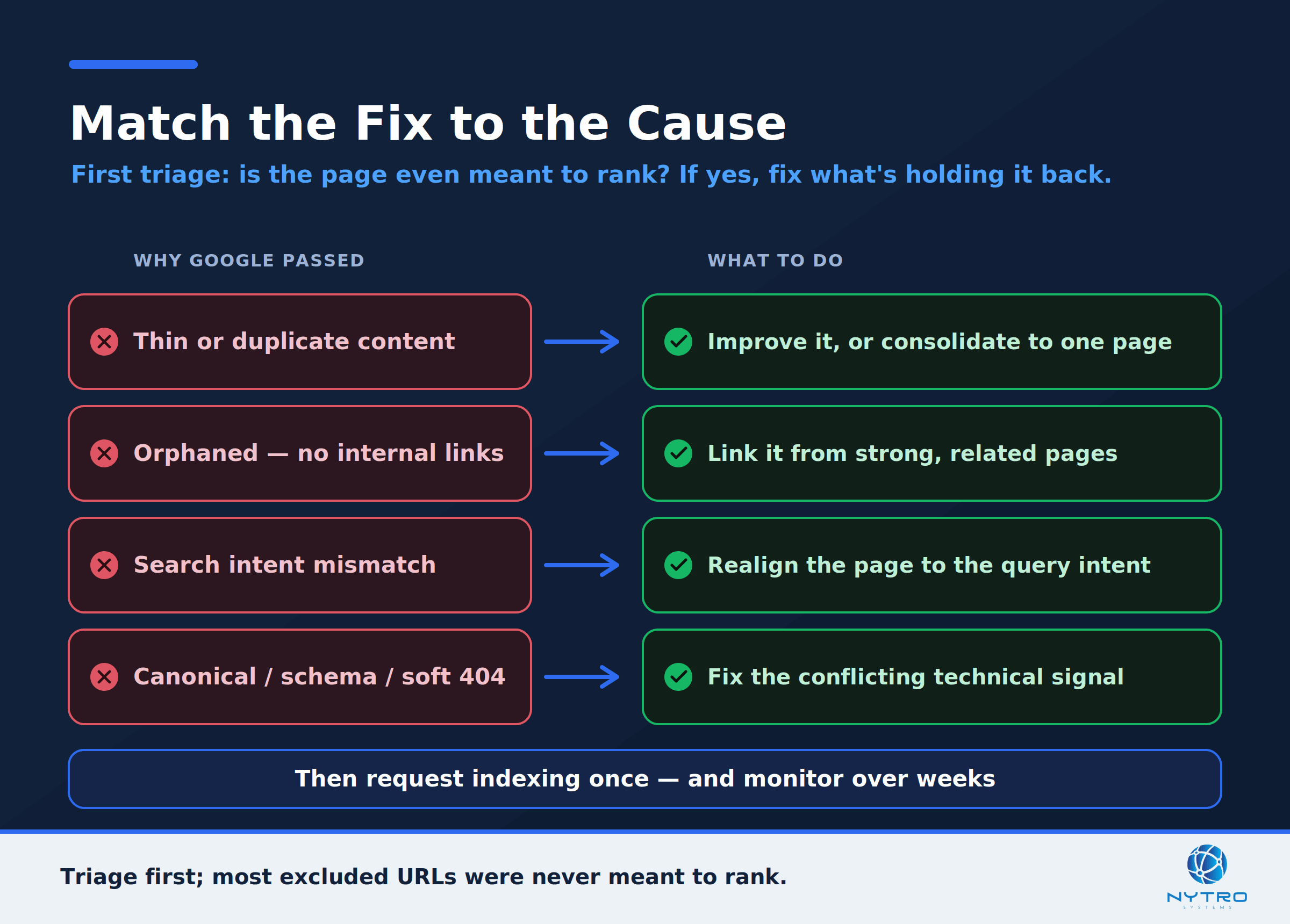
Triage first: fix only the pages that should rank, by the cause actually holding them back.
A durable crawled currently not indexed fix starts with triage, not with mass resubmission. Work in this order.
- Triage first. Open the Page indexing report and ask, for each affected URL, whether it should be indexed at all. Utility pages — login, cart, account, filtered variants — sitting in this status are normal and expected. Ignore them and focus on pages that genuinely should rank.
- Diagnose the cause per page. For a page that should be indexed, identify why Google passed: thin content, duplication, intent mismatch, orphaning, or a technical signal. The right fix follows directly from the cause.
- Improve or consolidate the content. Make thin pages substantively better, or merge near-duplicates into one comprehensive page. Counterintuitively, the fix often means publishing less: consolidating filler and deleting dead pages improves your crawled-to-indexed ratio, which helps the pages that remain.
- Strengthen internal links. Link to the page from strong, topically related pages that already perform well, so Google sees it as part of your important content rather than an orphan.
- Fix the technical signals. Resolve canonical conflicts, correct or remove invalid structured data, and clear soft 404s so nothing contradicts the page’s right to be indexed.
- Request indexing, then wait. For genuinely improved, important pages, use URL Inspection to request indexing. Then be patient and monitor over weeks — Google says there is no need to resubmit repeatedly, and re-evaluation takes time.
The flowchart below turns that order of operations into a single decision path.
The discipline is to fix the pages that deserve it and let go of the ones that do not. Chasing every URL in the report is how teams waste weeks on pages that were never meant to rank.
When the “should be indexed” pile is still large, prioritize by potential value rather than working top to bottom. Start with pages that target real demand — queries with genuine search volume and clear commercial or informational intent — and with pages that already earn impressions but no clicks, since those are closest to breaking through. A page that Google shows occasionally is a page Google is willing to reconsider; a page with zero impressions has further to travel. Group the survivors into topic clusters and improve the cluster together, because a stronger, well-linked cluster lifts indexing for all of its pages more reliably than isolated edits. This sequencing means your earliest fixes produce the fastest visible wins, which keeps the effort focused and easy to justify.
How Crawled Currently Not Indexed Hurts Your AI Visibility
Here is the part most indexing advice misses in 2026. Google’s AI features — AI Overviews and AI Mode — retrieve pages from the same index that powers classic search. So a page that is crawled but not indexed is not just missing from the blue links; it is also invisible to the AI answers built on that index. Unindexed means uncitable. Fixing indexing is therefore the gate for both surfaces at once, which raises the stakes on getting it right. A page stuck outside the index is not underperforming — it is absent, earning nothing from search and nothing from the AI answers your buyers increasingly read first.
This is where automation earns its place, with an honest boundary. No tool can manufacture value for a genuinely thin page — improving or consolidating weak content is editorial work, and it is yours. What automation can do is keep the signals that tip borderline pages into the index clean and consistent at scale: unique, intent-matched titles and meta descriptions so pages do not read as duplicates, valid structured data so Google is not confused about what a page is, and help prioritizing which non-indexed URLs actually matter. That is the layer our Automatic SEO software manages across an entire site. To be clear about scope: automation strengthens the metadata, structured-data, and prioritization signals; the content quality decisions remain yours.
Common Mistakes With Crawled Currently Not Indexed
A few habits make the problem worse or waste effort.
Panicking at the number. A large count is often dominated by utility and filler pages that should never be indexed. Triage before you worry.
Repeatedly resubmitting the same URL. Google explicitly says there is no need to resubmit for crawling. Hammering “Request indexing” does not force a quality decision to change.
Adding more thin pages. Publishing more low-value content lowers your crawled-to-indexed ratio and makes indexing harder for everything, not easier.
Ignoring internal links. Orphaned pages rarely earn indexing on content alone. A few links from strong, relevant pages often move the needle.
Editing and expecting overnight results. Re-evaluation takes time; judge results over weeks, not hours.
A Worked Example: From Thousands of Excluded URLs to a Clean Index
Consider a content site that opened its Page indexing report to roughly eight thousand URLs marked crawled currently not indexed and assumed disaster. The triage told a different story. About seven thousand were tag pages, internal search results, and paginated archives that were never meant to rank; those were left excluded, and thin tag pages were consolidated so they stopped competing. That left around a thousand genuine articles Google had passed on.
Reading those page by page, three patterns emerged: clusters of near-duplicate posts targeting slight keyword variations, a batch of scaled AI drafts that restated what was already indexed, and a set of solid articles that were effectively orphaned with no internal links. The team merged each duplicate cluster into one strong guide, rewrote or removed the thin AI drafts, and added contextual internal links to the orphaned articles from high-performing related pages. They requested indexing once on the improved pages and then waited. Over the following weeks, the genuinely useful pages moved into the index, while the excluded utility pages stayed excluded — exactly as they should. Industry coverage of indexing patterns, such as the reporting collected at Search Engine Land, echoes the same lesson: the win comes from improving the crawled-to-indexed ratio, not from chasing every URL.
The Bottom Line on Crawled Currently Not Indexed
Crawled currently not indexed is Google telling you it read a page and was not convinced it belonged in the index. Treat it as a quality and clarity problem, not a bug. Triage ruthlessly, fix only the pages that should rank by improving value, consolidating duplicates, strengthening internal links, and cleaning up technical signals, then request indexing once and wait. Keep your metadata and structured data clean and unique across the site so borderline pages have every reason to be indexed — and remember that getting a page indexed is now the entry ticket to both search and AI visibility. Get the indexing right, and every other optimization you make finally has a page to act on.
Want to know which of your important pages are stuck outside the index? Run a free visibility check, or talk to us about prioritizing your non-indexed URLs at scale.
Frequently Asked Questions
It means Googlebot fetched and read your page, and Google then deliberately chose not to add it to the search index, so the page will not appear in results. It is a status, not a penalty, and it usually reflects a quality, duplication, or relevance judgment. Google says the page may or may not be indexed later and there is no need to resubmit it.
Make the page genuinely worth indexing: unique, substantive content that matches a clear search intent, linked from strong related pages, with clean canonical tags and valid structured data. Then use URL Inspection to request indexing once. Indexing is a quality decision, so a better page — not repeated resubmission — is what changes the outcome.
Rarely. Crawl budget mainly matters for very large sites with hundreds of thousands of URLs, where Google prioritizes what to crawl. On small and mid-sized sites, pages that are crawled but not indexed are almost always a content quality or duplication issue rather than a crawl budget limit, so focus there first.
Yes. Near-duplicate and thin variation pages compete with each other, and Google often indexes one while leaving the rest crawled but not indexed. Consolidating duplicates into fewer comprehensive pages, and setting correct canonicals, improves your crawled-to-indexed ratio and helps the surviving pages earn a place in the index.
It varies. After you improve a page and request indexing, re-evaluation can take days to several weeks, and there is no guaranteed timeline. If a page stays crawled currently not indexed for a month or more after genuine quality improvements and stronger internal links, that is often Google signaling the page still does not clear the bar.