Last updated: September 5, 2026
On a small site, SEO is a to-do list you can work through by hand. On a site with tens or hundreds of thousands of URLs, that same list becomes physically impossible: no team can write unique titles, maintain structured data, and manage crawling across 100,000 pages one at a time, and by the time they finished, the site would have changed. This is why seo automation for large sites is not a convenience but a requirement. This guide covers the two problems that scale breaks — crawl efficiency and on-page optimization — and how to automate both without editing every page. The shift it asks for is one of mindset as much as tooling: from optimizing pages to designing the rules that optimize them.
Large ecommerce catalogs, marketplaces, media archives, and SaaS documentation all hit the same wall, and they solve it the same way: by working at the level of templates and rules rather than individual pages, as we describe in what large ecommerce sites do differently at scale.
Why Manual SEO Breaks, and SEO Automation for Large Sites Begins
Three things break at scale, and together they make the case for large scale seo automation.
The first is simple volume. Optimizing a page takes time, and that time multiplied by 100,000 pages is more than any team has. Work that is trivial on a small site — unique titles, meta descriptions, structured data, internal links — becomes an infinite backlog. And it is not a backlog you can clear once and be done with: the site keeps generating new pages, existing pages change, and products go in and out of stock, so the work regenerates faster than a team can process it. Manual SEO on a large site is not slow; it is mathematically impossible, and treating it as a staffing problem rather than a systems problem is the mistake that keeps large sites underperforming.
The second is crawl budget. Google does not crawl every page of a large site on every visit; it crawls a budget’s worth. Google defines that budget as the set of URLs it can and wants to crawl, and its own crawl budget documentation explains that it is the product of crawl capacity — how much your server can handle — and crawl demand, how much Google wants your pages based on their importance and freshness. On a large site, if that budget is spent on low-value URLs, your important pages get crawled less and updated slower.
The third is template sprawl. Large sites are built from templates, so thousands of pages share the same structure. That is what makes automation possible, but it is also a risk: a single bad pattern — a duplicated title formula, a missing canonical in the template — is not one mistake but tens of thousands, replicated across every page the template generates. At scale, both your fixes and your errors multiply.
“The shift that unlocks large-site SEO is mental, not technical: stop thinking in pages and start thinking in rules. You’ll never hand-optimize 100,000 URLs, and you don’t need to. Fix crawling so Google reaches what matters, then let templates generate the on-page layer. One good rule improves more pages than a team could touch in a year.” — Lee Agam, founder and CEO of NytroSEO.
Crawl Prioritization: The Foundation of SEO Automation for Large Sites
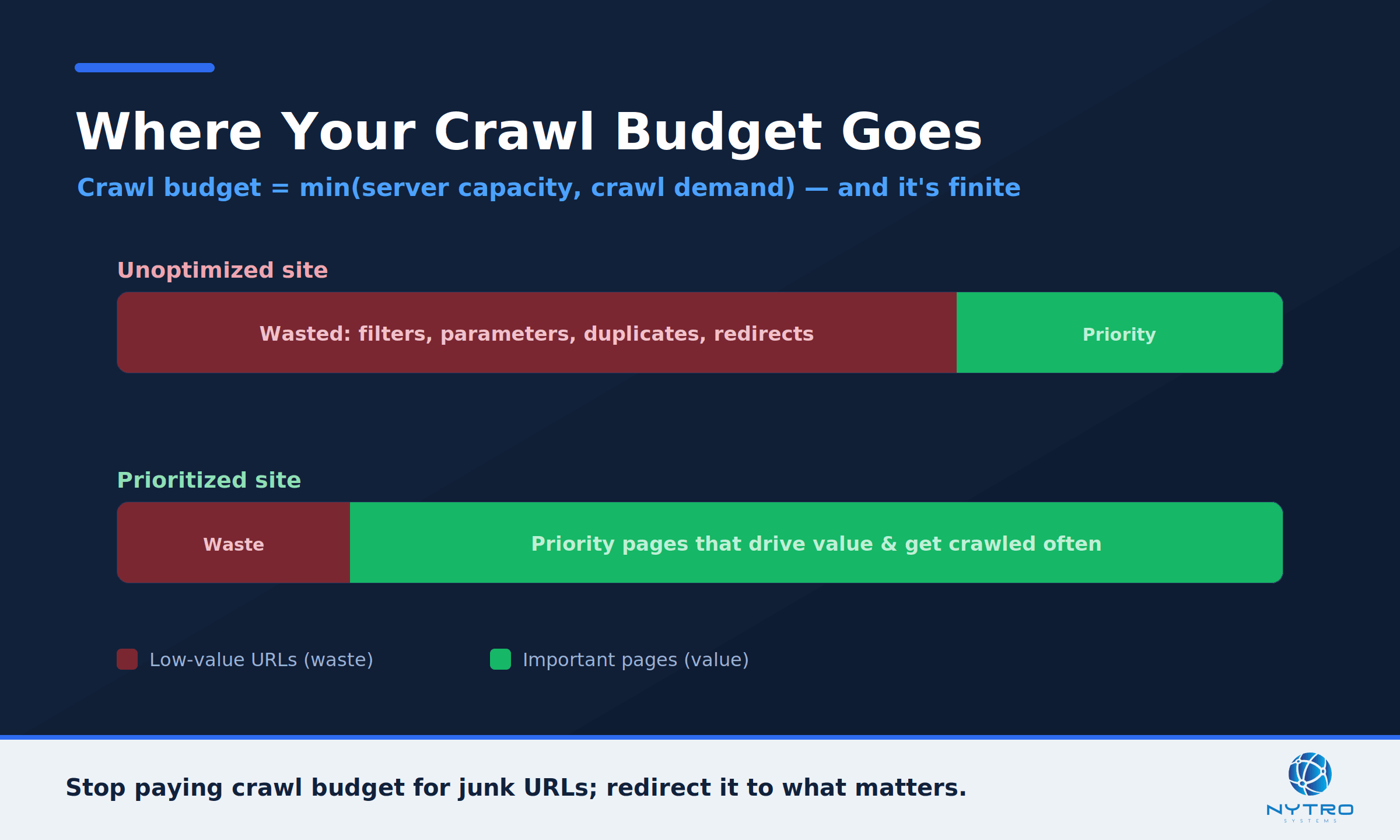
Before you automate on-page changes, you have to make sure Google can efficiently reach the pages that matter. Crawl prioritization is the foundation, because optimizing a page Google rarely crawls changes little. The goal is to stop wasting crawl budget on URLs that should not consume it and redirect that attention to pages that drive value.
Several levers do this. Consolidate duplicate content so Google crawls unique pages rather than unique URLs — Google explicitly warns that time spent on duplicates is time not spent on the rest of your site. Control the URLs your architecture generates: faceted navigation, filters, session parameters, and endless pagination can spawn millions of low-value URLs, and you manage them at the pattern level with robots rules, canonical tags, and parameter handling. Fix redirect chains and broken links that drain the budget. And keep your server fast, because crawl capacity rises when responses are quick and falls when they are slow — the reason server response time, documented in guides like web.dev’s on optimizing server response, is a crawl issue as much as a speed one. Watch the results in the Crawl Stats report, whose documentation shows how to read what Googlebot is actually spending its time on.
Two more levers work at the structural level. Segmented XML sitemaps let you group URLs by type — products, categories, articles — so you can see indexation rates per segment and spot which families Google is ignoring, rather than reading one undifferentiated number for the whole site. And internal linking decides how crawl equity flows: pages buried many clicks deep, or orphaned entirely, signal low importance and get crawled rarely, so a shallow architecture that links from strong hubs to priority pages pulls Googlebot toward the content you care about. On a large site these are not one-time fixes but ongoing systems, because every new batch of pages inherits the same structural decisions.
One 2026 wrinkle deserves attention: AI crawlers now consume a real share of server resources alongside Googlebot, which can suppress your effective crawl capacity. Managing their access — through rate limiting rather than blanket blocking, since blocking cuts your visibility in AI answers — is now part of crawl prioritization on large sites.
On-Page SEO Automation for Large Sites at Scale
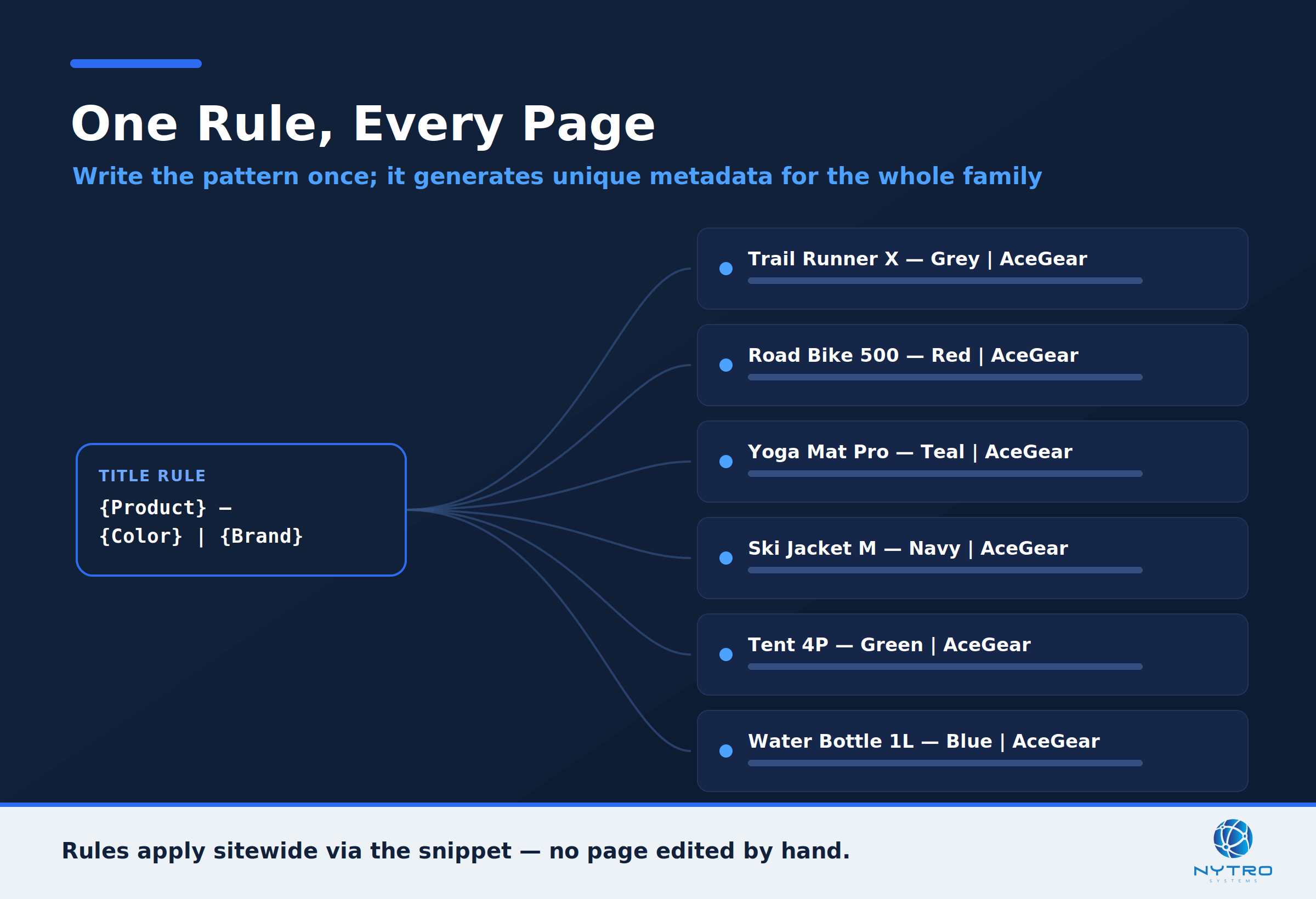
Once crawling is efficient, the on-page work is what automation handles best. The insight is to stop thinking in pages and start thinking in rules that apply to page families. Instead of writing 100,000 titles, you write the logic that generates a unique, intent-matched title for each page from its data — its product name, category, attributes, or topic — and the same for meta descriptions and structured data. This is how meta tags automation for large websites actually works: patterns, not manual entry.
A concrete example makes the idea clear. Rather than writing a title for each of 40,000 product pages, you define a pattern — the product name, a key attribute, the brand, and the category, assembled into a template that stays within length limits and reads naturally. The engine fills that pattern from each page’s own data, so every page gets a unique, accurate title without a human typing it. The same approach generates meta descriptions from product details and builds Product or Article structured data from the fields each page already has. The critical discipline is validation: because one rule touches thousands of pages, the system has to check that generated titles are not truncated or duplicated, that descriptions fall within range, and that structured data stays valid — catching a flawed pattern before it ships to the whole site rather than after.
The delivery matters as much as the logic. Editing every template in a large or legacy CMS is often impractical, which is where a snippet-based approach earns its place. NytroSEO applies these rules through a header snippet, scoped to the URL patterns or sitemap segments you choose, so the right rules reach the right page families and the changes apply across the whole site without touching each page — the essence of automatic seo changes at scale. That makes it a form of scalable seo software that fits on top of whatever platform a large site already runs, which you can explore on our Automatic SEO software page and our overview of AI-based SEO for large website owners.
An honest boundary applies here, the same one that governs any snippet approach. This automation controls the on-page metadata and structured-data layer, which rendering-capable engines like Google read and which is captured when pages are server-rendered or pre-rendered. It does not, by itself, fix crawl budget or rendering — those are the infrastructure work above — and on a client-side-rendered site, content must reach non-rendering crawlers through the server. Automation handles the on-page layer at scale; the crawl and rendering foundations still have to be sound.
Governance for SEO Automation for Large Sites
Automation that touches tens of thousands of pages needs governance, because a rule change propagates everywhere at once. Three practices keep it safe.
Overrides come first. Your highest-value pages — top categories, flagship products, key landing pages — should allow hand-tuned titles, descriptions, and schema that automation leaves alone, so rules handle the long tail while people control what matters most. Monitoring comes second: watch index coverage and Crawl Stats for changes in what is indexed and crawled, and track whether automated titles and descriptions are performing, so a bad rule is caught in days rather than quarters. A useful habit is to roll out a new rule to a small slice of pages first, confirm the metrics move the right way, and only then apply it to the whole family — the same staged-release discipline software teams use, applied to on-page SEO. Auditing comes third: schedule checks for duplicate or truncated titles, missing canonicals, orphaned pages, and links to non-indexable URLs, and feed the findings back into your rules.
Governance becomes even more important when you run more than one large property. Multi site seo automation — applying consistent rules across a network of sites while respecting each site’s differences — multiplies both the leverage and the risk, so shared rule libraries paired with per-site overrides are what keep a portfolio consistent without flattening it.
What to Automate First on a Large Site
With so many possible changes, sequencing matters, and a rough order of operations keeps the effort focused. Fix crawl-wasting problems first, because they cap everything downstream: no on-page work helps a page Google will not crawl. Within crawling, start with the issues that touch the most URLs — a parameter pattern spawning millions of duplicates outranks a handful of broken links in priority.
Then move to on-page automation, and there too, lead with leverage. A single template family usually accounts for a large fraction of a site’s pages, so fixing one title or schema pattern can improve tens of thousands of URLs in a single change. Prioritize the families that combine scale with commercial value — the product and category templates that drive revenue — before the long tail of rarely visited pages. Finally, layer human overrides onto the handful of pages important enough to deserve individual attention. The principle throughout is leverage per unit of effort: on a large site, the change that improves the most valuable URLs at once always comes first, and automation is simply the tool that makes that change reach every page it should.
A Worked Example: A 120,000-Page Catalog
Consider a marketplace with roughly 120,000 product and category pages that had stalled: new listings took weeks to index, and traffic had plateaued despite constant additions. Crawl Stats told the first half of the story — a large share of Googlebot’s activity was being spent on faceted-filter URLs and session-parameter duplicates, leaving core product pages crawled only occasionally.
The team fixed crawling first: canonicalizing filter URLs, blocking parameter combinations at the pattern level, pruning duplicate listings, and speeding up server response. With the budget redirected to real pages, they turned to on-page automation, generating unique titles, descriptions, and product schema from each listing’s attributes and applying them sitewide through a header snippet rather than re-templating the aging platform. High-value categories kept hand-written metadata through overrides. Within two months, indexation of new listings dropped from weeks to days, and the long tail of product pages — most of the catalog — finally carried consistent, unique on-page signals. Nothing was optimized by hand at the page level; everything was optimized by rule. The team’s SEO effort went from an unwinnable race against the catalog’s growth to a set of rules that scaled with it automatically, and the people who had been manually editing titles were freed to work on strategy and the high-value pages that genuinely warranted a human touch.
The Bottom Line on SEO Automation for Large Sites
At scale, SEO stops being about individual pages and becomes about systems. Effective seo automation for large sites works in two layers: make crawling efficient so Google reaches the pages that matter, then automate the on-page metadata and structured data those pages need, applied by rule across the whole site rather than by hand. Add governance — overrides, monitoring, and audits — so the leverage of automation never becomes the liability of a sitewide mistake. Do that, and a 100,000-page site can be as well-optimized as a ten-page one, without anyone editing pages one at a time. The sites that win at scale are not the ones with the biggest teams; they are the ones that turned repetitive SEO work into systems and spent their human attention where it actually moves the needle.
Want to see how your large site’s on-page SEO holds up across every template? Run a free visibility check, or talk to us about automating on-page SEO across your whole catalog.