Last updated: September 7, 2026
Most SEO agencies hit the same wall. Sales are working, referrals are coming in, and clients want more — but the delivery team is already at capacity, and every new proposal raises the same question: who is going to do the work? Owners stuck at roughly ten clients tend to be doing sales, delivery, reporting, and client communication all at once, watching margins erode as they try to grow, and feeling the whole operation contract whenever a single client leaves. This is not a talent problem. It is a systems problem, and the right software for seo agencies is how you solve it. The agencies that break through this ceiling are rarely the ones that simply hire faster; they are the ones that change how delivery works so that adding a client no longer means adding the same pile of manual hours.
This guide is about the systems that let an agency take on more clients without adding headcount for every one: what the capacity ceiling actually is, what to systematize first, where automation like NytroSEO fits, and how to turn the freed-up hours into margin. If cutting delivery cost is your priority, our breakdown of how to reduce your SEO agency’s operational cost is a useful companion, and our overview of AI for SEO agencies covers the bigger picture.
The Capacity Ceiling That Software for SEO Agencies Removes
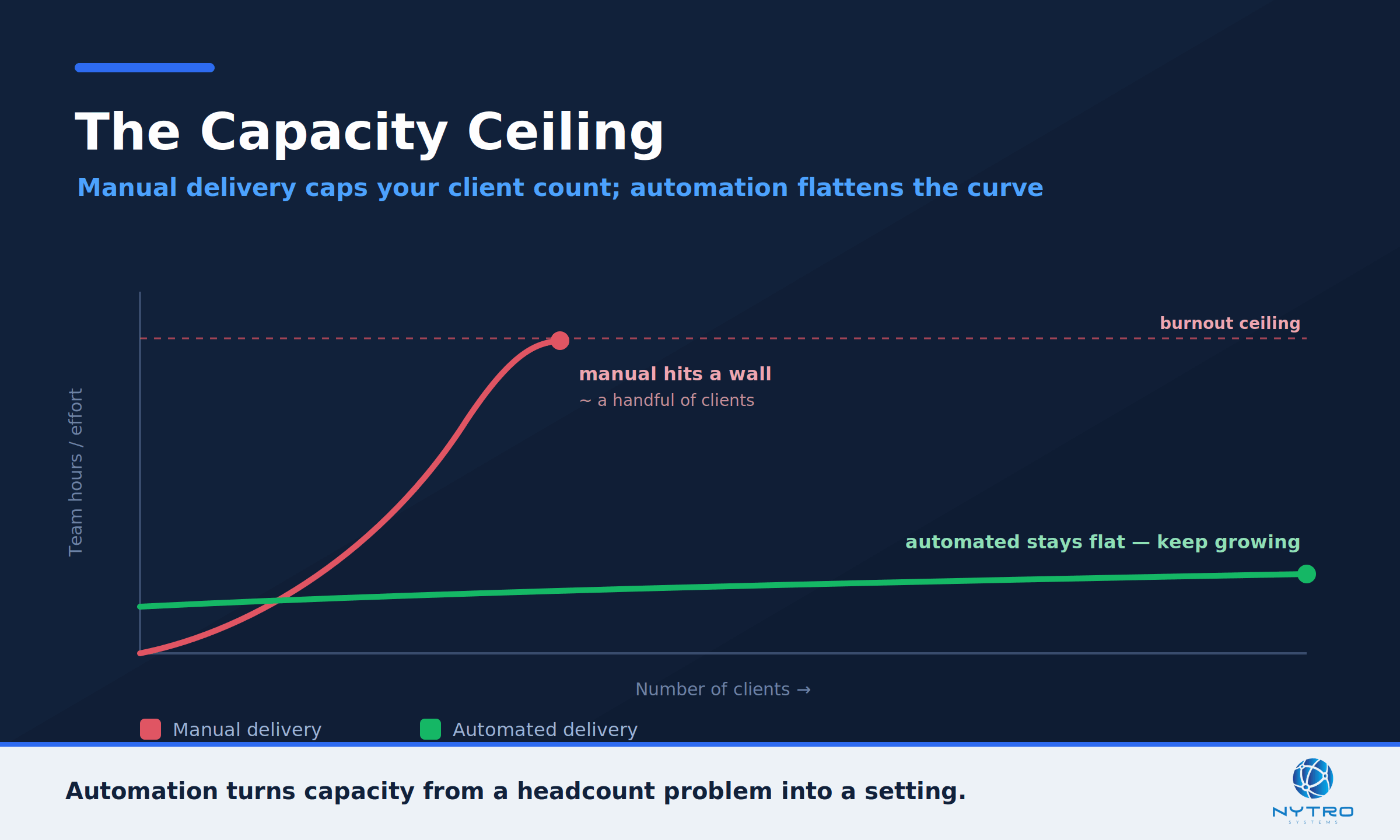
The ceiling is built from repetitive work. Every client needs audits, on-page fixes, metadata, monitoring, and reporting, and when a team does all of that by hand, delivery hours scale almost linearly with client count. Add a client, add the hours; there is no leverage, so the team maxes out and the only way to grow is to hire — which adds cost and management overhead before it adds capacity.
That linear math is why so many agencies plateau. Industry analyses commonly estimate that a majority of SEO agencies never pass a modest monthly recurring-revenue mark, and that agencies lose a large share of their time — often cited as roughly 30 to 40 percent (estimate, from industry commentary rather than first-party data) — to repetitive tasks like reporting, data entry, and status updates. Whatever the exact figure, the underlying pattern is real: the work that caps an agency is precisely the work that is repetitive enough to systematize. Good seo agency software breaks the link between client count and hours, so capacity stops being a headcount decision.
There is a fragility to the manual model that compounds the problem. When every account depends on hands-on delivery, the agency is only ever as stable as its current team’s bandwidth, so a single departure, a sick week, or one demanding client can throw the whole roster behind. Growth makes this worse, not better: each new client tightens the constraint until the owner becomes the bottleneck for everything, unable to step back without delivery slipping. Systematized delivery changes the shape of the risk. When the repetitive work runs on rules and tools rather than specific people’s hours, the agency can absorb a new client, a staffing change, or a busy month without the quality wobble that manual delivery makes almost inevitable. Capacity becomes something you configure, not something you constantly ration.
“Ask any agency why on-page work stalls and it’s rarely skill — it’s access. You’ve planned the fixes and you’re waiting weeks for CMS logins or developer time. Removing that one bottleneck, so you can optimise a client’s on-page layer from a header snippet without touching their CMS, is what lets a small team serve far more clients well.” — Lee Agam, founder and CEO of NytroSEO.
The Four Systems Behind a Scalable Agency
Software helps, but it only pays off inside a few operating systems, and it is worth naming them because tools without systems just create faster chaos. Scaling agencies tend to build four.
Pricing is the first, because it creates the margin that funds everything else — moving from hourly or bespoke quotes to defined packages priced on outcomes. Delivery is the second: documenting and systematizing the fulfillment process so the work happens the same way whether or not the founder is involved, which is exactly where automation lives. Acquisition is the third, a repeatable way to generate qualified leads rather than relying on referrals you cannot control. And team is the fourth: hiring people who can execute the documented systems without the owner’s constant supervision. Automation slots into the delivery system specifically, and it is most powerful when the other three are in place — a well-run delivery engine with loose pricing stays busy without getting more profitable, and a great tool handed to a team with no documented process just produces inconsistent output faster. This is why buying software before fixing systems so often disappoints: the tool is blamed for a problem that was really a missing process around it. The point of software for seo agencies is to make the delivery system scale; the surrounding systems decide whether that scale turns into a better business.
What to Systematize First With Software for SEO Agencies
Not everything should be automated, so sequencing matters. Systematize the repetitive, judgment-light work first, and keep strategy and relationships human.
Four areas give the fastest return. Audits come first: automated crawls and checks that flag indexing problems, broken links, missing metadata, and schema gaps turn a day of manual review into a prioritized task list. On-page and metadata are next, and they are the most repetitive of all — titles, descriptions, canonicals, and structured data across every page of every client site. Monitoring follows: automated tracking of rankings, index coverage, and Core Web Vitals surfaces problems before a client notices them. And reporting is the classic time sink — branded, automated reports that pull live data replace hours of manual slide-building each month, and, just as importantly, they arrive consistently rather than slipping whenever the team is busy. The one thing not to over-automate is content quality, because Google rewards genuine, helpful, first-hand content and penalizes low-effort mass production, as its helpful content guidance makes clear. The best seo software for agencies automates the mechanical work and frees humans for the judgment that clients actually pay for. Turning these repeatable workflows into defined packages, rather than bespoke projects, is what lets agency seo software deliver the same quality every time.
Where NytroSEO Fits in Your Software for SEO Agencies Stack
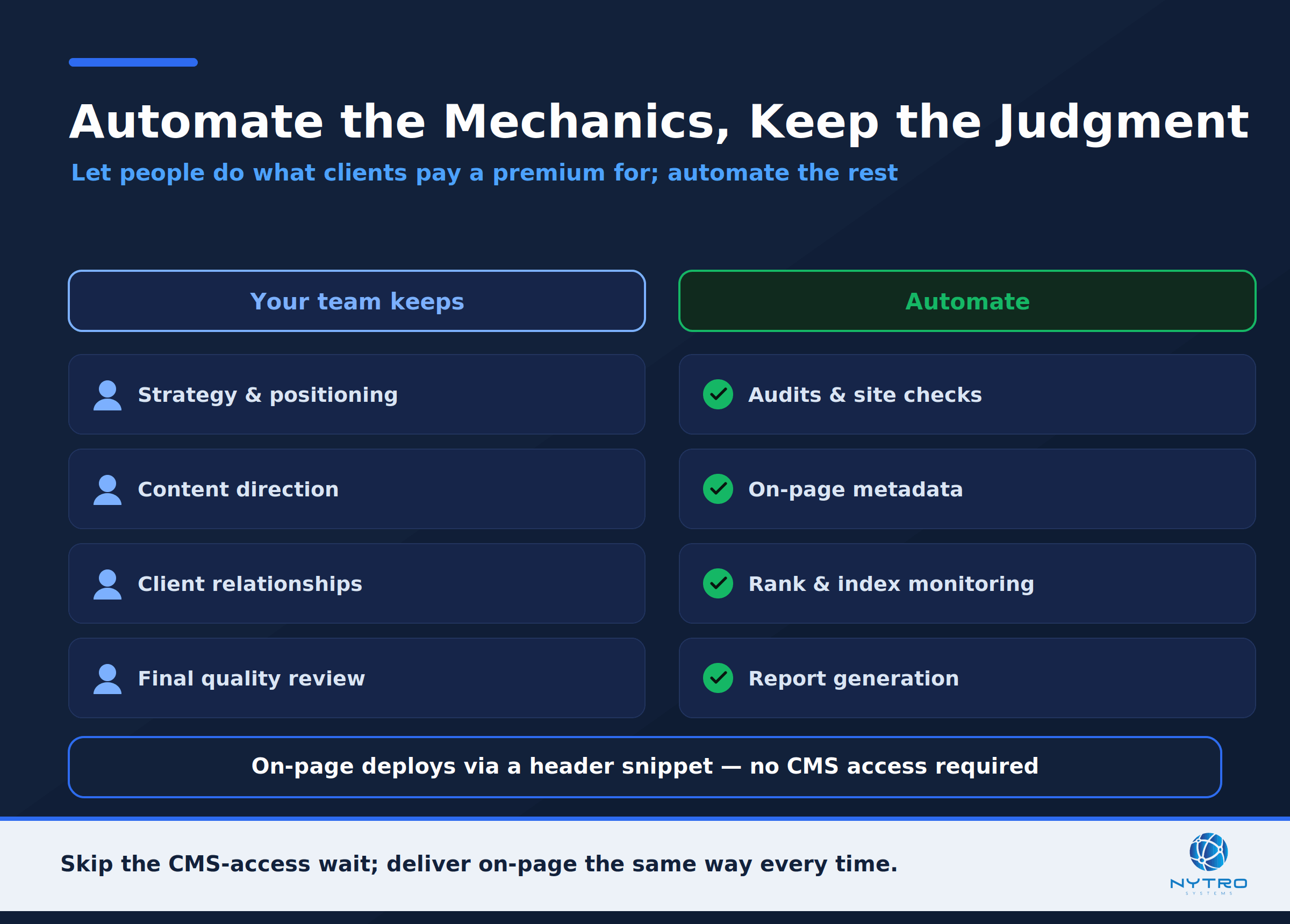
Here is a practical problem every agency knows: you win a client, plan the on-page fixes, and then wait weeks for CMS logins, developer time, or approval to touch the site. The technical work is ready; access is the bottleneck. This is exactly where NytroSEO fits an agency stack. Because it applies on-page changes through a single JavaScript snippet in the site header, an agency can manage titles, meta descriptions, canonicals, and structured data across a client site without full CMS access and without waiting on the client’s developers — one snippet, and the on-page layer is yours to optimize. As a seo automation platform, it turns on-page delivery from a per-site, access-gated chore into a repeatable step you apply the same way for every client.
An honest boundary matters here. NytroSEO automates the on-page metadata and structured-data layer; it does not write your clients’ content, build their links, or set their strategy — that is the work your agency still owns and charges for. It also, like any snippet approach, delivers metadata that rendering-capable engines like Google read, so pairing it with sound server-side essentials keeps non-rendering AI crawlers covered too. Used well, it removes the single most access-dependent part of delivery, which is why it fits so cleanly into an auto seo agency model where fulfillment is systematized and the team concentrates on strategy. Our rundown of the best AI SEO tools for agencies puts it in context alongside the rest of a modern stack.
The multi-client angle is what makes this matter at scale. An agency does not run one site; it runs dozens, each on a different platform — WordPress here, a custom build there, a no-code site for the newest client. Managing on-page SEO natively across that mix means learning each CMS, chasing each set of logins, and doing the work a different way every time. A snippet-based layer collapses that into one repeatable motion: the same rules, the same interface, the same deployment step, regardless of what the client’s site is built on. For a delivery team, that consistency is worth as much as the time saved, because it means a new hire learns one process instead of ten, and quality does not depend on which platform a client happens to use. Onboarding a new account’s on-page layer becomes minutes of setup rather than weeks of access requests.
Pricing the Capacity That Software for SEO Agencies Frees
Automation only improves the business if you capture the freed capacity, so pricing has to change with delivery. When on-page, audits, monitoring, and reporting no longer consume most of a delivery hour, each account costs less to serve, and that gap is margin — but only if you do not simply give the time back. Two moves turn freed hours into profit.
First, package and price on outcomes, not hours. Once delivery is systematized, sell defined tiers tied to a repeatable process rather than bespoke retainers, so clients buy results and you are not re-quoting custom work every time. Industry figures for white-label and productized SEO commonly cite gross margins in the range of forty to sixty percent, against the lower margins typical of fully manual in-house delivery (estimate, from industry commentary).
A simple illustration shows why this matters. Suppose serving a client used to take fifteen delivery hours a month, and automation cuts the mechanical portion to five. If you keep charging the same retainer, you have just turned ten hours into margin — or, put differently, freed the capacity to serve two or three more clients with the team you already have. The mistake agencies make is quietly absorbing that saved time into slower work or scope creep, so the efficiency never reaches the bottom line. The discipline is to treat the freed hours as a deliberate choice: bank them as margin, redeploy them into growth work that raises retention, or use them to take on new accounts — but decide, rather than letting them evaporate. Automation without pricing discipline makes an agency busier; automation with it makes an agency more profitable. Second, reinvest the freed hours into the work that grows accounts — strategy, content direction, and client relationships — which improves retention and justifies higher tiers. The agencies that scale are not the ones with the biggest teams; they are the ones whose systems let a small team serve many clients well, then price that leverage deliberately. Broader SEO-industry context on where the market is heading is worth following through sources like Search Engine Land and Moz.
A Worked Example: From Ten Clients to Thirty
Consider a five-person agency stuck at around ten retainer clients. The founder was still personally handling on-page fixes and monthly reports, every new client meant renegotiating access with a different CMS, and the team was turning away work because delivery was full. The bottleneck was not skill; it was that delivery hours scaled one-to-one with clients.
They rebuilt the delivery system around automation. Audits and monitoring were automated so problems surfaced as task lists instead of manual reviews. On-page metadata was applied through a header snippet across every client site, which removed the CMS-access delay that had made onboarding slow and unpredictable. Reporting was automated with branded templates pulling live data. With the mechanical work systematized, the same five people could serve far more accounts, and the founder’s time shifted from doing fixes to directing strategy. Over the following two quarters the agency roughly tripled its active clients without proportionally growing the team, and — because they repriced into packages rather than giving the saved hours back — margin per account rose rather than fell. The lesson was not that software replaced the team; it was that it removed the repetitive work capping how many clients that team could serve well. The people did more valuable work, not less.
The Bottom Line on Software for SEO Agencies
Scaling an SEO agency is not about working more hours; it is about building systems so a small team can serve many clients without quality slipping. Remove the capacity ceiling by systematizing the repetitive work — audits, on-page and metadata, monitoring, and reporting — keep strategy and content human, deploy automation like NytroSEO to handle on-page delivery even without CMS access, and price the freed capacity as margin rather than giving it away. Do that, and taking on the next client stops being a staffing crisis and becomes a decision you can say yes to. The agencies that will win the next few years are not the biggest ones; they are the ones whose systems let a focused team deliver excellent work across a growing roster of clients — and who priced that leverage so the growth actually reaches the bottom line.
Want to add automated on-page delivery to your agency stack? Talk to us about partnering, or run a free visibility check on a client site to see exactly what it surfaces and how much of it you could hand to automation.