Last updated: September 13, 2026
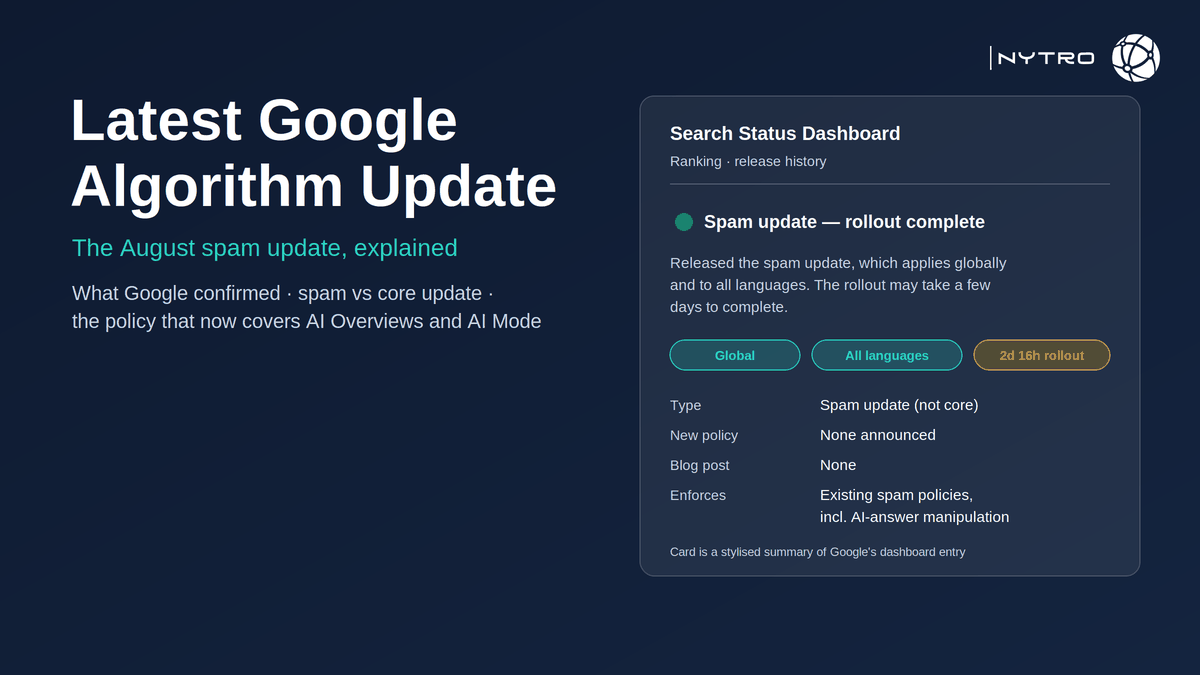
The latest google algorithm update confirmed by Google is the August 2026 spam update. It began at 09:27 Pacific on 18 August 2026 and was marked complete at 01:49 Pacific on 21 August, a rollout of two days and sixteen hours that applied globally and to all languages. Google published no accompanying blog post and announced no new spam policy category; the update enforces the spam policies already on the books, which since May 2026 explicitly cover attempts to manipulate generative AI responses in Google Search, including AI Overviews and AI Mode. This article separates what Google confirmed from what circulated, explains how a spam update differs from a core algorithm update so you can tell which one moved your traffic, and sets out what is safe to do for AI features under the policy as it now stands.
Search Engine Journal’s report on the completed rollout records the Search Status Dashboard entry as a ranking incident from 18 to 21 August, notes that Google did not post a blog article to go with either the release or the completion note, and confirms it is the third spam update of 2026 after the March rollout, which finished in 19 hours and 30 minutes, and the June rollout, which took two days and one hour. The same report ties the June update to a 15 May clarification that Google’s spam policies also apply to attempts to manipulate generative AI responses in Search.
If you would rather have every page’s metadata re-checked automatically after an update instead of by hand, sign up for free and NytroSEO will flag titles, descriptions and structured data that have drifted out of line with your content.
Two things make this update more consequential than its quiet release suggests. First, it is the first named spam update to run after that policy clarification had time to bed in, so it is a reasonable proxy for how Google enforces the rule against gaming AI answers. Second, it landed on top of three weeks of unexplained volatility, which means many sites are now attributing losses to the wrong cause.
Lee Agam, founder and CEO of NytroSEO, sees the diagnosis, not the recovery, as the step most teams get wrong after an update. In his experience the first question is never “what should we change” but “was it this update at all”: the late-July volatility, the August spam rollout and the model change inside AI Mode in the same fortnight each leave a different fingerprint, and a fix aimed at the wrong one costs a month. His rule for clients is to line the traffic drop up against the Search Status Dashboard before touching a page, and then to check the least glamorous layer first, because after a rollout it is often stale or mismatched titles, descriptions and canonicals, not the content itself, that keep a site from recovering once the underlying issue is fixed.
What the latest google algorithm update actually was
Strip away the commentary and five facts are confirmed by Google’s own record. The update is a spam update, not a core update. It began on 18 August 2026 at 09:27 Pacific and ended on 21 August at 01:49 Pacific. It ran for two days and sixteen hours. It applied globally. It applied to all languages. Google’s dashboard note reads, in full, that it released the August 2026 spam update, which applies globally and to all languages, and that the rollout may take a few days to complete; the completion line was added on 21 August.
What Google did not say matters as much. There was no blog post, no statement of the share of queries affected, and no new policy type. Search Engine Land’s completion coverage points readers to the existing spam updates help document rather than to anything new, and notes, fairly, that there will always be cases of sites that were not spamming and were still hit. Google’s Search Central account described it on LinkedIn as a normal spam update.
The duration is the one new number. At two days and sixteen hours it was the longest of the year’s three spam updates, not the shortest, which contradicts some early commentary. A longer rollout means a longer window in which rankings can move, and it means that a drop or gain observed on day one was not the final state.
The volatility before the update was not the update
Brafton’s analysis makes a point worth repeating: a wave of ranking volatility rattled publishers and trackers in late July and the first week of August, before Google confirmed anything, and no incident was logged on the Search Status Dashboard during that window. Sites that chased an “August core update” in that stretch were reacting to noise, or to something Google has not named. Google’s position is that it does not roll out named updates before announcing them. If your losses began before 18 August, the spam update did not cause them, and the spam policies are the wrong place to look.
Google’s spam policy now covers manipulating AI Overviews and AI Mode
The rule that gives this update its significance was not introduced with it. In May 2026 Google clarified that its spam policies for web search apply to attempts to manipulate generative AI responses in Google Search, including AI Overviews and AI Mode. In practical terms, tactics engineered purely to be scraped into an AI answer, rather than to help a person reading the page, now carry the same enforcement exposure as classic ranking manipulation. The spam policies for Google web search remain the reference document.
That reframes a category of advice that had spread quickly through 2025 and early 2026: hidden question-and-answer blocks written for models, pages chunked into model-sized fragments with no reader in mind, duplicated “AI summary” versions of existing pages, and mass-produced pages that exist to be quoted. Under the clarified policy those are not clever; they are the same scaled content abuse, hidden text and doorway patterns Google has always acted against, applied to a new surface.
The safe path is unremarkable. Google’s own guide to optimizing for generative AI features on Search says no special markup, file or AI-specific format is required, because AI Overviews and AI Mode are rooted in the same core ranking systems as Search. Write for people, organise with normal headings and paragraphs, answer directly, cite sources, and show who wrote the page. Our guide to getting cited in Google AI Overviews rather than just ranked covers that structure in detail, and none of it conflicts with the policy.
Spam update vs core algorithm update: how to tell which one hit you
Google runs several kinds of google search algorithm updates, and they leave different marks. A spam update, like this one, applies Google’s spam-detection systems, including the automated system it calls SpamBrain, against sites that violate a specific policy. A core algorithm update reassesses how Google evaluates content quality more broadly; nothing is “violated”, the bar moves. Reviews updates, helpful-content adjustments and other named systems sit alongside these. Google Core Updates Volatility, the churn that trackers report around a core rollout, is a different signal from the sharp, site-wide drops a spam action produces.
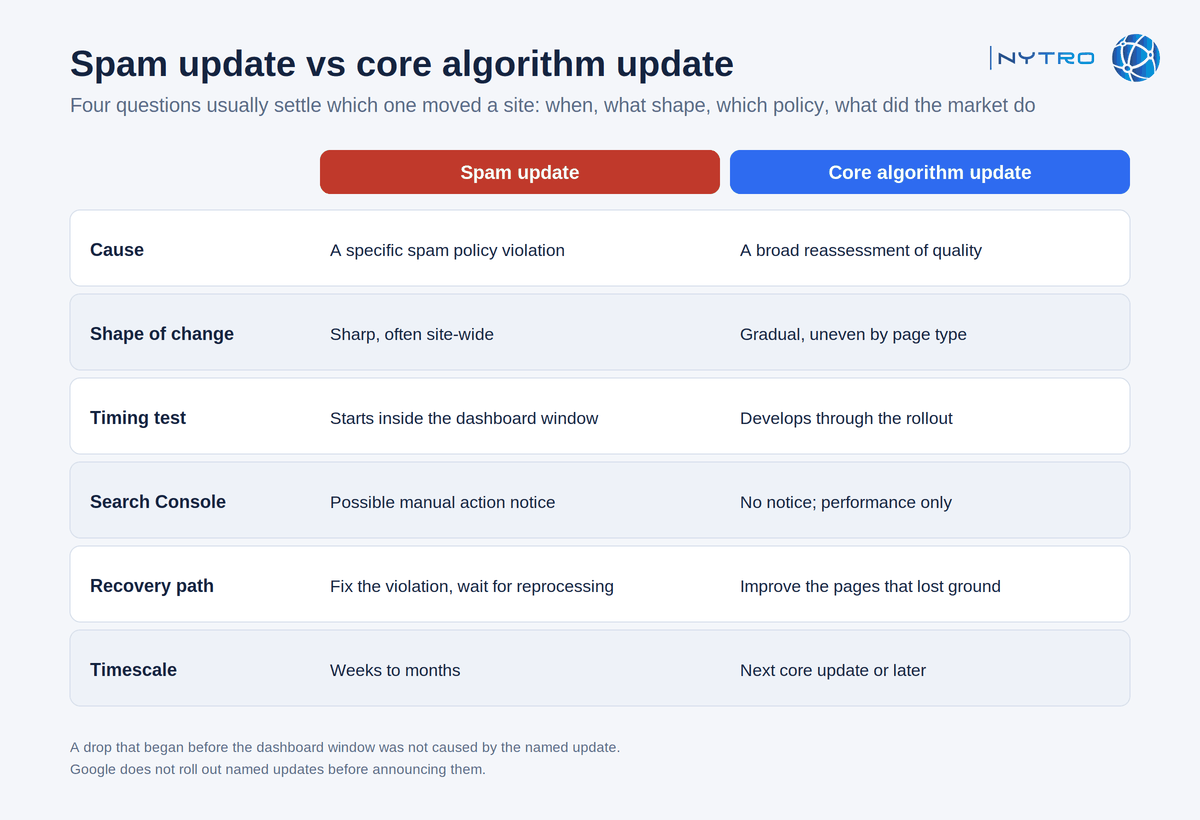
The comparison above lists the four questions that usually settle which type of update moved a site; work through them in order.
Use four questions, in this order.
- When did the change start? Compare the first day of the drop with the dashboard window. A drop that begins inside 18 to 21 August is consistent with the spam update; a drop that began in late July is not, and one that continues to develop weeks later may be a later system.
- What shape is the drop? Spam enforcement tends to be sharp and site-wide, sometimes accompanied by a manual action notice in Search Console. Core algorithm update effects are usually gradual and uneven, hitting some page types or topics more than others.
- Is there a policy you could plausibly be violating? Scaled or thin content, doorway pages, hidden text, expired-domain abuse, site reputation abuse, and now content built to manipulate AI answers. If none applies, a spam update is an unlikely cause even if the timing fits.
- What does the rest of the market show? If competitors in your niche moved in the same window without changing anything, you are looking at a systemic reassessment, which points toward google core updates rather than enforcement.
Our earlier note on the March 2024 core and spam updates walked through the same logic when Google last overhauled its spam policies, and our analysis of the September 2025 volatility and the num=100 data change is a reminder that not every visibility change in Search Console is a ranking change at all.
A measurement caveat for this window
Google logged a Search Console data-logging issue affecting parts of August, including the period that forms the pre-rollout baseline for this update. Before you trust a before-and-after comparison, check the data anomalies note in Search Console and, where the anomaly overlaps your baseline, extend the baseline earlier or compare against analytics sessions instead. A drop that is really a logging gap will “recover” on its own and teach you nothing.
What is safe to do for AI features under the latest google algorithm update
The clarified policy narrows the field to what Google has always rewarded, so the list is short and unglamorous.
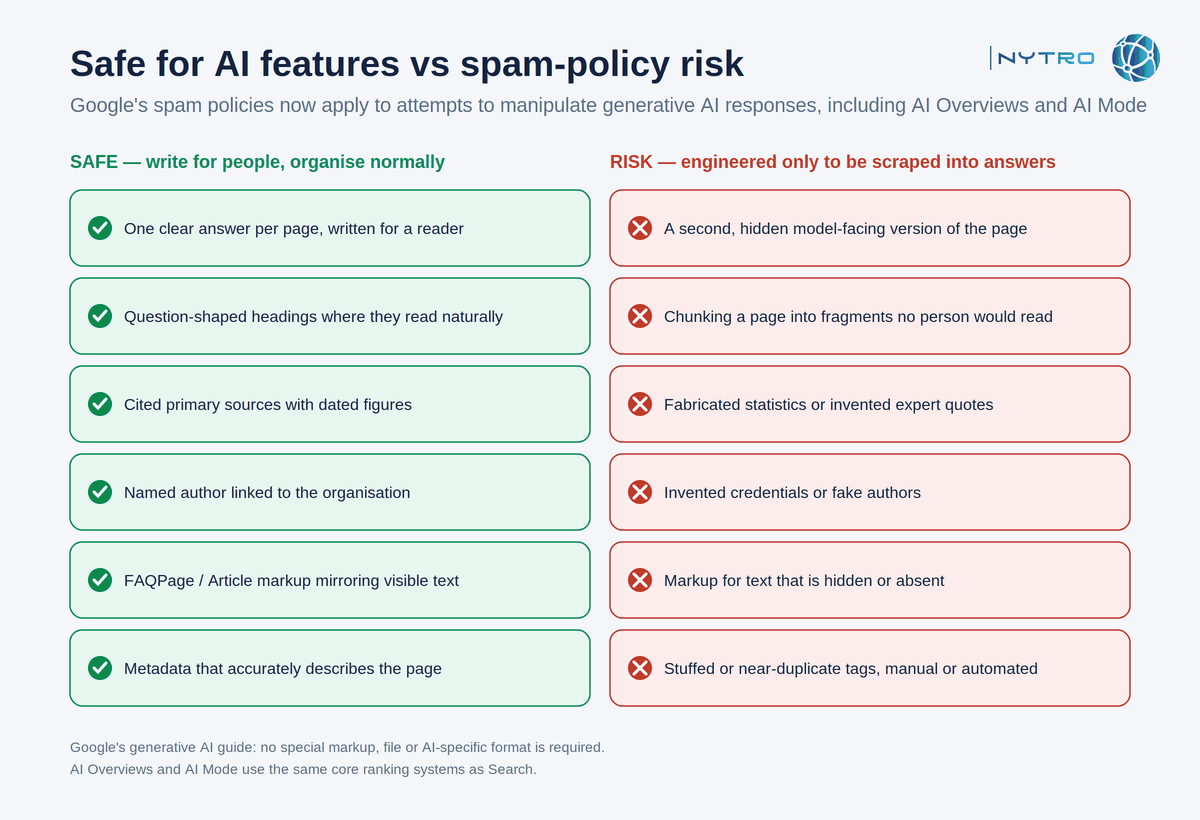
The card above pairs each safe practice with the manipulation pattern it replaces; the rest of this section explains each pair.
- Write one clear answer per page, in the first paragraph, for a reader. Do not publish a second, model-facing version of the same page.
- Use ordinary question-shaped headings where they read naturally. Do not chunk a page into fragments that make no sense to a person.
- Cite primary sources and put dated figures next to the claims they support. Do not fabricate statistics or attribute quotes to experts who did not say them.
- Name the author and connect them to the organisation with structured data. Do not invent credentials.
- Use FAQPage and Article markup that mirrors visible content. Do not mark up text that is hidden or absent.
- Keep titles, descriptions and canonicals accurate to the page. Do not stuff them, and do not let automation generate metadata that misdescribes the content.
That last point is where automation has to be held to the same standard as a writer. Metadata generated at scale is only safe if it reflects the page; rules that produce accurate, descriptive tags are aligned with Search Essentials, and rules that produce keyword-stuffed or near-duplicate tags are a spam risk you have simply automated. Our discussion of when to automate SEO and when to keep it manual draws that line in detail.
Recovering and staying resilient through google core updates and spam updates
If the four questions point to the spam update, recovery follows Google’s documented path: identify the policy issue, fix it across the site, and wait. Google’s guidance for spam updates is that improvements are reflected over time as its systems recrawl and reprocess pages; for algorithmic actions there is no reconsideration request, and for manual actions there is. The timescale is measured in weeks to months, not days.
If the questions point to a core algorithm update, or to the unlogged volatility before it, the work is different: assess content quality against Google’s people-first guidance, consolidate thin or overlapping pages, and improve the pages that lost ground rather than the site as a whole.
In both cases there is a layer that decides how quickly a recovery becomes visible once the cause is fixed, and it is the one most teams skip. After any rollout, check that the pages you are relying on still carry the titles, descriptions, canonical tags and structured data you intended. Theme updates, plugins and builders overwrite these silently, and a corrected page with a stale or duplicated title recovers more slowly because Google is reading a mismatch. Our guide to adaptive SEO automation and recovery from core updates explains how NytroSEO re-aligns that layer automatically across a site; it does not fix content quality or policy violations, which remain people’s work, but it removes the drag that keeps a fixed site from being seen as fixed. Book a strategy meeting if you manage a large site or a client portfolio and want the post-update audit run as one project.
A 14-day post-update routine
- Days 1 to 3: annotate the Search Status Dashboard window in your analytics; note the Search Console data anomaly; do nothing else yet.
- Days 4 to 7: answer the four diagnostic questions per site; classify as spam, core, unlogged volatility or not affected.
- Days 8 to 10: for spam, fix the policy issue site-wide; for core, list the pages that lost ground and improve them; for not affected, stop.
- Days 11 to 14: audit metadata and structured data on the affected pages and correct drift; set a 60-day review, because the next spam or core rollout is likely before then.
Frequently Asked Questions
Google released the August 2026 spam update on 18 August 2026 at 09:27 Pacific and marked it complete on 21 August at 01:49 Pacific, a rollout of two days and sixteen hours. It is a global spam update covering all languages, not a core update, and Google announced no new spam policy categories alongside it.
Yes. In May 2026 Google clarified that its spam policies apply to attempts to manipulate generative AI responses in Google Search, including AI Overviews and AI Mode. Tactics built purely to be scraped into AI answers, such as hidden model-facing text or mass-produced quotable pages, carry the same enforcement risk as classic ranking manipulation.
Check the Search Status Dashboard for the exact rollout window and compare it to the first day of your traffic drop, then look at the shape: spam enforcement is usually sharp and site-wide, core effects gradual and uneven. If your drop began before 18 August, the spam update did not cause it, because Google does not roll out named updates before announcing them.
No. Google’s guidance is to write for people and organise with normal headings and paragraphs; no special markup, file or AI-specific format is required. Separate or chunked “AI content” risks the scaled content abuse policy. Clear structure, cited statistics and named expert attribution help both classic Search and AI features without breaking the rules.
It can shorten the time between fixing a problem and Google seeing it fixed. Automated metadata alignment keeps titles, descriptions, canonicals and structured data consistent with your content across thousands of pages, so recovery is not delayed by stale or mismatched tags. It does not repair content quality or policy violations, which still need people.
Ready to check your site against the latest google algorithm update?
The August spam update enforced rules you already know; the hard part is proving whether it touched you and making sure nothing on the page slows the recovery. Sign up for free to have NytroSEO audit and re-align your metadata and structured data automatically, or book a strategy meeting if you manage many sites and want the post-update diagnosis done as one project.