Last updated: October 26, 2026
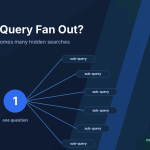
One AI prompt can trigger a whole set of hidden searches. Query fan-out optimization is how you make a single page answer those hidden searches, the comparisons, definitions, and edge cases behind the main question, so your content is pulled into more of the generated answer. Done right, it is one of the highest-leverage things you can do for AI search. Done wrong, it tips straight into the kind of mass-produced, thin-page publishing that search engines penalize.
This guide is the tactical companion to understanding fan out. It covers what query fan-out optimization actually is, how to apply it on a real page, the exact line that separates it from scaled content abuse, and the techniques, section structure, question headings, comparisons, and evidence blocks, that let one deep page win many sub-queries at once. The whole discipline comes down to a single rule: go deep on one page, not wide across fifty.
Lee Agam, CEO of Nytro Systems, is direct about why this matters. The most common mistake he sees teams make when they first learn about fan out is the instinct to spin up a separate page for every sub-query they can think of, which is exactly the behavior Google’s spam policies target. In his experience, the pages that actually win fan out are deep, well-organized pages that resolve a cluster of related questions in one place, because that is what both the reader and the engine reward. His guidance is to treat query fan-out optimization as a structure-and-depth problem, not a volume problem, and to automate the consistency that makes depth sustainable across a whole site.
What Is Query Fan-Out Optimization?
Query fan-out optimization is the practice of structuring a single page so it cleanly answers the many sub-queries an AI search system generates from one user prompt. Where fan out is the engine’s behavior, decomposing a question into sub-queries and synthesizing an answer, fan-out optimization is your response to it: organizing content so your page supplies passages for as many of those sub-queries as possible.
The important word is single. The engine may ask ten sub-questions behind one prompt, but the correct reaction is not ten pages. It is one deep page with ten clearly answered sections. Each section gives the engine an extractable passage for a different sub-query, while the page as a whole stays genuinely useful to a human reader. This is what good AI Search optimization looks like under fan out: depth and structure concentrated, not content scattered.
That distinction is not stylistic, it is a policy line. Google’s spam policies define scaled content abuse as generating many pages primarily to manipulate search rankings, and producing a thin page per sub-query falls squarely into it. Query fan-out optimization deliberately stays on the other side of that line by consolidating coverage into fewer, deeper pages. It is the safe, durable way to act on fan out.
How Query Fan-Out Optimization Works on a Page
On a real page, query fan-out optimization is a sequence of deliberate structuring choices. The goal at each step is to make a specific sub-query easy for the engine to locate and lift.
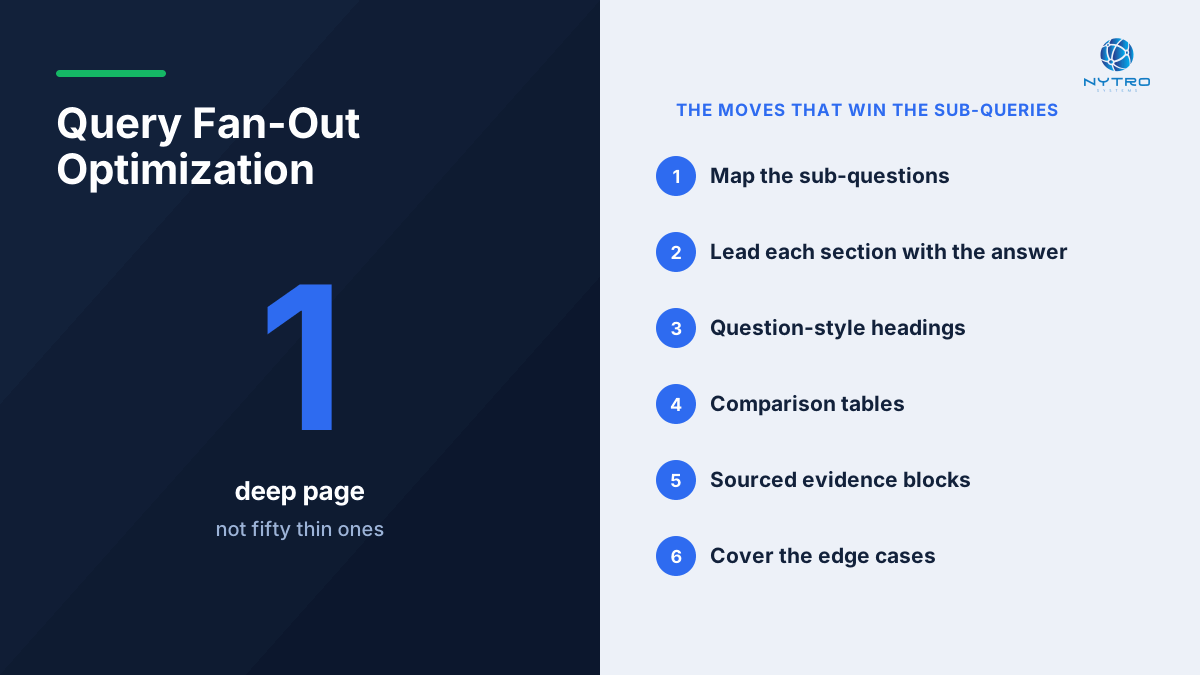
It starts with mapping. Before writing, list the sub-questions a thorough answer to the page’s main topic would need to cover, the definitions, comparisons, steps, edge cases, objections, and evidence a careful reader would expect. Those are, in effect, the sub-queries the fan out is likely to generate. Next comes sectioning: each sub-question gets its own clearly labeled section with a direct answer in the first sentence or two, so the engine can match the sub-query to the passage and reuse it. Then comes formatting the evidence: comparisons become compact tables, processes become numbered steps, and claims get specific, sourced support the engine can safely reproduce. Finally comes coherence: the sections are ordered and linked so the page reads as one authoritative treatment of the topic rather than a bag of disconnected answers.
The result is a page that behaves like many answers wearing one URL. A fan out that generates sub-queries about what a thing is, how it compares, how to do it, and what to watch out for can pull from four different sections of the same page, and because the page is deep and coherent, it reads as the authoritative source rather than a thin match. That is the entire mechanic of query fan-out optimization.
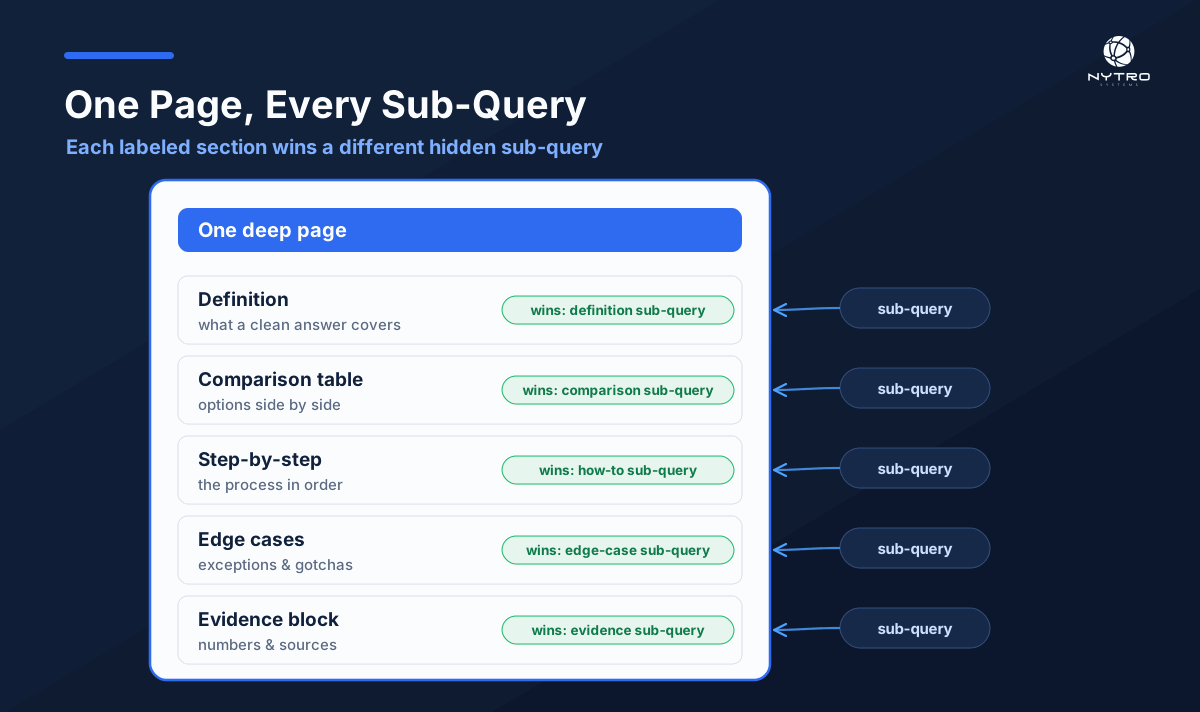
Query fan-out optimization: one deep page with a labeled section for each hidden sub-query.
A Worked Example of Query Fan-Out Optimization
A concrete case makes the method obvious. Suppose you sell project-management software and want a page to earn visibility for the topic of switching tools. The naive, volume approach would be to publish a dozen thin pages: “switch from Tool A,” “switch from Tool B,” “project management migration checklist,” “how to export data from Tool C,” and so on, each shallow, each competing with the others. That is the scaled-content path, and it ages badly.
The query fan-out optimization approach builds one deep page instead. It opens with a direct answer to the main question, how to switch project-management tools without losing data. Then it adds a labeled section for each predictable sub-query: a definition of what a clean migration involves, a comparison table of the common source tools and what exports well from each, a numbered step-by-step process, a section on the edge cases that trip teams up, an honest section on the objections and risks, and a short evidence block citing real data-loss rates or timelines. One page now answers the migration-checklist sub-query, the comparison sub-query, the how-to sub-query, and the risk sub-query, all of which a fan out is likely to generate from a single “how do I switch tools” prompt.
As industry analysis of query fan-out has noted, the durable play is grouping related questions by intent into entity-rich, well-structured content rather than chasing each sub-query with its own page. The deep page is the one the engine can lean on; the thin pages are the ones it skips, and the ones the policy catches.
Query Fan-Out Optimization vs Scaled Content Abuse
The difference between query fan-out optimization and scaled content abuse is the difference between depth and volume, and it is worth making explicit because the penalty for getting it wrong is severe.
Scaled content abuse is the volume play: generating a separate, thin page for each keyword variation or sub-query, usually at low quality and often with automation, primarily to capture rankings. Google treats this as a spam violation regardless of whether a human or a machine produced the pages. The tactic is attractive precisely because fan out seems to reward breadth, if the engine asks fifty sub-questions, fifty pages feels like fifty chances. In practice it is fifty liabilities, because the pattern is exactly what the policy is written to catch, and the pages compete with and cannibalize each other.
Query fan-out optimization is the depth play: one substantial page that answers the cluster of related questions thoroughly, with real structure and real evidence. It satisfies the same sub-queries without triggering the spam signal, because it is genuinely useful and genuinely singular. The parallel to the old content farm problem is exact, mass-produced pages built to satisfy algorithms rather than readers have always eventually lost, and AI search has only sharpened the penalty. The safe path has not changed: consolidate, deepen, and structure.
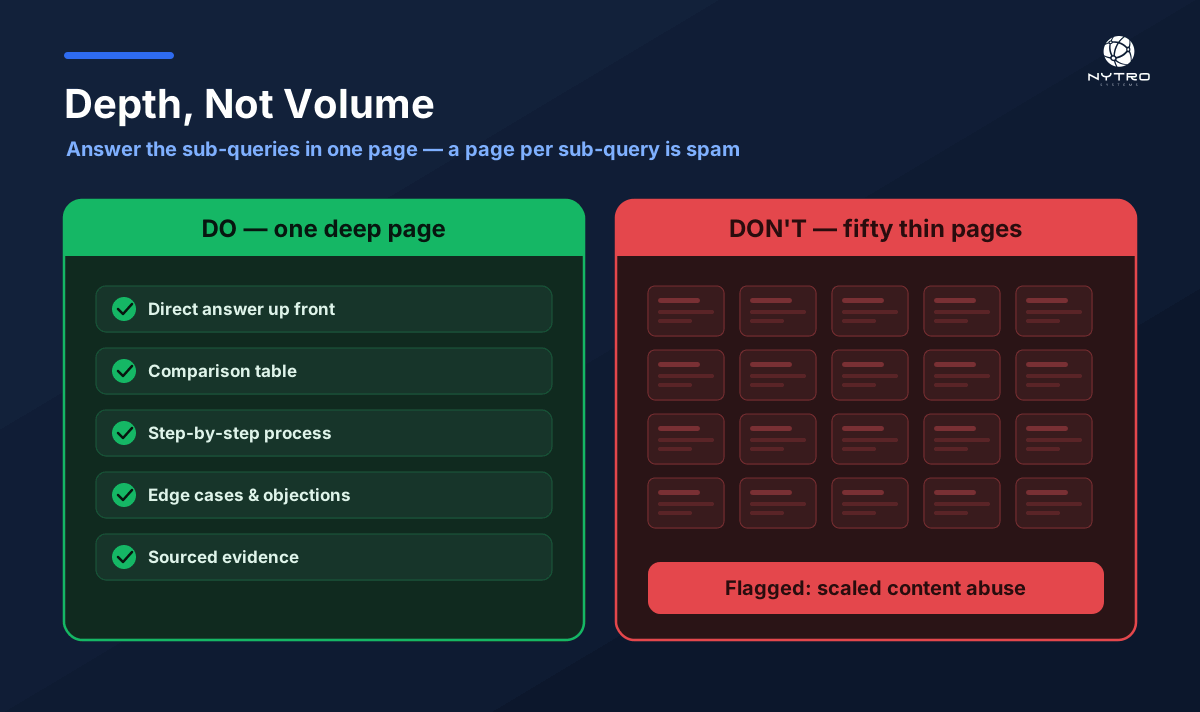
The line that matters: one deep page is optimization; a page per sub-query is scaled content abuse.
Query Fan-Out Optimization Techniques
The techniques below are the practical toolkit for making one page win many sub-queries. None of them involve producing more pages, they all concentrate quality into one. Think of them as ways of adding clearly marked doors to a single building, so an engine arriving with any one of a dozen sub-queries finds an obvious entrance, rather than as reasons to build a dozen separate, flimsy structures.
Lead each section with a direct answer
Under every heading, state the answer in the first one or two sentences before you expand. This gives the engine a complete, extractable response for that sub-query and is the single highest-impact habit in fan-out optimization.
Write headings as the sub-questions themselves
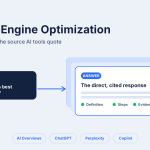
Phrase headings as the real questions people ask, not compressed keyword strings. When a heading mirrors a sub-query, the engine can map the user’s underlying question straight to your section. This is where fan-out optimization and Answer Engine Optimization overlap most directly.
Use comparison tables for “which is better” sub-queries
Fan outs routinely generate comparison sub-queries. A compact table comparing options on consistent criteria is far easier for an engine to reuse accurately than the same comparison buried in prose, and it earns the comparison sub-query cleanly.
Add evidence blocks the engine can trust
Replace vague claims with specific, sourced facts, numbers, dates, named standards. Attributed specifics are safer for an engine to reproduce and make your page the low-risk choice for an evidence-seeking sub-query.
Cover edge cases and objections explicitly
The sub-queries that competitors miss are usually the edge cases and objections. A short section that names and answers them captures the long tail of a fan out that thin pages never reach, and it is often where the easiest wins are.
Keep the page crawlable and fast
Everything above depends on the engine being able to read the page. Clean HTML, server-rendered content, and reasonable speed are the baseline; this is where query fan-out optimization meets ordinary Search Engine Optimization, and neither works without it. If your most important content only appears after heavy client-side rendering, assume some engines will miss it entirely, and a sub-query your page could have won is quietly handed to a competitor instead.
How to Measure Query Fan-Out Optimization
Measuring fan-out optimization is less about a single rank and more about coverage and inclusion. A few signals, read together, tell you whether a deep page is winning its sub-queries.
Watch impression breadth in Search Console: a page optimized for fan out should earn impressions across a wider cluster of related queries, not just its headline keyword, and a widening cluster is a good sign the sections are matching sub-queries. Test the target topic directly in AI Overviews and assistant tools, and note which of your sections get quoted, being cited for a comparison table or a definition is direct evidence the structure is working. Track referral traffic and brand mentions from AI surfaces, since a page that supplies passages often earns both. And watch engagement on the page itself: a deep page that genuinely answers the cluster tends to hold readers longer than a thin one. None of these is a single clean number, but together they show whether your one deep page is doing the work of the fifty thin ones you correctly did not build.
A practical cadence helps keep this honest. Pick the handful of topics that matter most to the business and, once a month, run the same test questions through the main answer engines, recording whether your page is cited and which section supplied the passage. Over a few months you will see a pattern: the sections that consistently get quoted are the ones your structure handled well, and the sub-queries you never win point directly at the sections worth deepening next. That feedback loop, test, note the gaps, deepen the page, is the entire operating rhythm of query fan-out optimization, and it never involves spinning up a new thin page to chase a missed sub-query. The fix is always to make the existing page better, not to make another one.
Where NytroSEO Fits
Query fan-out optimization is a per-page discipline, but its hardest part is consistency: every important page needs clean structure, accurate metadata, and valid schema so the engine can locate the passage for each sub-query, and that has to hold across a whole site, not just the pages a team hand-optimized. Maintaining that at scale, without drifting into the thin-page trap, is where most teams struggle.
That is the gap NytroSEO is built to close. Its Automatic SEO engine optimizes existing pages for broad sub-query coverage, maintaining titles, descriptions, and structured data so pages stay index-eligible and clearly structured, instead of spawning thin pages that risk a scaled-content-abuse penalty. For the deeper background, our Ask Engine Optimization guide covers answer-ready formatting, our LLM SEO strategies guide bridges traditional ranking work into AI retrieval, and our overview of getting AI-search-ready walks through the metadata and schema that fan-out optimization depends on.
Want to optimize website for AI search without risking a spam penalty? Sign up free and explore the NytroSEO system, or book a free strategy session.