Last updated: November 5, 2026
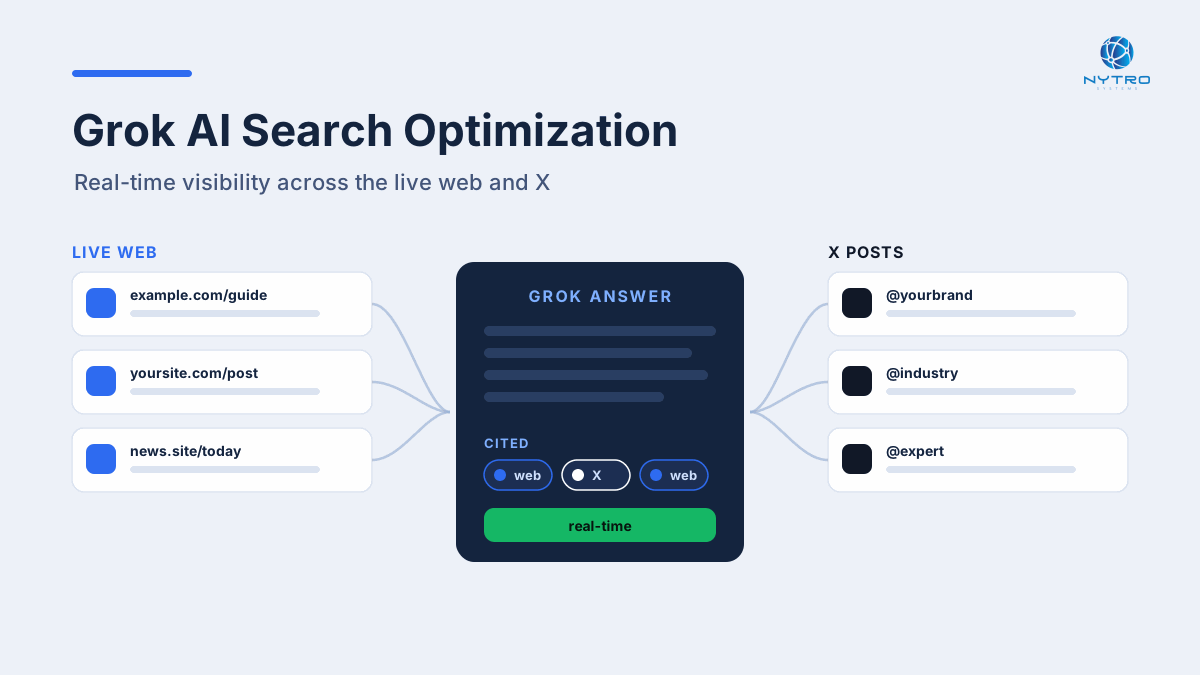
Most AI answer engines lean on an index built hours, days, or weeks ago. Grok, xAI’s assistant, is different in one way that changes the whole playbook: it can reach the live web and X in real time, right when a question is asked. That makes Grok AI search optimization less about ranking in a static index and more about being fresh, public, and verifiable at the moment Grok looks. If your brand is stale on-site and silent on X, there may be nothing current for Grok to pull.
This guide explains what Grok AI search optimization is, how Grok reads the live web and X, why freshness carries unusual weight, how public-conversation signals and your X presence feed in, what Grok tends to cite, and a five-step real-time playbook. It is grounded in xAI’s own documentation of Grok’s search tools, not assumptions about how the model works.
Lee Agam, CEO of Nytro Systems, frames the shift plainly. Classic SEO optimizes a page and waits for an index to catch up; a real-time engine like Grok optimizes for the moment of retrieval. In his view the two halves that matter for Grok are on-site freshness — pages that are current and clearly dated when Grok browses them — and off-site presence, meaning an active, credible public conversation on X that gives Grok something live to cite. Brands that treat Grok like a slower version of Google, he notes, miss the one signal Grok is built around: recency.
What Is Grok AI Search Optimization?
Grok AI search optimization is the practice of making your content and public presence reachable, current, and credible enough that Grok cites or draws on it when it answers in real time. It spans two surfaces that Grok can search: the live web, and X.
What makes it distinct from classic Search Engine Optimization is the timing. Traditional ranking rewards pages that have accumulated authority in an index over time. Grok, by contrast, can fetch current information at query time, so recency and public activity count for more than they do in a slow index. That reframes the goal: instead of only building long-term authority, Grok AI search optimization also asks whether there is something fresh, public, and verifiable about your topic right now.
It is best understood as a real-time branch of broader AI Search optimization and Answer Engine Optimization. The content fundamentals — clarity, evidence, structure — still apply. The difference is that Grok rewards being current and publicly present, not just being well-optimized in the abstract.
How Grok Reads the Live Web and X
According to xAI’s documentation of Grok’s search tools, Grok’s web search tool “enables Grok to search the web in real-time and browse web pages to find information.” That is the core of why Grok AI search optimization is a recency game: Grok is not limited to a pre-built snapshot of the web, so a page you publish or update can be reachable when Grok looks, provided Grok can find and browse it.
xAI’s documentation also describes a separate X Search tool alongside web search. In other words, Grok can draw on X as its own source surface, distinct from the open web. The documentation names the X Search tool without detailing its mechanics on that page, so the responsible claim is simply this: X is a first-class source for Grok, which is why your public presence there is part of Grok AI search optimization rather than an afterthought.
The documentation further notes domain controls — allowed_domains and excluded_domains, each accepting up to five domains and not combinable in one request — which shape which sites a given search can draw from. The practical takeaway for anyone trying to optimize website for AI search on Grok is that reachability and credibility of the open web page still matter, because web search remains one of Grok’s two retrieval surfaces.
Why Freshness Drives Grok AI Search Optimization
If Grok can read the live web, then recency becomes a ranking-like signal in its own right. There is now measurable evidence that AI engines in general lean fresh. Ahrefs, analyzing 17 million citations, found that AI-cited content is 25.7% fresher than organic Google results, with ChatGPT citing URLs roughly 393 to 458 days newer than organic Google results, and Perplexity and Gemini also favoring more recent content. That is a correlation rather than proof that freshness alone causes citations, but the direction is consistent: current content is cited disproportionately often.
For an engine built to search in real time, that tendency is amplified. The practical implications for Grok AI search optimization are concrete. Keep important pages genuinely current — update figures, dates, and guidance rather than letting them ossify. Publish on timely topics while they are being discussed, not months later. And make the recency legible: a visible, accurate publish or update date helps any engine, and a human reader, see that the page is live rather than abandoned.
This is also where Grok AI search optimization diverges most sharply from the “write it once and forget it” model of evergreen SEO. Evergreen content still has a place, but on a real-time engine, a stale page competes against whatever was published this morning. Maintenance is not optional upkeep here; it is the core tactic.
Public-Conversation Signals and Your X Presence
Because X is one of Grok’s two search surfaces, your public presence there is a direct input to Grok AI search optimization — not a social-media nicety. If your brand, product, or expertise is being discussed on X in a credible, current way, Grok has live public material to draw on when it answers related questions. If your brand is absent from the conversation, that source is simply empty.
This does not mean gaming X with volume or spam, which tends to read as low-credibility to any system weighing sources. It means maintaining a genuine, active public presence: sharing substantive updates, participating in relevant discussions, and giving credible accounts something real to reference. Think of it as the off-site half of Grok AI search optimization, the way quality backlinks are the off-site half of classic search — the signal lives in public conversation rather than only on your own domain.
The pairing is what matters. An active X presence with nothing substantive on-site to back it up is thin; strong on-site content with total silence on X leaves one of Grok’s two surfaces blank. Grok AI search optimization works best when the live web page and the public conversation point at the same credible story.
Verifiable Sources: What Grok Chooses to Cite
xAI’s documentation confirms that Grok’s search supports citations — there is a dedicated mechanism to “retrieve and use citations from search results.” For optimization, the implication is that being citable, in the literal sense, is the goal: Grok surfacing your page or post as a named source is the win, much as it is on other answer engines covered in general AEO guidance such as Search Engine Land’s AI-search optimization guide.
What makes a source worth citing is the same discipline that underpins AI Search Ranking everywhere: verifiable claims, clear attribution, named data, and content a system can lift cleanly and attribute. On a real-time engine the credibility bar is paired with the recency bar — Grok is choosing, in the moment, among sources that are both current and trustworthy. Vague, undated, or unsourced content loses on both counts.
So the citation strategy for Grok AI search optimization is not a trick; it is to be the most verifiable current source on your topic. Back claims with data and links, keep the page current, and make sure the public conversation around you is consistent with what your pages say.
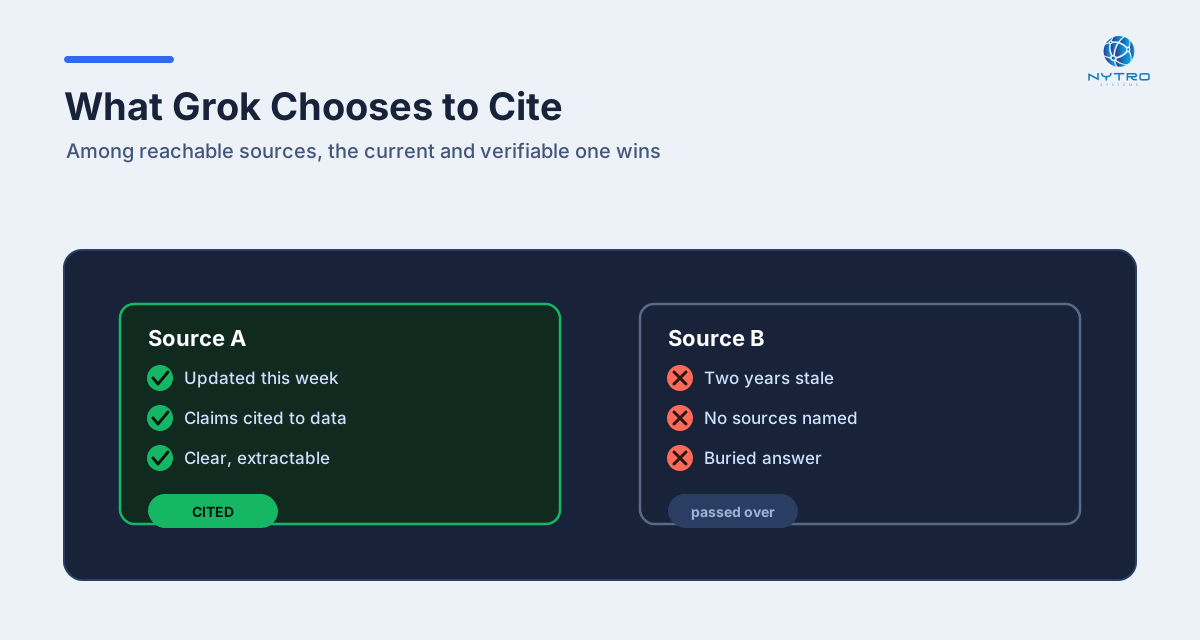
What Grok cites: among reachable sources, the current and verifiable one wins the citation — the stale, unsourced page is passed over.
A Grok AI Search Optimization Playbook
Pulling the tactics into a sequence gives a repeatable routine. These five moves map directly to how Grok retrieves.
First, keep pages fresh — update important content on a real schedule and show accurate dates, because a real-time engine favors current sources. Second, maintain an active X presence — give Grok a credible, current public conversation to draw on, since X is one of its two search surfaces. Third, make every claim verifiable — cite data and name sources so Grok has reason to trust and quote you. Fourth, cover timely topics while they are live — publish during the discussion window rather than long after. Fifth, keep the open web page reachable and clean — clear structure and self-contained answers so that when Grok browses the page, it can extract and attribute a clean passage.
Worked together, these are the on-site and off-site halves of Grok AI search optimization in one loop: fresh, reachable pages on your domain, and an active, credible presence in public conversation, both pointing at verifiable claims. None of it is Grok-specific trickery — it is the ordinary discipline of being current and credible, aimed at an engine that reads in real time.
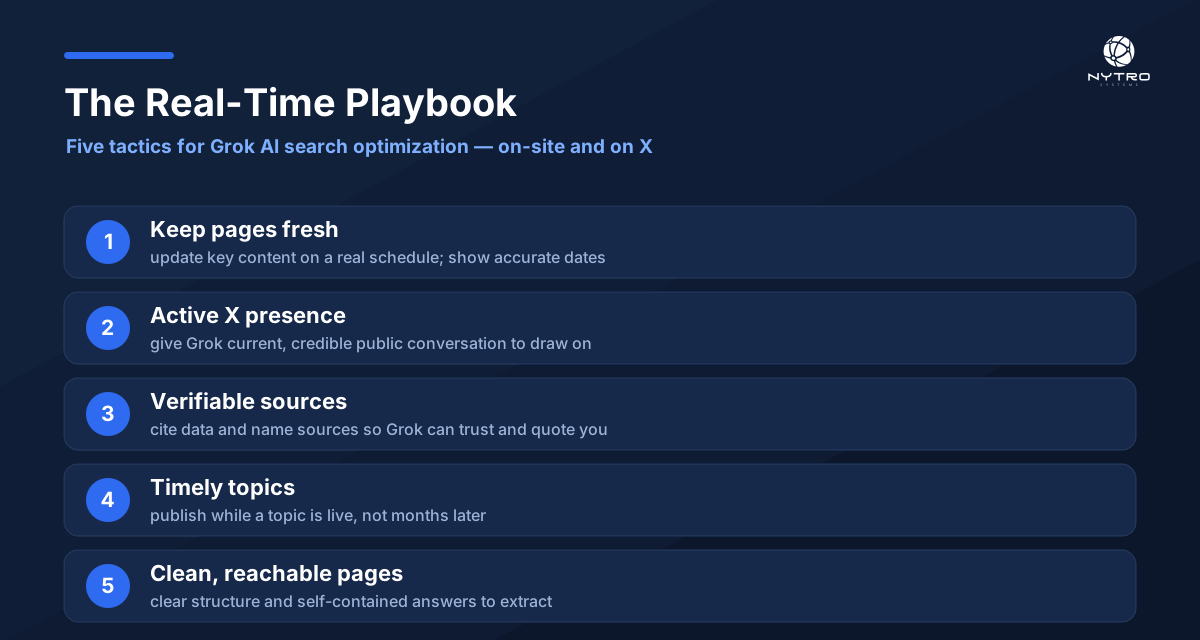
The Grok AI search optimization playbook: five real-time tactics across your site and your public presence on X.
Where Grok AI Search Optimization Meets Classic SEO and AEO
Grok AI search optimization does not replace your existing work; it extends it toward recency. The content quality, structure, and credibility that drive classic Search Engine Optimization and Answer Engine Optimization are the same qualities that make a page worth citing in real time. What Grok adds is a heavier weighting on two things most SEO programs under-invest in: on-site freshness and off-site public presence.
The honest framing is that a brand already doing strong AEO is most of the way there. The gap is usually maintenance and public activity — the page that was great two years ago and has not been touched since, or the strong website with no voice on X. Close those two gaps and the same content that earns citations on Perplexity or ChatGPT becomes eligible on Grok, with recency as the tiebreaker.
Measuring Grok AI Search Optimization
Unlike a classic rank, Grok visibility has no public ranking report, so measurement is more hands-on — but it is still the step that tells you whether any of this is working. The most direct method is to test your real buyer questions in Grok and record what happens: Does Grok mention your brand? Does it cite one of your pages or X posts as a source? Where competitors are named instead, which of theirs does it draw on, and is that source fresher or more verifiable than yours? Running the same prompts periodically turns a one-off impression into a trend.
Two inputs are worth tracking alongside the answers themselves. The first is on-site freshness: which of your key pages have been meaningfully updated recently, and whether their dates are accurate and visible. The second is your public presence: whether there is current, credible conversation about your brand on X for Grok to find. Because Grok reads in real time, a change in either input can show up in answers far faster than a change would move a traditional ranking — which cuts both ways, since letting pages and public activity go quiet can cost visibility just as quickly.
The discipline here mirrors the measurement thinking behind any serious AI Search Ranking program: decide what a good answer looks like, check against it on a schedule, and treat a missing citation as a diagnosis rather than a verdict. For Grok specifically, the question to keep asking is whether you were the most current, verifiable source on the topic at the moment Grok looked. When the answer is no, the fix is almost always one of the two levers already covered — a page that needs updating, or a public conversation that has gone quiet — which keeps the work focused rather than guesswork.
Where NytroSEO Fits
Real-time visibility rewards sites whose pages stay clear and consistently understandable at scale — and the metadata that engines use to interpret and summarize each page is a large part of that. Across hundreds of pages, titles and descriptions drift, and inconsistent metadata quietly costs visibility even when the underlying content is strong.
That is the gap NytroSEO is built to close. Its Automatic SEO engine automatically generates and maintains optimized page titles and meta descriptions across an entire site, so the metadata answer engines rely on to understand each page stays consistent and current without manual rework. For the wider picture, our overview of getting AI-search-ready covers the metadata and structure AI retrieval depends on, our Ask Engine Optimization guide covers the answer-ready formatting that wins citations, and our LLM SEO strategies guide bridges classic ranking work into AI retrieval.
Want your site clear, consistent, and ready for real-time engines like Grok? Sign up free and explore the NytroSEO system, or book a free strategy session.