Last updated: November 6, 2026
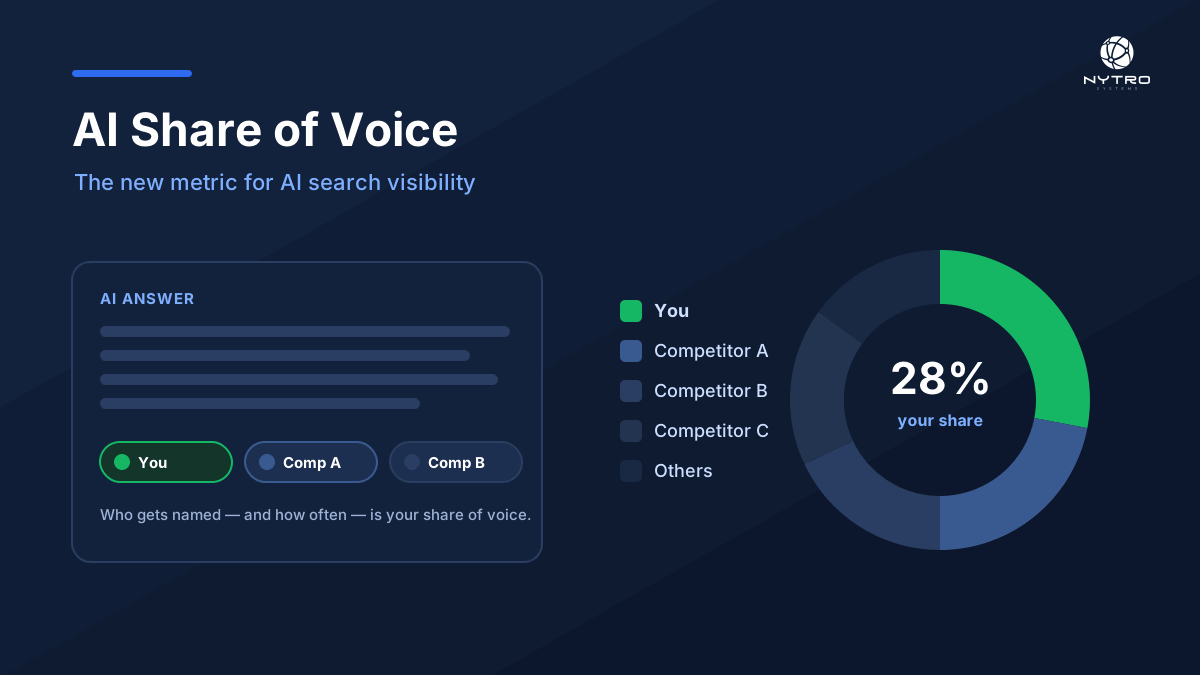
You can hold the number-one ranking for your best keyword and still be invisible where buyers now ask their questions. When someone asks ChatGPT, Perplexity, or Gemini “what’s the best tool for X,” the answer names a handful of brands — and either you are in it or you are not. AI share of voice is the metric that captures this: how often AI answers mention, cite, or recommend your brand versus competitors across the prompts your buyers actually use. It replaces single-rank thinking with a presence-across-answers view.
This guide covers what AI share of voice is, the three lenses it is measured through (share of answer, citation, and mention), how it is calculated, the tools that track it, and — most importantly — how to turn the number into action. It is grounded in how real measurement tools define and compute the metric today, including an important caveat: there is no single standard formula yet.
Lee Agam, CEO of Nytro Systems, is blunt about why this matters. Measurement, he argues, is where most brands are flying blind: they track keyword rankings that AI answers do not use, while the conversations that actually influence buyers go unmeasured. His framing is that AI share of voice finds the gap — it tells you where you are absent across real buyer prompts — but the number is only useful if it drives on-site action afterward. Measuring the gap and closing it are two different jobs, and most teams have not started either.
What Is AI Share of Voice?
AI share of voice is a measure of how prominent your brand is inside AI-generated answers, relative to competitors, across a set of representative prompts. Instead of asking “where do I rank for this keyword,” it asks “when AI answers questions in my category, how often — and how prominently — do I show up compared with everyone else?”
The shift is from a single position to a share of a conversation. In classic search, a query returns a ranked list, and you occupy one slot. In an AI answer, the engine synthesizes a response that may name several brands, cite a few sources, and recommend one or two. AI share of voice quantifies your slice of that synthesized output across many prompts and, increasingly, across many engines. It is the measurement counterpart to AI Search optimization and Answer Engine Optimization: those disciplines try to get you into the answer; AI share of voice tells you whether it is working.
One caveat belongs up front, because it is easy to get wrong: there is not yet a single standard definition. As we will see, different tools compute AI share of voice differently — some from mentions alone, some by weighting mentions and citations together. That makes the metric genuinely useful for tracking your own trend over time, but risky to compare across tools at face value. The number is a compass for your own progress, not a leaderboard position you can quote against a rival who measured it with a different instrument.
Three Lenses: Share of Answer, Citation, and Mention
AI share of voice is best understood through three lenses, because “showing up” in an AI answer can mean three different things.
The first is share of mention: how often your brand is named in the answer text at all, relative to all brands named. This is the most common basis for the metric. Peec AI, for example, defines share of voice purely on mentions — “the percentage of your brand mentions in AI responses compared with all brands mentioned, including yours.” The second is share of citation: how often your pages are the linked, cited sources behind the answer, as opposed to merely being named. Citations are a stronger signal than a mention because they indicate the engine drew on your content directly. The third is share of answer: whether and how prominently you appear in the answer overall — presence and position, not just a raw count.
These lenses are not interchangeable, and the better tools keep them distinct. Profound’s Answer Engine Insights, for instance, reports a visibility score and share of voice alongside separate mention counts and a “Citation Authority” view of which sites influence answers about your brand. Reading all three together is what makes AI share of voice actionable: a brand can be mentioned often but rarely cited (people talk about you, but your own pages are not the source), or cited well but mentioned narrowly (you own a few queries and are absent elsewhere). The lens you optimize decides the work you do next.
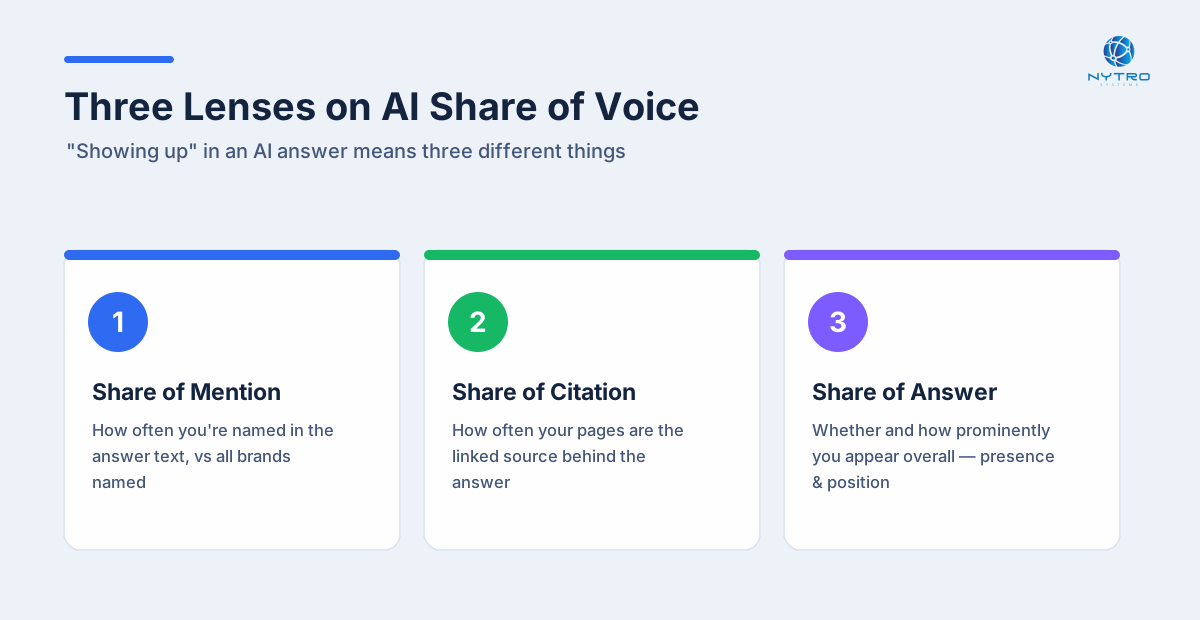
AI share of voice through three lenses — mention, citation, and answer presence — each pointing at different optimization work.
How AI Share of Voice Is Calculated
The most transparent calculation is the mention-based one. Peec AI states it directly: SoV equals the number of times your brand was mentioned divided by the total number of brand mentions across all tracked brands, multiplied by 100. In their example, a brand mentioned 4 times against a competitor’s 12 has a 25% share of voice. It is simple, intuitive, and easy to track over time.
Other tools weight the components. Quattr, for example, combines citations and mentions into a single AI share of voice figure, weighting citations at 1.25 and mentions at 1.0 to form an “AI answer presence score,” then expressing your weighted total as a share of the weighted total across the tracked competitor set. Quattr also notes that an older, position-weighted “Share of Answers” variant exists but is deprecated — a useful reminder that even a single vendor’s definition evolves.
Two things follow for anyone trying to optimize website for AI search using this metric. First, the denominator is always a tracked set, not the whole world: AI share of voice reflects your prompt basket and your competitor list, which is a sample, not a census. Untracked competitors and untracked prompts simply do not appear. Second, because the weights and bases differ, you should compare AI share of voice to your own history within one tool, not across tools. The trend is the signal; the absolute number is tool-specific.
Tools That Measure AI Share of Voice
Three tools illustrate the current range, from a free one-time check to enterprise monitoring. Each is described here from its own documentation.
HubSpot’s AI Search Grader is a free, one-time AEO brand check across ChatGPT, Perplexity, and Gemini that returns a score out of 100. Share of Voice is one of its five scored dimensions — worth up to 10 points and defined as where your brand ranks against competitors in AI responses — alongside sentiment, presence quality, brand recognition, and market competition. It is a fast way to get a baseline; ongoing prompt-level tracking is a separate paid HubSpot product. Profound’s Answer Engine Insights is a monitoring platform that reports a visibility score and share of voice (“how often you appear in AI answers”), plus mentions, Citation Authority, sentiment, a FactCheck for inaccurate claims, and competitive benchmarking across a broad set of engines including ChatGPT, Perplexity, Claude, Copilot, Google AI Overviews and AI Mode, Gemini, Grok, and DeepSeek. Peec AI focuses on brand metrics with its clean, mention-based share-of-voice formula described above, making its methodology easy to explain to stakeholders.
The practical point is not which tool is best but that the number is only as good as its inputs: the prompts you track and the competitors you list. A thoughtful prompt basket — the questions your buyers actually ask — matters more than the dashboard. Choose prompts that reflect real buying intent, keep the competitor set honest, and the metric becomes a reliable gauge of your AI Search Ranking over time.
Turning AI Share of Voice Into Action
A metric that does not change what you do is a vanity number. The value of AI share of voice is that it localizes the gap: it tells you which prompts you are absent from, which competitors own them, and whether the problem is mention, citation, or presence. That maps to a measure-then-optimize loop.
The loop is straightforward. Define the prompts that matter and the competitors to track. Measure your share across them. Read the three lenses to diagnose the gap — absent entirely, mentioned but not cited, or cited narrowly. Then do the on-site work that closes it: the answer-ready content and credible, extractable pages that earn a place in the answer. Then measure again. The score is the scoreboard; the optimization is the game. Brands that stop at measuring — that buy a dashboard and admire the gap — see nothing change, because the number only moves when the underlying content does.
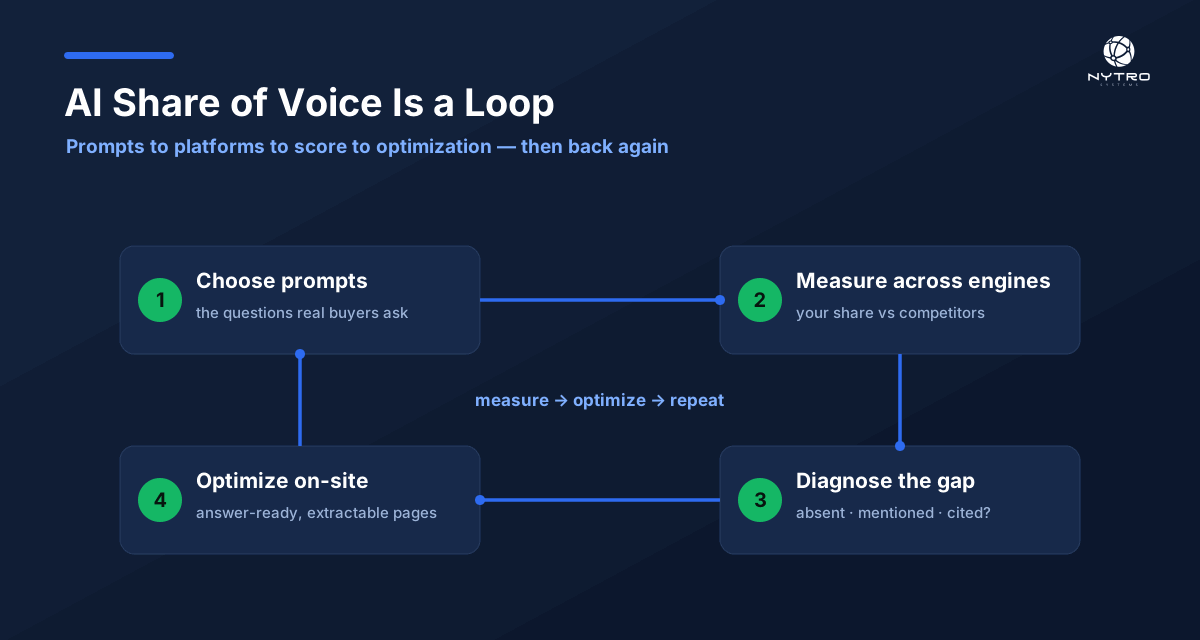
AI share of voice is a loop, not a report: prompts to platforms to score to optimization, then back again.
AI Share of Voice vs Classic Rank Tracking
It is worth being precise about why rank tracking alone no longer suffices. A keyword rank describes one position in one ranked list for one query. An AI answer is a synthesized response that may name several brands and cite a few sources, and the user may never see a ranked list at all. Measuring your rank tells you nothing about whether you appear in that synthesized answer.
AI share of voice does not replace Search Engine Optimization measurement — rankings and traffic still matter where classic search drives value. It adds the layer that classic metrics miss: presence across AI answers. The two are complementary. Rankings tell you how you do in the blue-link world; AI share of voice tells you how you do in the answer world, which is increasingly where consideration happens. Measuring only the first, in 2026, is measuring half the field.
Common AI Share of Voice Mistakes
The metric is easy to misread, and a few mistakes recur often enough to call out. The first is comparing the number across tools. Because Peec AI computes share of voice from mentions alone while Quattr weights citations and mentions together, two dashboards can report very different figures for the same brand on the same day, and neither is wrong — they are measuring different things. Treat AI share of voice as a within-tool trend line, not a universal score.
The second mistake is tracking a weak prompt basket. AI share of voice only reflects the prompts and competitors you choose, so a basket stuffed with branded or low-intent queries will flatter you while hiding the questions that actually decide deals. The honest version is to track the questions a real buyer asks before choosing, including the unflattering ones where you are currently absent. The third is treating the number as the destination. A dashboard that shows a 12% share and nothing else is a measurement, not a result; the point is to diagnose why — mention, citation, or presence — and act.
A fourth, subtler mistake is reading a single snapshot as a verdict. AI answers vary between runs and shift as models and indexes update, so one measurement is noisy. The signal is the trend across repeated measurement, which is also why the measure-then-optimize loop matters more than any one report. A single low reading might reflect a model update that week as much as a real gap in your content, and a single high one can evaporate just as fast; only the direction over several measurements is trustworthy enough to plan around. Used this way — within one tool, against honest prompts, as a trend that drives on-site work — AI share of voice becomes a reliable gauge rather than a vanity figure.
Where NytroSEO Fits
Measurement finds the gap; closing it is on-site optimization work. Once AI share of voice shows where you are absent, the task is to make your pages the kind of clear, consistent, answer-ready sources that engines are willing to name and cite — across a whole site, not one page at a time.
That is where NytroSEO fits as the optimization layer. Its Automatic SEO engine automatically generates and maintains optimized page titles and meta descriptions across an entire site, so the metadata that answer engines rely on to understand and summarize each page stays consistent and current — the groundwork that helps pages be understood, surfaced, and ultimately named in answers. For the content side of closing the gap, our Ask Engine Optimization guide covers the answer-ready formatting that wins mentions and citations, our overview of getting AI-search-ready covers the metadata and structure AI retrieval depends on, and our LLM SEO strategies guide bridges classic ranking work into AI retrieval.
Want to find your AI share of voice gap and build the plan to close it? Book a free strategy session, or sign up free and explore the NytroSEO system.