Last updated: November 7, 2026
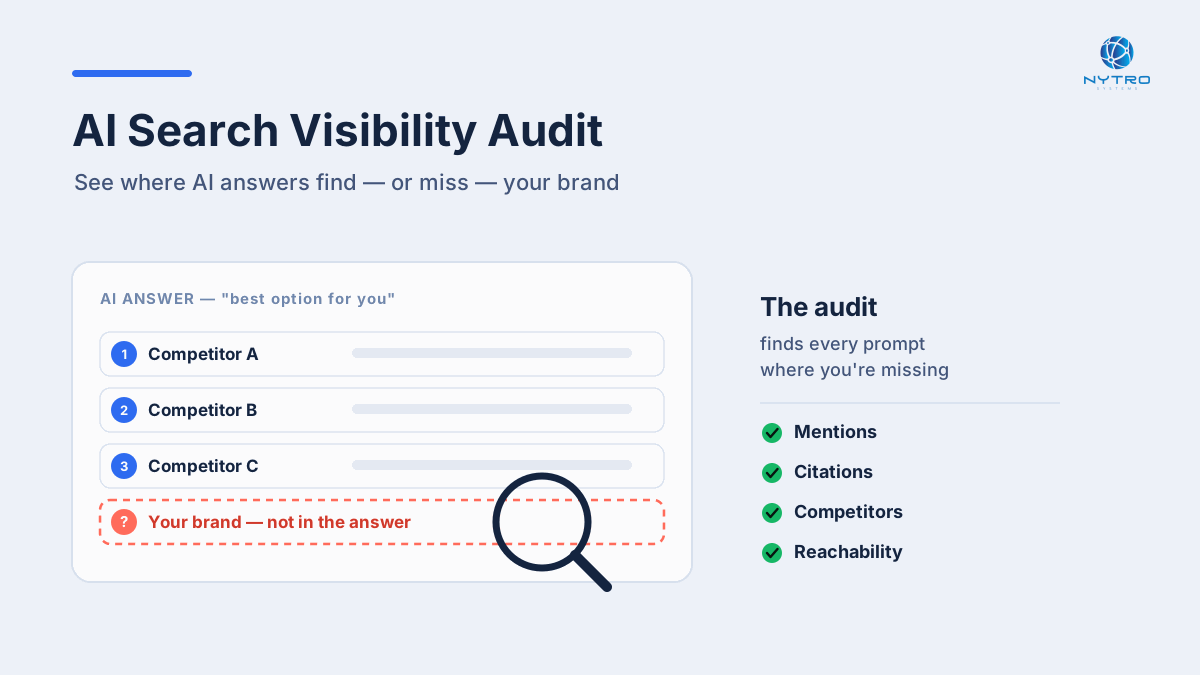
Ask ChatGPT a question your best customer would ask — “what’s the best [your category] for [their need]?” — and look at the answer. Is your brand in it? For a growing share of businesses, the honest answer is no, and they have no idea, because nobody has measured it. An AI search visibility audit fixes that: it is a structured check of whether, where, and how AI tools surface your brand across the questions your buyers actually ask. You cannot fix what you have not measured, and the audit is how you measure.
This is a practical framework, not a theory piece. It covers what an AI search visibility audit is, why it matters, a six-step process you can run yourself, the tools that speed it up, how to turn the findings into an action plan, and how often to repeat it. The methodology draws on how established tools structure the same work, adapted into a sequence any team can follow.
Lee Agam, CEO of Nytro Systems, sees the audit as the honest starting point for any AI-search program. Most companies, he notes, are optimizing in the dark — guessing at their AI presence instead of testing it against the real prompts buyers use. His framing is simple: an AI search visibility audit turns a vague worry (“are we showing up in AI answers?”) into a specific, prioritized list of gaps, and only once you have that list can you decide what to fix first. The audit exposes the gaps; the work afterward closes them.
What Is an AI Search Visibility Audit?
An AI search visibility audit is a systematic assessment of how AI answer engines represent your brand across a defined set of prompts and competitors. Instead of checking a single keyword ranking, it asks a broader question: when AI tools answer the questions that matter in your market, do they mention you, cite your pages, recommend you — and how do you compare with competitors?
A complete audit looks at several things together: whether you appear at all across representative prompts, whether AI tools cite your own pages as sources or only name you in passing, how accurately and favorably they describe you, which competitors show up where you do not, and whether your pages are even reachable and structured well enough to be used. It is the diagnostic front end of AI Search optimization and Answer Engine Optimization — the measurement step that tells you where to point the optimization work.
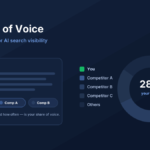
It is worth being clear about what the audit is and is not. It is a point-in-time diagnostic that produces a prioritized gap list. It is not the same as ongoing citation monitoring, which tracks the same signals continuously over time, nor is it the single metric of AI share of voice, which is one of the numbers an audit collects. The audit is the structured once-through that gives you the full picture before you commit to a plan.
Why Run an AI Search Visibility Audit?
The case is straightforward: buyer behavior has moved, and classic metrics do not see the move. When someone asks an AI assistant for a recommendation, they may never see a ranked list of blue links, so your keyword position says nothing about whether you were in the answer. If AI tools consistently name competitors and omit you, you are losing consideration before a prospect ever reaches your site — silently, with no line on a dashboard to warn you.
An AI search visibility audit makes that invisible loss visible. It answers concrete questions a leadership team can act on: Which high-intent questions in our category do AI tools answer without us? Which competitors own those answers, and why — better content, more citations, stronger third-party presence? Where are we described inaccurately, which is its own risk? And which of our pages are strong enough to be cited but are not being, versus pages that are not reachable or clear enough to use at all?
The result reframes a data gap as an opportunity list. Each prompt where you are absent is a specific, addressable target for AI Search Ranking work, not a vague sense of falling behind. That is why the audit works so well as the first step: it converts anxiety into a plan.
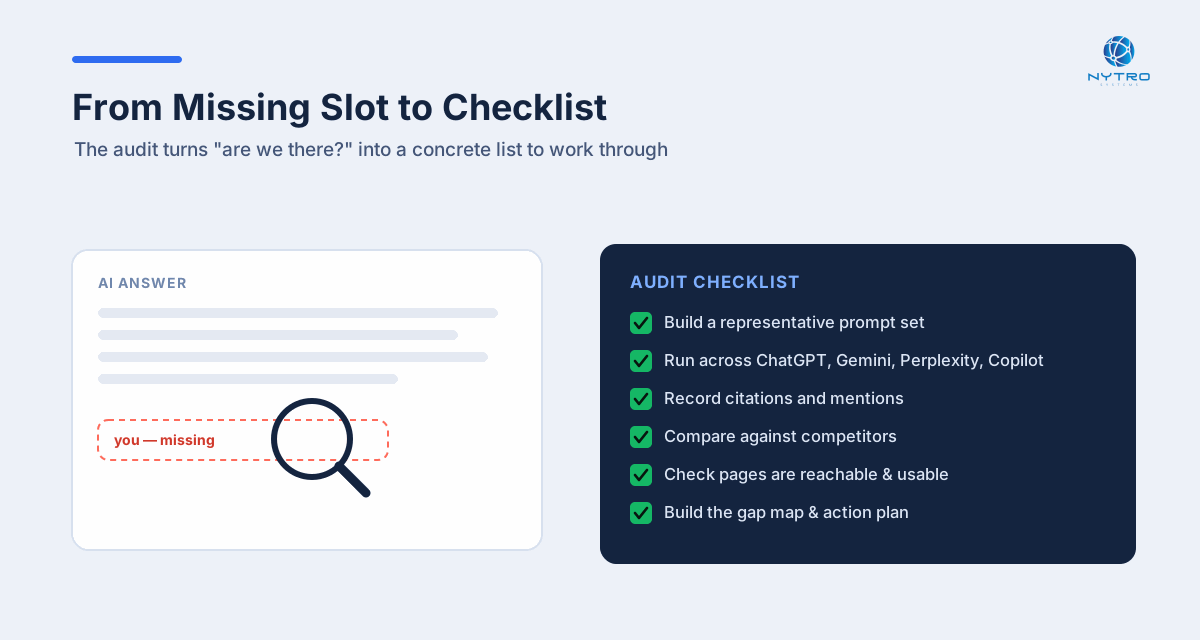
An AI search visibility audit reveals exactly where your brand is missing from AI answers — and gives you a checklist to close the gap.
The 6-Step AI Search Visibility Audit Framework
The audit breaks into six steps. Run them in order; each feeds the next.
Step 1 — Build a representative prompt set
List the real questions your buyers ask before choosing — category comparisons (“best X for Y”), problem-framed queries, and brand and competitor questions. Include the unflattering ones where you suspect you are absent. A strong prompt set reflects genuine buying intent, not a wish list of queries you would like to win.
Step 2 — Run the prompts across the major AI platforms
Ask each prompt on the engines your audience uses — ChatGPT, Gemini, Perplexity, and Copilot at minimum, and Claude and Grok where relevant. Record the full answer each time. Because AI answers vary between runs, note that you are taking a representative sample, not a single definitive verdict.
Step 3 — Record citations and mentions
For each answer, log whether your brand is named (a mention), whether your pages are the linked sources (a citation), and how prominently you appear. Do the same for competitors. This is the raw data behind your AI share of voice — which Ahrefs defines simply as how often your brand is mentioned in AI responses compared to competitors — and it is the backbone of the whole audit.
Step 4 — Compare against competitors
Map who shows up where you do not. For the prompts you lose, look at which competitors win and what the AI draws on to name them — their own pages, third-party reviews, or community sources. The pattern usually points straight at the work required.
Step 5 — Check that your pages are reachable and usable
A page cannot be cited if the engine cannot reach or parse it. Confirm your important pages allow the relevant AI crawlers (through robots.txt and any firewall rules), are indexable, and lead with clear, self-contained answers an engine can lift. This is the technical half that prompt-only audits miss, and it is often the cheapest gap to close.
Step 6 — Build the gap map and action plan
Turn the findings into a prioritized list: the high-intent prompts where you are absent, the competitors to displace, the pages to improve or create, and any inaccuracies to correct. Rank by intent and effort so the first fixes are the ones most likely to move real consideration.
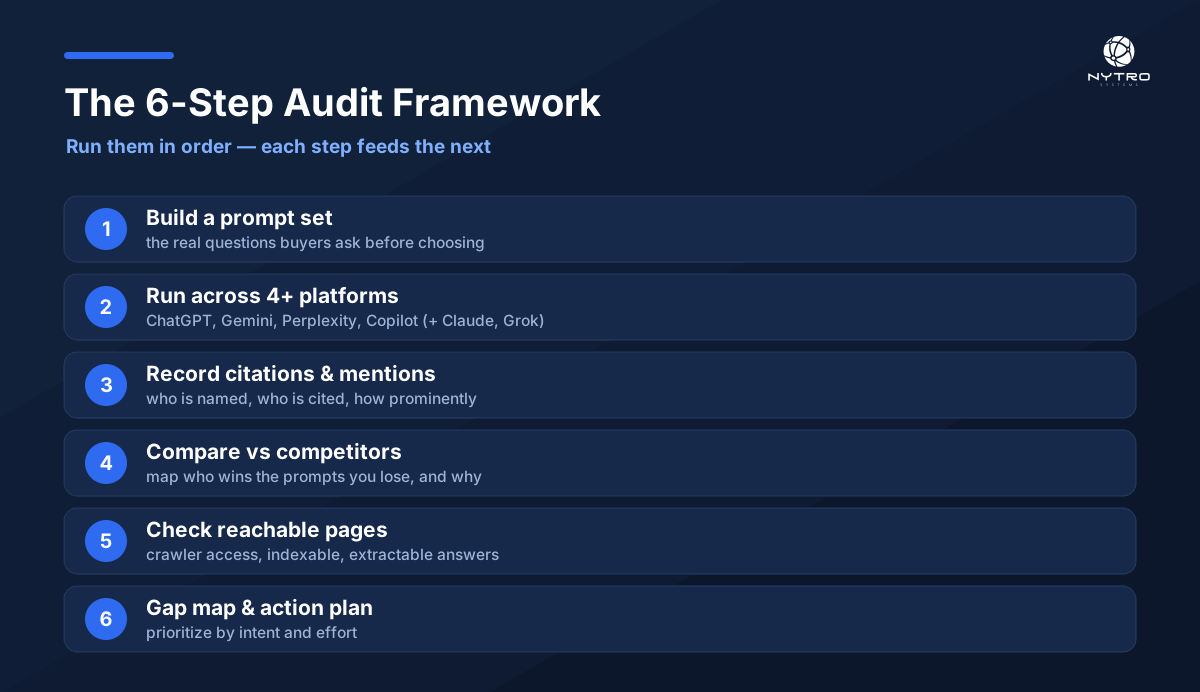
The six-step AI search visibility audit framework — from a representative prompt set to a prioritized action plan.
Tools That Speed Up an AI Search Visibility Audit
You can run a first audit entirely by hand, and for a small prompt set that is a reasonable start. Tools help when you want scale, consistency, and repeatability.
For a fast baseline, HubSpot’s free AI Search Grader runs a one-time check across ChatGPT, Perplexity, and Gemini and returns a score that includes a share-of-voice dimension — a quick way to see roughly where you stand before a deeper audit. For ongoing, structured measurement, platforms such as Profound’s Answer Engine Insights report visibility, share of voice, mentions, and which sources influence answers about your brand across a wide set of engines. And a general AEO reference such as Ahrefs’ AI visibility audit guide is useful for structuring the prompt-to-strategy workflow and defining the metrics consistently.
The tool matters less than the inputs. Whether you work by hand or with a platform, the quality of an AI search visibility audit comes down to an honest prompt set and an honest competitor list. A tool makes the work faster and more repeatable; it does not replace the judgment about which questions actually decide deals.
Turning Your AI Search Visibility Audit Into an Action Plan
A gap map is only valuable if it changes what you do next. The move from audit to action follows the gaps directly. Where you are absent from high-intent prompts, the work is answer-ready content that earns a place in the answer — clear, credible, extractable pages on exactly those questions. Where competitors are cited and you are not, the work is improving the pages that should be cited and, where relevant, earning presence on the third-party sources AI tools trust. Where you are described inaccurately, the work is correcting the record at the source. And where pages are unreachable or unclear, the work is the technical fix that makes them usable in the first place.
The discipline is to rank by impact. Not every gap is worth closing immediately; the ones tied to real buying intent come first. This is also where a point-in-time audit hands off to ongoing optimization — you fix the priority gaps, then re-measure to confirm the work moved the needle. The audit is the diagnosis; the plan is the treatment; and the only proof is a later measurement showing the gap has closed.
How Often to Repeat the AI Search Visibility Audit
AI answers shift as models update and competitors publish, so a single audit is a snapshot, not a settled score. Treat the full AI search visibility audit as something to repeat on a cadence — many teams run it quarterly, with a lighter monthly spot-check on the highest-value prompts. The trend across repeated audits is more informative than any single run, because it shows whether your optimization work is actually gaining ground.
Between full audits, the lighter check is enough: re-run your top handful of buying-intent prompts, confirm you are holding or gaining, and watch for inaccuracies creeping in. The goal is to make sure that when you optimize website for AI search, you can see the result rather than assume it.
What an AI Search Visibility Audit Can and Can’t Tell You
An AI search visibility audit is powerful, but reading it well means knowing its limits. The most important one is that AI answers are not deterministic. Ask the same question twice and you may get two different answers, with different brands named and different sources cited. That is why a responsible audit treats each prompt as a sample rather than a single verdict, and why running a prompt a few times beats trusting one response. A single screenshot showing you absent is a data point, not a conclusion.
The second limit is scope. An audit only sees the prompts and competitors you chose to include, so it reflects your judgment about what matters, not an objective census of your whole market. If your prompt set misses the questions that actually drive deals, the audit will look reassuring while the real gaps go unmeasured. This cuts the other way too: a deliberately broad set can surface opportunities you did not know existed. The quality of the audit is set before you run it, in the prompt list.
The third limit is that an audit diagnoses, it does not fix. It will tell you that competitors own a high-intent question and that your relevant page is thin or unreachable, but closing that gap is separate content and technical work. Used with those limits in mind, the audit is exactly what it should be: an honest, prioritized map of where to aim — the starting point for AI Search optimization, not the finish line. Knowing what it cannot do is what keeps the findings credible when you take them to a leadership team or use them to justify where the next quarter’s effort should go.
Where NytroSEO Fits
An audit’s value is realized only when the gaps get closed — and many of them come down to the same root cause across a whole site: pages that are not clear, consistent, or well-described enough for engines to understand and cite. At scale, the metadata that answer engines rely on drifts, and inconsistent titles and descriptions quietly cost visibility even where the content is strong.
That is the gap NytroSEO is built to close. Its Automatic SEO engine automatically generates and maintains optimized page titles and meta descriptions across an entire site, so the metadata answer engines use to interpret and summarize each page stays consistent and current without manual rework — the on-site groundwork behind many of the gaps an audit surfaces. For the content side, our Ask Engine Optimization guide covers the answer-ready formatting that wins mentions and citations, our overview of getting AI-search-ready covers the metadata and structure AI retrieval depends on, and our LLM SEO strategies guide bridges classic Search Engine Optimization into AI retrieval.
Already run an audit, or want help running one? Book a free strategy session — bring your audit results and leave with an automation plan — or sign up free and explore the NytroSEO system.