Last updated: September 17, 2026
FAQ schema best practices changed on 7 May 2026, when Google stopped showing FAQ rich results in Search for every website. The expandable question-and-answer dropdown that made FAQPage markup the easiest win in SEO for two years is gone, and with it the reason most sites added the markup in the first place. What remains is more useful than it sounds: FAQPage is still a valid schema.org type, Google says unused structured data does no harm, and the discipline that makes FAQ markup honest, visible questions with concise self-contained answers, is exactly what earns citations in AI Overviews, AI Mode and third-party assistants. This guide explains what changed, what FAQ schema still does, how to implement it correctly from visible content, and how to automate it across a large site without recreating the abuse that killed the rich result.
Search Engine Journal reported the deprecation from a notice Google added to its FAQ structured data documentation: FAQ rich results stopped appearing in Google Search on 7 May 2026; the FAQ search appearance, the rich result report and support in the Rich Results Test were dropped in June 2026; and support in the Search Console API is being removed in August 2026. Google published no blog post explaining the decision, and the same notice confirmed that sites do not need to remove existing FAQPage markup because unused structured data does not cause problems for Search.
If you would rather have FAQ markup generated from your visible questions and kept consistent automatically, sign up for free and NytroSEO will show you which pages already carry question-and-answer content it can mark up.
The history explains the present. FAQ rich results launched in 2019, and within months marketers were bolting generic question blocks onto pages that did not need them to claim more space in the results. In August 2023 Google restricted the rich result to well-known, authoritative government and health websites and retired HowTo rich results in the same move. The May 2026 change closed the door for everyone. Any guide that still tells you to add FAQ markup to win a dropdown is describing a feature that no longer exists.
Lee Agam, founder and CEO of NytroSEO, sees the deprecation as a correction that helps serious sites. In his view the rich result rewarded the wrong behaviour: it paid for the presence of markup rather than the quality of the answer, so pages filled up with questions nobody asked and the structured-data layer of the web became less trustworthy. The signal that now matters, he argues, is the one the rich result was always a proxy for: a visible question a real person types, followed by a complete answer in a few sentences, on a page that is about that topic. FAQPage markup is the machine-readable mirror of that structure, cheap to generate and harmless if unused, and his rule for clients is simple: if the question and answer would not be on the page without the schema, do not add the schema.
What is FAQ schema markup and why is it important?
FAQ schema markup is structured data, usually a JSON-LD block, that uses the schema.org FAQPage type to describe a page containing questions and their official answers. Each visible question becomes a Question entity with an acceptedAnswer, so machines can read which passage answers which question without parsing the page layout. It applies where the site owner provides one authoritative answer per question; forum-style pages with many user answers use the separate QAPage type.
Why it still matters after May 2026 comes down to three things, and it is worth being exact about each.
First, the visible content it describes is the part that earns AI citations. Question-shaped headings with 40 to 60-word answers that read correctly out of context are the unit AI Overviews, AI Mode, ChatGPT, Perplexity, Gemini and Copilot extract. Google’s own guidance for generative AI features on Search says no special markup is required; the structure of the visible page is what counts. FAQ discipline produces that structure whether or not the schema is present.
Second, the markup is a clean, predictable, machine-readable version of the same structure. JSON-LD is designed for machines, and schema.org types are parsed by crawlers beyond Google. Several practitioners report that non-Google engines and assistants make use of it; those engines have not documented how, so treat that as plausible rather than proven. What is documented is that Google does not penalise valid, unused structured data.
Third, on large sites the markup enforces consistency. A FAQPage block generated from visible headings and answers is a specification: it fails validation when the visible content drifts, which makes it a useful monitor for the question-and-answer sections that matter most.
What it no longer does is produce any visible feature in Google Search results. Any faq schema seo advice that promises a dropdown, extra pixels or a click-through lift from the markup itself is out of date.
FAQ schema best practices that still matter
The practices below survive the deprecation because they were never really about the rich result; they were about honest, useful question-and-answer content that machines can read. Follow them in this order.
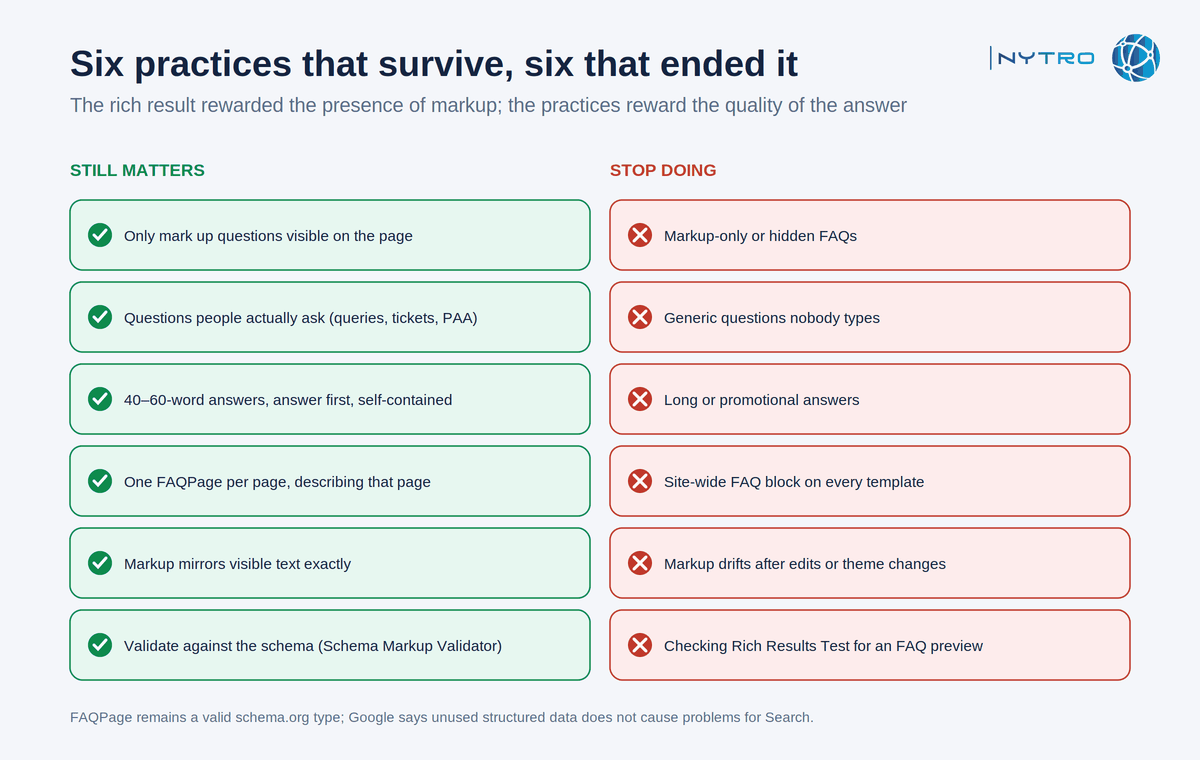
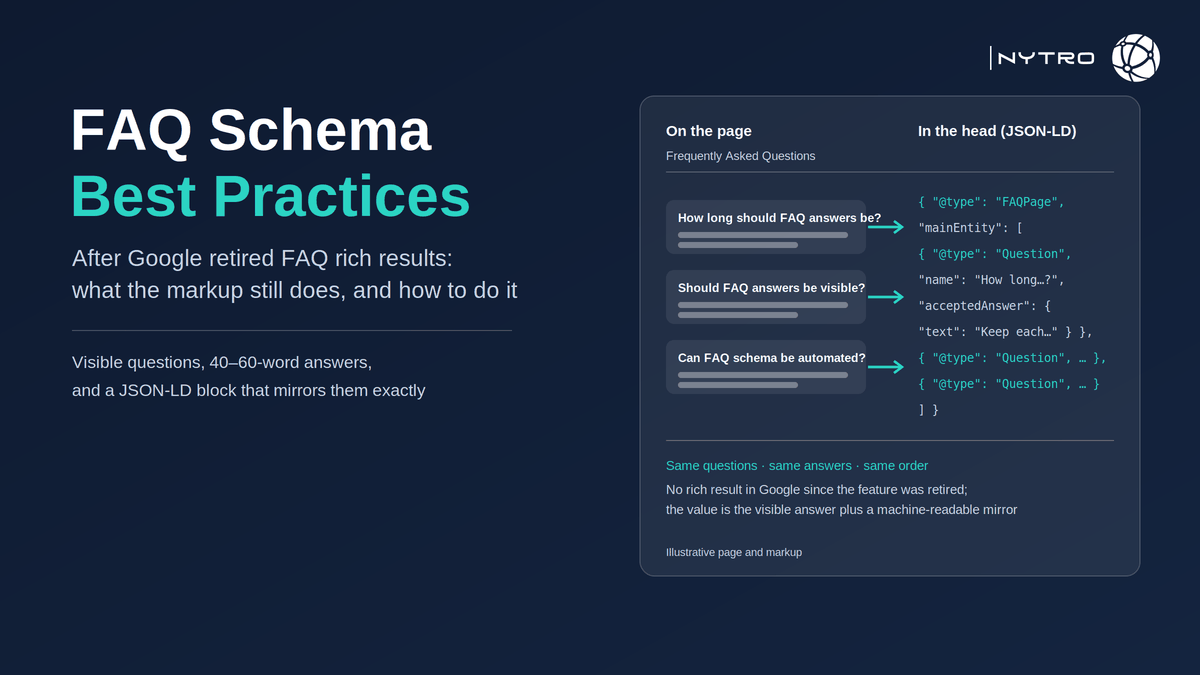
The card above pairs each surviving practice with the abuse it prevents; the rest of this section explains each.
- Only mark up questions and answers that are visible on the page. Structured data must reflect content users can see. Hidden or markup-only FAQs violate Google’s structured data guidelines and give AI systems no page text to verify against.
- Use questions people actually ask. Pull them from Search Console queries, support tickets, sales calls and the “People also ask” and AI Mode follow-ups for the topic. A question nobody types earns nothing.
- Answer in 40 to 60 words, completely, in the first sentence. Lead with the answer, then qualify. The answer should stand alone if lifted out of the page, because that is how it will be used.
- One FAQPage per page, describing that page’s questions. Do not repeat the same questions across many pages, and do not put a site-wide FAQ block on every template; duplicated question sets across a site are the pattern that made the markup look like spam.
- Match the markup to the visible text exactly. Same question wording, same answer wording, same order. Any edit to the visible FAQ has to flow into the JSON-LD, which is an argument for generating the markup from the page rather than maintaining it separately.
- Keep it non-promotional. A question whose answer is an advertisement is not an FAQ. Google’s guidelines exclude promotional content from FAQPage, and readers and models both discount it.
Two things to stop doing: stop checking the Rich Results Test for an FAQ preview, because the FAQ result has been removed from it; validate against the schema instead. And stop treating the markup as the goal. If the visible FAQ is good, the markup is a five-minute mirror of it; if the visible FAQ is bad, the markup makes nothing better.
How to implement faq schema: a JSON-LD walkthrough
The implementation has not changed; what has changed is where you validate it and what you expect from it.
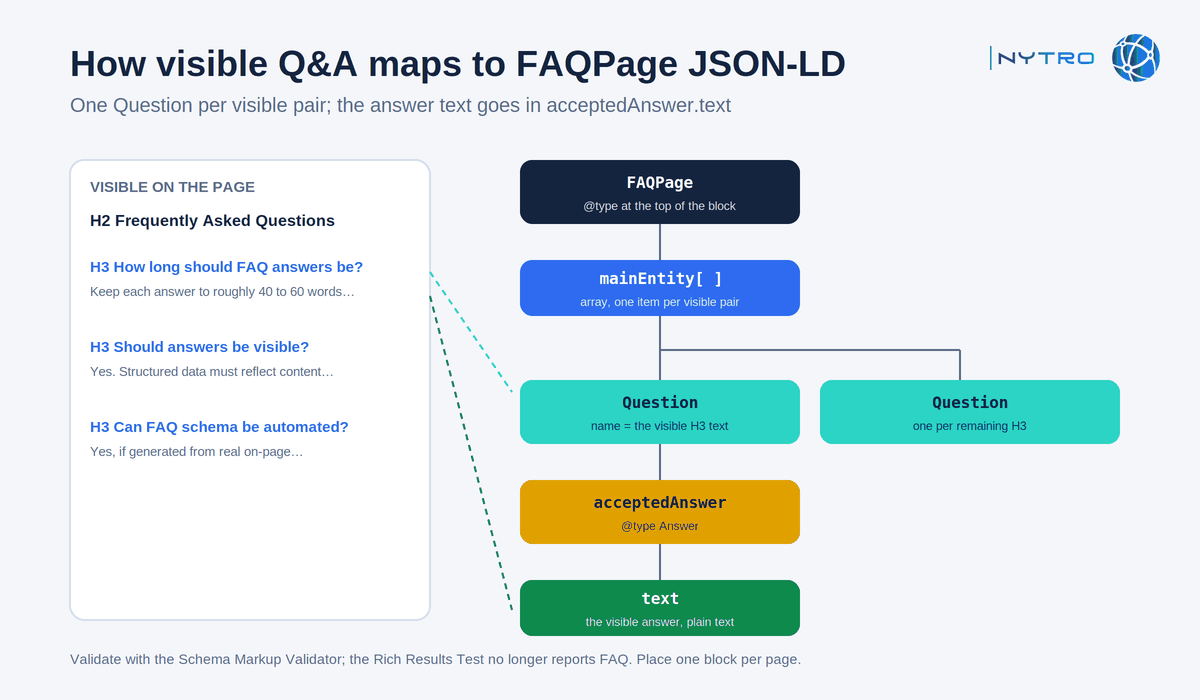
The diagram above maps the visible Q&A to the JSON-LD structure; the steps below produce it.
Step 1: Write the visible FAQ section. Three to seven questions, each as an H3 under a “Frequently Asked Questions” H2, each followed by its answer as a plain paragraph of 40 to 60 words.
Step 2: Build the JSON-LD. One FAQPage entity with a mainEntity array; one Question per visible pair, with the question text in name and the answer text in acceptedAnswer.text. Plain text in the answer, no HTML beyond simple formatting.
Step 3: Place it. A script tag of type application/ld+json in the head or the body, once per page. Server-rendered is simplest; injected by a header snippet is also read by Google, which renders JavaScript, as long as it appears once and does not duplicate a server-side block.
Step 4: Validate against the schema. Use the Schema Markup Validator, which checks schema.org validity, rather than the Rich Results Test, which no longer reports FAQ. Confirm every Question in the markup has a visible twin on the page.
Step 5: Re-check after edits. Any change to the visible FAQ, and any theme or plugin update, should trigger a re-validation, because drift between page and markup is the failure mode that goes unnoticed.
For WordPress, most SEO plugins and block editors expose an FAQ block that writes the JSON-LD from the visible block. For Shopify and no-code builders, a theme section or a header snippet generating the block from the page’s visible question headings is the usual route. Our guide to how structured data works covers the general placement rules, and our explainer on how to optimize content for questions covers the research side.
FAQ schema examples for blogs, product pages and local pages
Three short faq schema examples show how the same structure adapts to different page types. In each case the questions are ones a visitor to that page would ask, and each is visible on the page.
A blog article about crawl budget carries five questions in its FAQ section: what crawl budget is, whether it matters for small sites, how to check it in Search Console, whether AI crawlers consume it, and the fastest fix. The JSON-LD lists the same five in the same order with the same 40 to 60-word answers. Nothing about the product; everything about the topic.
A product page for a bicycle helmet carries three: how sizing works, what the return window is, and whether the model meets a named safety standard. These are pre-purchase questions the page already answers in prose; the markup mirrors them. The product’s price, availability and reviews belong in Product schema, not in the FAQ.
A location page for a clinic carries four: opening hours, parking, whether appointments are needed, and which insurers are accepted. The NAP and geo details belong in LocalBusiness schema; the FAQ covers the practical questions people ask before visiting. Our guide to adding LocalBusiness schema for multiple locations covers the entity side.
In all three, the test is the same: remove the schema and the page still answers the questions; remove the visible questions and the schema would be lying. If a page fails that test, fix the page before touching the markup, because no amount of valid JSON-LD makes an absent answer appear.
Automating faq schema best practices across a large site
On a site with thousands of pages, the honest way to add schema faq markup is to generate it from content that already exists rather than to invent questions to fill a template. That means a rule, not a form.
The rule detects question-shaped headings and the paragraph that follows each one, builds the FAQPage block from those pairs, scopes the rule by sitemap so it only touches pages that actually have question-and-answer sections, validates the output, and re-generates when the page changes. Pages without visible questions get nothing, which is the correct outcome. Duplicated questions across many pages are flagged rather than marked up, because they are a content problem first.
This is the approach NytroSEO takes through its header snippet: structured data generated from visible page fields, applied at load, scoped by sitemap, logged and reversible. It does not write the questions or the answers, and it does not add FAQ markup to pages that have no FAQ. What it prevents is the drift and duplication that turn a good FAQ section into invalid or misleading markup six months later. Our guide to getting AI-search ready with metadata and structured data sets the FAQ layer in the wider context, and our overview of Ask Engine Optimization explains why the question-and-answer format matters for conversational search regardless of markup. Book a strategy meeting with the NytroSEO team if you want the rule configured across a large site or a client portfolio.
FAQ schema best practices for sites that already have markup
- Export any remaining FAQ rich result data from Search Console before the API support ends, as a historical baseline.
- Update QA checklists that used the Rich Results Test as an FAQ preview; validate against the schema instead.
- Audit for site-wide or templated FAQ blocks that repeat the same questions; remove the duplicates or make them page-specific.
- Keep valid markup that mirrors visible questions; there is no benefit in ripping it out and no harm in leaving it.
- Redirect the effort the rich result used to justify into the visible answers themselves: shorter, clearer, in the first sentence.
Frequently Asked Questions
Not as a rich result. Google stopped showing FAQ rich results for all sites on 7 May 2026 and removed the related Search Console report and Rich Results Test support in June 2026. FAQPage remains a valid schema.org type, Google says unused structured data does no harm, and the visible question-and-answer structure it describes is what AI systems extract.
Add a JSON-LD script block containing a FAQPage entity with one Question and acceptedAnswer per visible question-and-answer pair. Place it once in the page head or body, make sure the same questions and answers appear on the page, and validate it in the Schema Markup Validator, since the Rich Results Test no longer reports FAQ.
Yes. Structured data must reflect content users can see. Hidden or markup-only FAQs violate Google’s structured data guidelines and give AI systems no page text to verify against. Show each question and answer in the page body and mirror it exactly in the JSON-LD, in the same wording and order.
Keep each answer to roughly 40 to 60 words: a complete, self-contained statement that reads correctly when lifted out of context. That length matches how AI systems extract passages and keeps the markup consistent with a concise on-page answer that a reader can absorb quickly.
Yes, if it is generated from real on-page questions and answers. Automation should detect question-style headings, build the FAQPage JSON-LD per page, scope it by sitemap, re-validate when content changes, and skip pages with no visible FAQ. It should flag duplicated or promotional questions rather than mark them up.
Ready to apply faq schema best practices without the rich result?
The dropdown is gone; the value of a clear question answered in the first sentence is not. Sign up for free to have NytroSEO generate FAQPage markup from the questions already visible on your pages and keep it consistent as they change, or book a strategy meeting if you manage a large site or a client portfolio and want the FAQ layer audited as one project.