Last updated: September 12, 2026
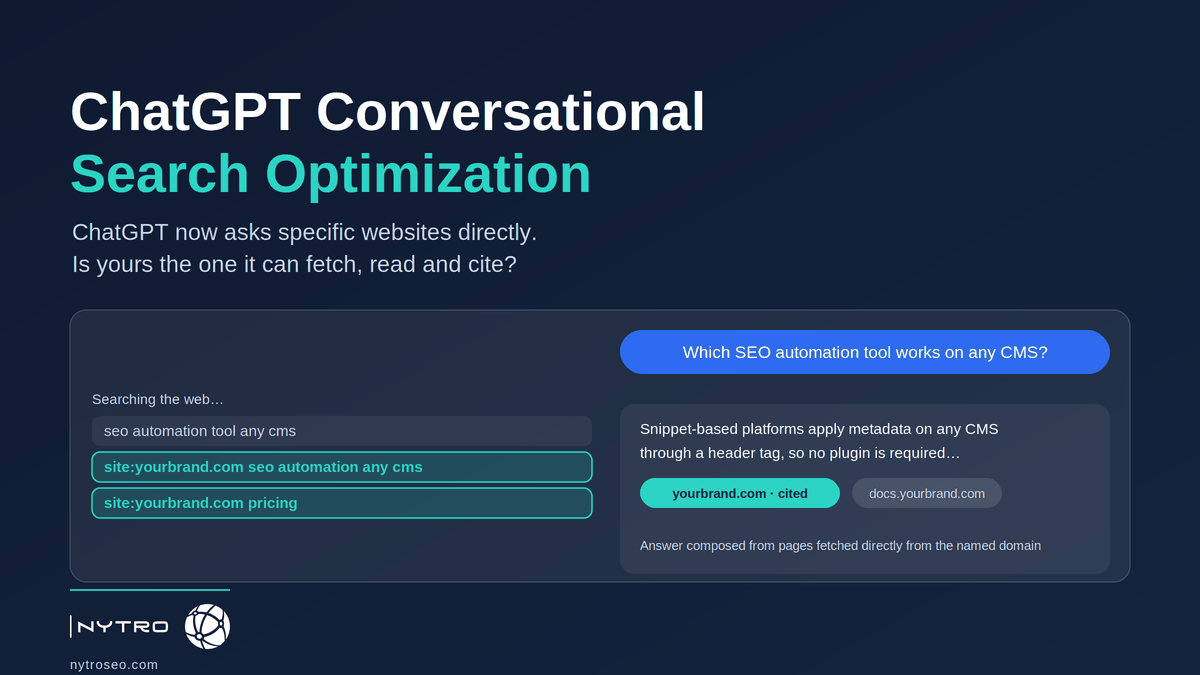
ChatGPT Conversational search optimization is the work of making your own website the page ChatGPT retrieves and cites when someone asks it a question, follows up, and asks again. In the second week of August 2026 that work changed shape. ChatGPT Search began scoping a large share of its background searches to individual domains instead of searching the open web, and within days the sources it cited shifted from forums and directories toward official brand sites, documentation and institutions. This article sets out what the tracking data shows, why your own domain has become the retrieval surface, and the six site-level fixes that decide whether ChatGPT can ask your site directly and get a usable answer.
Promptwatch’s citation tracking recorded the change in two parts: on 8 August the share of ChatGPT’s fan-out queries using the site: operator jumped from about 0.37 per cent to 16.8 per cent in a single day, roughly a 46-fold increase, and the average number of searches ChatGPT runs per response nearly doubled from about 1.08 to 1.83. Six days later Reddit, one of the most cited domains in ChatGPT Search for two years, saw its share of citations fall from a 3.83 per cent average to 0.52 per cent, an 86.4 per cent relative drop. Promptwatch itself notes that a data-collection issue cannot be ruled out and treats the size of the drop as provisional; the direction and timing are corroborated by several independent trackers.
If you want the on-page side of that handled automatically, sign up for free and NytroSEO will keep the titles, descriptions and structured data ChatGPT reads consistent across every page it might be sent to.
The reason this matters beyond one platform’s fortunes is mechanical. A site: query does not ask “what does the web say about X”; it asks “what does this specific site say about X”. A model that increasingly asks the second question will surface official sources and structurally under-sample sprawling discussion platforms. Your pages are no longer competing only to rank in an open search; they are being interrogated directly, and either they answer well or ChatGPT moves on.
Lee Agam, founder and CEO of NytroSEO, reads the August shift as the moment conversational search stopped being a distribution channel you influence indirectly and became one you host. In his experience, teams had been treating Reddit threads and review sites as a shortcut to AI visibility, because that was where the citations were; the shortcut has now closed, and the retrieval surface has moved to the one place a business controls completely. His priority order for clients is deliberately unglamorous: first make sure OpenAI’s crawlers can fetch every page that matters, then make sure each page carries one clear, extractable answer, and only then worry about tone, brand voice or third-party presence. A page that cannot be fetched cannot be asked, and a page that can be fetched but buries its answer will lose to a competitor’s page that does not.
What is ChatGPT conversational search optimization?
ChatGPT Conversational search optimization is the practice of structuring a website so that ChatGPT can retrieve, understand and cite its pages during multi-turn conversations, where each follow-up question triggers new background searches. It differs from classic search optimization in three ways. The unit of retrieval is a passage, not a page. The query is generated by the model from the conversation, not typed by a person, so it is often longer and more specific. And the output is a synthesised answer with citations, so being retrieved and being cited are separate outcomes that need separate measurement.
The term overlaps with what some practitioners call OpenAI Conversational search optimization or, more broadly, AI Conversational search readiness. Whatever the label, the mechanics are the same: ChatGPT decomposes a prompt into one or more web searches, fetches candidate pages, extracts the passages that answer the sub-questions, and composes a response that cites some of those pages. Optimising for it means intervening at each stage: access for the fetch, structure for the extraction, and authority signals for the citation decision.
What changed in ChatGPT Search in August 2026
The change had a visible shape. According to the Search Engine Journal analysis of the Promptwatch data, ChatGPT started scoping more of its background searches to individual domains on 8 August, that share has stayed at roughly 16 to 17 per cent of fan-out queries since, and Reddit’s citation share did not collapse until 14 August, six days later. Search Engine Journal’s point is a fair one: the site: operator change explains part of the story, and the six-day gap means it does not explain all of it. A robots.txt block was suggested as a mechanism around 20 August; Promptwatch has not confirmed a single cause.
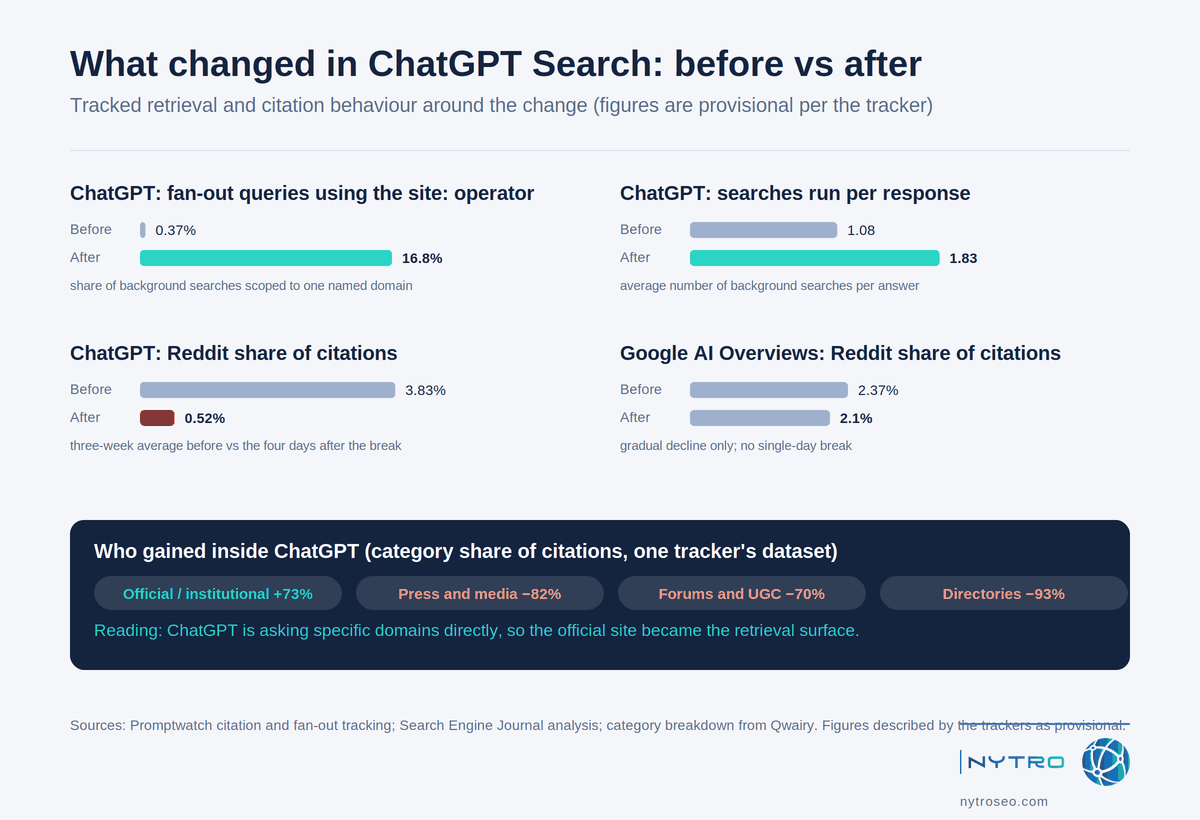
The chart above summarises the tracked shifts before and after the change; the figures are from Promptwatch and are described by the tracker as provisional.
Three details from the data change what you should do:
- The shift is specific to ChatGPT. Over the same window Promptwatch measured only a gradual decline in Reddit citations in Google AI Overviews, about 11 per cent, and roughly 30 per cent in Google AI Mode, with no single-day cliff in either. Google’s systems did not make the same change.
- Reading and citing are different. Trackers observed that Reddit continued to be fetched heavily while vanishing from citations. A fetched-but-uncited page is a silent source: it may still shape the answer, but it earns no link and no mention.
- The winners were official sources. Qwairy’s category breakdown of the same period reported that, within ChatGPT, press and media lost about 82 per cent of citation share, forums and user-generated content about 70 per cent, and business directories about 93 per cent, while institutional and official sources gained about 73 per cent. Qwairy also noted the timing matches an OpenAI model rollout announced on 6 August; that link is plausible but not confirmed by OpenAI.
Forbes’ coverage made the practical implication explicit: the question for brands has shifted from how to get cited on Reddit to whether their own site is crawlable enough to be asked directly.
Why your own domain became the surface for ChatGPT Conversational search optimization
When ChatGPT sends a query scoped to your domain, three things have to be true for you to be cited. OpenAI’s crawlers must be able to fetch the page. The page must contain a passage that answers the sub-question in a form the model can lift out. And the page must carry enough authority signals for the model to prefer it over other candidates it fetched at the same time. Each is a site-level property you control, and each fails silently.
The first failure is the most common. Sites that blocked GPTBot in 2024 and 2025 to prevent training have, in many cases, also blocked OAI-SearchBot, the crawler that feeds ChatGPT Search, or blocked ChatGPT-User, the fetch a live conversation makes. Our guide to allowing AI crawlers while blocking AI training in robots.txt sets out how to separate the two, and the same logic applies to CDN and bot-management rules. If your logs show no OAI-SearchBot activity, ChatGPT cannot ask you anything.
The second failure is structural. A site: query returns pages, but ChatGPT cites passages. A 3,000-word page that answers the question in paragraph fourteen, after a preamble and a history section, is a weaker candidate than a 600-word page that answers in sentence one. This is the same extractability principle our guide to ranking on ChatGPT and getting your brand cited is built on, and the August change raised its weight: the model is now asking your site directly and will take the first clean answer it finds.
The third failure is entity confusion. When ChatGPT scopes a query to a domain, it has already decided that domain is the authority for the topic. Inconsistent naming, missing Organization and Person markup, or product names that differ between pages make it harder for the model to connect the page it fetched to the brand it intends to cite. Our guide to entity-based AI SEO covers how to make the brand legible to a model that is trying to name it.
A ChatGPT Conversational search optimization checklist for your site
The checklist below is ordered by the sequence ChatGPT follows: fetch, extract, cite. Do the items in order; a strong answer block on a page OAI-SearchBot cannot reach is wasted work.
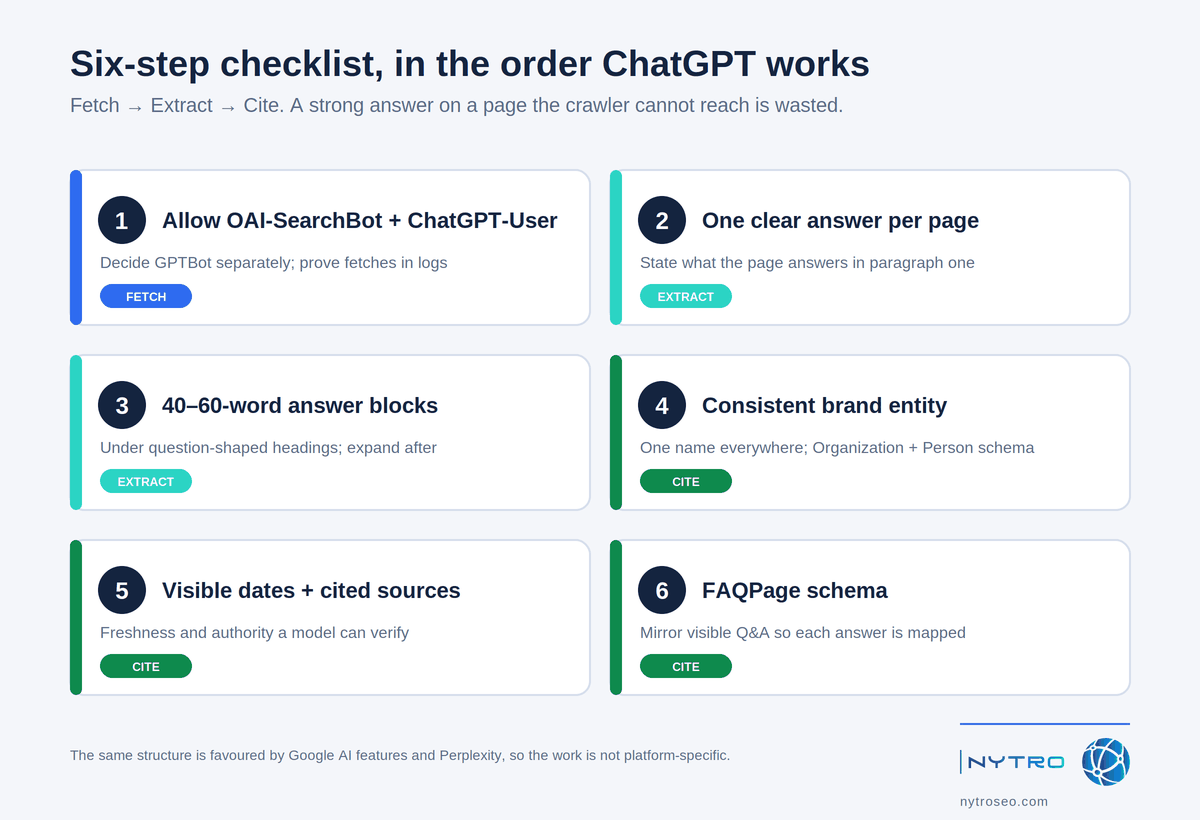
The six steps above follow the order in which ChatGPT fetches, extracts and cites; each is expanded below.
1. Allow OAI-SearchBot and ChatGPT-User, then prove it in the logs
Check robots.txt, CDN bot rules and any bot-management defaults for OAI-SearchBot and ChatGPT-User. Decide about GPTBot separately, because it is the training crawler. Then confirm in your server or CDN logs that the search and user-fetch agents are actually retrieving pages; a rule that looks correct but is overridden at the CDN produces the same silence as a block.
2. One clear answer per page, in the first paragraph
Every page that matters should open with a direct statement of what it answers, in plain language, before any context. If the page covers three questions, split it or add clear question-shaped headings so each section can be lifted independently.
3. Write 40 to 60-word answer blocks under question headings
Under each question-shaped heading, lead with a self-contained answer of roughly 40 to 60 words that reads correctly out of context, then expand. This is the unit ChatGPT extracts, and it is the same unit Google’s AI features and Perplexity favour, so the work is not platform-specific.
4. Make the brand entity consistent
Use one canonical brand name and one product name everywhere. Add Organization and Person structured data with sameAs links to verified profiles. Make sure the author of each page is named and connected to the organisation.
5. Show visible dates and cite your sources
Put a visible published or updated date on every page and cite the primary sources for any figure you use. Trackers repeatedly observe that dated, sourced pages are cited more readily, and a model interrogating a domain directly has no other way to judge freshness.
6. Add FAQ structured data that mirrors visible questions
Mark up visible question-and-answer pairs with FAQPage schema. It does not produce rich results in Google for most sites any more, but it gives every AI system a clean map of which passage answers which question.
Steps 4 and 6, and the metadata that supports steps 2 and 3, are the kind of work that drifts on a large site: a theme update rewrites a title, a plugin regenerates a description, and the page ChatGPT was cited from last month is not the page it fetches this month. Book a strategy meeting with the NytroSEO team if you manage a large site or a client portfolio and want that layer applied by rule and monitored, rather than maintained by hand.
Measuring chat gpt citations and chat gpt brand mentions
Nothing in Search Console tells you whether ChatGPT cites you, so measurement has to be built. The method we use, and describe in our guide to measuring AI search visibility, is a fixed prompt panel: twenty buyer questions, run monthly in ChatGPT with search enabled, recording for each whether the brand was cited with a link, mentioned without a link, or absent. Keep the question set fixed so the month-to-month comparison is valid.
Separate the two outcomes, because they drive different behaviour. Chat gpt citations link to a page and can send a visit; chat gpt brand mentions name the company inside the answer without a link and shape the shortlist the user carries into their next query. In a multi-turn conversation the mention often matters more than the link, because the follow-up question is frequently “tell me more about [brand]”, and that follow-up triggers a site: query aimed at you.
Cross-check the panel against your logs. OAI-SearchBot requests to a page you were cited from confirm the fetch; ChatGPT-User requests show a live conversation reaching you. If the logs show fetches but the panel shows no citations, the page is being read and not chosen, which points to steps 2 through 5 above. If the logs show nothing, it is step 1.
Finally, keep a portfolio view. The August change was ChatGPT-specific; Google’s AI features, Perplexity, Gemini and Copilot each select sources differently. A site that optimises only for ChatGPT’s current retrieval behaviour is exposed to the next unannounced change, and the trackers who documented this one point out that Reddit’s visibility dipped and recovered once before, in September 2025. The durable strategy is a site that any engine can fetch, extract from and attribute, which is what the six steps produce.
Frequently Asked Questions
It is the practice of structuring your website so ChatGPT can retrieve, understand and cite your pages during multi-turn conversations. It combines crawler access for OAI-SearchBot and ChatGPT-User, clear self-contained answer passages, consistent brand entity signals and visible freshness so ChatGPT selects your page as a source when it interrogates your domain.
Promptwatch recorded Reddit’s share of ChatGPT Search citations falling from 3.83 per cent to 0.52 per cent between 8 and 17 August 2026. The reported mechanism is a change in ChatGPT’s query fan-out toward site:-scoped searches, with official brand and institutional sources gaining share. Promptwatch and Search Engine Journal both note that the exact cause is not fully explained and the figures are provisional.
More often than before. Trackers reported that ChatGPT Search increased its use of the site: operator in fan-out queries from under 0.5 per cent to roughly 17 to 24 per cent of queries in August 2026, depending on the dataset. That means your own domain is queried directly more often, so crawler access, indexable pages and clear answer blocks have a larger effect on whether you are cited.
Run a fixed panel of twenty buyer questions in ChatGPT with search enabled each month and record citations and brand mentions separately. Cross-check OAI-SearchBot and ChatGPT-User requests in your server or CDN logs to confirm ChatGPT is fetching the pages; fetches without citations point to page structure, no fetches point to access.
They are different signals. A citation links to your page and can send traffic; a brand mention names you inside the answer without a link and shapes the user’s shortlist. In multi-turn conversations the mention often matters more, because the follow-up question is frequently about the named brand and triggers a search scoped to your site.
Ready to be the site ChatGPT asks directly?
ChatGPT now goes to specific domains and takes the first clean answer it finds. Making every page on your site that kind of page is rule-based work. Sign up for free to have NytroSEO apply consistent metadata and structured data across your site automatically, or book a strategy meeting if you manage a large site or a client portfolio and want the fetch, extract and cite layers checked as one project.