Last updated: October 2, 2026
To increase brand visibility in AI search is to become a brand that AI assistants name when someone asks them for a recommendation, and to be the source they cite when they explain why. That is a different objective from ranking a page, and it is decided by different evidence: how consistently the brand is described on its own site, how often and how credibly it is mentioned on the sources assistants consult, and whether the pages that carry those mentions can be fetched, read and attributed. This guide sets out why brand visibility now sits at the top of the funnel, where AI assistants look when they decide whom to name, what to fix on your own domain, a ninety-day brand visibility strategy, and how to measure mentions and citations across the assistants your buyers use.
The best evidence on what predicts AI visibility is Ahrefs’ analysis of 75,000 brands, which measured which factors correlate with a brand being mentioned in Google’s AI Overviews. Branded web mentions correlated most strongly, at 0.664; branded anchor text at 0.527; branded search volume at 0.392; traditional backlinks at 0.218; and total page count near zero. Brands in the top quartile for web mentions earned up to ten times more AI Overview mentions than the next quartile, and 26 per cent of brands studied had no AI Overview mentions at all. Ahrefs is careful to note that correlation is not causation; the pattern is nonetheless consistent across every independent study of the question.
If you want the on-site half of that pattern, consistent Organization and Person data, accurate metadata and readable about, pricing and documentation pages, kept in place automatically across every page, sign up for free and NytroSEO will start with an inventory of which pages carry them.
Two further findings frame the problem. Muck Rack’s analysis of what AI systems read found that about 95 per cent of AI citations come from unpaid sources, which puts earned presence rather than advertising at the centre of the work. And Promptwatch’s tracking of ChatGPT in August 2026 recorded a sharp shift in citation share from forums toward official brand, institutional and documentation sources after ChatGPT began scoping more of its searches to specific domains. The lesson of the two together: the sources that matter are earned and, increasingly, your own.
Lee Agam, founder and CEO of NytroSEO, describes brand visibility in AI search as a reconciliation problem before it is a marketing problem. In his experience, an assistant that has read a brand’s site, three review profiles, a podcast transcript and a partner’s case study will only name the brand confidently if those sources describe the same entity in the same terms: the same name, the same category, the same claims. Inconsistency does not produce a bad mention; it produces no mention, because the model cannot be sure the sources are about one company. His advice is to fix the official surfaces first, since they are the only sources a brand controls completely and the ones ChatGPT now queries directly, then to earn a small number of mentions on the sources an assistant would consult for the category, and only then to measure, because measuring before the entity is consistent records noise.
The importance of brand visibility when AI answers first
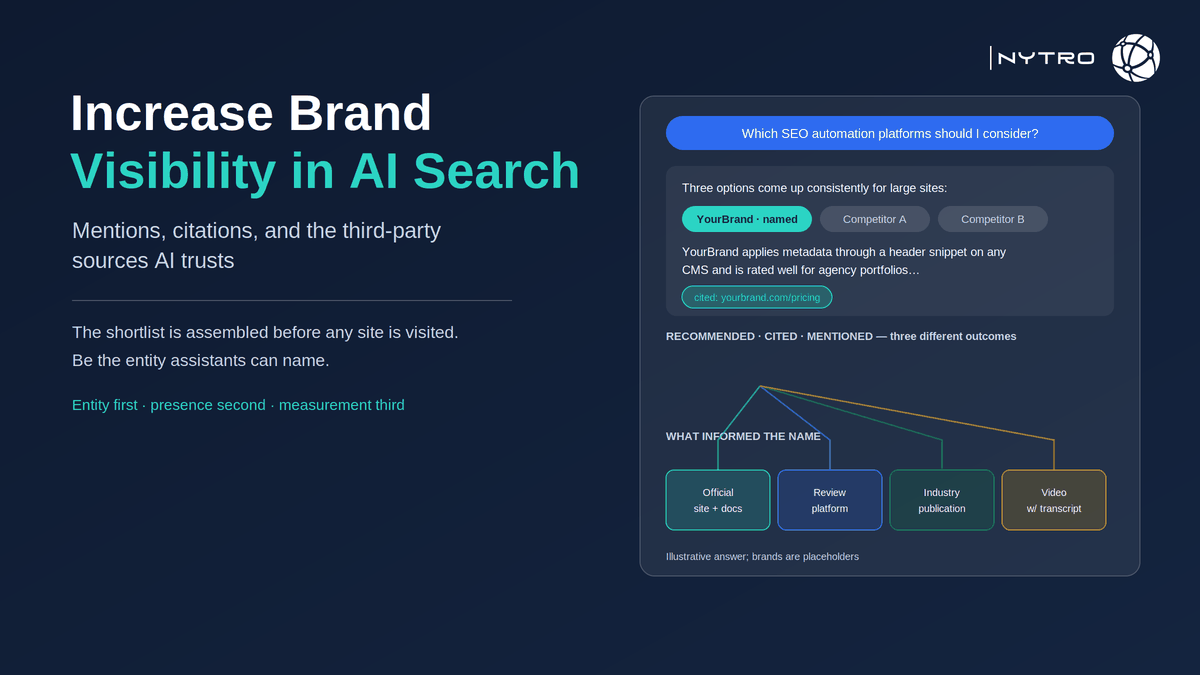
The importance of brand visibility has changed with where the buying decision is made. When a person asks an assistant which tools, providers or products are worth considering, the answer is a shortlist assembled from what the model knows and can retrieve, and the brands on it were chosen before any website was visited. A brand that is not named is not in the consideration set, however well its pages rank.
Three outcomes need separate names, because they are earned differently and measured differently.
Recommended: the brand is one of the options the assistant proposes. This depends on entity strength, how widely and consistently the brand is associated with the category across sources the model has read.
Cited: a page from the brand’s site is listed as a source for a claim in the answer. This depends on the page being fetchable, extractable and authoritative for that claim.
Mentioned: the brand is named inside the answer without a link. This is the most common outcome, and the most undervalued, because the follow-up question is frequently about the named brand and that follow-up is where the click happens.
Our overview of AI brand visibility defines the concept for Google’s surfaces, and our guide for agencies on improving AI brand visibility covers the client-management side. This guide is about the work itself.
Where AI assistants look: the third-party sources that shape mentions
Assistants assemble their picture of a brand from sources they can read, and the sources differ by platform and by category. The pattern across studies is consistent enough to plan around.
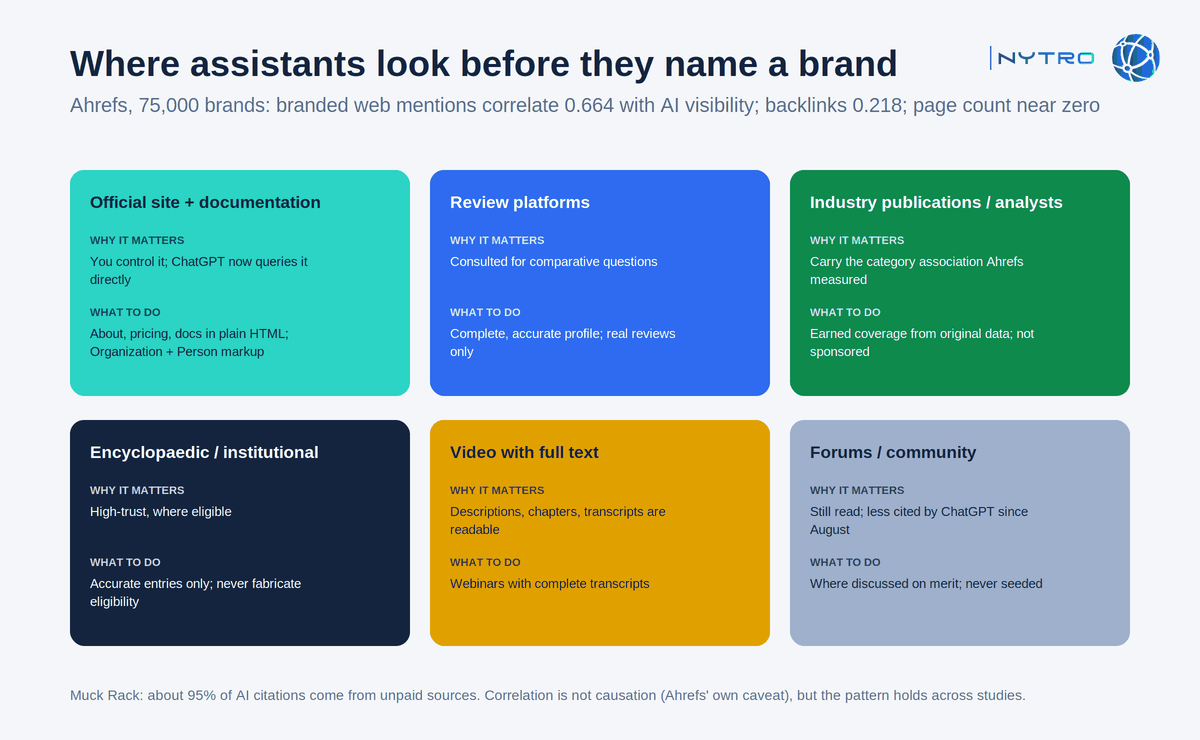
The sources above are the ones that appear repeatedly in citation studies; the weighting shifted toward official sources in 2026.
The official site and its documentation. The source a brand controls, and after August 2026 the one ChatGPT queries directly for a large share of its searches. About, pricing, product and documentation pages that state plainly what the company is, does and costs are read more often than any marketing page.
Review platforms. Category review sites and software directories are consulted for comparative questions because they describe many brands in one structure. A complete, accurate profile with real reviews is a mention on a source assistants trust.
Industry publications and analyst coverage. Editorial mentions in publications the model has read carry the category association that Ahrefs’ data measures. Muck Rack’s finding that most citations are unpaid points here: earned coverage, not sponsored placement.
Encyclopaedic and institutional references. Where a brand is eligible, an accurate encyclopaedia entry, an association listing or an academic citation is a high-trust mention. Where it is not eligible, do not fabricate one; the policies of those sources exist precisely to keep promotional entries out.
Video with full text. Video descriptions, chapters and transcripts are text an assistant can read; the video itself is not. A recorded webinar with a complete description and transcript is a mention on a source many models weight.
Forums and community discussion. Still read, still cited on some platforms, and less cited by ChatGPT since August. Useful where a brand is discussed on its merits; not a channel to manufacture.
Our guide to entity-based AI SEO covers how these sources connect into one entity a model can recognise.
Ways to increase brand visibility on your own domain
The ways to increase brand visibility that a brand fully controls are all on its own site, and they are the first month of any plan.
Make the entity unambiguous. One brand name, spelled and punctuated one way, on every page. Organization structured data on every page with the same name, URL, logo and sameAs links to the profiles a model can reconcile. Person structured data for named people connected to the Organization. Our guide to how structured data works covers the markup.
Make the official surfaces readable. An about page that says what the company is in its first sentence. A pricing page with tiers, limits and inclusions in plain HTML, not behind a form or a script. Documentation an assistant can quote. Each of these is a page ChatGPT may now query directly.
Make the claims consistent. The category you say you are in, the customers you say you serve and the outcomes you claim should match across the site and across every third-party profile you control. A model reconciling “SEO automation platform” on one page with “AI marketing suite” on another will name neither.
Publish something only you can publish. Original data from your own operations, a study, a benchmark, a first-hand test. Original findings are what earn the editorial mentions in the next section, because a publication needs a reason to name you.
Keep the layer stable. Titles, descriptions and entity markup drift on large sites, and a page that described the brand one way last month and another way this month weakens the entity. That layer is what NytroSEO keeps consistent by rule; it does not earn the mentions, and it should not be asked to.
A brand visibility strategy to increase brand visibility in the next 90 days
A brand visibility strategy runs in three months, in order, because each month’s work depends on the previous one.
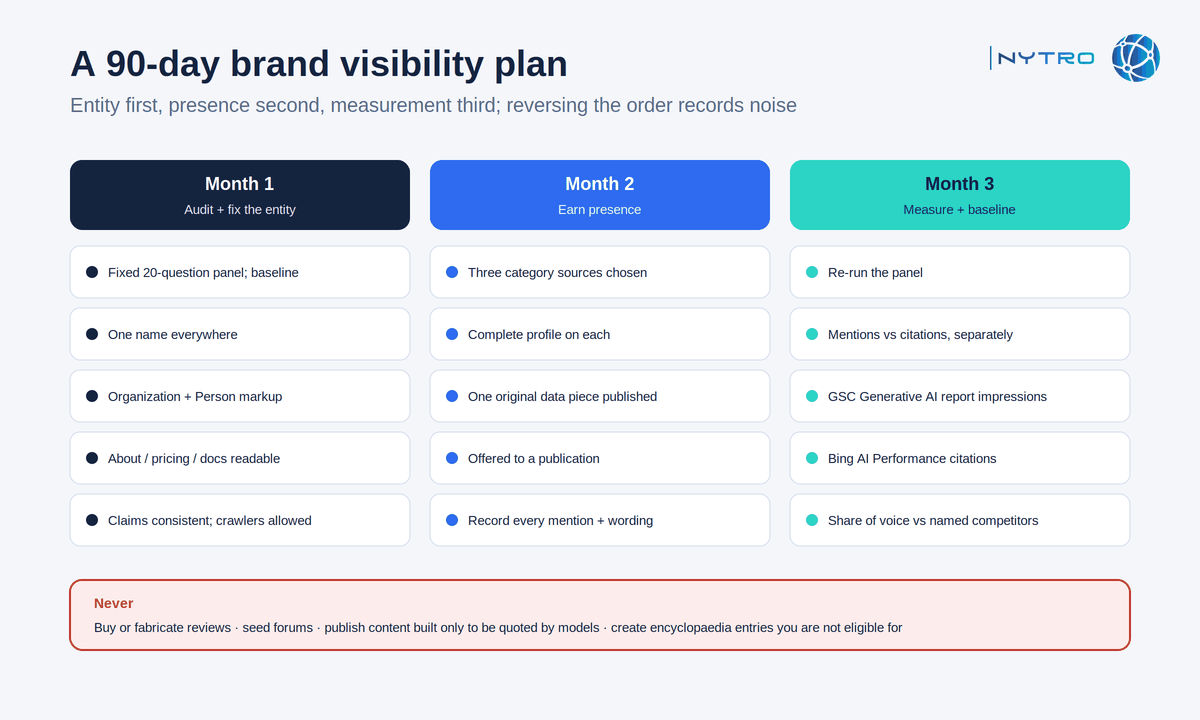
The plan above runs entity first, presence second, measurement third; reversing the order records noise.
Month one: audit and fix the entity. Run a fixed panel of twenty buyer questions across ChatGPT, Perplexity, Gemini and Copilot and record, for each, whether the brand is recommended, cited, mentioned or absent, and how it is described. Then fix the official surfaces: naming, Organization and Person markup, about, pricing and documentation pages, category and claim consistency. Confirm the site is fetchable by the search and user-fetch crawlers of each assistant.
Month two: earn presence. Choose the three third-party sources an assistant would consult for your category, typically one review platform, one industry publication and one community or association, and earn a complete, accurate presence on each. Publish one original data piece and offer it to the publication. Record every mention as it appears, with the source and the wording.
Month three: measure and set the baseline. Re-run the twenty-question panel. Compare recommended, cited, mentioned and absent counts with month one, and compare how the brand is described. Pull AI impressions per page from the Search Console Generative AI report and citations from Bing Webmaster Tools’ AI Performance report. Set the numbers as the baseline for the quarterly cycle that follows.
What not to do at any stage: buy or fabricate reviews, seed forums with promotional posts, publish content built only to be quoted by models, or create encyclopaedia entries the brand is not eligible for. Each of those is now covered by a platform policy or by Google’s spam policy on manipulating AI answers, and each produces the inconsistency that stops a model naming you.
Measuring chat gpt brand mentions and citations
Chat gpt brand mentions and citations cannot be read from any report OpenAI provides, so the measurement is built from a panel and cross-checked against logs.
The panel is twenty buyer questions, fixed for the year, run monthly in ChatGPT with search enabled, and in Perplexity, Gemini and Copilot. For each answer record four things: whether the brand is recommended, whether a brand page is cited with a link, whether the brand is mentioned without a link, and the one-line description the assistant gives. Keep the questions identical month to month so the comparison holds, and run each question fresh rather than in one long conversation, because context changes answers.
Separate mentions from citations in the record and in the report, because they move independently and mean different things. Independent trackers have found that citations without a brand mention are common, a page linked but the company never named, and that the reverse is also common. A brand that tracks only one of the two misreads its position.
Cross-check with logs and official reports. OAI-SearchBot and ChatGPT-User requests in your server or CDN logs confirm ChatGPT is fetching the pages you expect to be cited; Bing’s AI Performance report shows citations and grounding queries for Copilot; Search Console’s Generative AI report shows impressions for Google’s surfaces. Our guide to measuring AI search visibility sets out the full metric set.
Report share of voice against the two or three competitors that appear most often in the same answers, not against an industry benchmark, because platform behaviour varies widely and the only meaningful comparison is the one inside your own category. Book a strategy meeting with the NytroSEO team if you want the panel, the entity fixes and the reporting set up across a large site or a client portfolio.
The ninety-day checklist in one list
- Fixed twenty-question panel across four assistants; baseline recorded.
- One brand name everywhere; Organization and Person markup on every page; sameAs to verified profiles.
- About, pricing and documentation pages readable in plain HTML.
- Category and claims consistent across the site and every controlled profile.
- Search and user-fetch crawlers of each assistant allowed and confirmed in logs.
- Three third-party sources chosen for the category; complete presence on each.
- One original data piece published and offered to a publication.
- Panel re-run; mentions and citations recorded separately; share of voice against named competitors.