Last updated: September 15, 2026
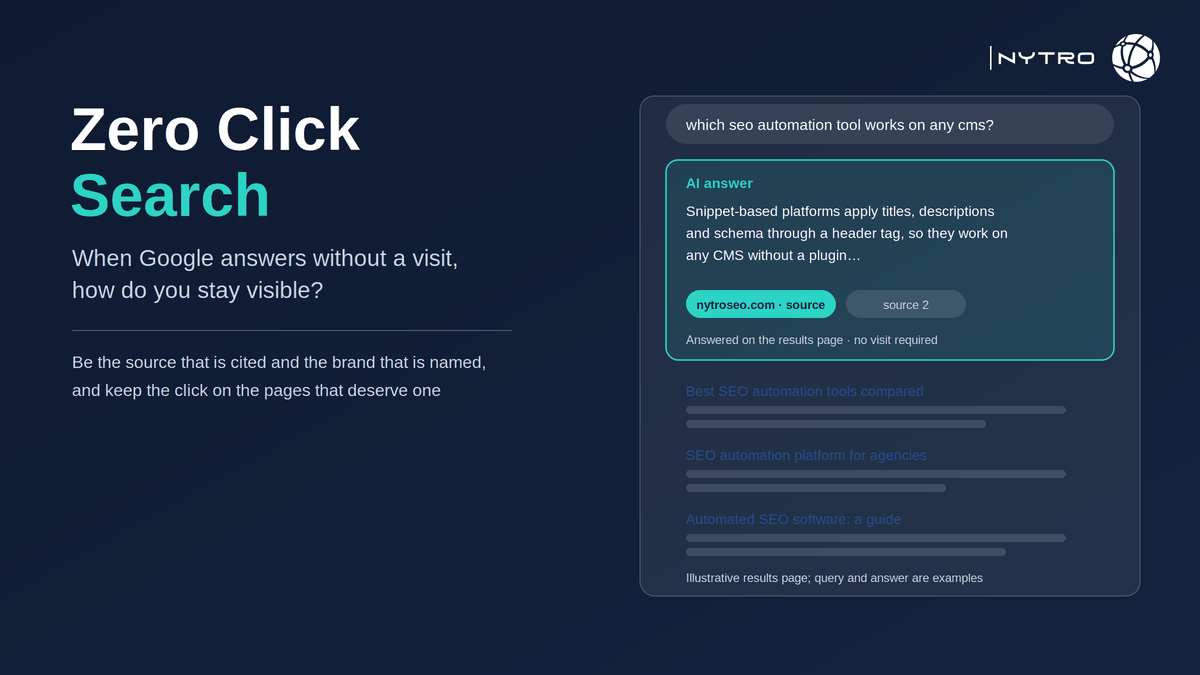
A zero click search is a query where the person gets what they need on the results page and never visits a website. Featured snippets, knowledge panels and direct answers produced it for years; AI Overviews and AI Mode now produce it at a scale that changes how visibility has to be measured. This article sets out what the best available data says about how often it happens, which kinds of pages still earn a click, why being the cited source inside the answer has become the objective, and how to build a measurement model in which the citation, the mention and the follow-up query count alongside the visit.
The clearest evidence comes from Pew Research Center’s analysis of Google users’ browsing behaviour, which tracked 900 US adults across 68,879 Google searches in March 2025. When an AI summary appeared, users clicked a traditional result link in 8 per cent of visits; without a summary they clicked in 15 per cent. Clicks on links inside the summary itself occurred in just 1 per cent of visits, and users ended their browsing session on 26 per cent of pages with a summary compared with 16 per cent without. Pew also found that, with or without AI, roughly two-thirds of all Google searches ended without any click at all.
If you would rather have the on-page work that follows from this handled automatically, sign up for free and NytroSEO will keep the titles, descriptions and structured data that decide both the citation and the remaining click aligned across every page.
The Pew figures predate the largest change. At Google I/O in May 2026, Google said AI Mode had passed one billion monthly users a year after launch, with queries more than doubling every quarter. The answer surface is now the default entry point for a large share of searches, and the Search Console Generative AI performance report, rolled out to all sites worldwide on 31 August 2026, reports impressions in those features but not clicks, which is itself a statement about what Google expects the click to mean.
Lee Agam, founder and CEO of NytroSEO, argues that the phrase “zero click” misleads teams into measuring the wrong thing. In his view the question is not whether the click disappeared but where the decision moved: when an answer engine names three brands and a buyer opens one of them in the next query, the visit still happens, it just no longer starts on your ranking. His advice to agencies is to separate pages by the job they do. Informational pages should be judged on whether they are the cited source and whether the brand is named; transactional, pricing, comparison and tool pages should still be judged on clicks, because a person who wants to buy or compare still has to arrive somewhere. Treating both with one KPI, he says, makes informational content look like a failure and hides the pages that are actually losing the clicks they should keep.
What is zero click search?
Zero click search describes any query that ends on the results page. The searcher reads an answer, a definition, a fact, a set of hours, a price, a comparison or a recommendation, and either stops or types a new query. In Google, the features that produce it are AI Overviews, AI Mode, featured snippets, knowledge panels, direct answers such as weather and conversions, and increasingly the follow-up questions inside AI Mode, where an entire session can run without a single outbound link.
Three properties distinguish it from a simple lost click. The searcher’s need was met, so the result page did its job. The source that met it is usually named, so a brand can be present without being visited. And the query that follows often carries the brand the answer named, so the click may arrive later under a different keyword. Zero click search results are not empty of value; they redistribute it to whoever is cited and named.
How big zero click traffic loss really is
Pew’s numbers are the most rigorous published measurement and they are worth reading precisely. The 8 per cent versus 15 per cent comparison is the click rate on traditional results with and without a summary present; the study reports an association, not a proof that the summary alone caused the difference, and the sample is US adults in a single month. Two further findings matter for planning. AI summaries were triggered by 18 per cent of searches overall in that period, but by 60 per cent of question-style searches beginning with who, what, when or why, and by 53 per cent of searches of ten or more words. The queries most likely to produce a zero click result are the informational, conversational ones, which is where most content marketing lives.
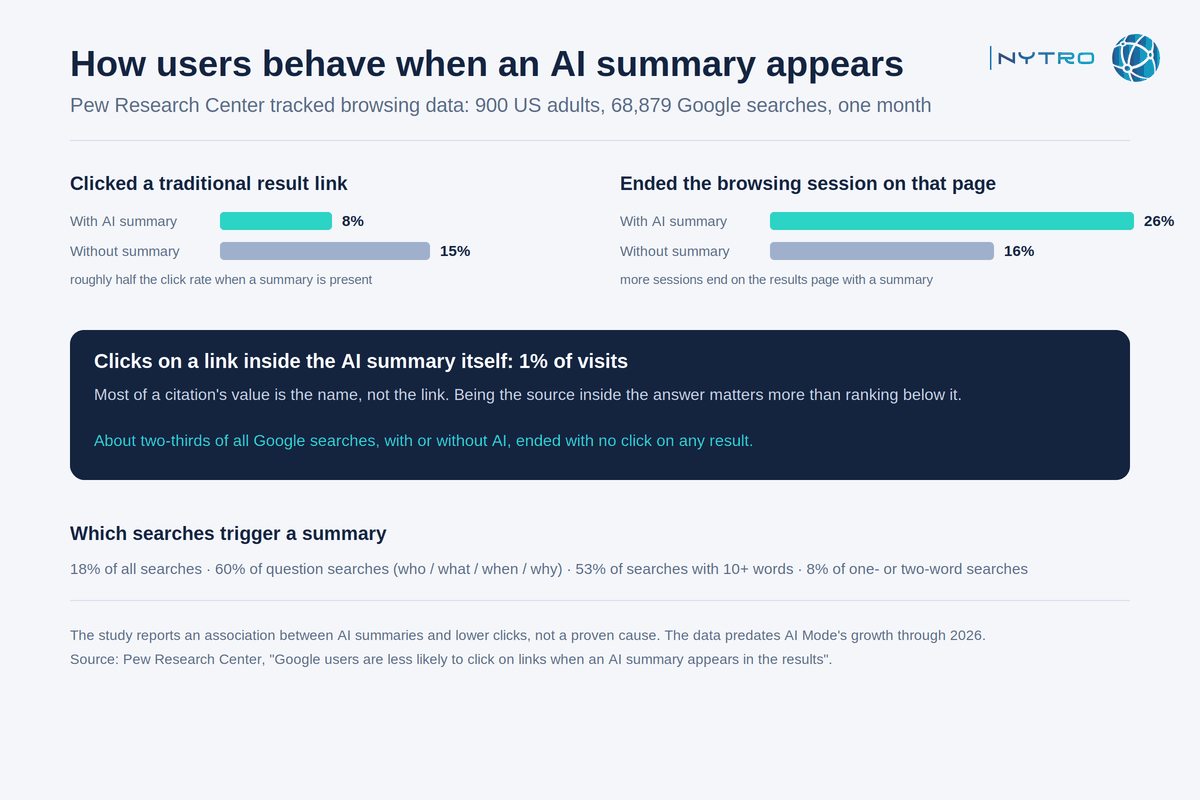
The chart above shows the Pew comparison; the gap on traditional-result clicks is the loss most sites feel, and the 1 per cent click rate inside the summary is why being the cited source matters more than the link.
Two caveats keep the picture honest. First, the Pew data was collected before AI Mode’s growth through 2026, so the share of searches that end on the page is likely higher now than the study recorded, but no equally rigorous public measurement of the current figure exists. Second, the study measured Google only; ChatGPT, Perplexity, Gemini and Copilot answer questions with their own citation behaviour, and none of them reports clicks to site owners at all. Anything beyond Pew’s measured figures is an estimate. Industry claims that a specific overall percentage of Google searches are now zero click vary widely by methodology and should be labelled as estimates when repeated. What is not an estimate is direction: AI Overviews reach billions of users, AI Mode is past a billion monthly users, both are growing, and Google’s own reporting for those surfaces counts impressions rather than clicks.
Zero click seo: winning the impression, the mention and the next query
If the click is not coming, the value has to be captured where the decision is being made. Zero click seo has three targets.
The first is the impression. Search Console now shows how often each page appears in AI Overviews and AI Mode. Pages with classic impressions but no AI impressions are the gap; pages that already earn AI impressions are the template. Our guide to measuring AI search visibility sets out the five metrics to track, and our note on getting cited in AI Overviews rather than just ranked covers the page structure that earns the citation.
The second is the mention. Pew found that only 1 per cent of visits included a click on a link inside the AI summary, which means the citation’s value is mostly not the link; it is the name. An answer that says which three tools do a job has created a shortlist, and the brand on it is the one the searcher types next. Our overview of AI brand visibility explains how entity consistency across the site and third-party sources determines whether the name is used.
The third is the next query. Branded search growth is the cleanest signal that zero click exposure is working, because a person who saw the brand in an answer and then searched for it directly has converted an impression into intent. Track branded impressions and clicks in Search Console as a separate series and annotate them against AI impression growth.
None of this replaces the click on the pages that should still earn one, and it must be pursued inside Google’s rules. Google’s spam policies now cover attempts to manipulate generative AI responses, so content built only to be quoted is a risk, not a strategy. The pages that get cited are the ones that answer clearly for a reader: one clear answer in the first paragraph, question-shaped headings where they read naturally, cited sources, a named author.
Pages that survive zero click results
Not every page loses the click, and the pattern is predictable enough to plan around. A page survives zero click results when the searcher’s need cannot be satisfied by a summary: they have to do something, see something or decide something on the page itself.
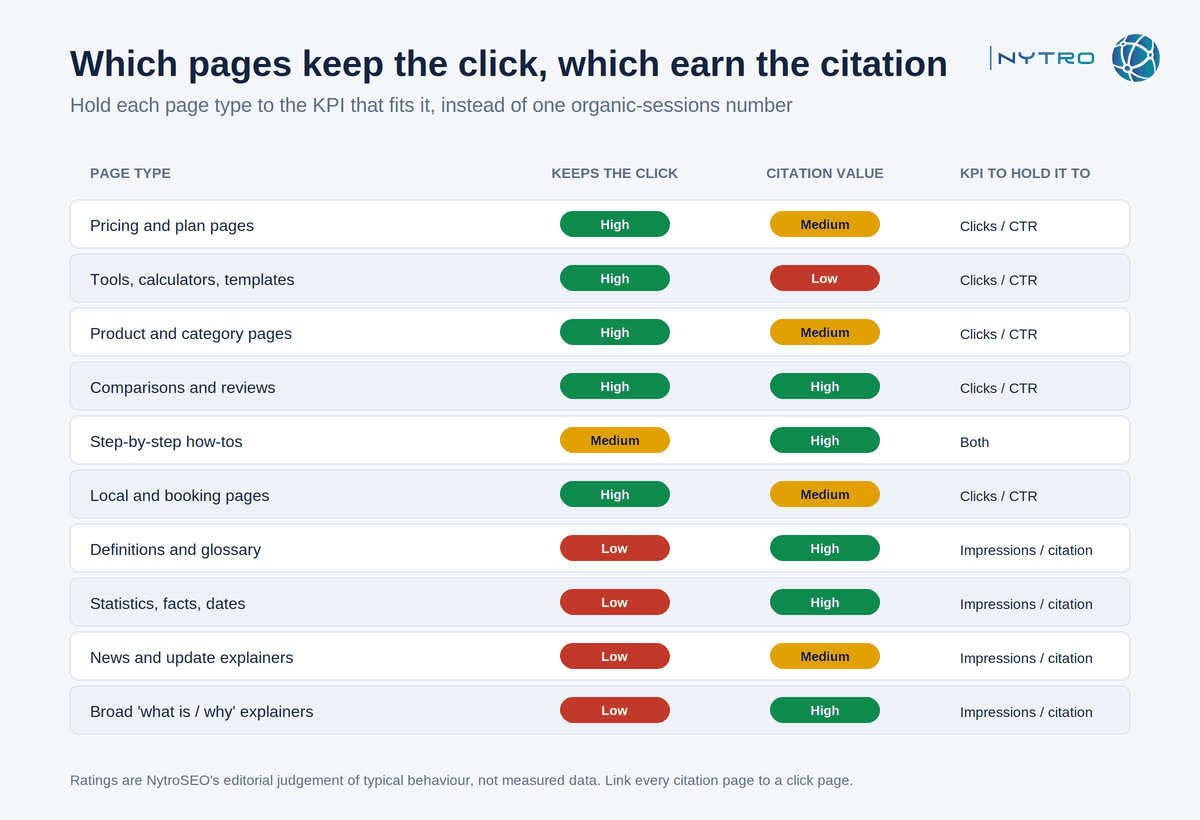
The matrix above rates page types on two axes; use it to decide which KPI each page is held to.
Pages that keep the click:
- Pricing and plan pages, because the searcher wants the current number and the sign-up.
- Tools, calculators, templates and downloads, because the value is the interaction.
- Product and category pages with stock, specifications and purchase paths.
- Detailed comparisons and reviews, where the summary names the options and the searcher opens the source to decide.
- Step-by-step how-tos with screenshots, code or files the summary cannot reproduce.
- Local and appointment pages, where the next action is a booking, a call or directions.
Pages that mostly earn the citation instead:
- Definitions and glossary entries.
- Short factual answers, statistics and dates.
- News summaries and update explainers.
- Broad “what is” and “why does” explainers.
The two lists are not fixed. A definition page that adds a worked example, a downloadable template or an interactive check moves into the first group; a comparison page that reduces to a one-line verdict drifts into the second. The practical move is not to stop writing the second group. It is to hold them to the impression and mention KPIs, keep them concise and citable, and make sure each one links to a page from the first group so the follow-up click has somewhere to go. For the first group, the remaining click is decided by the title and description a searcher sees; our guide to auto-generating titles and meta descriptions that earn clicks shows how to keep those aligned with what the page actually offers across a large site.
A measurement model for google zero click searches
The model below replaces “sessions from organic” as the single number with four series that together describe google zero click searches honestly. All four come from tools you already have.
- AI impressions per page, from the Search Console Generative AI report, trended weekly and compared with classic impressions for the same page. This is visibility.
- Citation and mention rate, from a fixed monthly panel of twenty buyer questions run in ChatGPT, Perplexity, Gemini, Copilot and Google AI Mode, recording cited-with-link, mentioned-without-link or absent. This is presence.
- Branded search impressions and clicks, from the Search Console branded queries filter, as a separate series. This is intent created by presence.
- Clicks and click-through rate on the pages that should keep the click, from the standard Search performance report, filtered to pricing, product, tool, comparison and local pages. This is the funnel doing its job.
Report the four together and annotate the series with your own publishes, Google’s announced updates and model changes. A month in which AI impressions and branded search rise while informational clicks fall is a month in which zero click search is working for you, not against you; a month in which pricing-page click-through drops is a real problem, and it is usually a title or description problem rather than a zero click one.
The layer under all four is consistency. The Search Console report attributes AI impressions to the canonical URL; the citation panel depends on the page being the same page month to month; branded search depends on the entity being named the same way everywhere. On a large site or an agency portfolio, that consistency is a rules problem, and it is what NytroSEO’s automation maintains: titles, descriptions, canonical hints and structured data applied by rule, scoped by sitemap, monitored for drift. It does not write the content that earns the citation; it keeps the page that earned it recognisable. Book a strategy meeting with the NytroSEO team if you want the four-series model set up across many sites.
A 30-day zero click search review
- Week 1: export AI impressions and classic impressions by page; build the gap list and the template list.
- Week 2: run the twenty-question panel; record citations and mentions; note which pages were cited.
- Week 3: classify every page as “keep the click” or “earn the citation”; assign the KPI; fix titles and descriptions on the first group.
- Week 4: add the branded-search series; annotate; set the baseline for next month.
Frequently Asked Questions
A zero click search is a query where the user gets what they need on the results page and does not visit a website. Featured snippets, knowledge panels, AI Overviews and AI Mode answers all produce zero click results, especially for informational and question-style queries, and the source that answered is usually named on the page.
Exact shares vary by study and query type and should be treated as estimates. Pew Research Center’s tracked data found that when Google shows an AI summary, users click a traditional result in about 8 per cent of visits, roughly half the 15 per cent rate without a summary, and that about two-thirds of all Google searches end without any click.
Focus on pages that still earn clicks, such as pricing, tools, comparisons, transactional and step-by-step content, and make your informational pages the cited source so your brand is named in the answer. Strong titles and descriptions still capture the clicks that remain, and internal links give the follow-up click somewhere to land.
Yes. Pew found only 1 per cent of visits included a click inside the AI summary, so most of a citation’s value is the name, not the link. A mention places your brand on the user’s shortlist before they visit any site, and follow-up queries often go directly to the named brand. Track mentions alongside sessions to see the value.
Track AI impressions per page from the Search Console Generative AI report, citation and mention rate across ChatGPT, Perplexity, Gemini, Copilot and AI Mode, branded search growth, and click-through on the pages that should still earn a visit. Clicks remain the right KPI for pricing, product, tool and local pages.
Ready to stay visible when the answer replaces the visit?
Zero click search rewards the page that is cited and the brand that is named, and it still rewards the click on the pages that deserve one. Keeping every page consistent enough to earn both is rule-based work. Sign up for free to have NytroSEO apply and monitor titles, descriptions and structured data across your site, or book a strategy meeting if you manage a large site or a client portfolio and want the measurement model built for you.