Last updated: September 29, 2026
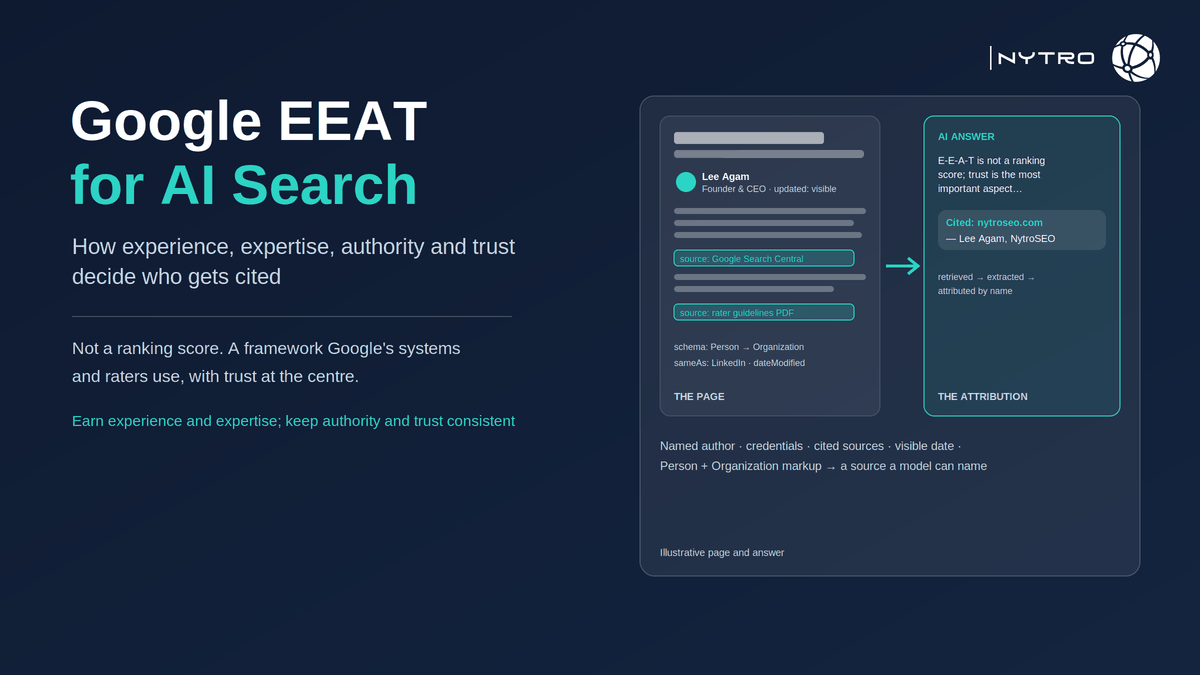
Google EEAT, written E-E-A-T, stands for Experience, Expertise, Authoritativeness and Trustworthiness. It is the framework in Google’s Search Quality Rater Guidelines for judging whether content and the people behind it are credible, and Google’s own documentation says the same thing about it in two sentences that most guides split apart: trust is the most important of the four, and E-E-A-T itself is not a specific ranking factor. That combination is the whole subject. There is no E-E-A-T score to raise, but Google’s ranking systems, and now its AI Overviews and AI Mode, are built to find signals that align with the framework, and the same signals decide whether third-party assistants cite a page and name its author. This guide sets out what the EEAT guidelines actually say, what changed in the 2025 edition, how the framework surfaces in AI answers, how to demonstrate experience and expertise on every page, and which authoritativeness and trust signals can be applied by rule across a site.
Google’s guidance on creating helpful, reliable, people-first content, last updated in December 2025, is the primary source. It states that of the four aspects trust is most important and the others contribute to it; that content does not have to demonstrate all four; that E-E-A-T is not a specific ranking factor but Google’s systems use a mix of factors that can identify content with good E-E-A-T; that those systems give even more weight to such content on topics that could affect health, financial stability, safety or the welfare of society; and that search quality raters, who are trained to assess E-E-A-T, have no control over rankings and their data is not used directly in ranking algorithms.
If you want the trust signals that can be applied by rule, consistent author and organisation markup, accurate metadata and dated updates, kept in place across every page automatically, sign up for free and NytroSEO will start with an inventory of which pages carry them.
This page replaces two earlier posts on this site that covered Google’s August 2024 core update and its emphasis on content creators. Those posts leaned on a Search Engine Land analysis by Jason Barnard, who documented Google’s Knowledge Panel subtitles such as “Content Creator (Medicine)” as visible evidence that Google connects people to the topics they are credible on; his article on Google recognising content creators remains the reference for that observation. What has changed since is the surface: the question is no longer only whether Google ranks a credible creator’s page, but whether an AI system retrieves it, lifts a passage from it and attributes the passage to a person it can name.
Lee Agam, founder and CEO of NytroSEO, draws a line through the framework that most teams miss. In his experience E-E-A-T is two different problems wearing one acronym. Experience and expertise are about the content and the person: they cannot be automated, they have to be earned, and they show up as original data, first-hand testing, specific detail and a named author with a reason to be believed. Authoritativeness and trust are largely about consistency and verifiability: the same organisation and person described the same way on every page, with structured data a machine can read, cited sources beside every figure, a visible date, and metadata that says what the page is. That second half is rules work, and on a large site it is the half that decays first, because a theme update or a template change removes the author markup from ten thousand pages without anyone noticing. His rule is to spend people on the first half and automation on the second, and never to fake either.
What Google EEAT means in 2026
Google EEAT is the four-part quality framework in the Search Quality Rater Guidelines, the document Google gives to the human raters who evaluate whether its search results are good. The acronym began as E-A-T; Experience was added in December 2022 to distinguish first-hand involvement from credentialed expertise. The guidelines in force today are the edition dated 11 September 2025, which runs to 182 pages and added, among other things, guidance for raters on evaluating AI Overviews and expanded definitions of “Your Money or Your Life” topics to cover government, civics and society.
The four aspects, in Google’s framing:
- Experience: does the creator have first-hand or life experience of the topic? A product review from someone who used the product; a guide from someone who has done the procedure.
- Expertise: does the creator have the knowledge or skill the topic requires? Credentials matter for some topics; demonstrated depth matters for all of them.
- Authoritativeness: is the creator or the site a recognised, go-to source for the topic, as judged by others?
- Trustworthiness: is the page accurate, honest, safe and reliable? Trust is the centre; the other three are evidence for it, and a page can fail on trust alone.
Two consequences of the “not a ranking factor” statement are worth being precise about. First, nothing you do to “add E-E-A-T” moves a score, because there is no score; what moves is the set of observable signals Google’s systems use as proxies. Second, because raters evaluate against the framework and Google uses their pooled judgements to test its systems, the framework describes what the systems are tuned to reward. Optimising for it is therefore rational; treating it as a checkbox is not.
Is Google EEAT a ranking factor? What the EEAT guidelines actually say
Is Google EEAT a ranking factor? No, and Google says so directly: E-E-A-T is not a specific ranking factor, there is no E-E-A-T score, and rater ratings are not used directly in ranking. What Google also says, in the same paragraph, is that its systems use a mix of factors that can identify content with good E-E-A-T and give such content more weight on YMYL topics. The EEAT guidelines are thus a description of the target, not the mechanism.
The mechanism is the set of signals Google’s systems can measure. Nobody outside Google has the list, but the signals that plausibly align with the framework are the ones the rater guidelines tell raters to look for: a clearly identified creator and their reputation, the accuracy of the main content against consensus, the presence and quality of sources, evidence of first-hand involvement, and the reputation of the site as reported by others. Google’s guidance for site owners adds practical questions: who wrote it, how was it produced, why does it exist, and would a reader trust it.
A clarification on updates. There is no “EEAT Google update” as a named release. Core updates, including the March 2024 update that folded the helpful-content system into core ranking and the updates through 2025 and 2026, reassess quality broadly, and E-E-A-T is the framework that quality is described against. Our earlier note on Google’s December 2023 EEAT guidelines update describes an earlier revision of the rater guidelines; this page supersedes it as the current reference.
How Google EEAT shows up in AI answers
The framework was written for raters looking at ranked results. It now applies to a different act: a model selecting which pages to retrieve, which passages to lift and which sources to name.
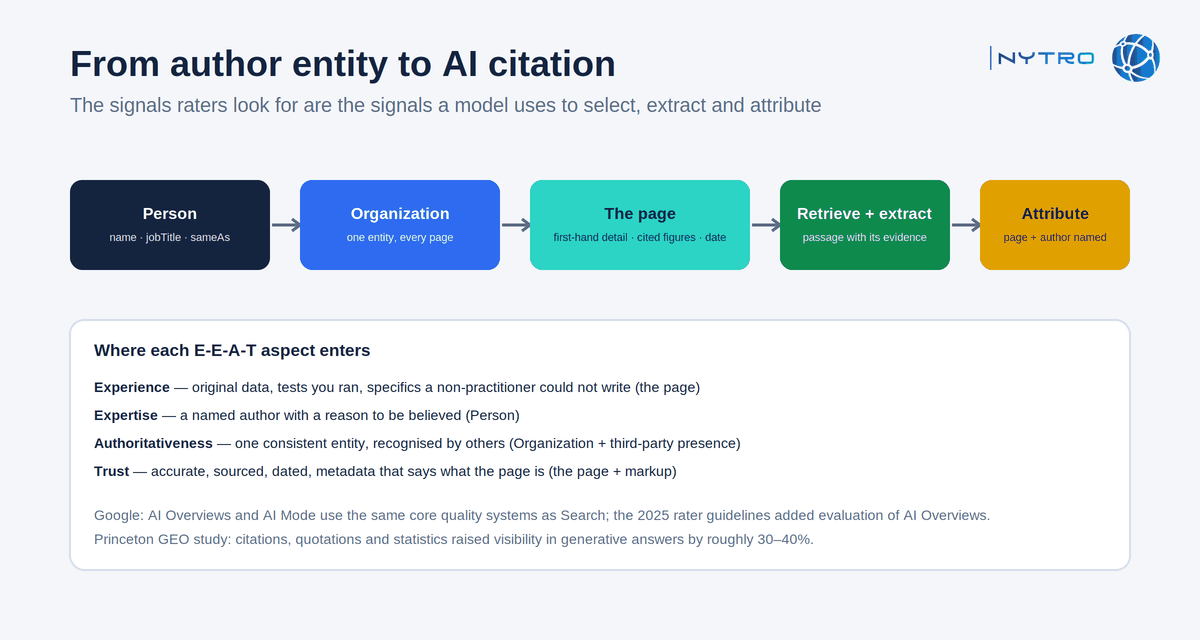
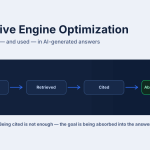
The flow above traces how author and organisation signals travel from the page to the attribution inside an AI answer.
For Google’s AI Overviews and AI Mode, the connection is direct. Google states its generative AI features are rooted in the same core ranking and quality systems as Search, so the signals that identify strong E-E-A-T for ranking are the signals that make a page eligible for an AI answer. The 2025 rater guidelines’ addition of AI Overview evaluation confirms that raters are now judging AI answers against the same framework.
For third-party assistants, the connection is empirical. The Princeton generative engine optimisation study reported that adding citations, quotations from relevant sources and statistics to content increased its visibility in generative answers by roughly thirty to forty per cent, which is the E-E-A-T trust half rendered as an extraction preference: models favour passages that carry their own evidence. And tracking of ChatGPT’s retrieval in August 2026 showed citation share shifting toward official, institutional and documentation sources, which is authoritativeness expressed as source selection.
The practical implication is that SEO E-E-A-T and AI-citation work are the same work. A page with a named author whose credentials are stated, sources cited beside each figure, a visible updated date, and Organization and Person structured data that connect the page to a real entity is more likely to be ranked, more likely to be lifted into an AI answer, and more likely to have its author named when it is. Our guide to entity-based AI SEO covers the entity side, and our guide to getting cited in Google AI Overviews rather than just ranked covers the page structure.
Demonstrating Experience and Expertise on every page
Experience and expertise have to be shown, not asserted. The rater guidelines tell raters to look for evidence, and models behave the same way. On every page that matters:
Name the author, and make the name mean something. A byline linked to a bio that states the person’s role, relevant history and where else they can be verified. On this site, every knowledge-base article is attributed to a named person; the profile of Lee Agam is the pattern: role, background, and links to profiles a search or AI system can reconcile.
Show first-hand involvement. Original screenshots from your own tools, figures from your own data, results from tests you ran, and the specific details a person who has not done the work could not write. “In our experience across the sites we manage” is a claim; the number that follows it is the evidence.
Cite primary sources and date them. Every statistic with a link to where it came from and the date it was published, placed beside the claim. Google’s guidance asks whether the content provides original information and whether it cites sources; models extract sourced passages preferentially.
Keep it current and say so. A visible published and updated date, and content that reflects the current state of the topic. This page is itself an example: it replaces two 2024 posts whose central facts, the rater guidelines edition and the AI surfaces, had moved on.
Match the depth to the topic. YMYL topics, health, finance, safety, legal, civic, carry a higher bar and get more weight from Google’s systems; credentials and institutional backing matter there in a way they do not for a product comparison.
None of this is automatable, and any tool that offers to generate experience or credentials is offering to fabricate them, which Google’s spam policies now cover explicitly for content built to manipulate AI answers.
Authoritativeness and trust signals you can automate
Authoritativeness and trust are where rules belong, because they depend on consistency across every page and consistency is what decays.
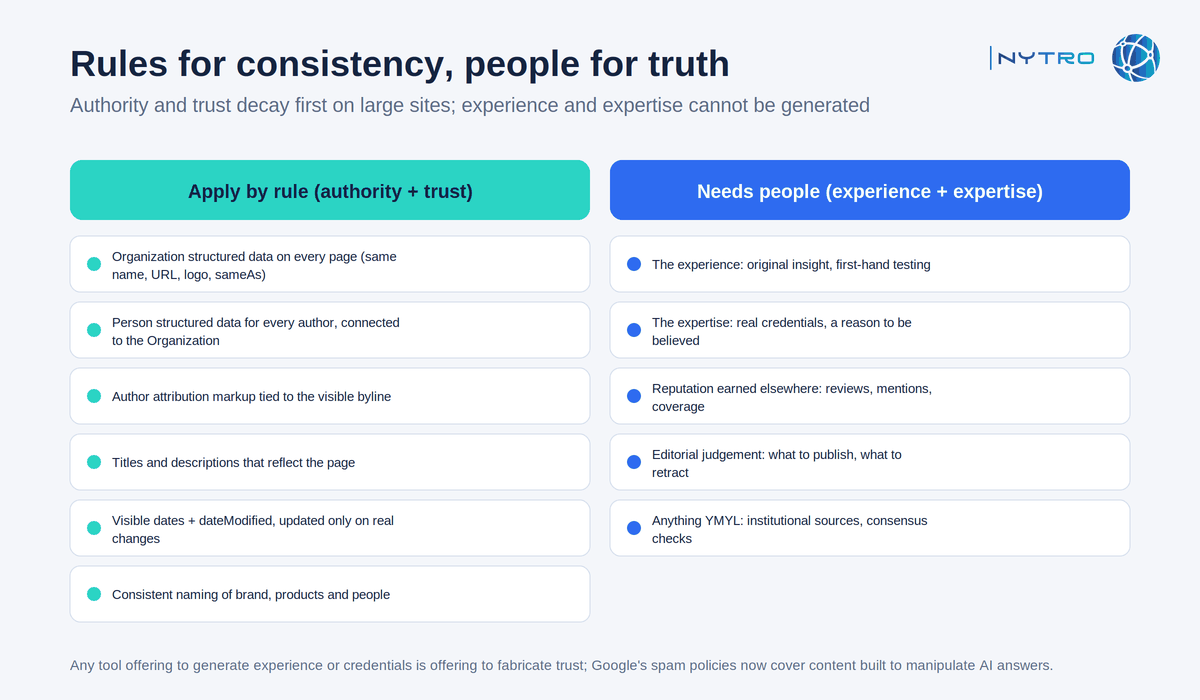
The split above is the one to apply: rules for the signals that need to be identical everywhere, people for the signals that need to be true.
Signals that can be applied by rule:
- Organization structured data on every page: the same legal name, URL, logo and sameAs links to verified profiles, so that every page connects to one entity.
- Person structured data for every author, with job title, URL and sameAs links, connected to the Organization, so that a byline is machine-readable and the author is the same entity across the site.
- Author attribution markup on every article, tied to the visible byline.
- Accurate titles and descriptions that reflect the page, because a mismatch between what a page claims to be and what it is reads as a trust failure to raters and to models.
- Visible dates and dateModified in structured data, updated when the content changes and not otherwise.
- Consistent naming of the brand, products and people across the site, so that Authoritativeness accrues to one entity rather than being split among variants.
Signals that need people:
- The experience and expertise themselves: original insight, first-hand testing, real credentials.
- Reputation earned elsewhere: reviews, mentions, coverage, listings on sources AI systems consult.
- Editorial judgement about what to publish and what to retract.
NytroSEO applies the first list through its header snippet, scoped by sitemap, with a preview before rules apply, drift monitoring and a change log; it does not write the second list, and it should not be asked to. Our guide to how structured data works covers the entity markup in detail. Book a strategy meeting with the NytroSEO team if you manage a large site or a client portfolio and want the rules-based half of E-E-A-T audited and applied as one project.
EEAT Google SEO checklist for one page
- Named author with a linked bio and Person markup connected to the Organization.
- One clear answer in the first paragraph; first-hand detail a non-practitioner could not write.
- Every figure sourced and dated beside the claim.
- Visible published and updated dates; dateModified in markup.
- Organization markup with sameAs to verified profiles.
- Title and description that say exactly what the page is.
- For YMYL topics: credentials stated, institutional sources cited, claims checked against consensus.