Last updated: October 8, 2026
Local seo automation is the practice of generating and maintaining the machine-readable layer of every location page from a single source of truth: one dataset holding each location’s name, address, phone, hours, coordinates and services, from which LocalBusiness structured data, titles, descriptions and monitoring are produced by rule and kept consistent as the data changes. It exists because the multi-location business has the same problem as the ecommerce catalogue in a different shape: forty, four hundred or four thousand pages that must each be accurate about one thing, hours that change seasonally, phone numbers that move with staff, and a Google policy that punishes the lazy version of the solution. This guide explains what local seo automation covers and what it leaves to people, how to generate local business schema for multiple locations from one dataset, how to write location pages that stay on the right side of the doorway policy, what to monitor, and how local entities get named in AI answers.
Two pieces of Google documentation set the boundaries. The LocalBusiness structured data guidance requires only two properties, name and address, and recommends url, telephone, geo, openingHoursSpecification, priceRange and image, with the url pointing at that location’s own page rather than the homepage. And Google’s spam policies define doorway abuse to include having multiple domain names or pages targeted at specific regions or cities that funnel users to one page, and creating substantially similar pages that are closer to search results than a clearly defined, browseable hierarchy. Automation that produces one honest schema block per real location is what the first document describes; automation that produces forty pages differing only by city name is what the second one forbids.
If you want every location page’s schema and metadata generated from your location data and re-checked when it changes, sign up for free and NytroSEO will inventory the location pages in your sitemap and preview what it would apply.
The reason local work rewards automation is that its facts are structured already. A business knows each location’s address, phone and hours in a spreadsheet or a store-locator database; the failure is that the same facts are retyped into a page template, a schema block, a Business Profile and three directories, and then drift apart. Our earlier note that 80 per cent of people who do a local search convert made the case for local visibility; this guide is about keeping it true at scale.
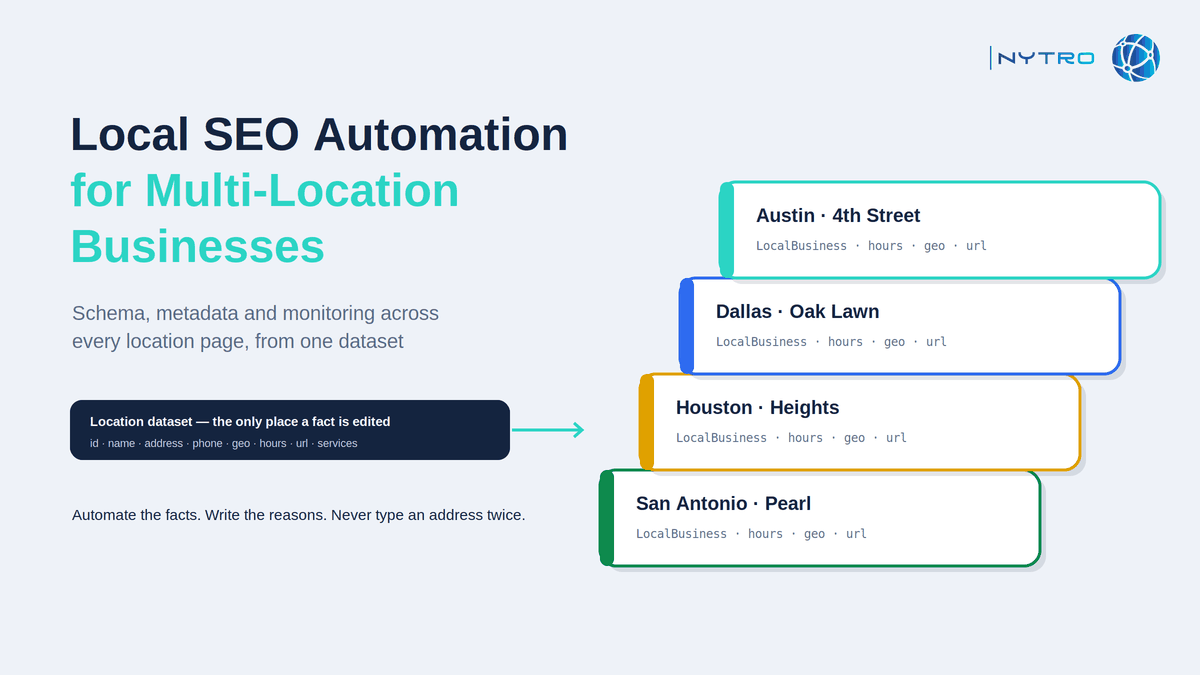
Lee Agam, founder and CEO of NytroSEO, draws the line for multi-location clients in one sentence: automate the facts, write the reasons. In his experience the facts, name, address, phone, hours, coordinates, services, are identical in structure across every location and should never be typed twice, so they belong in one record that generates the schema, the title and the description for each page. The reasons a person should visit this location rather than the one two miles away, the staff, the parking, the local projects, the services only this branch offers, are different on every page and cannot be generated without producing exactly the doorway pattern Google describes. His warning to clients is that the most common multi-location failure is not a penalty but silence: forty pages Google has quietly decided are one page, so thirty-nine of them never appear.
What local seo automation covers
Local seo automation covers the machine-readable and repeatable layer of location pages, and it is honest to list what that excludes.
Covered. LocalBusiness structured data per location, generated from the dataset with location-specific name, address, phone, hours, geo coordinates, url and services. Titles and descriptions per location, templated but truthful: “Dental care in Austin, TX, 4th Street clinic | Brand” says something a generic template does not. Image alt text for location photos from the record and image role. Consistency of name, address and phone, NAP, across every page and every schema block. Monitoring: indexing status per location page, schema validity, NAP drift, missing elements. A location hub page and the internal links from it.
Not covered. Google Business Profile management, posting and review responses, which live in Google’s product rather than on your site. Review generation. The unique content on each page that explains why that location matters. Directory listings on third-party sites, although the dataset that feeds your pages should feed those too. Our overview of global and local SEO solutions by region shows how a regional structure fits above the location level.
The split matters because automation applied to the second list produces the doorway pattern. The first list is where rules belong.
Local business schema for multiple locations, generated from one source
Local business schema for multiple locations is the clearest case for generating markup from data rather than maintaining it by hand, because the shape of every block is identical and only the values differ.
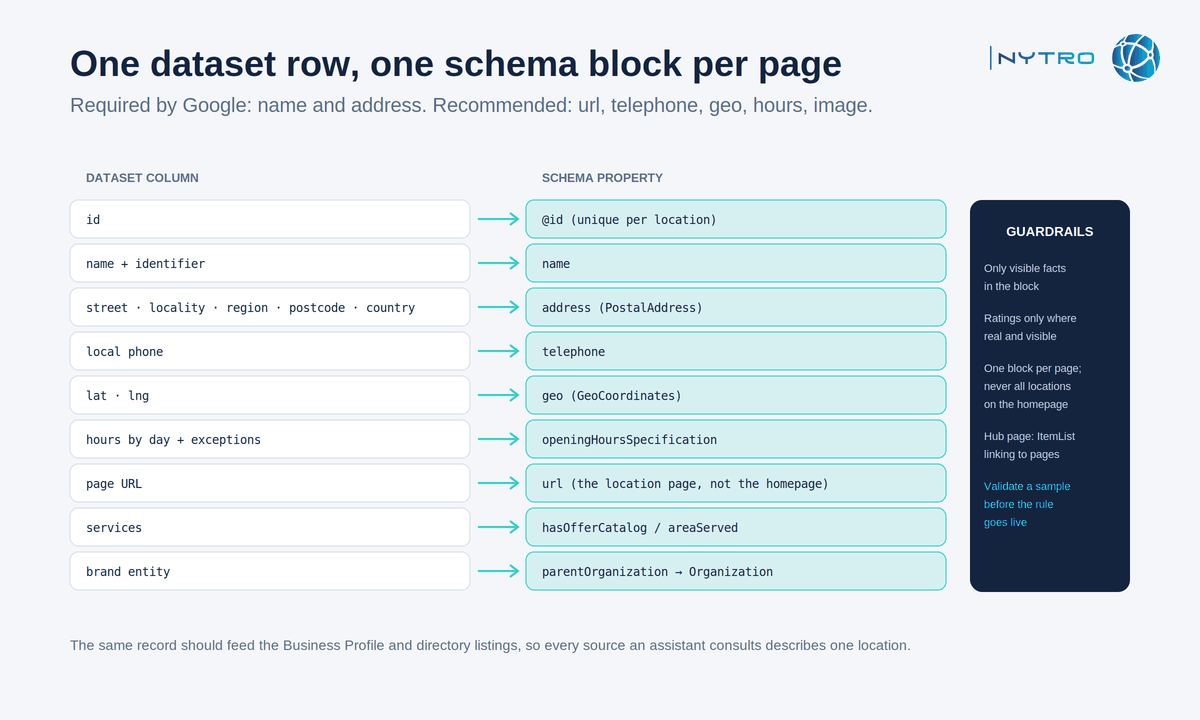
The flow above produces one block per location page from one record; the same record should feed Business Profile and directories.
The data model. One row per location with: a stable location ID; the location’s public name including its identifier, “Brand, Austin 4th Street”; street address, locality, region, postal code and ISO country code as separate fields; the local telephone number for that branch; latitude and longitude; opening hours as structured day and time ranges, with exceptions for holidays; the location page URL; the services offered at that location; and image URLs. Keep it in one place, a sheet, a database or the store-locator’s source, and make that place the only one where a fact is edited.
The template. One LocalBusiness block, or the more specific subtype, Dentist, Restaurant, Store, where one applies, per location page, with an @id unique to the location, name, a PostalAddress object, telephone, geo as a GeoCoordinates object, url pointing at the location page itself, openingHoursSpecification built from the hours fields, image, and areaServed or hasOfferCatalog where services vary. Connect it to the brand with parentOrganization pointing at the Organization entity used sitewide. Do not place all locations in one block on the homepage; Google’s guidance is that each location’s markup belongs on the page about that location, and a hub page listing locations is better served by an ItemList linking to them.
Schema markup for local seo has three guardrails. Only mark up what is visible: the address, phone and hours in the block must appear on the page. Ratings only where real reviews are visible, never a corporate average copied to every branch. And validate: run the generated block for a sample of locations through the Schema Markup Validator before the rule goes live, and again whenever the template changes. Our guide to adding multiple LocalBusiness schema blocks for local SEO covers the hand-built version; this is the same output produced by rule, and our guide to how structured data works covers the general case.
Local seo automation and the doorway policy: metadata rules that avoid the risk
The doorway policy is the constraint every multi-location rule has to be designed around, and the way through it is to be precise about which parts of a location page are templated and which are not.
Templated, truthfully. The title: location name, the service or category, the locality, the brand. The description: what the location offers, where it is, when it is open, drawn from the record. The schema. The map, the address block, the hours table, the phone link. These differ by data on every page, which is not the doorway pattern; the pattern is pages that differ by nothing except a swapped word.
Written, per location. A paragraph or more that would be wrong on any other location page: the staff, the parking and transport, the services or specialisms only this branch offers, projects or cases from the area, photographs of this location rather than a stock image. Google’s own test, as its representatives have put it, is whether you could swap the city names and leave both pages correct; if so, they are doorways.
Linked into a hierarchy. A locations hub page that lists every location with an ItemList and links to each; each location page linked from the hub and from the service pages it supports; regional pages above the hub where the footprint is large. Isolated location pages reachable only from a sitemap are the “closer to search results than a browseable hierarchy” pattern the policy describes.
Honest about service areas. A page for a city where the business has no presence, no staff, no projects and no address, is the pattern Google’s representatives have called doorway pages outright. Service-area businesses should describe the areas they genuinely serve on the pages for the locations that serve them, not spin a page per town.
Our explainer on how to write image alt text covers the photos, which on location pages should be of the location.
Automated local seo monitoring: the second job of local seo automation
Automated local seo monitoring is where the dataset earns its keep a second time, because every fact in it is a value a monitor can check against the live page.
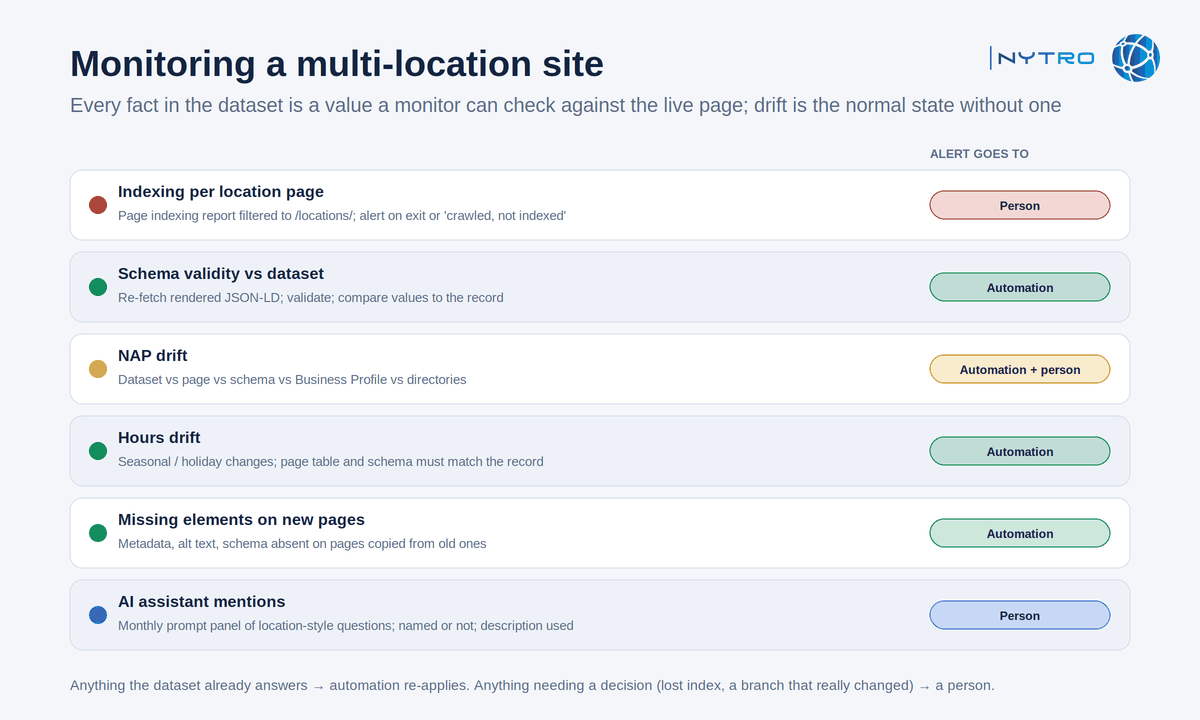
Each check above compares the live page against the dataset; drift is the normal state of a multi-location site without one.
Indexing per location. The Page indexing report, filtered to the locations directory, with an alert when any location page leaves the index or enters “crawled, currently not indexed”, which on multi-location sites is the symptom that Google has judged the pages too similar.
Schema validity. Re-fetch each location page’s rendered JSON-LD on a schedule, validate it, and compare its values with the dataset. A changed template, a plugin update or a theme release can drop or corrupt the block on every page at once.
NAP drift. Compare name, address and phone across four places: the dataset, the visible page, the schema block and the Business Profile. A branch that changed its number updates one of the four and forgets three; the monitor catches it.
Hours drift. Seasonal hours, holiday closures and temporary changes are the most frequent edits and the most frequently wrong on the page. Hours in the dataset drive the schema and the visible table; the monitor confirms they match.
Missing elements. Location pages added without the template’s metadata, alt text or schema, usually because a new branch was created from a copy of an old page.
Mentions in AI answers. A monthly prompt panel of location-style questions, “best dentist near 4th Street Austin”, recording whether the brand’s location is named, with the description used.
Alerts go to the automation for anything the dataset already answers, re-applying the correct schema, title or description, and to a person for anything that needs a decision, a page that lost its index or a branch whose details genuinely changed. Our guide to automated SEO monitoring covers the general cadence.
Local SEO in AI answers
Local SEO has acquired a second audience: the AI assistants that answer “near me” and “which branch” questions by combining map and business-profile data with what they can read on the site and on trusted directories. The entity that is named is the one whose facts agree everywhere.
Consistency is the whole mechanism. An assistant reconciling a Business Profile that says one phone number, a location page that says another and a directory that says a third does not pick one; it loses confidence in the entity. The dataset that drives your pages is the instrument of consistency: the same values feed the schema, the visible page, the Business Profile and the directory listings, so that every source an assistant consults describes one location.
Visibility in HTML. Address, hours, phone and services in text an assistant can read without executing scripts or opening a map widget, with the schema confirming them. A location page whose hours live only inside an embedded map is invisible to a non-rendering agent.
Specificity. The written, per-location paragraph that keeps the page off the doorway list is also what lets an assistant say why this branch: the specialism, the parking, the service only offered here. Templated facts get a location found; written reasons get it recommended.
Measurement. The Search Console Generative AI report shows which location pages earn impressions in AI Overviews and AI Mode; Bing’s AI Performance report shows Copilot citations and grounding queries; the monthly prompt panel shows whether the location is named. Our guide to increasing brand visibility in AI search covers the entity side for the brand as a whole. Book a strategy meeting with the NytroSEO team if you run a multi-location business or an agency with several, and want the dataset, the rules and the monitoring set up as one project.
Local Business Schema Markup and page checklist, per location
- One row in the dataset; one page; one LocalBusiness block with unique @id, url pointing at the page, local phone, structured hours, geo, parentOrganization.
- Visible address, phone and hours on the page matching the block; ratings only where real.
- Title and description generated from the record; alt text for photos of this location.
- A written paragraph that would be wrong on any other location page.
- Linked from the locations hub (ItemList) and from relevant service pages.
- Indexed; schema valid; NAP identical across page, schema, Business Profile and directories; monitored.
Frequently Asked Questions
Local SEO automation generates and maintains the machine-readable layer of every location page from one dataset: LocalBusiness structured data, titles, descriptions and alt text per location, plus monitoring of indexing, schema validity and name, address and phone drift. It covers the facts that are identical in structure across locations; the written reasons to visit each one stay with people.
Yes. Store each location’s name, address, phone, hours, geo coordinates, services and page URL in one dataset and generate a separate LocalBusiness JSON-LD block per location page from it, with a unique @id and the url pointing at that page. Validate a sample before the rule goes live, mark up only what is visible, and regenerate whenever the data changes.
Yes. Google’s doorway-abuse policy covers pages targeted at specific regions or cities that funnel users to one page and substantially similar pages outside a browseable hierarchy. Templated facts such as address, hours and schema are fine because they differ by data; each page also needs written content, staff, parking, local services, projects, that would be wrong on any other location page.
Assistants combine map and business-profile data with what they can read on the site and on trusted directories, and they favour entities whose name, address, hours and services agree across every source. Visible facts in HTML, matching LocalBusiness schema and a specific written reason to choose each branch improve the chance a location is named.
Indexing status of every location page, LocalBusiness schema validity against the dataset, drift in name, address, phone and hours between the page, the schema and the Business Profile, missing metadata or alt text on new pages, and mentions in AI answers for location-style prompts. Alerts the dataset can answer go to automation; decisions go to a person.
Ready for local seo automation that makes every location say the same true thing?
The facts are already in your spreadsheet; the failure is retyping them. Generate the schema and metadata from one record, write the reasons per location, and let a monitor catch the drift. Sign up for free to have NytroSEO inventory your location pages and preview the LocalBusiness schema and metadata it would apply, or book a strategy meeting if you run a multi-location business or an agency with several and want the full setup designed as one project.