Last updated: October 9, 2026
Seo services for small business are sold as one monthly fee, and the fee pays for two very different things: judgement, which a person has to supply, and repetition, which a person has to be paid to do only because nobody has automated it. The question an owner should ask is not whether to hire an agency or buy software, but which parts of the work belong to each. This guide sets out what the market actually charges, what Google’s updated guidance on hiring an SEO now warns about, which tasks need a specialist, which can be automated for a fraction of the cost, which an owner can do in an hour a week, and how to combine the three into a plan that costs less than a retainer and does more than a plugin.
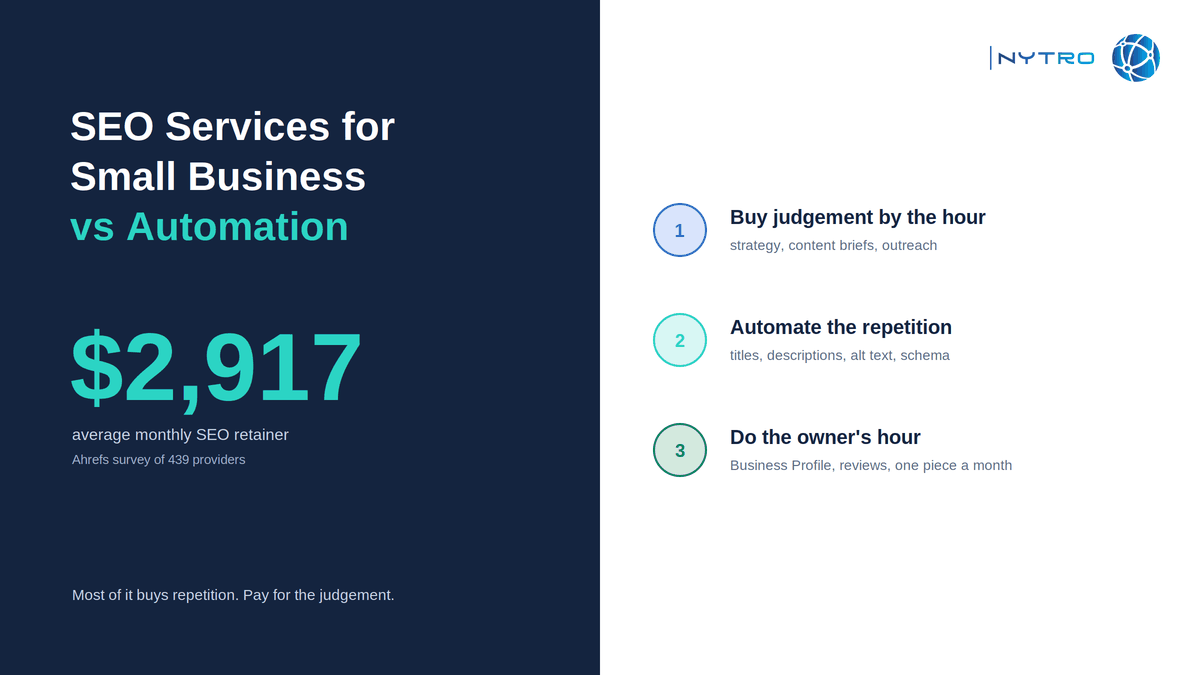
The pricing benchmark comes from Ahrefs’ survey of 439 SEO providers, the most-cited data on the subject. SEO costs $2,917 per month on average; 78.2 per cent of providers charge a monthly retainer; the single most common retainer band is $501 to $1,000 per month, charged by 20.4 per cent of respondents; local SEO averages $1,557 per month; and the average hourly rate is $111. Agencies and consultants charge roughly double what freelancers charge. The figures are self-reported by providers and skew toward established firms, so a local business reading quotes will see both lower and higher numbers; the structure, a retainer bought by the month for a bundle of tasks, is the constant.
If you want to see which of those tasks a rule can do on your site before you decide what to pay a person for, sign up for free and NytroSEO will inventory your pages and show the titles, descriptions, alt text and structured data it would apply.
Google has also sharpened its own advice to buyers. In June 2026 it revised its page Do you need an SEO? and published a companion document on using third-party SEO tools, services and advice. As Search Engine Roundtable reported, the revised page warns against providers who guarantee a first-place ranking, cautions about services selling AI or generative-engine optimisation on the strength of claims rather than evidence, advises against granting write access to Search Console during an audit, and points businesses to Search Console as the source of data that comes directly from Google. It also tells buyers who have been misled where to complain. Those are the first things to check about any provider, before the price.
Lee Agam, founder and CEO of NytroSEO, puts the small-business question in terms of what the hours are spent on. In his experience, a typical small retainer buys perhaps ten to fifteen hours a month, and when the invoices are itemised a large share of those hours are rewriting titles and descriptions, adding alt text, fixing schema and checking that nothing has broken, work that has to be done but does not need a specialist’s judgement. The judgement, which pages to create, what the business should be known for, how to earn mentions and reviews, fits in a fraction of the time and is what the owner is really paying for. His advice is to buy the judgement by the hour, automate the repetition, and keep the one task that nobody else can do, which is writing what the business actually knows.
What seo for small business actually costs, and what the money buys
Seo for small business is priced by the month and delivered as a bundle, so the first step is to open the bundle.
A typical small-business retainer, in the $500 to $1,500 band that most providers charge, bundles some combination of: an initial audit; keyword research; on-page optimisation of titles, descriptions, headings and alt text; a few pieces of content a month; Google Business Profile management; citation and directory listings; link outreach; and a monthly report. The proportions vary, and the itemisation is where the value is.
Judgement tasks, which need a person who understands the business and search: deciding which services and locations to build pages around; writing or briefing content that says what the business knows; earning reviews, mentions and links; responding to a drop; choosing what not to do. These are worth paying for and they are a minority of the hours.
Repetition tasks, which follow rules once the rules are set: titles and descriptions on every page; alt text on every image; Organization, LocalBusiness and FAQPage markup; canonical consistency; checking after a theme or plugin update that none of it broke; monthly data pulls. These are the majority of the hours on most small retainers, and they are the tasks a rule does better than a person, because a rule does not forget the new page.
Our overview of cost-effective automated SEO software for agencies frames the cost question from the provider’s side; this guide reframes it by task for the business buying the service. The honest arithmetic: if two-thirds of a $1,200 retainer is repetition, automating it at a fraction of the price and keeping a few specialist hours a month costs less and loses nothing.
SEO companies for small business: what to look for and what to avoid
SEO companies for small business range from a freelancer with ten clients to a national agency with a small-business tier, and the price tells you less than the answers to five questions, three of which Google now asks for you.
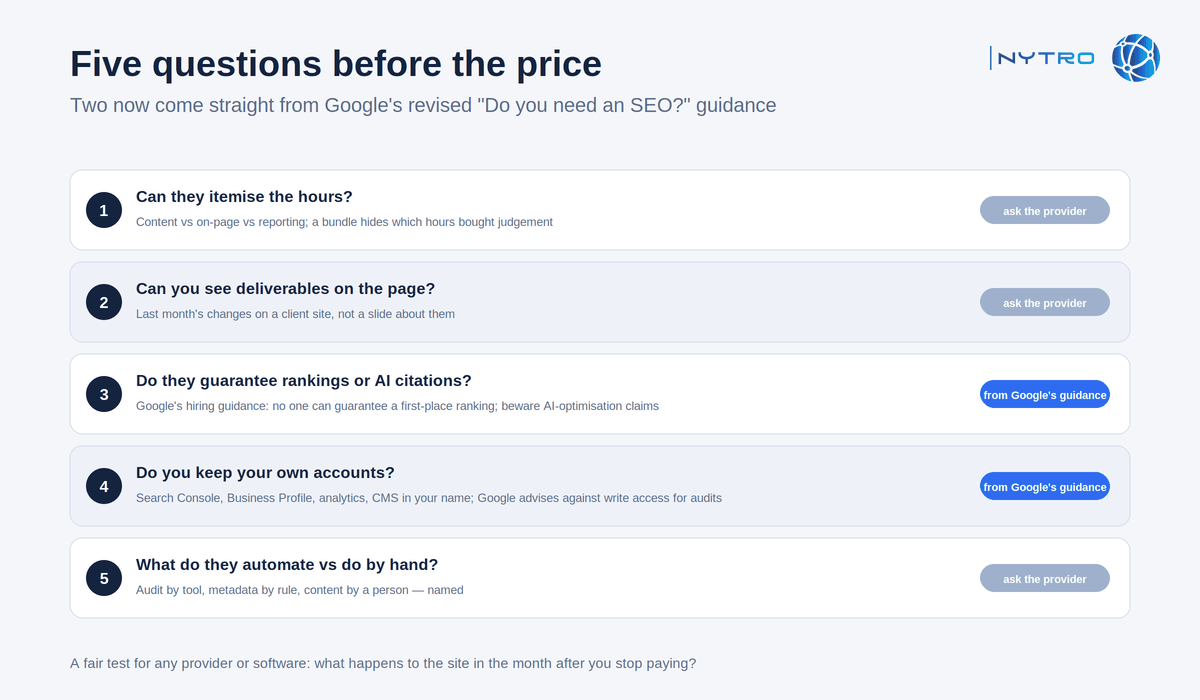
The five questions above sort providers faster than their price lists do; the ranking-guarantee and account-access questions now come straight from Google’s hiring guidance.
Can they itemise the hours? A provider who can say how many hours go to content, how many to on-page work and how many to reporting is telling you what you are buying. One who cannot is selling a bundle.
Can you see the deliverables on the page? Titles, descriptions, schema and content either exist on your site or they do not. Ask to see last month’s changes on a client’s site, not a slide about them.
Do they guarantee rankings or AI citations? Google’s revised guidance says no one can guarantee a first-place ranking and cautions against AI-optimisation services sold on claims; a provider who guarantees either is planning to measure something easy or planning to leave.
Do you keep your own accounts? Search Console, Business Profile, analytics and the CMS should be in your name with the provider added as a user; Google now advises against granting Search Console write access for an audit. A provider who holds your accounts is a provider you cannot leave.
What do they automate, and what do they do by hand? A good answer names the tools and the tasks: audit crawled by a tool, metadata applied by rule, content written by a person. A vague answer means the repetition is being billed as judgement.
Our guide to automated SEO audit vs SEO automation explains the tool categories a provider should be able to name, and our guide to increasing brand visibility in AI search covers the newer deliverable a provider should now be able to describe without guaranteeing it.
Automatic SEO for small business: what a rule can do
Automatic SEO for small business means applying the repetition tasks by rule across every page, scoped by the sitemap, previewed before anything changes, and re-applied when a theme or plugin undoes them. On a site of fifty to five hundred pages, it covers more of the retainer than most owners expect.
What it does. Generates a title for every page from the page’s heading and the queries it already earns, within Google’s display length. Generates a description from the opening paragraph. Adds alt text to images that have none, from the image and the page context. Applies Organization markup sitewide and LocalBusiness markup to location pages from one record, and FAQPage markup from visible question sections. Keeps canonical hints consistent. Monitors for drift and re-applies. Logs every change so the monthly report’s “what changed” section is a query, not a memory.
What it does not do. It does not decide which pages the business needs, write the content that says what the business knows, earn reviews or mentions, manage the Business Profile, or fix a site that does not render. Those are the judgement tasks and the owner tasks, and no honest automation claims them.
How it is delivered. A snippet installed once in the site header, directly or through a tag manager, on any builder or CMS, which is why it suits small businesses on Wix, Squarespace, Shopify or WordPress without a developer. Our explainer on what an SEO automation snippet is covers the install and the limits, including that JavaScript-applied changes are read by Google and Bing but need a server-side route for AI crawlers that do not execute scripts.
The cost comparison is the point. At the Ahrefs median, the repetition two-thirds of a $1,000 retainer is roughly $650 a month of labour; automation for a small site is a fraction of that, and the specialist hours it frees are the ones worth buying. Our guide to reducing SEO cost with automation sets out the model in full for larger sites; the arithmetic is the same at small scale.
How to automate seo and keep the judgement: a plan for one owner
How to automate seo without losing what a specialist adds comes down to assigning each task to the right one of three budgets: a few hours of expert time, a rules-based layer, and the owner’s own hour a week.
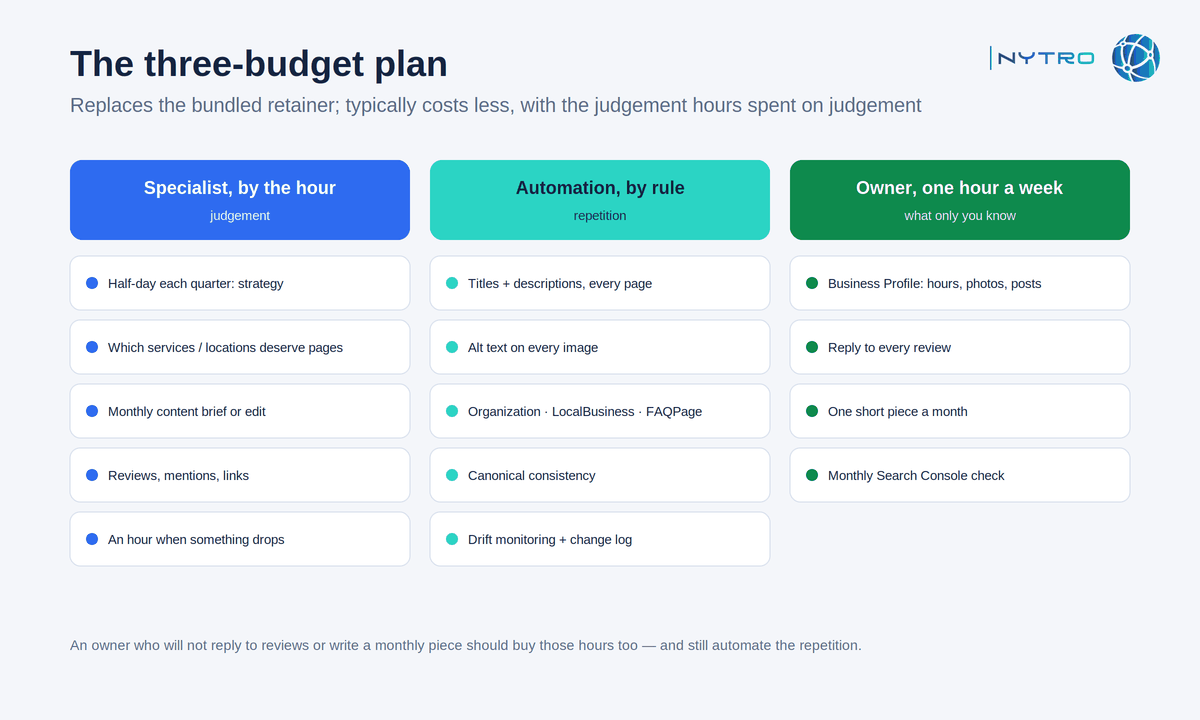
The three columns above replace a bundled retainer with three budgets; most owners find the middle column was most of what they were paying for.
Buy, by the hour, from a specialist. A half-day each quarter to set strategy: which services and locations deserve pages, which questions the content should answer, what the business should be known for. A few hours a month to brief or edit content and to pursue the mentions, reviews and links that the brand needs; our hub on search optimization sets out the four pillars those hours should serve. An hour when something drops, to diagnose it.
Automate, by rule. Everything in the previous section: titles, descriptions, alt text, Organization, LocalBusiness and FAQPage markup, canonicals, drift monitoring, the change log.
Do yourself, one hour a week. Keep the Google Business Profile current: hours, photos, posts, and a reply to every review; the Business Profile help centre covers the mechanics. Write one short piece a month that says something only the business knows, a case, a question customers actually ask, a before-and-after; the specialist edits it. Check Search Console once a month for pages that dropped out of the index.
What this replaces. The $501 to $1,000 bundle that most providers sell, in which the owner cannot tell which hours bought judgement and which bought repetition. What it costs: a modest automation subscription plus a handful of specialist hours, typically less than the bundle, with the judgement hours spent on judgement.
Affordable seo services for small business: a decision guide
Affordable seo services for small business are the ones that charge for judgement and automate the rest, and the right mix depends on four things about the business.
Site size. Under fifty pages, an owner with a checklist and a small automation layer can cover the on-page work; a specialist half-day a quarter is enough. Fifty to five hundred pages, automation becomes the majority of the saving. Above that, or across several locations, the rules layer and a monitor are essential and the specialist’s role becomes the content and the entity.
Competition. A plumber in a small town needs a correct Business Profile, a few honest pages and consistent metadata. A clinic in a large city competing with chains needs the specialist hours for content and reviews; the metadata is still a rule.
Platform. Builders without title templates, which is most of them, make automation more valuable, because the alternative is editing every page by hand. Our guide to SEO automation for ecommerce catalogs covers the small store case, where product churn makes hand editing impossible.
What the owner will do. The plan above assumes one hour a week. An owner who will not reply to reviews or write a monthly piece should buy those hours too, and should still automate the repetition, because paying a person to retype titles is the one expense that never made sense.
A fair test for any provider, agency or software: ask what happens to your site in the month after you stop paying. A retainer stops producing; an automation layer keeps the metadata in place until it is removed; the content and the Business Profile are yours either way. Book a strategy meeting with the NytroSEO team if you want the three-budget plan worked out for your business, or for the small-business clients an agency serves.
The three-budget plan in one list
- Specialist, by the hour: quarterly strategy; monthly content brief or edit; mention, review and link outreach; diagnosis when something drops.
- Automation, by rule: titles, descriptions, alt text, Organization and LocalBusiness and FAQPage markup, canonicals, drift monitoring, change log.
- Owner, one hour a week: Business Profile hours, photos, posts and review replies; one short piece a month on what the business knows; a monthly Search Console check.
Frequently Asked Questions
Ahrefs’ survey of 439 providers found SEO costs $2,917 per month on average, with the most common retainer band at $501 to $1,000 and local SEO averaging $1,557 per month. Most small businesses see quotes between about $500 and $1,500 a month for a bundle of audit, on-page work, content, listings and reporting.
The repetition: titles and descriptions on every page, alt text on images, Organization, LocalBusiness and FAQPage structured data, canonical consistency, monitoring for drift after theme or plugin updates, and the change log for reporting. Judgement tasks, strategy, content, reviews and mentions, Business Profile management, stay with a specialist or the owner.
Both, in different proportions. Buy a few specialist hours for strategy, content and outreach; automate the on-page repetition; and keep the Business Profile and one short piece a month yourself. Ask any provider to itemise hours, show deliverables on the page, avoid ranking guarantees and leave your accounts in your name, as Google’s hiring guidance advises.
Keep the Google Business Profile current with hours, photos, posts and a reply to every review; write one short piece a month that says something only the business knows; and check Search Console monthly for pages that dropped out of the index. An hour a week covers it, with a specialist editing the writing.
It replaces the repetitive on-page layer, which is the majority of hours on most small retainers, and it keeps that layer consistent after you stop paying a person. It does not replace strategy, content that says what the business knows, reviews, mentions or Business Profile management, which need a specialist or the owner.
Ready to pay for judgement and automate the rest of your seo services for small business?
The retainer bundled two things; the plan separates them. Sign up for free to see which of your site’s on-page tasks a rule can take over, or book a strategy meeting if you want the three-budget plan worked out for your business or for an agency’s small-business clients.