Last updated: September 24, 2026
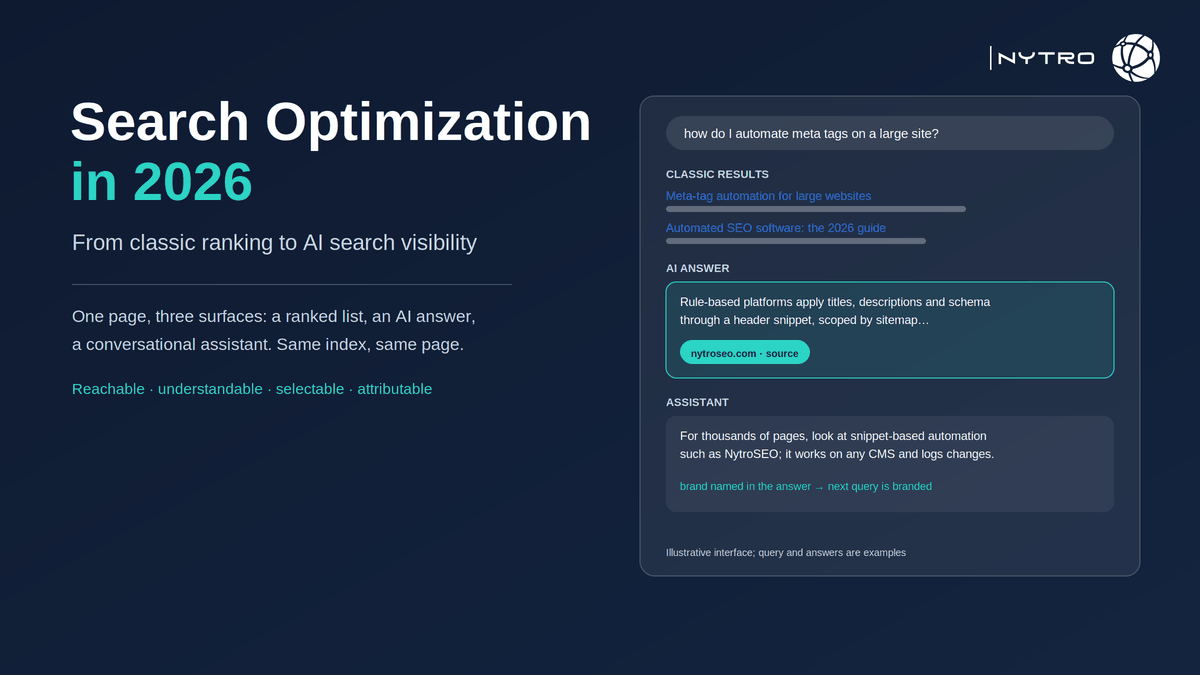
Search optimization is the practice of making a website discoverable, understandable and preferable to the systems that answer people’s questions: the classic ranked results on Google and Bing, the AI Overviews and AI Mode answers that now sit above or replace them, and the conversational assistants such as ChatGPT, Perplexity, Gemini and Copilot that cite websites in their replies. The term is often written as searching optimization or shortened to SEO, and for twenty years it meant one thing, ranking a page for a keyword. In 2026 it means something broader: being indexed, being retrieved, being extracted and being named, across every surface where a query is resolved. This guide is the entry point to everything on this site. It explains how search works now, sets out the four pillars every site has to get right, describes where automation fits and where it does not, and ends with a thirty-day plan that links to the detailed guides for each step.
The foundations have not moved as much as the surfaces have. Google’s own account of how Search works still describes three stages, crawling, indexing and serving, and Google’s guide to optimizing for generative AI features states that AI Overviews and AI Mode are rooted in the same core ranking systems as Search and that no special files, markup or AI-specific formats are needed to appear in them. What has changed is scale and shape: Google confirmed at I/O in May 2026 that AI Mode had passed one billion monthly users, and since 31 August 2026 the Search Console Generative AI performance report has shown every site how often its pages appear in those answers.
If you would rather have the repeatable part of this guide, the titles, descriptions, canonical tags and structured data on every page, applied and maintained automatically, sign up for free and NytroSEO will start with an inventory of your sitemap.
We use “search visibility” rather than “rankings” throughout this guide, and the choice is deliberate. A ranking is a position in one list. Visibility is whether your page is present wherever the question is answered, whether it is the source an AI answer cites, and whether your brand is the one named when someone asks an assistant for a recommendation. Rankings are one input to visibility; they are no longer the whole of it.
Lee Agam, founder and CEO of NytroSEO, describes the shift as a change in what a page is for. In his experience, the sites that struggle in 2026 are still writing pages to win a position, and the sites that do well are writing pages to be the answer: a clear statement in the first paragraph, headings that match how people ask, a named author, cited figures, and metadata that says exactly what the page is. He argues that the fundamentals have become more important, not less, because every AI surface reads the same index and the same page, and that the practical difference between sites is now consistency: whether those fundamentals are true on every page or only on the ones someone had time to edit. That, in his view, is the case for automating the repeatable layer and spending people on the rest.
What search optimization means today
Search optimization, in its 2026 sense, is the set of practices that make a page reachable by crawlers, understandable by indexing systems, selectable by ranking and answer systems, and attributable to a recognisable entity. Each verb corresponds to a place a page can fail.
Reachable means crawlers can fetch it: no robots.txt or CDN rule blocks them, the server responds quickly, and the page is linked from somewhere the crawler already visits. Understandable means the content renders, the title and description say what the page is, structured data describes what is visible, and the canonical tag points where it should. Selectable means the page answers a real question well enough to be ranked in a list or lifted into an answer, which depends on quality, completeness and structure. Attributable means the page is clearly connected to an author and an organisation that search and AI systems can name.
The phrase SEO Search Optimization is sometimes used to distinguish the discipline from the broader marketing it sits inside; searching optimization is a common variant in queries; search engine optimization is the traditional name. They describe the same work. What has expanded is the list of systems the work has to satisfy: Google’s classic ranking, Google’s AI Overviews and AI Mode, Bing and the Copilot answers grounded in it, and the third-party assistants that fetch and cite pages directly. Our explainer on AEO vs SEO covers how answer-engine optimisation relates to the classic discipline, and our short primer on what SEO is is the place to start if the vocabulary is new.
How google search optimization works in 2026
Google search optimization still follows Google’s three stages, and each stage has acquired an AI-era consequence.
Crawling. Googlebot discovers URLs through links and sitemaps and fetches them, within the crawl capacity your server allows and the crawl demand your site earns. In 2026 Googlebot shares the site with AI crawlers from OpenAI, Anthropic, Perplexity and others, and with Google-Extended, the token that governs use of your content for Google’s AI training. Blocking the wrong bot removes you from an entire answer surface without producing an error; our guide to allowing AI crawlers while blocking AI training covers the distinction.
Indexing. Google renders the page, reads its content and metadata, decides whether it is a duplicate of something else, and stores its understanding. Pages that are discovered but never crawled, or crawled but not indexed, are outside every downstream system; our guides to crawled, currently not indexed and to canonical tags cover the two most common reasons.
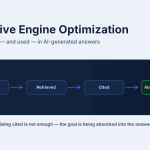
Serving. For a query, Google’s ranking systems select and order results from the index. AI Overviews and AI Mode sit on top of the same systems: a query is fanned out into sub-queries, candidate pages are retrieved from the index, passages are extracted, and an answer is composed with citations. The pages selected are the pages Google already trusts, structured so that a model can lift the answer out. Our guide to getting cited in AI Overviews rather than just ranked covers that structure.
The intelligent search box announced at I/O in May 2026 accepts text, images and files and can route a query to classic results, an AI answer or an agent task. For site owners the implication is the one Google keeps repeating: there is no separate optimisation for the AI surfaces, because they read what Search indexes. There is only doing the fundamentals completely.
The four pillars: indexability, relevance, authority, structure
Every practice in search optimization falls under one of four pillars, and every guide on this site belongs to one of them.
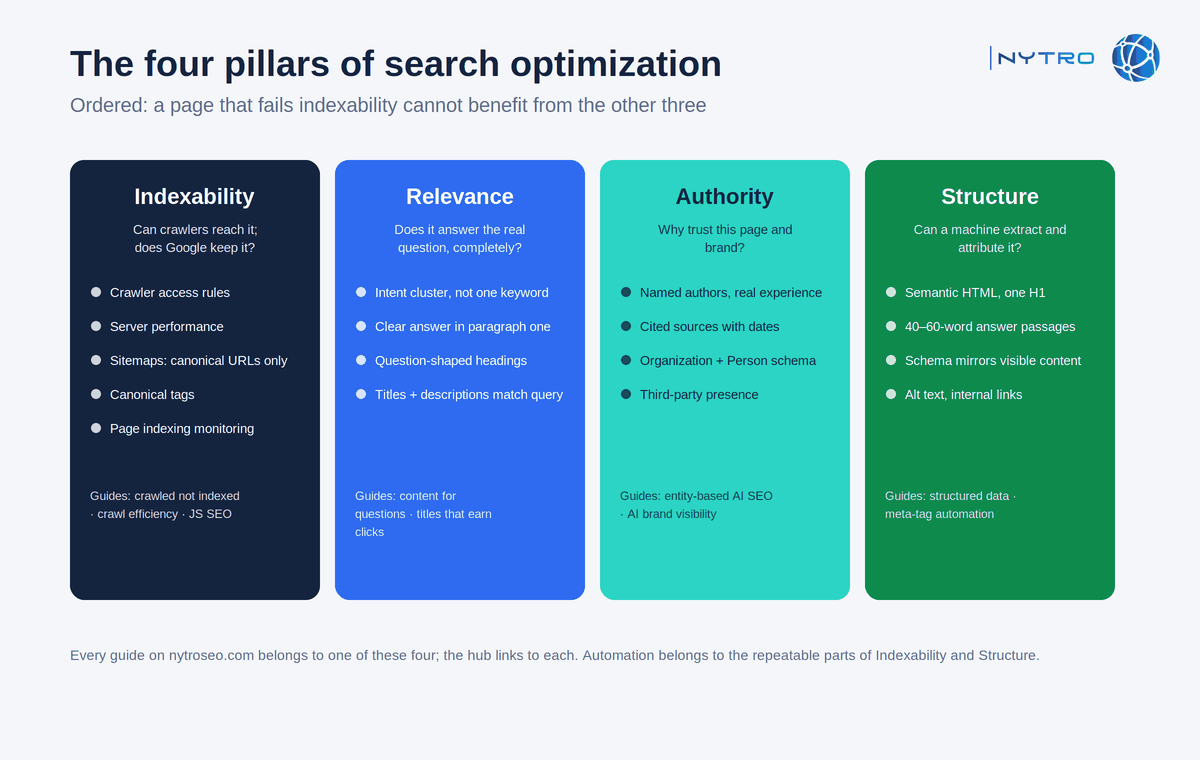
The four pillars above organise everything on this site; the guides linked below each pillar go into the detail.
Indexability. Can crawlers reach the page, and does Google keep it? Practices: crawler access rules, server performance, XML sitemaps that list only canonical indexable URLs, canonical tags that point where they should, and monitoring of the Page indexing report. Detailed guides: crawled, currently not indexed, crawl efficiency, JavaScript SEO for AI agents.
Relevance. Does the page answer the question people actually ask, completely? Practices: mapping the cluster of intents behind a topic rather than a single keyword, one clear answer in the first paragraph, question-shaped headings where they read naturally, and titles and descriptions that match the query. Detailed guides: optimising content for questions, auto-generating titles and descriptions that earn clicks.
Authority. Why should a search or AI system trust this page and this brand? Practices: named authors with relevant experience, cited primary sources with dated figures, consistent Organization and Person structured data, and presence on the third-party sources AI systems consult. Detailed guides: entity-based AI SEO, AI brand visibility.
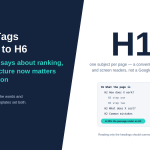
Structure. Can a machine extract the answer and attribute it? Practices: semantic HTML, a single H1 and a clean heading hierarchy, 40 to 60-word answer passages, structured data that mirrors visible content, descriptive image alt text, and internal links that connect a cluster. Detailed guides: how structured data works, meta-tag automation for large websites.
The pillars are ordered. A page that fails indexability cannot benefit from the other three; a page that is relevant and authoritative but unstructured is read by fewer systems than it deserves.
Search engine optimization software vs manual work
The question of tools is really a question of which pillar the work belongs to. Search engine optimization software falls into four categories by what happens after the crawl: audit tools that report, audit tools that draft suggested fixes, automation platforms that apply changes to the live page, and monitoring tools that alert on drift. Most tools are in the first two categories; the third is the one that changes pages.
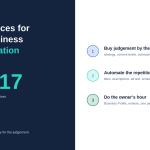
Manual work is right for anything that needs judgement about the business: strategy and topic selection, the content itself, brand voice, earning links and mentions, site architecture, and fixing rendering. Automation is right for anything repetitive, rule-based and present on every page: titles and descriptions generated from page content and the queries the page earns, canonical hints, image alt text, structured data from visible fields, and monitoring for the drift that theme updates and plugins introduce. Our guide to when to automate SEO and when to keep it manual works through the split task by task.
The size of the site decides the balance. Under a thousand pages, an audit and a checklist are enough. Above ten thousand, or across an agency portfolio, the per-page work is most of the hours and does not get done by hand, which is where a platform such as NytroSEO applies the metadata and structured-data layer through a header snippet on any CMS, scoped by sitemap, previewed, logged and reversible. It does not write content, earn links or fix rendering; our guide to automated SEO software sets out what to expect from the category and a checklist for choosing within it. Our product overview of on-page search SEO for searching optimization describes how the layer is applied in practice.
AI SEO: the same work, measured differently
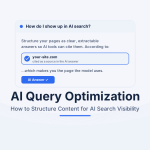
AI SEO is the name many practitioners now give to search optimization aimed at AI Overviews, AI Mode and third-party assistants. The work is the four pillars done completely; what differs is measurement. Search Console’s Generative AI report shows impressions in Google’s AI features by page, with no clicks or queries. Bing Webmaster Tools’ AI Performance report shows the pages Copilot cites and the grounding queries that found them. Neither Google nor OpenAI reports citations in ChatGPT, so a fixed monthly panel of buyer questions, run in each assistant and recorded as cited, mentioned or absent, remains the only direct measure. Our guide to measuring AI search visibility sets out the five metrics to track, and our overview of Ask Engine Optimization explains why question-and-answer structure matters for conversational search.
A 30-day search optimization starter plan
The plan below assumes one person with access to Search Console and the CMS. Each week links to the guide that covers it in depth.
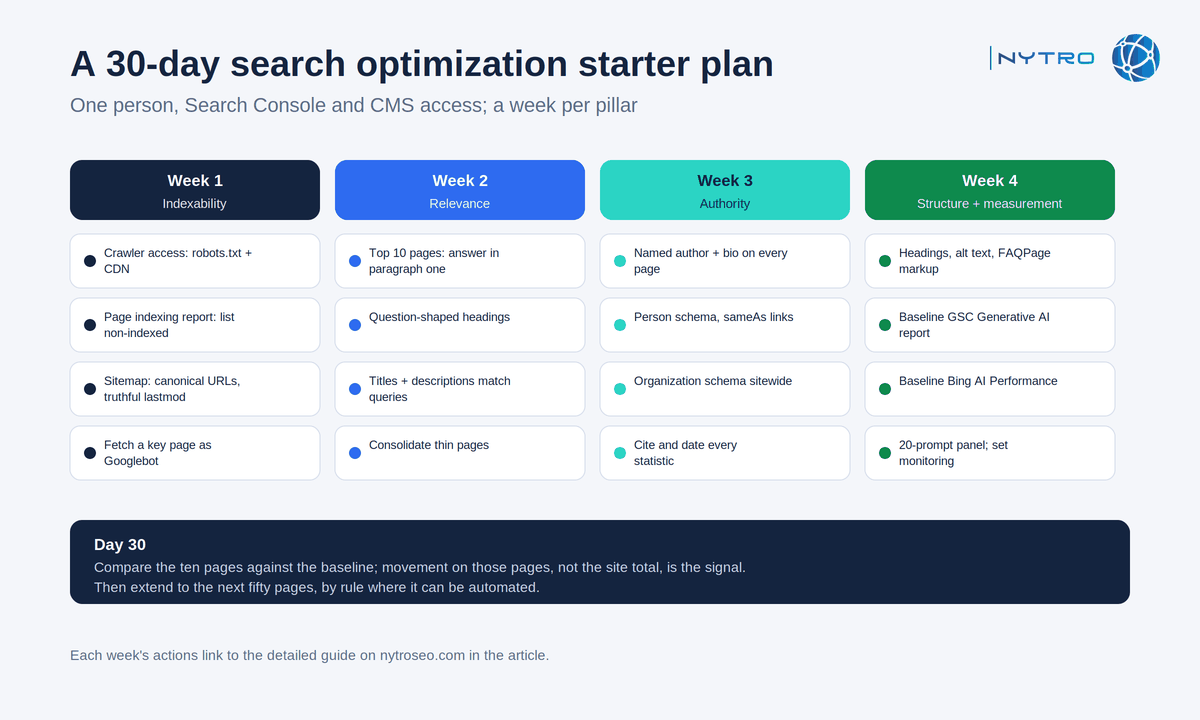
The four weeks above follow the pillars in order; each week’s actions are expanded below.
Week 1, indexability. Confirm Googlebot, Bingbot and the AI search crawlers you want can fetch the site, in robots.txt and at the CDN. Open the Page indexing report and list every URL in “discovered” or “crawled, currently not indexed”. Fix the sitemap so it lists only canonical, indexable URLs with truthful lastmod values. Fetch a key page as Googlebot and confirm it renders.
Week 2, relevance. For your ten most important pages, rewrite the opening paragraph to state what the page answers, add question-shaped headings where they read naturally, and check that the title and description match the page and the queries it earns in Search Console. Consolidate any thin pages that split one topic across several URLs.
Week 3, authority. Add a named author with a bio to every editorial page, connect them with Person structured data and sameAs links, and add Organization structured data to every page. Cite the primary source for every statistic and put the date beside it. List the three third-party sources AI assistants would consult about your category and check whether you appear.
Week 4, structure and measurement. Audit heading hierarchy, image alt text and FAQ sections on the ten pages; add FAQPage markup that mirrors visible questions. Baseline the Search Console Generative AI report and Bing’s AI Performance report. Run a twenty-question prompt panel across ChatGPT, Perplexity, Gemini and Copilot and record the results. Set the monitoring cadence for indexing, crawler access and metadata drift.
Day 30. Compare the ten pages against the baseline. Movement in AI impressions and citations on those pages, not the site total, is the signal that the plan worked; then extend the same work to the next fifty pages, by rule where it can be automated. Book a strategy meeting with the NytroSEO team if you are running the plan across a large site or a client portfolio and want the repeatable layer handled as one project.
Frequently Asked Questions
Search optimization is the practice of making a website discoverable, understandable and preferable to the systems that answer people’s questions: classic ranked results, AI Overviews and AI Mode, and conversational assistants that cite websites. It covers technical indexability, relevant content, authority signals and structure that machines can extract and attribute.
Yes. Google states that its generative AI features are rooted in the same core ranking systems as Search and need no special markup, so indexable, helpful, well-structured pages remain the foundation for appearing in AI Overviews, AI Mode and third-party assistants. The KPIs shift from clicks alone to impressions, citations and mentions.
They are largely the same discipline. Search optimization is the broader term, covering answer engines and AI assistants as well as ranked links on Google, and it is the term we use to emphasise visibility across every surface where a query is answered. Searching optimization and SEO search optimization are common variants of the same phrase.
Small sites can manage with an audit tool and a checklist. As page counts grow, software that applies titles, descriptions, canonical tags and structured data consistently saves the per-page hours and prevents drift. Choose tools that apply changes and monitor results rather than only reporting issues, and keep strategy and content with people.
New or refreshed pages are typically crawled within days to weeks, and ranking and citation improvements build over one to three months as authority and consistency signals accumulate. Sites with indexing problems should fix those first, because a page that is not indexed cannot rank or be cited anywhere.
Ready to make search optimization consistent across every page?
The four pillars are not new; what decides visibility in 2026 is whether they are true on every page. Sign up for free to have NytroSEO apply and maintain the repeatable layer, titles, descriptions, canonical tags and structured data, across your whole site, or book a strategy meeting if you manage a large site or a client portfolio and want the thirty-day plan run as one project.