Last updated: September 20, 2026
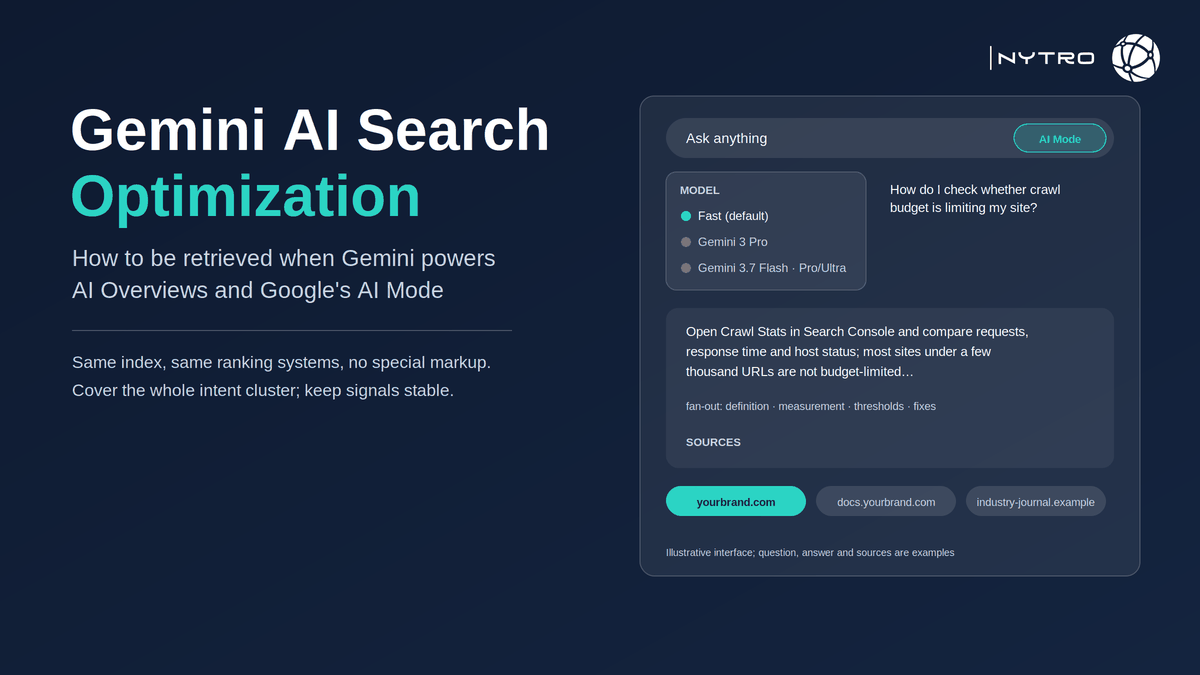
Gemini AI Search Optimization is the work of making your pages retrievable, understandable and citable by the Gemini models that write Google’s AI answers: the AI Overviews that sit above classic results, the AI Mode conversation that has become a destination in its own right, and the standalone Gemini app, which grounds its answers in Google Search. It is not a separate discipline with its own files and markup. Gemini draws on Google’s index, Google’s ranking systems and Google’s understanding of entities, so the pages it selects are the pages Google Search already trusts, structured so that a model can lift the answer out. This guide explains which Gemini models power which surfaces in 2026, how Gemini chooses sources, why covering a topic’s full intent cluster matters more than targeting single keywords, a checklist that needs nothing Google has not asked for, and how to measure Gemini LLM Search Visibility with the tools that exist.
The model layer moves faster than most site owners realise. According to Search Engine Journal, Gemini 3 Pro was added to AI Mode in November 2025, Gemini 3 Flash became the default the following month, Gemini 3.5 Flash replaced it as the global default at I/O in May 2026, and on 14 August Google added Gemini 3.7 Flash as a selectable model for Google AI Pro and Ultra subscribers, announced through a post on X rather than a Search Central article. Google’s own position, stated by its then chief scientist, is that Flash-class models remain Search’s production tier because of their lower latency and cost. Google’s guide to optimizing for generative AI features is the document that describes what those features actually read.
If you want the on-page layer that every Gemini surface reads kept consistent automatically, sign up for free and NytroSEO will start with an inventory of every page in your sitemap.
Two facts anchor everything that follows. First, Google says that no special files, markup or AI-specific formats are needed to appear in its generative AI features, because those features are rooted in the same core ranking systems as Search. Second, Google has confirmed that AI Mode passed one billion monthly users a year after launch, with queries more than doubling every quarter. The surface is enormous, and the way onto it is ordinary.
Lee Agam, founder and CEO of NytroSEO, sees the Gemini question as a test of whether a site has done classic SEO properly, with one addition. In his experience, pages that rank well but are not selected by AI Overviews or AI Mode usually fail on completeness rather than on quality: they answer the keyword and not the cluster of questions Gemini fans a query out into, so a competitor’s page that covers the parent topic and its sub-questions on one URL is retrieved instead. His advice is to stop building thin pages per query, consolidate each topic into one authoritative page or a tightly linked set, and then keep the titles, descriptions and entity markup on those pages stable, because when Google swaps the model underneath AI Mode, as it now does every few months, the pages whose signals are consistent are the ones whose visibility survives the change.
What Gemini AI Search Optimization means
Gemini AI Search Optimization means optimising content so that the Gemini models behind Google’s AI features retrieve, understand and cite it. In 2026 those features are three:
- AI Overviews, the generated summary that appears above classic results for a share of queries, with source links.
- AI Mode, the conversational tab and default entry point for many searches, where a session can run through several follow-up questions and where the default model is a Flash-class Gemini model, with Gemini 3 Pro and, for subscribers, Gemini 3.7 Flash selectable.
- The Gemini app, a separate product that grounds many of its answers in Google Search and cites web sources.
All three share the same retrieval foundation: Google’s index, its core ranking systems, its Knowledge Graph for entities, and query fan-out, the technique by which a single question is expanded into several sub-queries before sources are selected. That shared foundation is why Gemini Search Optimization is mostly classic search optimization done completely, and why our guide to getting cited in Google AI Overviews rather than just ranked applies to AI Mode and the Gemini app as well.
What it is not: it is not optimising for a file such as llms.txt, which Google says its Search ignores; it is not adding AI-specific markup, which Google says is unnecessary; and it is not a separate content track for models, which Google’s spam policies now treat as manipulation when it is built only to be scraped.
How Gemini selects sources for Gemini AI Search Optimization: index, entities and query fan-out
Understanding the selection path tells you where to intervene.
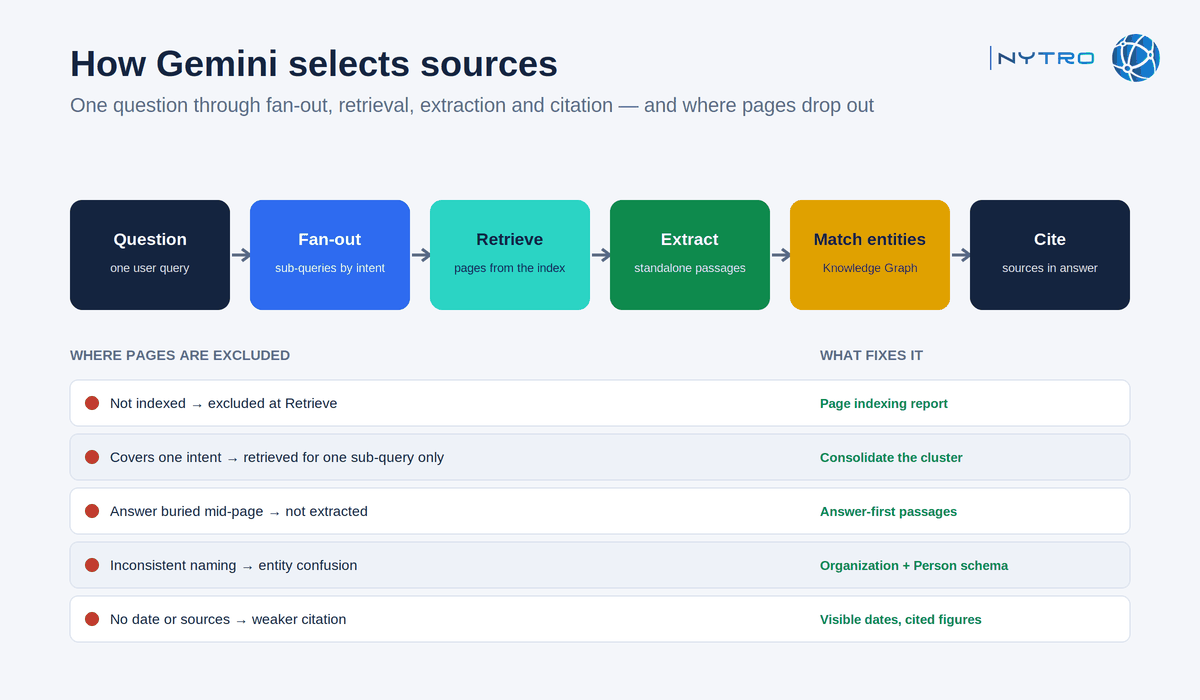
The diagram above traces one question through fan-out, retrieval, extraction and citation; each stage is a place a page can be excluded.
The index comes first. A page that is not indexed cannot be retrieved by any Gemini surface. The Search Console Page indexing report is therefore the first Gemini tool, and “discovered” or “crawled, currently not indexed” pages are outside the conversation entirely.
Query fan-out comes next. Gemini breaks the user’s question into sub-queries, often several, and runs them against the index. The sub-queries are shaped by intent: a question about a product category becomes sub-queries about options, prices, comparisons, use cases and caveats. Pages that answer several of those sub-queries are retrieved more often than pages that answer one.
Entity matching runs alongside. Gemini connects the brands, people, products and places it finds to Knowledge Graph entities. A brand whose name, description and relationships are consistent across its site and third-party sources is easier to name; one with inconsistent naming or missing Organization and Person markup is easier to confuse. Our guide to entity-based AI SEO covers the mechanics.
Extraction and citation finish the job. From the retrieved pages, the model lifts passages that answer the sub-queries and composes an answer that cites some of the sources. Passages that are self-contained, placed under clear headings and supported by cited figures are lifted more reliably.
The stages a site owner controls are the index, the completeness of coverage, the entity consistency and the extractability of passages. The model itself, and which version of it is answering, is not controllable, which is an argument for building signals that survive model swaps.
Gemini Semantic Search Optimization and Gemini Intent-Based Optimization
The two phrases describe the same practical move from different angles.
Gemini Semantic Search Optimization is about meaning rather than strings. Gemini’s models understand that “crawl budget”, “crawl capacity” and “how often Google crawls my site” are the same topic, so a page that uses the natural vocabulary of the subject, including synonyms and related concepts, is matched to more sub-queries than a page that repeats one phrase. Write for the topic, not for the keyword.
Gemini Intent-Based Optimization is about covering the intents behind a topic on one strong page or a tightly linked cluster. Because a single question fans out into several sub-queries, the page that is retrieved most is the one that answers the parent question and its natural follow-ups: what it is, why it matters, how to do it, what it costs, what goes wrong, how to measure it. A site with ten thin pages each targeting one variant will lose to a competitor with one complete page, and it will also be judged as thin by Google’s core systems, which feed the same retrieval.
A worked example makes the difference concrete. A software company publishes four pages: “what is crawl budget”, “crawl budget for large sites”, “crawl budget and Search Console” and “crawl budget tools”, each around 600 words. A user asks AI Mode how to check whether crawl budget is limiting their site. Gemini fans that into sub-queries about definition, measurement, thresholds and fixes; each of the four pages answers one and none answers the set, so the retrieved source is a competitor’s single 2,500-word guide that covers all four under question-shaped headings. Consolidating the four into one page, with the four sections preserved as H2s and the old URLs redirected, is the fix, and it also removes four thin pages from Google’s view of the site.
Three practical rules follow. Map the intent cluster before writing, using the questions in AI Mode’s follow-ups, the “People also ask” set and your own Search Console queries. Structure the page so each intent has its own question-shaped heading with a direct answer beneath it. Link the cluster tightly, so that a page retrieved for one sub-query leads Gemini to the pages that answer the rest.
Gemini Answer Engine Optimization checklist
The checklist below contains nothing Google has not asked for. It is ordered from the gate to the polish.
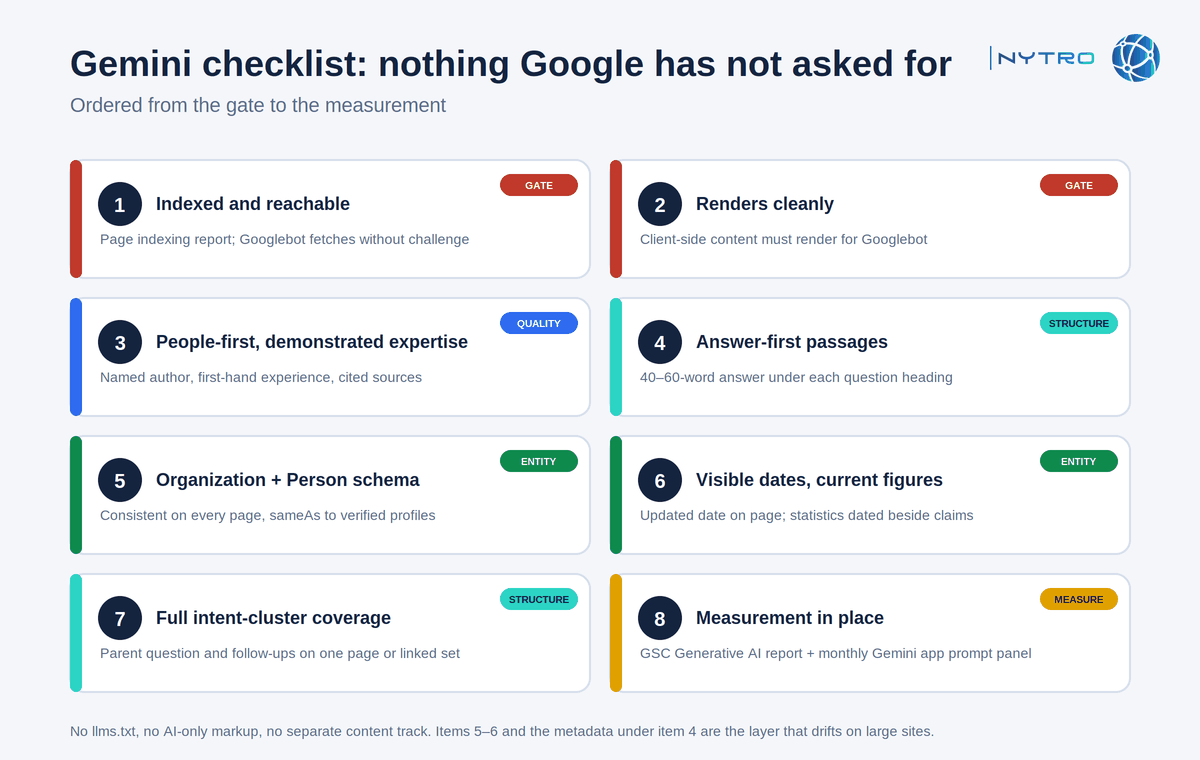
The eight items above are ordered from the gate, indexing, to the measurement that tells you whether the rest worked.
- Indexed and reachable. Confirm the page is indexed in Search Console and that Googlebot fetches it without challenge. Decide separately about Google-Extended, the token that controls use for AI training; it does not affect Search or AI Overviews.
- Renders cleanly. Content that depends on client-side JavaScript to appear must render for Googlebot; our guide to JavaScript SEO for AI agents covers the checks.
- People-first content with demonstrated expertise. Google’s helpful-content and E-E-A-T guidance is the quality bar Gemini’s retrieval inherits; named authors, first-hand experience and cited sources are the signals.
- Answer-first passages. Under each question-shaped heading, a 40 to 60-word answer that reads correctly out of context, then the detail.
- Organization and Person structured data. Consistent, on every page, with sameAs links to verified profiles, so the entity is unambiguous.
- Visible dates and current figures. A published or updated date on the page and statistics dated next to the claim they support.
- Full intent-cluster coverage. The parent question and its follow-ups on one page or a tightly linked set, with descriptive internal links.
- Measurement in place. The Search Console Generative AI report for AI Overviews and AI Mode impressions, and a monthly prompt panel in the Gemini app for citations.
Items five and six, and the titles and descriptions that support item four, are the layer that drifts on a large site, and drift matters more when the model underneath changes every few months: a page whose metadata and entity markup are stable is re-selected by the new model on the same signals that earned it a place under the old one. NytroSEO applies and monitors that layer by rule across every page in scope; it does not write the content or fix rendering, which remain people’s work. Book a strategy meeting with the NytroSEO team if you manage a large site or a client portfolio and want the checklist run across it.
Measuring Gemini LLM Search Visibility
There is no Gemini-specific report, but there are three usable measures.
The Search Console Generative AI performance report shows impressions in AI Overviews and AI Mode by page, country, device and date, and has been available to all sites worldwide since 31 August 2026. It reports impressions only, not clicks, queries or which model answered. Trend it weekly per page and compare it with classic impressions for the same page; our guide to measuring AI search visibility sets out the derived metrics.
A monthly prompt panel in the Gemini app fills the citation gap. Run a fixed set of twenty buyer questions, record whether your brand is cited with a link, mentioned without one, or absent, and keep the question set stable so month-to-month comparisons hold. Run the same panel in AI Mode, and note which model is selected if you are using a subscriber account, because a Pro or Ultra user choosing Gemini 3.7 Flash sees a different answer engine from the free default.
Annotate both series with model announcements. Google announces AI Mode model changes through blog posts, product notes and, as with Gemini 3.7 Flash, an executive’s social post, and its help documentation does not always name the default model. A citation or impression change in the week after a model change is a model effect until proven otherwise; treating it as the result of your own work leads to the wrong conclusions in both directions.
A measurement caveat specific to Gemini: the Search Console report counts an impression when a link to your site appears in an AI feature, aggregated by property, so two of your pages in one AI Mode answer count once in the chart. Use the page-level table for per-page work and the chart for the property trend, and keep the two apart in your notes.
What none of this requires is a special file, a markdown copy of the site or AI-only markup. Gemini reads what Google indexes. The measurable work is making that indexed page complete, consistent and extractable, and keeping it that way through every model swap.
Frequently Asked Questions
It is optimising content so Gemini, the family of models behind Google’s AI Overviews, AI Mode and the standalone Gemini app, retrieves, understands and cites your pages. Because Gemini draws on Google’s index, ranking systems and Knowledge Graph, it builds directly on strong classic SEO, complete topic coverage and consistent entity signals rather than on any Gemini-specific file or markup.
Largely no. AI Overviews and AI Mode are both powered by Gemini models and grounded in Google’s core ranking systems, so the same fundamentals apply: indexable pages, people-first content, full intent-cluster coverage, clear structure and consistent Organization and Person data. AI Mode adds multi-turn follow-ups, which reward pages that answer a topic’s related questions together.
No. Google states that no special files, markup or markdown are required for its generative AI features and that Search ignores llms.txt. Standard structured data such as Organization, Person, Article and FAQPage helps Google understand entities and content, which indirectly supports Gemini retrieval, but nothing Gemini-specific exists or is needed.
Use the Search Console Generative AI performance report to track impressions in AI Mode and AI Overviews per page, and run a monthly panel of fixed prompts in the Gemini app and in AI Mode to record citations and brand mentions. There is no query-level or model-level Gemini report yet, so annotate both series with model announcements.
It means covering the full set of related intents behind a topic on one authoritative page or tightly linked cluster, because Gemini fans a single question out into several sub-queries before selecting sources. Pages that answer the parent topic and its natural follow-ups are retrieved more often than narrow single-keyword pages, and they are also judged stronger by Google’s core systems.
Ready to put Gemini AI Search Optimization to work?
Gemini reads what Google indexes, and it swaps the model underneath every few months. The pages that keep being selected are the ones whose coverage is complete and whose signals stay consistent. Sign up for free to have NytroSEO keep titles, descriptions and entity markup aligned across every page automatically, or book a strategy meeting if you manage a large site or a client portfolio and want the Gemini checklist applied as one project.