Last updated: October 3, 2026
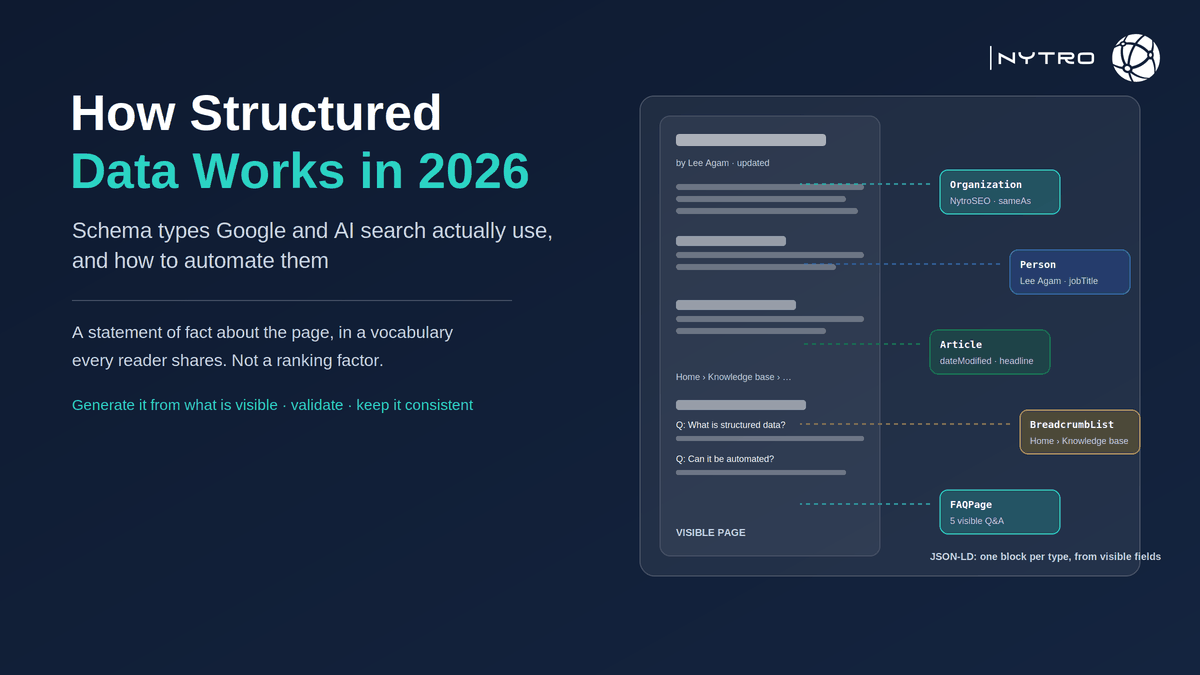
Structured data is machine-readable code, almost always a JSON-LD block, that describes the entities on a page and their properties so that a search engine or an AI system can understand the content without inferring it from prose: that this page is an article, written by this person, who works for this organisation, published on this date, citing these sources. It does not make a page rank, and Google has been explicit for years that it is not a ranking factor. What it does is remove ambiguity, which is worth more in 2026 than it was in 2022, because the same page is now read by Google’s classic ranking systems, by AI Overviews and AI Mode, by Bing and Copilot, and by third-party assistants that need to know whom to name when they cite. This guide explains what structured data is and how search reads it, which schema types still earn something in Google and which merely support understanding, what Google’s AI features do and do not require, how to automate structured data across a large site, and the guardrails that separate a clean deployment from a manual action.
Google’s own guidance sets the boundaries. Its structured data general guidelines require that markup describe only content visible on the page, that it be complete and accurate, and that it not be used for deceptive or irrelevant purposes; violations can cost rich results or trigger a manual action. And Google’s May 2026 guide to optimizing for generative AI features on Search states that no special markup, file or AI-specific format is needed for AI Overviews and AI Mode, which draw on the same index and ranking systems as classic Search; structured data helps those systems the way it always has, as part of ordinary SEO.
If you want structured data generated from what is already visible on every page, scoped by sitemap and re-validated when the page changes, sign up for free and NytroSEO will show you a page-by-page preview.
Two changes since this page was first written explain why it needed rewriting rather than updating. The FAQ rich result, the most-implemented schema feature of the early 2020s, was retired for all sites in May 2026, so a guide that still promises a dropdown is describing something that no longer exists. And the reader of structured data is no longer only Google: entity markup that connects a page to a named author and a named organisation is now the difference between an assistant citing a page and naming the brand, or citing the page and naming no one.
Lee Agam, founder and CEO of NytroSEO, describes structured data as the one part of on-page SEO that is entirely a statement of fact, which is why it is both the easiest to automate and the easiest to get wrong. In his experience, the failures are never exotic: a theme update that drops the Organization block from ten thousand pages, a plugin that emits two conflicting Article blocks, an aggregateRating copied into a template with no real reviews behind it, a FAQPage block still describing questions someone deleted from the page. None of those is a content decision; each is a consistency failure, and consistency is what rules are for. His position is that structured data should be generated from the visible page rather than maintained beside it, validated before every deployment, and monitored for drift afterwards, and that any tool offering to add markup for content the page does not contain is offering to earn a manual action.
What structured data is and how search reads it
Structured data is a set of statements about a page, written in a vocabulary machines share. The vocabulary is schema.org, which defines types, Article, Organization, Person, Product, LocalBusiness, FAQPage and hundreds more, and the properties each type carries. The format is almost always JSON-LD, a script block in the page head or body that Google, Bing and most other consumers prefer over the older Microdata and RDFa attributes woven into the HTML.
How search reads it is a three-step process. The crawler fetches the page and, where necessary, renders it, so JSON-LD injected by JavaScript is read as long as it appears once and does not conflict with a server-side block. The parser extracts each entity and its properties and checks them against the visible content, which is why markup for invisible content is a policy violation rather than a clever trick. Then the indexing systems use what they extracted in two ways: to make the page eligible for enhanced result features where a type still supports one, and to improve their understanding of the entities involved, which feeds ranking, knowledge panels and, since the AI features share the same index, the source selection behind AI Overviews and AI Mode.
The distinction between those two uses matters more now than the list of rich-result types. Enhanced features come and go; Google retired FAQ and HowTo rich results in 2023 for most sites and FAQ entirely in 2026. Entity understanding is permanent, and it is what every reader of the page, including third-party assistants, relies on. Our guide to entity-based AI SEO covers the entity side in depth.
The structured data elements that matter in 2026
The structured data elements worth implementing on most sites fall into two groups: types that still unlock a visible feature in Google, and types whose value is understanding and attribution. Both are worth doing; only the first should be promised to a stakeholder as a visible outcome.
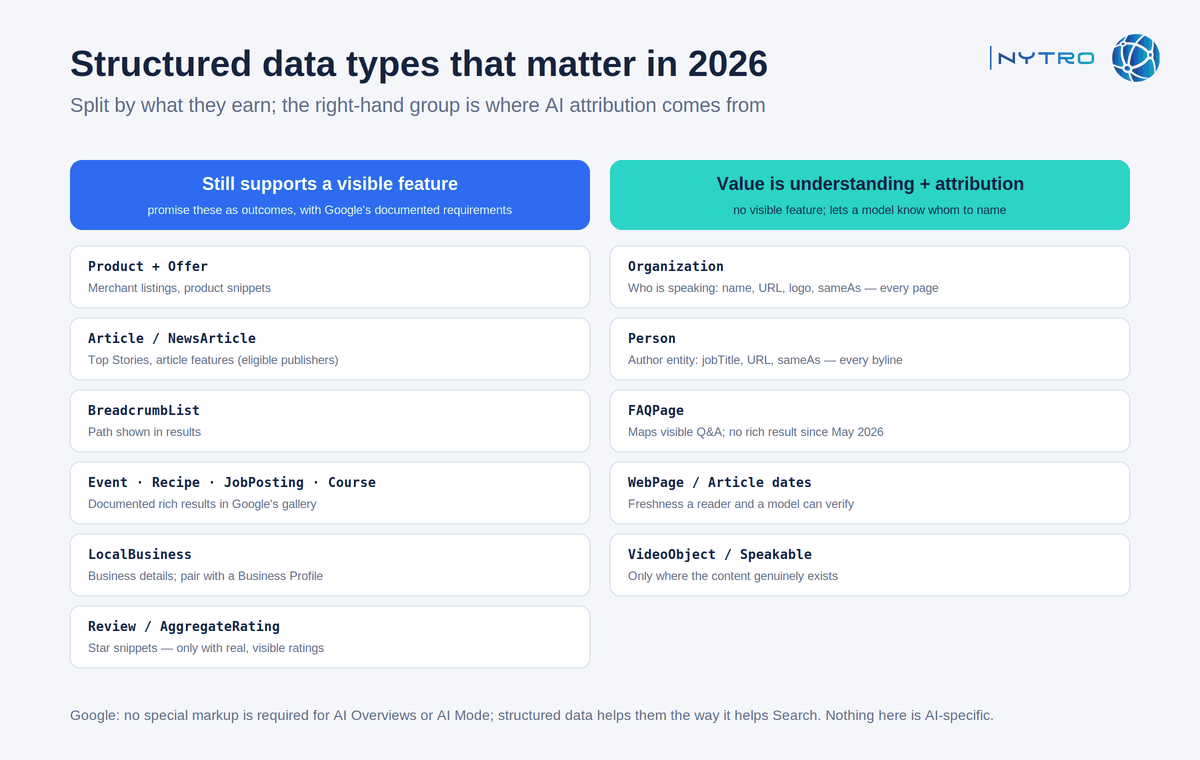
The table above separates types by what they earn; the right-hand group is where AI attribution comes from.
Types that still support a visible feature. Product, with offers, price and availability, drives merchant listings and product snippets. Article and NewsArticle support Top Stories and article carousels for eligible publishers. BreadcrumbList shapes the path shown in results. Event, Recipe, JobPosting, Course, LocalBusiness and Review remain in Google’s search gallery with their own documented requirements. Each has required and recommended properties that Google lists, and each is validated by the Rich Results Test.
Types whose value is understanding. Organization, on every page, tells every reader which company is speaking: name, URL, logo, and sameAs links to verified profiles. Person, for every author, connects a byline to an entity with a job title and profiles of its own. FAQPage no longer produces a dropdown but still maps visible questions to their answers in a form every system can parse; our guide to FAQ schema best practices after the rich result was retired covers what changed. WebPage and Article properties such as dateModified and author tie freshness and authorship to the page.
Types to be careful with. AggregateRating and Review belong only where real, visible ratings exist; templated ratings are the most common cause of structured data manual actions. Speakable, VideoObject and others are worth adding where the content genuinely exists and not otherwise.
Google’s position on the AI features is the one to keep in view when prioritising: the types in the second group help Google understand entities and content, which indirectly supports selection for AI Overviews and AI Mode, but nothing on this list is required for those features and nothing AI-specific exists.
Does seo structured data help AI search?
Does seo structured data help AI search? Indirectly, and honestly stated, in three ways, with one thing it does not do.
For Google’s AI features, structured data does what it does for classic Search: it improves entity and content understanding in the shared index that AI Overviews and AI Mode retrieve from. Google says those features need no special markup; it also recommends structured data as part of the SEO those features are built on. There is no measured citation lift from a JSON-LD block alone, and no serious study claims one.
For attribution, structured data is decisive. When an assistant lifts a passage and names its source, the Organization and Person entities on the page are what let it say “according to Lee Agam at NytroSEO” rather than “according to a website”. Consistent entity markup across every page is the mechanism; a single missing block breaks it for that page.
For non-Google systems, JSON-LD is a clean, predictable structure that parsers beyond Google read. Several practitioners report that Bing, Copilot and other assistants make use of it; those systems have not documented how, so treat that as plausible rather than proven.
What it does not do: it does not substitute for visible, extractable content. An assistant cites passages, and a passage has to exist on the page in words a person can read. Structured data describes the page; it cannot improve it. Our guide to getting cited in Google AI Overviews rather than just ranked covers the content side that markup supports.
How can I automate structured data on my site?
How can I automate structured data on my site? By generating it from fields the page already exposes, applying it by rule within a defined scope, validating before deployment and re-checking after every change. The sequence is the same on any platform.
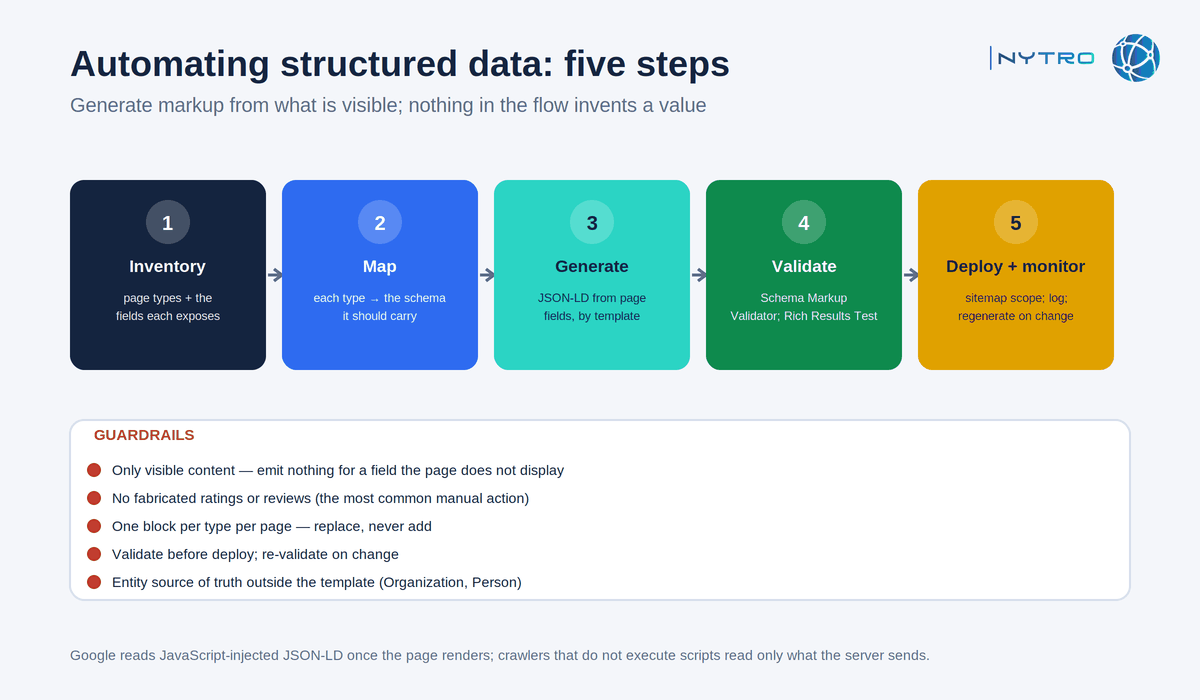
The five steps above generate markup from what is visible; nothing in the flow invents a value.
- Inventory page types and the fields each exposes. Articles expose a title, author, dates and headings; products expose name, image, brand, price and availability; location pages expose name, address, phone and hours. The inventory is the map of what can be marked up truthfully.
- Map each page type to the schema it should carry. Every page: Organization and BreadcrumbList. Articles: Article plus Person for the author. Products: Product with Offer. Locations: LocalBusiness. Pages with visible question-and-answer sections: FAQPage. Nothing else unless the content is there.
- Generate JSON-LD from page fields by template. A template per type reads the fields and emits the block; a page without the field emits no property, and a page without the content type emits no block. Author and organisation values come from a single approved source so they are identical everywhere.
- Validate. The Schema Markup Validator checks schema.org validity for any type; Google’s Rich Results Test checks eligibility for the types that still support features. Validate a sample of every template before the rule goes live.
- Deploy by scope and monitor. Apply within the sitemap’s canonical, indexable URLs; log every change; re-fetch rendered pages on a schedule and re-generate when the underlying fields change, so that a theme update or a deleted section cannot leave stale markup behind.
Delivery depends on the platform. WordPress plugins write the block into the CMS; a JavaScript header snippet applies it at load on any CMS without CMS access, which is how NytroSEO delivers it, scoped by sitemap with a preview, a change log and rollback; an API or edge layer writes it server-side. Google reads JavaScript-injected JSON-LD once the page renders; crawlers that do not execute scripts read only what the server sends, so sites that depend on those systems should ensure the block is also in the initial HTML. Our explainer on what an SEO automation snippet is covers that distinction, and our guide to meta-tag automation for large websites shows structured data alongside titles and descriptions in one rule set. Book a strategy meeting with the NytroSEO team if you manage a large site or a client portfolio and want the inventory and templates set up as one project.
Structured data automation guardrails and schema markup automation at scale
Structured data automation multiplies whatever it is given. Applied to accurate fields it produces a consistent, machine-readable site; applied without guardrails it produces a policy violation on every page at once. Five rules keep schema markup automation on the right side of Google’s guidelines.
Only visible content. Every property must correspond to something a visitor can see on that page. Automation must emit nothing for a field the page does not display.
No fabricated ratings or reviews. AggregateRating and Review appear only where real, visible ratings exist, with real counts. This is the single most common cause of a structured data manual action, and a template that copies a rating into every product page is the usual mechanism.
One block per type per page. Duplicate or conflicting blocks, a plugin’s Article and a snippet’s Article with different authors, confuse parsers and can invalidate both. Automation must replace, not add.
Validate before deploy, and re-validate on change. A rule that passed validation in March can fail in September after a theme change; drift monitoring on rendered pages catches it.
Keep the entity source of truth outside the template. Organization and Person values live in one approved record, so that a brand name or an author title changes once and propagates everywhere, and so that markup and visible bylines cannot disagree.
Applied that way, structured data on a large site becomes what it was always meant to be: a complete, current, truthful description of every page that any system can read, maintained by rule rather than by memory. Our guide to XML sitemap strategy covers the scope file that decides which pages the rules touch, and our guide to adding LocalBusiness schema for multiple locations shows the pattern for one entity type generated from one dataset.
A structured data checklist for one page
- Organization block with the same name, URL, logo and sameAs as every other page.
- Person block for the named author, connected to the Organization.
- Article or the page’s content type, with dates that match the visible ones.
- BreadcrumbList matching the visible path.
- FAQPage only if visible questions and answers exist, and matching them exactly.
- Product, LocalBusiness, Event or Review only where the content genuinely exists; ratings only where real.
- Validated; one block per type; regenerated when the page changes.
Frequently Asked Questions
Structured data is machine-readable code, usually JSON-LD using the schema.org vocabulary, that describes a page’s entities and properties, for example an article’s author and date, a product’s price, or a business’s address, so search engines and AI systems can understand the content without inferring it from prose. It is not a ranking factor.
For most sites: Organization and Person for entity identity, Article or BlogPosting for content, BreadcrumbList for hierarchy, FAQPage for visible question-and-answer content, Product with Offer for commerce and LocalBusiness for physical locations. Add others only when the page genuinely contains that entity, and ratings only where real reviews exist.
Google says structured data is not required to appear in AI Overviews or AI Mode but recommends it as part of the SEO those features are built on. It improves entity and content understanding in the shared index and is what lets an assistant name the author and organisation when it cites a page. It is a support signal, not a shortcut.
Yes. Automation can generate JSON-LD from existing page fields such as title, author, dates, headings and visible Q&A, scope it by sitemap, validate it and re-check for drift after theme changes. It must describe only content visible on the page and must never invent ratings, reviews or entities the page does not contain.
Marking up content that is not visible on the page, fake or unverifiable ratings, misleading or irrelevant types, and spammy markup all violate Google’s structured data policies. Consequences range from losing rich results to a manual action, so validate and review generated markup before deploying it and monitor it afterwards.
Ready to keep structured data true on every page?
Structured data is a statement of fact about a page; the work is keeping it complete, current and identical everywhere. Sign up for free to have NytroSEO generate and maintain entity and content markup from what is visible on your pages, or book a strategy meeting if you manage a large site or a client portfolio and want the inventory, templates and guardrails designed as one project.